
How to Pivot Sales Strategy in Response to Market Changes: A 2026 Framework
Your buyer's first "sales call" is now with an AI answer engine. By the time an SDR reaches out, 94% of buying groups have already ranked their preferred vendors, and they purchased from that preliminary favorite 77% of the time, according to 6sense's 2025 Buyer Experience Report. Pivoting your sales strategy is no longer an annual planning exercise; it's an operating discipline. This framework gives GTM teams a concrete system to read market signals, redesign seller roles, and execute faster pivots that convert change into pipeline. For a broader foundation, start with Apollo's go-to-market strategy guide.

Your Reps Research. Rivals Close.
Tired of watching hours vanish to manual lead research and data entry? Apollo surfaces verified contacts instantly, so reps spend time selling — not searching. Join 600K+ companies building pipeline faster.
Start Free with Apollo →Key Takeaways
- Pivoting effectively requires mapping specific market signals to GTM levers (ICP, channel mix, pricing, plays) before touching execution.
- Hybrid journeys outperform pure digital or pure rep-led models; the seller's new role is validator and confidence builder, not primary information source.
- Most sales plays fail at execution, not design: teams with a genuine Sales Play System grow at more than twice the average rate.
- AI time savings only create growth when reinvested into high-value activities like executive engagement, multithreading, and expansion plays.
- A 30/60/90 cadence with clear owners and KPIs replaces annual planning as the operating rhythm for market-responsive teams.
What Market Signals Should Trigger a Sales Strategy Pivot?
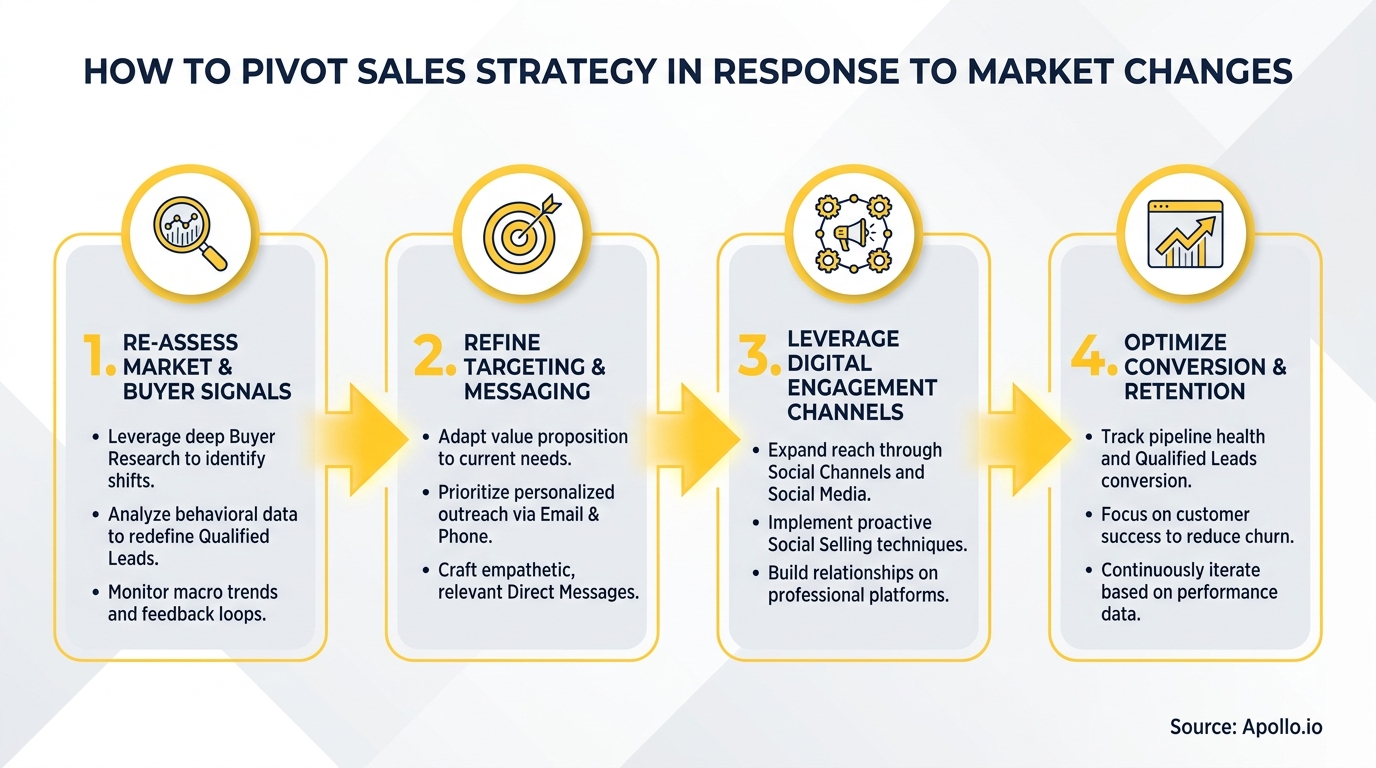
A sales strategy pivot is warranted when external signals outpace your current GTM model's ability to generate qualified pipeline. Four signal categories map to distinct GTM levers:
| Signal Category | Example Triggers | GTM Lever to Pull |
|---|---|---|
| Demand Shift | ICP segment contracting, new buyer persona emerging | ICP refinement, segment re-prioritization |
| Buyer Behavior | Longer cycles, more stakeholders, rep-free preference rising | Hybrid journey design, buyer enablement assets |
| Competitive Pricing | Competitor discounting, new entrants commoditizing a tier | Value-based messaging, ROI proof, packaging |
| Macro Uncertainty | Trade barriers, budget freezes, procurement involvement | Champion enablement, procurement-ready proof |
Research from Pipeline360 shows the B2B buying journey now involves an average of 6 to 10 stakeholders per deal, with enterprise deals sometimes reaching 17 or more cross-functional decision-makers. That complexity alone demands a pivot away from single-threaded selling. Use intent data to detect demand shifts before they show up in lagging pipeline metrics.
Why Is the Hybrid Self-Serve and Rep-Selling Model the Winning Pivot?
The winning pivot is not choosing between digital and human sales; it is orchestrating both. A March 2026 Gartner survey found 67% of B2B buyers prefer a rep-free experience, yet Gartner's research also shows organizations offering both rep-led and self-service interactions are 3.9x more likely to exceed profit growth expectations.
The strategic implication: stop positioning reps as the primary information source. Buyers arrive pre-researched.
Gartner reported in May 2026 that 69% of B2B buyers turn to sales reps specifically to validate AI-generated insights, using an average of seven information sources before that conversation. The seller's new job is risk reduction and decision confidence, not pitch delivery.
- Self-serve layer: Pricing pages, ROI calculators, case studies, trial experiences, and procurement-ready proof sheets.
- Rep layer: Contextual diagnosis, buying-group consensus, value framing, and executive alignment.
- AI layer: Signal monitoring, next-best-action suggestions, outreach personalization, and call summaries.
According to Intentsify, more than half of large B2B transactions of $1 million or greater are now processed through digital self-serve channels. AEs and sales leaders who still treat every deal as requiring a full rep-led cycle are leaving speed and margin on the table.

How Do Sales Teams Build a Sales Play Operating System?
A Sales Play Operating System is the governance structure that turns repeatable plays from a slide deck into a growth engine with CRM integration, measurement loops, and enablement. Bain's 2025 research found 82% of B2B companies say they run sales plays, but only 21% realize full value; companies with a genuine system posted more than 2x the average growth rate.
The lifecycle of a high-performing play has five stages:
- Signal intake: Define the trigger (intent spike, competitor displacement opportunity, expansion signal).
- Play design: Map the sequence, talk track, proof assets, and objection responses. See 10 proven sales pitch techniques for talk track structure.
- CRM integration: Embed play steps directly into your CRM workflows so reps execute inside their existing system.
- Enablement: Role-specific training, call recording review, and manager coaching tied to play adherence metrics.
- Measurement loop: Track play-level conversion rates, cycle length, and win rate weekly. Kill or iterate within 30 days.
Struggling to keep your prospecting aligned with new plays after a pivot? Automate your updated sequences with Apollo's multi-channel sales engagement platform so reps execute the new play consistently from day one.
Turn Blind Spots Into Pipeline Clarity
Pipeline forecasting a guessing game because deal stages shift without warning? Apollo surfaces real-time buyer signals so your team always knows where opportunities stand. Join 600K+ companies calling their number with confidence.
Schedule a Demo →How Do SDRs and AEs Adapt Their Roles During a Sales Pivot?
SDRs and AEs face the most direct role disruption when a sales strategy pivots. Each must shift their daily workflow, not just their messaging.
For SDRs: A pivot toward hybrid buying means less cold volume and more signal-led outreach. SDRs should prioritize accounts showing intent signals, concentrate on buying-group mapping rather than single contacts, and use AI tools to compress research time. According to Fast Company, by 2027 an estimated 95% of seller research will begin with AI, up from just 20% in 2024. SDRs who reinvest that research time into personalized outreach and multi-threading will outperform those who use AI as a volume multiplier. For a deeper look at evolving SDR models, see what sales development looks like in 2026.
For Account Executives: AEs managing deals in a pivot environment need to multithread earlier, build internal business cases for procurement, and prioritize accounts where the buying group is already active. A Gartner May 2026 finding shows AI saves sellers 4.8 hours per week, yet 72% of sales organizations show low reinvestment of those savings. AEs who redirect that time toward executive sponsorship and expansion plays are 2.2x more likely to exceed customer growth goals.
What Does a 30/60/90 Sales Pivot Execution Plan Look Like?
A 30/60/90 plan converts a market-change decision into a structured operating cadence with owners and measurable checkpoints.
| Phase | Focus | Owner | Key KPI |
|---|---|---|---|
| Days 1–30 | Signal audit, ICP re-qualification, messaging update | RevOps + Sales Leadership | ICP match rate, lead quality score |
| Days 31–60 | New plays live in CRM, enablement sessions, hybrid assets deployed | Enablement + Marketing | Play adoption rate, meeting-to-opportunity conversion |
| Days 61–90 | Play performance review, channel mix optimization, pipeline health check | CRO + RevOps | Pipeline coverage, win rate, churn early indicators |
RevOps leaders are the connective tissue across all three phases. Revenue operations teams that own data quality, CRM governance, and reporting cadence make pivots faster because the operating model already supports rapid signal intake. Use sales analytics to baseline current pipeline health before launching the pivot so you can measure actual movement.
Need to quickly rebuild your pipeline around a new ICP after pivoting? Build a qualified pipeline faster with Apollo's advanced search and lead qualification tools across 230M+ verified contacts.
How Does Omnichannel Consistency Protect Revenue During a Pivot?
Omnichannel consistency means your website, pricing pages, rep talk tracks, and proof assets all tell the same story at the same time. McKinsey's May 2026 Global B2B Pulse found B2B buyers use an average of 10 channels across the buying journey, and 60% of market leaders reported double-digit revenue growth versus 21% of laggards.
The gap is execution consistency, not channel presence.
Three failure points that erode revenue during a pivot:
- Messaging lag: Reps are using updated talk tracks while the website still reflects old positioning.
- Proof asset gaps: New ICP segments lack relevant case studies or ROI data for their vertical.
- Channel disconnects: A buyer researches self-serve, then hits a rep who has no context from that digital journey.
A structured marketing team structure with clear ownership of each channel's content update cycle is the operational fix. Pair it with a consolidated sales tech stackso reps see buyer digital activity inside the same workspace they use to execute outreach. As Cyera noted: "Having everything in one system was a game changer."

How Do You Sustain a Sales Pivot for Long-Term Growth?
Sustaining a pivot requires converting a one-time response into a permanent operating cadence. The teams that consistently outperform treat market-change response as a quarterly discipline, not a crisis reaction.
Three practices that separate sustained growth from one-time pivots:
- Quarterly signal reviews: Schedule a formal market-signal audit every 90 days. Assign a RevOps owner. Update ICP criteria and play triggers based on findings.
- AI reinvestment policy: Define where AI time savings go. Teams that reinvest into executive engagement, account planning, and expansion plays outperform those that absorb the savings as efficiency.
- Sales and marketing alignment on lead definitions: Gartner found 49% of sales and marketing teams have greatly different definitions of a qualified lead. Fix this before any pivot; misaligned qualification is the fastest way to waste new pipeline investment.
Apollo consolidates prospecting, engagement, enrichment, and analytics into one unified platform, so GTM teams from SDRs through enterprise sales leaders can execute every phase of a pivot without switching tools. Customers like Predictable Revenue found they "reduced the complexity of three tools into one," and Census reported they "cut costs in half." That kind of tech stack consolidation is itself a competitive advantage when market conditions demand speed.
Ready to execute your next sales pivot faster? Get Leads Now and see how Apollo's all-in-one GTM platform helps B2B teams turn market changes into pipeline.
Prove Pipeline ROI From Day One
Budget approval stuck on unclear pipeline metrics? Apollo delivers measurable results fast — 46% more meetings with AI, real pipeline impact your CFO can see. Join 600K+ companies justifying every dollar spent.
Start Free with Apollo →Don't miss these
Sales
Inbound vs Outbound Marketing: Which Strategy Wins?
Sales
What Is a Sales Funnel? The Non-Linear Revenue Framework for 2026
Sales
What Is a Go-to-Market Strategy? The 2026 GTM Playbook
See Apollo in action
We'd love to show how Apollo can help you sell better.
By submitting this form, you will receive information, tips, and promotions from Apollo. To learn more, see our Privacy Statement.
4.7/5 based on 9,690 reviews
