
How Does the System Learn from Campaign Results to Improve Outreach?
Most sales teams measure campaign performance. Few actually use those results to make the next campaign smarter. The gap between reporting and learning is where pipeline gets left on the table. Understanding how sales analytics drives revenue growth is the first step, but closing the loop between campaign data and outreach decisions is where the real gains happen.
In 2026, the shift is clear: static sequences are being replaced by adaptive systems that update targeting, messaging, and timing after every reply, click, meeting, and lost deal. Here is how it works.

Research Smarter, Not Harder With Apollo
Tired of burning hours on manual lead research and dead-end contact info? Apollo surfaces verified contacts instantly so your reps spend time selling, not searching. Join 600K+ companies building pipeline faster.
Start Free with Apollo →Key Takeaways
- Campaign learning works as a closed loop: capture outcomes, attribute causally, update targeting and messaging, then run the next sequence with better inputs.
- Engagement metrics (opens, clicks) are not learning signals on their own. Pipeline and revenue outcomes are what make the loop meaningful.
- SDRs and RevOps teams that separate list-building from outreach execution create cleaner feedback data and reduce noise in campaign results.
- Multiobjective optimization matters: optimizing only for replies can harm long-term deliverability and brand trust. Balance short-term conversion with unsubscribe rates and account-level sentiment.
- AI personalization and predictive targeting are only as smart as the revenue data fed back into the system. Connect CRM outcomes to outreach signals to see measurable improvement.
What Is the Campaign Learning Loop?
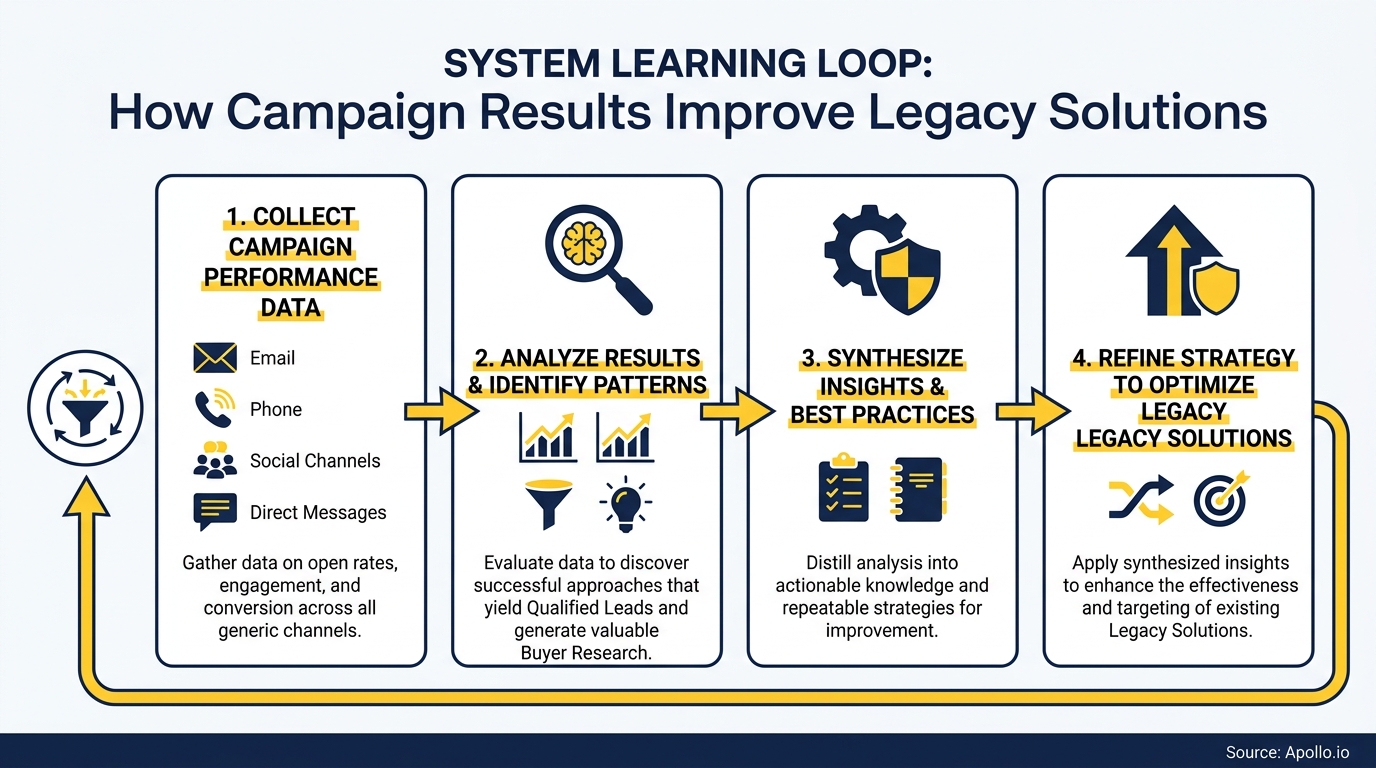
The campaign learning loop is a closed-cycle system where outreach outcomes feed directly back into the inputs that shape the next campaign. It has four stages: data capture, causal attribution, policy update, and next-sequence execution.
Unlike a dashboard that shows what happened, a learning loop changes what happens next.
Most B2B teams already collect data but lack the operating system to use it. The system learns by connecting engagement signals (replies, clicks, meetings booked) to downstream revenue outcomes (pipeline created, deals closed, accounts lost) and using that connection to adjust who gets contacted, with what message, at what time.
- Stage 1 - Capture: Log every touchpoint event (email sent, opened, replied, call connected, meeting booked, deal stage change).
- Stage 2 - Attribution: Connect touchpoints to outcomes, not just to clicks. Which sequence variant produced qualified pipeline, not just responses?
- Stage 3 - Policy Update: Adjust ICP filters, message angles, send times, and follow-up cadence based on what actually converted.
- Stage 4 - Execution: Run the updated sequence. Measure again. Repeat.
Why Do Most Teams Fail to Learn from Campaigns?
Most B2B teams treat campaign results as a reporting artifact rather than an input for the next decision. The core failure is measuring engagement without connecting it to revenue outcomes. According to Salesforce, 83% of sales teams using AI saw revenue growth versus 66% of teams not using AI in 2025. The differentiator is not the AI itself. It is the quality of the revenue data flowing back into the system.
A Reddit user shared a firsthand perspectivethat captures this precisely: the skill that moved numbers most was understanding real customer problems, then testing one clear message per campaign instead of mixing several ideas. A SaaS team they worked with changed their headline using phrases from customer calls, and conversions improved without increasing traffic. That is incrementality learning in practice: isolate one variable, measure the outcome, apply the finding.
The tech-stack gap is a structural blocker. When CRM data, email sequence data, and pipeline data live in separate systems, attribution breaks. Solving data synchronization across business systems is a prerequisite for any meaningful campaign learning loop.
How Do SDRs and RevOps Use Campaign Feedback to Improve Sequences?
SDRs improve outreach by treating each completed sequence as a structured experiment, not just a list of tasks. RevOps leaders turn those experiments into durable playbooks by tracking which variables (persona, message angle, timing, channel) produced the highest pipeline-to-sequence ratio.
A sales professional wrote on Reddit that separating list-building from outreach changes everything. Building a verified list of 500 ideal-fit accounts on one day means daily outreach becomes a focused 45-minute activity rather than a four-hour hunt. This separation also creates cleaner data: when your list is consistent, reply rate variance reflects message quality, not list quality.
For RevOps, the practical checklist looks like this:
- Define success metrics before launch: reply rate, meeting rate, pipeline influenced, not just open rate.
- Tag every sequence variant with the ICP segment, message angle, and send-time window.
- Review outcomes at the account level, not just the contact level. Did the account progress?
- Feed closed-lost reasons back into the ICP filter to exclude poor-fit accounts from future sequences.
Struggling to automate this feedback cycle? Apollo's AI sales automation connects outreach signals to pipeline outcomes in one unified workspace, so SDRs and RevOps teams work from the same data, not separate spreadsheets.

What Is Incrementality Learning and Why Does It Beat Engagement Reporting?
Incrementality learning measures whether a campaign action caused an outcome, not just whether the outcome happened near the action. Engagement reporting shows correlation.
Incrementality learning shows causation.
For B2B outreach, this distinction is critical. A contact who replied to your email may have already been ready to buy.
Incrementality asks: did your email actually accelerate the deal, or would the outcome have happened anyway? Answering this correctly changes how you allocate follow-up effort and which message variants you scale.
Data from SerpSculpt shows AI adoption drives a 50% increase in lead generation and 47% higher conversion rates. But those outcomes depend on systems that connect the AI output to actual revenue signals, not just activity volume.
| Approach | What It Measures | What It Changes |
|---|---|---|
| Engagement Reporting | Opens, clicks, replies | Subject lines, send times |
| Incrementality Learning | Pipeline influence, causal lift | ICP targeting, message angle, sequence design |
Turn Funnel Gaps Into Qualified Pipeline
Tired of watching marketing leads stall before they ever reach your AEs? Apollo surfaces high-intent prospects and arms your team with verified contacts that actually convert. Nearly 100K paying customers stopped guessing and started closing.
Start Free with Apollo →How Does Multiobjective Optimization Prevent Outreach Burnout?
Multiobjective optimization means tuning outreach for multiple outcomes simultaneously, not just maximizing one metric. Optimizing only for reply rate often increases unsubscribes, hurts deliverability, and damages long-term account relationships.
A balanced policy optimizes for replies alongside pipeline quality, unsubscribe rate, and account-level sentiment.
Research from Cazoomi found personalized emails generated 58% higher transaction rates than generic ones in 2025. But personalization that ignores negative signals (unsubscribes, spam reports, no-response after multiple touches) trains the system toward short-term activity at the expense of long-term deliverability.
The governance checklist for multiobjective outreach:
- Set a maximum touch frequency per account per quarter, not just per contact.
- Track unsubscribe rate and spam complaint rate as primary KPIs alongside reply rate.
- Require human review before scaling any sequence variant beyond a defined threshold.
- Define pipeline quality criteria (ICP fit, deal size, buyer stage) so the system optimizes for revenue, not volume.
Understanding how revenue operations drives growth is foundational here. RevOps teams that own the KPI definitions for outreach learning loops consistently outperform teams that leave those definitions to individual SDRs.
How Do You Build a Workflow-Integrated Learning System?
A workflow-integrated learning system means campaign insights update outreach inputs automatically, without requiring a weekly manual review meeting. The key is connecting the tools where data lives to the tools where outreach happens, through a unified platform or a tight integration layer.
The practical implementation steps:
- Centralize outcome data: CRM deal stages, call outcomes, and email engagement must feed a single record per account.
- Automate tagging: Every contact and sequence should carry ICP segment tags so you can filter outcomes by persona without manual sorting.
- Set trigger rules: When a contact replies negatively or reaches a defined touch limit, automatically suppress future outreach and flag the account for review.
- Review and apply: Weekly, pull the top-performing and bottom-performing sequence variants. Apply winning elements to the next build. Archive losers with notes on why they underperformed.
Platforms like Apollo consolidate prospecting, sequencing, and analytics into one workspace, which eliminates the data fragmentation that breaks most learning loops. As Cyera noted, "Having everything in one system was a game changer." Spending hours reconciling data across disconnected tools? Apollo's multi-channel sales engagement platform keeps your outreach data and outcomes in one place, so your sequences actually get smarter over time.
For deeper context on building repeatable outreach systems, see how to create an email campaign that closes deals and what a sales system is and how to implement one. Teams that pair these structural foundations with a closed-loop learning process consistently outperform those running campaigns in isolation.

Start Building a Smarter Outreach System Today
The system learns from campaign results by capturing outcomes, attributing them causally, updating targeting and messaging, and executing the next sequence with better inputs. The teams winning in 2026 are not sending more emails.
They are building feedback loops that make every campaign more precise than the last.
Apollo gives SDRs, AEs, and RevOps leaders a unified platform to prospect, sequence, and analyze outreach results without stitching together five separate tools. The result is a learning loop that actually closes: data in, better outreach out.
Get Leads Now and start turning every campaign result into a smarter next sequence.
Prove Pipeline ROI Before Next QBR
Budget approval stuck on unclear metrics? Apollo delivers measurable pipeline impact from day one — so you walk into every review with numbers that close the conversation. Nearly 100K paying customers already made the case.
Schedule a Demo →Don't miss these
Sales
Inbound vs Outbound Marketing: Which Strategy Wins?
Sales
What Is a Sales Funnel? The Non-Linear Revenue Framework for 2026
Sales
What Is a Go-to-Market Strategy? The 2026 GTM Playbook
See Apollo in action
We'd love to show how Apollo can help you sell better.
By submitting this form, you will receive information, tips, and promotions from Apollo. To learn more, see our Privacy Statement.
4.7/5 based on 9,690 reviews
