
How Does a Sales Platform's AI Adapt to Your Specific Sales Process in 2026?
Your sales process is not generic, so your AI should not be either. The question every revenue leader is asking in 2026 is not whether AI can generate an email, but whether it can reflect your actual pipeline stages, qualification criteria, objection playbooks, and ICP definition. According to Cirrus Insight, AI adoption among sales representatives nearly doubled from 24% in 2023 to 43% in 2024, and the teams pulling ahead are those embedding AI into their specific workflows, not just using it ad hoc. Understanding how sales automation software drives revenue starts with understanding how the AI underneath it maps to your motion.

Research Less, Pipeline More With Apollo
Tired of your reps burning hours verifying contact info instead of selling? Apollo delivers accurate business contacts instantly, so your team scales outreach without scaling headcount. Join 600K+ companies building predictable pipeline.
Start Free with Apollo →Key Takeaways
- AI adaptation means workflow-level customization: CRM stages, qualification rules, playbooks, and messaging guardrails, not just prompt tuning.
- Teams that effectively partner with AI are significantly more likely to hit quota, making process alignment a revenue priority, not a nice-to-have.
- SDRs, AEs, and RevOps each need AI configured to their specific role and stage in the pipeline for adoption to stick.
- Governance and auditability are now core parts of adaptation: ungoverned AI outputs create buyer trust problems at scale.
- Measurement matters: without KPIs tied to stage conversion and message consistency, you cannot know if the AI is actually working.
What Does "Adapt to Your Sales Process" Actually Mean?
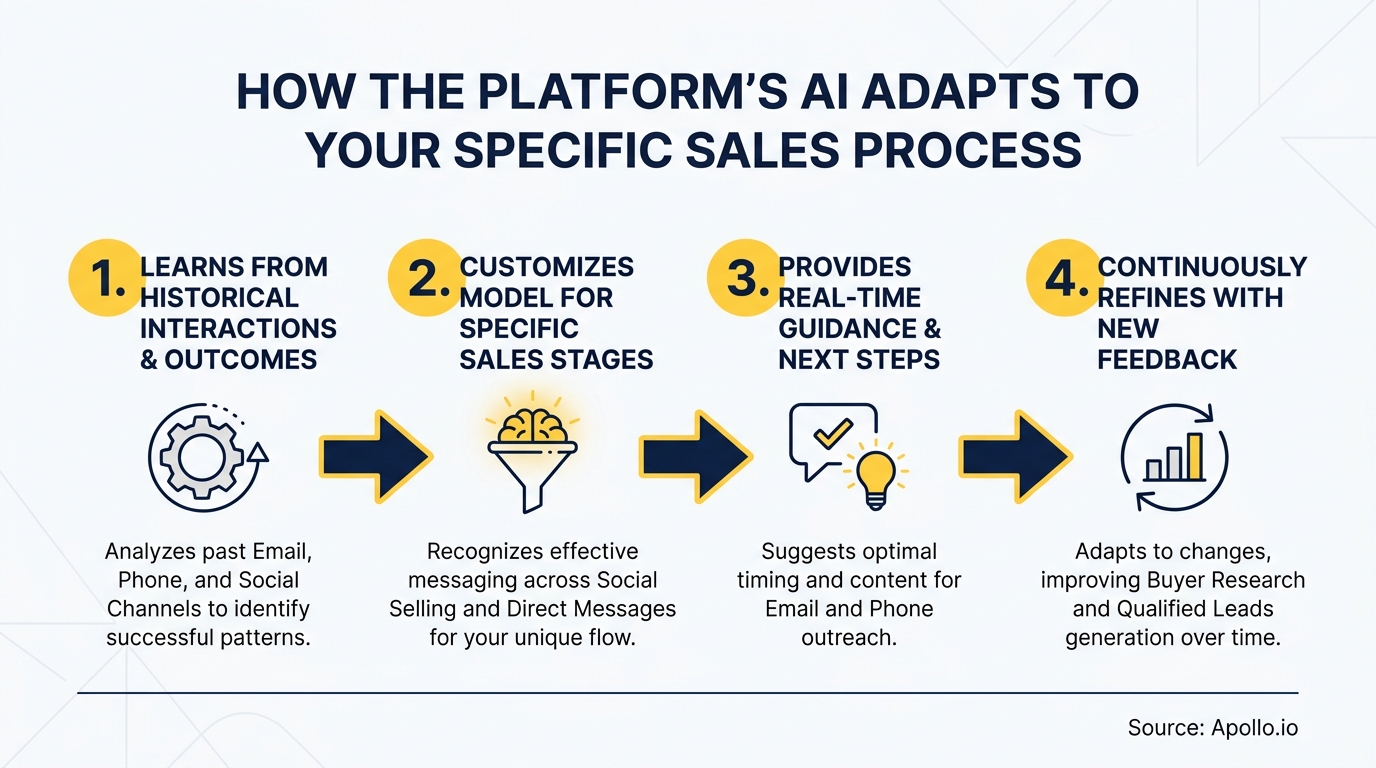
AI adapting to your sales process means the platform uses your specific pipeline stages, ICP criteria, qualification rules, and approved messaging as the operating context for every output it generates. This is different from a generic copilot that drafts content from scratch. True adaptation means the AI knows that your process moves from Discovery to Technical Validation to Legal Review, and it surfaces next-best actions, messaging, and content that match each stage's exit criteria.
The distinction matters because generic AI outputs create buyer friction. Gartner's 2025 buyer survey found 73% of B2B buyers actively avoid suppliers that send irrelevant outreach.
If your AI does not know your ICP, your value proposition, or where a deal sits in your funnel, it will produce content that misses the mark, or worse, contradicts what your website says.
Think of it as the difference between a new hire who read your sales playbook versus one who only read a generic sales textbook. Only the first one can actually run your play.
What Inputs Does the AI Use to Learn Your Sales Motion?
A well-configured sales AI draws from six core input layers that define your unique selling motion.
| Input Layer | What It Includes | What the AI Does With It |
|---|---|---|
| CRM Stage Mapping | Stage names, exit criteria, required fields | Surfaces stage-appropriate next actions and content |
| ICP Definition | Firmographics, technographics, personas, buying signals | Scores and prioritizes prospects by fit |
| Qualification Rules | MEDDIC, BANT, or custom criteria | Flags deals missing required qualification data |
| Sales Playbooks | Talk tracks, objection responses, discovery questions | Generates role-specific, stage-specific messaging |
| Approved Assets | Case studies, pricing decks, one-pagers | Recommends the right asset for the buyer's stage and role |
| Win/Loss Patterns | Historical deal data from closed-won and closed-lost | Weights scoring models toward high-conversion signals |
A sales professional wrote on Reddit that they created custom skills and workflows specific to their role, supporting 40 AEs with AI-built demo assets, architecture diagrams, and solution notes. The key was configuring the AI around their actual job context, not using it out of the box. That same principle applies at the platform level.
Turn Funnel Guesswork Into Pipeline Clarity
Tired of forecasts built on stale data and gut instinct? Apollo surfaces in-market buyers the moment they're ready, so your pipeline reflects reality — not hope. Nearly 100K paying customers stopped guessing and started closing.
Schedule a Demo →How Do SDRs and AEs Use Process-Adapted AI Differently?
SDRs and AEs need the AI configured to different objectives, and a well-adapted platform serves each role without requiring a rebuild.
For SDRs: The AI should reflect your ICP filters, outreach cadence rules, and approved messaging sequences. Spending hours on manual research and writing is the primary time drain. Struggling to build qualified pipeline fast enough? Apollo's AI-powered engagement sequences adapt to your target personas and outreach playbooks, so SDRs execute your motion at scale instead of reinventing it daily.
For AEs: The AI should reflect deal stage context. Before a discovery call, AEs need prospect research tailored to your qualification framework. During a deal, they need next-best actions tied to your pipeline stages and objection handling guidance grounded in your approved playbooks. After a call, AI-generated summaries should map to your CRM fields, not generic notes. Apollo's deal management keeps every stage action tied to your pipeline logic, so nothing falls through.
For RevOps: The AI's value is data consistency. When AI outputs map to defined CRM fields and qualification criteria, revenue operations teams get cleaner data, fewer manual overrides, and a single source of truth for forecasting.

How Does AI Stay On-Brand and On-Process Without Going Rogue?
Governance is what separates a useful AI from a liability. Forrester warned in its 2026 B2B predictions that ungoverned GenAI use could cost B2B companies more than $10 billion in enterprise value, partly because 19% of buyers using AI-assisted tools feel less confident due to inaccurate or unreliable outputs.
Three governance mechanisms keep the AI grounded in your process:
- CRM Grounding: Outputs reference live deal data, contact history, and stage context rather than generating from scratch.
- Approved Asset Libraries: The AI recommends only pre-approved content, keeping messaging consistent with what marketing has sanctioned.
- Human-in-the-Loop Review: High-stakes outputs (pricing proposals, executive communications) require rep review before sending, preserving brand trust.
A Reddit user shared a firsthand perspective on building a structured AI scoring template for cold call transcripts, with explicit sections for Opening, Qualification, Discovery, and Objection Handling.
Their approach shows that process adaptation does not have to be enterprise-scale to be effective.
Even individual reps can define guardrails that keep AI outputs consistent with their specific selling method.
This is also why building the right sales tech stackmatters: platforms that consolidate prospecting, engagement, and deal management in one workspace reduce the governance complexity of managing AI across five disconnected tools.
How Do You Measure Whether the AI Is Actually Adapting?
Without measurement, you cannot distinguish a well-adapted AI from an expensive one. Four KPIs tell you whether the AI is working for your specific process:
- Stage Conversion Rate: Are deals moving through your defined stages faster after AI adoption? Compare pre- and post-implementation by stage.
- Pipeline Velocity: Is average time-in-stage decreasing for AI-assisted deals? This reveals where the AI is genuinely accelerating the process.
- Message Consistency Score: Are AI-generated sequences aligning with your approved talk tracks? Manual audits or AI-assisted review can flag drift.
- Rep Adoption Rate: Are reps using the AI outputs or overriding them? High override rates signal the AI is not yet calibrated to your motion.
Research from MarketBetter.ai shows 92% of sales teams plan to increase their AI investment in 2026. The teams that will see returns are those measuring adaptation quality, not just adoption volume. Pair these KPIs with sales analytics to close the loop between AI output and pipeline outcomes.
How Does Apollo's AI Adapt to Your Specific Sales Process?
Apollo's agentic GTM platform is built around company-specific variables. When Apollo announced its end-to-end agentic platform in late 2025, the core design principle was that AI agents should reflect each company's ICP definition, fit scoring logic, qualification criteria, and messaging playbooks, not a one-size-fits-all model. According to Litmos, 81% of sales teams are currently experimenting with or have fully implemented AI. Apollo is built for the teams that want to move past experimentation and into operational execution.
Apollo's platform consolidates prospecting, engagement, enrichment, and deal management into one workspace, which means your ICP filters, sequence logic, and CRM stage rules are all in the same system. "Having everything in one system was a game changer," noted Cyera after adopting Apollo. "We cut our costs in half," said Census. That consolidation is what makes AI adaptation practical: the AI operates on a unified data layer instead of stitching together signals from five separate tools.
Key adaptation capabilities inside Apollo include:
- AI-powered prospect scoring tied to your ICP and firmographic criteria
- Sequence personalization grounded in contact context and your messaging guidelines
- AI Research Agent that delivers pre-meeting intelligence mapped to your qualification framework (users report 46% more meetings booked)
- AI-powered messaging that reflects your approved value propositions (users report a 35% increase in bookings)
- AI call assistant that captures call summaries aligned to your CRM fields and stage exit criteria

Start Adapting AI to Your Sales Process Today
AI that does not reflect your pipeline stages, qualification rules, and approved messaging is just noise. The teams winning in 2026 are those that have moved from generic AI experimentation to process-grounded AI execution.
That means defining your inputs (ICP, stages, playbooks, approved assets), choosing a platform that maps outputs to those inputs, and measuring adaptation quality with stage-level KPIs.
Apollo gives B2B GTM teams, from SDRs and AEs to RevOps leaders and founders, a unified platform where AI operates inside your sales process, not alongside it. Whether you are building your first outbound motion or optimizing an enterprise pipeline, the path to better results runs through a sales acceleration approach grounded in your specific data.
Ready to see how AI adapts to your motion? Start a free trial of Apollo and configure your ICP, sequences, and pipeline stages in one workspace.
Prove Pipeline ROI From Day One
Budget approval stuck on unclear metrics? Apollo delivers measurable pipeline impact fast — with 46% more meetings using AI and real results your CFO can't argue with. Nearly 100K paying customers already closed the case.
Schedule a Demo →Don't miss these
Sales
Inbound vs Outbound Marketing: Which Strategy Wins?
Sales
What Is a Sales Funnel? The Non-Linear Revenue Framework for 2026
Sales
What Is a Go-to-Market Strategy? The 2026 GTM Playbook
See Apollo in action
We'd love to show how Apollo can help you sell better.
By submitting this form, you will receive information, tips, and promotions from Apollo. To learn more, see our Privacy Statement.
4.7/5 based on 9,690 reviews
