
How Machine Learning Identifies Patterns in Sales Data
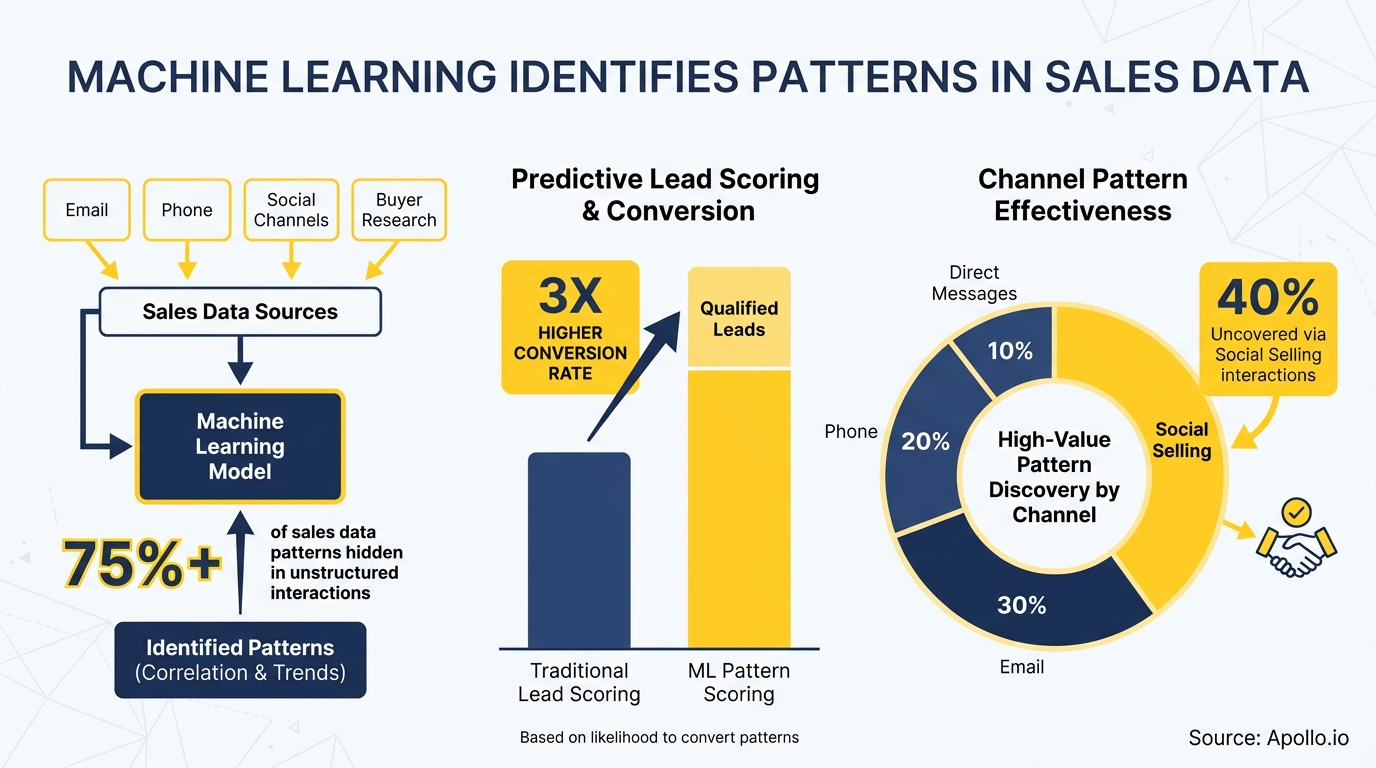
Machine learning identifies patterns in sales data by ingesting historical transactions, CRM activity, buyer behavior, and engagement signals, then learning which feature combinations predict outcomes like won deals, churn, or stalled opportunities. The result: your pipeline stops being a gut-feel exercise and starts being a signal-driven system. Understanding how sales analytics drives revenue growth starts with knowing what ML is actually doing under the hood.

Let Apollo Find Contacts Instantly
Tired of burning hours verifying emails and chasing down phone numbers? Apollo surfaces accurate, ready-to-use contact data so your reps spend time selling — not researching. Join 600K+ companies building pipeline faster.
Start Free with Apollo →Key Takeaways
- ML converts raw CRM, engagement, and behavioral data into features, then learns which combinations predict sales outcomes.
- There are seven distinct sales patterns ML can detect: win propensity, stalled deals, churn risk, seasonality, lead scoring, price sensitivity, and cross-sell affinity.
- Data quality matters more than model sophistication — fragmented CRM data produces unreliable patterns regardless of algorithm.
- Sales professionals who actively use AI-derived signals are significantly more likely to exceed quota than those who ignore them.
- The most effective implementations embed ML outputs directly into CRM workflows as next-best actions, not separate dashboards.
What Does Machine Learning Actually Mean for Sales Patterns?
Machine learning identifies sales patterns by applying statistical models to labeled historical data — for example, deals that closed versus deals that were lost — and finding which input variables consistently explain the difference. This is distinct from traditional reporting, which describes what happened.
ML predicts what is likely to happen next.
Three ML approaches apply most directly to sales data:
- Supervised learning: Trained on labeled outcomes (win/loss, churned/retained). Produces lead scores, win-probability scores, and churn-risk flags.
- Unsupervised learning: Groups accounts or deals by behavioral similarity without predefined labels. Useful for segmentation and cross-sell affinity mapping.
- Time-series models: Detect seasonality, pipeline velocity trends, and quota attainment cycles across calendar periods.
A commenter shared a firsthand perspective in a Reddit discussion that most relationships in sales data are simple enough that exploratory analysis and basic statistics will do — and that explainability matters more than model complexity when presenting to business stakeholders. That is a useful check before investing in heavy ML infrastructure.
How Does the Sales Pattern Detection Pipeline Work?
The pattern detection pipeline runs in four sequential stages: data collection, feature engineering, model training and validation, and CRM-embedded action.
What Data Sources Feed the Model?
Reliable pattern detection requires connected data across multiple systems. Fragmented inputs produce unreliable signals. Key sources include:
- CRM records: deal stage, age, owner, activity history, close date changes
- Email and call engagement: reply rates, sentiment, meeting frequency, response lag
- Intent data: content consumption, competitor research, category-level search signals
- Marketing attribution: campaign touches, content downloads, webinar attendance
- Product usage data (where available): login frequency, feature adoption, support ticket volume
What Is Feature Engineering for Sales Forecasting?
Feature engineering transforms raw data fields into predictive variables the model can learn from. Raw fields like "last activity date" become engineered features like "days since last meaningful two-way interaction" — a far stronger predictor of deal health.
Examples of high-signal engineered features:
- Deal velocity ratio: actual days in stage vs. historical average for similar deals
- Stakeholder coverage score: number of unique contacts engaged at the buying organization
- Sentiment drift: change in email tone over the last three interactions
- Seasonal timing index: deal start date relative to historical close-rate peaks
According to MarketsandMarkets, AI-augmented forecasting can improve forecast accuracy by up to 35%, with advanced platforms achieving up to 96% accuracy. Feature engineering quality is the primary driver of that gap.
Struggling to keep your pipeline data clean enough to feed these models? Apollo's CRM enrichment tool keeps contact and account data verified and current so your ML inputs stay accurate.
What Is the Sales Pattern Taxonomy ML Can Detect?
ML can detect at least seven distinct pattern types in sales data, each requiring different signals and triggering different actions.
| Pattern Type | Key Detection Signals | Recommended Action |
|---|---|---|
| Win Propensity | ICP fit score, stakeholder count, deal velocity, champion engagement | Prioritize rep time and executive sponsorship |
| Stalled Deals | Stage age, email response lag, missing next step, sentiment decline | Trigger re-engagement sequence or manager review |
| Churn Risk | Support ticket volume, login frequency drop, NPS dip, contract age | Alert CSM, schedule executive business review |
| Seasonality | Historical close-rate by month, fiscal quarter patterns, industry cycles | Adjust pipeline targets and resource allocation by period |
| Lead Scoring | Intent signals, firmographic fit, engagement depth, content consumption | Route high-score leads to senior reps immediately |
| Price Sensitivity | Discount request history, competitor mentions, deal cycle length after pricing | Arm reps with ROI calculators and tiered proposals |
| Cross-Sell Affinity | Product usage clusters, purchase sequence patterns, account segment similarity | Trigger expansion plays at the right account maturity stage |
Understanding how contact data enrichment drives ROI connects directly to lead scoring accuracy — richer contact profiles produce sharper ML signals.
Turn Funnel Gaps Into Pipeline Gold
Pipeline forecasting a guessing game because quality leads dry up before they ever reach your AEs? Apollo surfaces in-market buyers at the right moment, turning weak lead flow into predictable opportunity. Nearly 100K paying customers have already stopped guessing.
Schedule a Demo →How Do RevOps and SDRs Use ML Patterns in Practice?
For RevOps leaders, ML patterns replace manual pipeline inspection with systematic deal-health monitoring. Instead of reviewing every opportunity in a weekly call, RevOps can surface only the deals showing stall signals or win-probability drops, then direct manager attention there.
For SDRs and BDRs, ML-powered lead scoring changes the daily prioritization question from "who should I call next?" to "which accounts are showing the right buying pattern right now?" Research from Cirrus Insight found that in 2025, 56% of sales professionals use AI daily, and those users are twice as likely to exceed their sales targets compared to non-users.
A data scientist noted in a Reddit discussion that a good starting point is always to talk to the business and subject matter experts before building models — domain knowledge from AEs and SDRs often reveals the most predictive variables faster than automated feature selection.
For Account Executives managing large deal portfolios, the stalled-deal pattern is the highest-value signal. ML can flag risk earlier than any pipeline review by detecting that a key stakeholder has gone silent, email sentiment has shifted, or the deal has exceeded its historical close-time benchmark.
Need to act on those signals with targeted outreach immediately? Apollo's multi-channel sales engagement platform lets you launch personalized sequences the moment a pattern triggers, without switching tools.

When Should You Use ML vs. Simpler Analytics?
ML is warranted when relationships between variables are non-linear, interaction effects matter, and you have enough labeled historical data to train a reliable model — typically hundreds of closed deals at minimum. For smaller data sets, simpler approaches often outperform ML on both accuracy and explainability.
A practical decision framework:
- Use ML when: You have 500+ closed deals, multiple interacting variables, and need probabilistic scores rather than binary rules.
- Use rules-based scoring when: Your ICP is narrow, your deal volume is low, or your stakeholders need to understand exactly why a lead was prioritized.
- Start with data quality, not algorithms: Fragmented CRM data, missing fields, and inconsistent stage definitions will produce misleading patterns regardless of model sophistication. Explore how to build a data enrichment strategy before investing in ML infrastructure.
Data from Articsledge, citing a McKinsey report, shows companies using ML in sales reported 30% higher conversion rates in 2023 — but those results depend on data foundations being in place first. The right sales automation software can help standardize data capture before ML is layered on top.
How Do You Measure Whether ML Pattern Detection Is Working?
Model accuracy in sales ML is measured using precision, recall, and AUC-ROC for classification models, and MAE or RMSE for forecasting models. But business-level validation matters more than technical metrics.
Key business-level checks:
- Do high-score leads convert at a higher rate than low-score leads in practice?
- Do deals flagged as stalled actually close at a lower rate, or slip stage?
- Does forecast accuracy improve compared to the prior quarter's rep-submitted numbers?
- Are reps actually using the scores, or ignoring them in favor of gut feel?
If reps are ignoring model outputs, the issue is usually explainability — they do not trust a score they cannot understand. Embedding pattern outputs as plain-language next-best actions inside CRM records (rather than abstract scores) drives adoption. Connecting data sync across your sales and marketing stack ensures model outputs surface where reps already work.

Start Turning Sales Patterns Into Pipeline
Machine learning identifies sales patterns by connecting the dots across CRM history, engagement behavior, intent signals, and deal outcomes — then surfacing those patterns as prioritized actions for SDRs, AEs, and RevOps teams. The competitive advantage goes to teams that combine clean, unified data with ML-derived signals and act on them faster than their competitors.
Apollo gives B2B GTM teams a unified platform to enrich data, score leads, run multi-channel sequences, and track deals in one workspace. Trusted by nearly 100,000 paying customers including Anthropic, Redis, and Smartling, Apollo consolidates the tools that feed your ML models and act on their outputs.
As Census put it: "We cut our costs in half."
Get Leads Now and put ML-powered signals to work in your pipeline today.
Prove Pipeline ROI Before Next QBR
ROI pressure killing your tool budget before it even gets approved? Apollo delivers measurable pipeline impact fast — 46% more meetings with AI, real results your CFO can't argue with. Start free today.
Start Free with Apollo →Don't miss these
Sales
Inbound vs Outbound Marketing: Which Strategy Wins?
Sales
What Is a Sales Funnel? The Non-Linear Revenue Framework for 2026
Sales
What Is a Go-to-Market Strategy? The 2026 GTM Playbook
See Apollo in action
We'd love to show how Apollo can help you sell better.
By submitting this form, you will receive information, tips, and promotions from Apollo. To learn more, see our Privacy Statement.
4.7/5 based on 9,690 reviews
