
How Integration Streamlines Pipeline Management for Faster Revenue Growth
Your pipeline problem probably isn't a pipeline problem. It's an integration problem. When CRM data sits in one system, marketing automation in another, and conversation notes in a third, deals stall, forecasts drift, and reps spend time on admin instead of selling. According to Abacum, companies with mature Revenue Operations functions typically grow revenue three times faster than those without. Integration is how you build that maturity. This article breaks down exactly how integration streamlines pipeline management and what governance steps separate teams that see results from those still chasing data quality issues.

Let Apollo Do the Research for You
Tired of burning hours verifying contacts before a single email goes out? Apollo surfaces accurate, ready-to-work leads so your reps spend time selling, not searching. Join 600K+ companies building pipeline faster.
Start Free with Apollo →Key Takeaways
- Integration transforms pipeline management from data syncing into a revenue-goal operating system with real forecast confidence.
- Poor data governance, not tool count, is the primary cause of pipeline friction and missed quota.
- RevOps maturity and cross-system alignment directly correlate with faster revenue growth and better pipeline predictability.
- A four-stage maturity model helps GTM teams sequence integration investments and measure progress.
- Apollo consolidates prospecting, engagement, enrichment, and deal tracking into one workspace, reducing the need for multiple disconnected tools.
What Does Integration Actually Streamline in Pipeline Management?
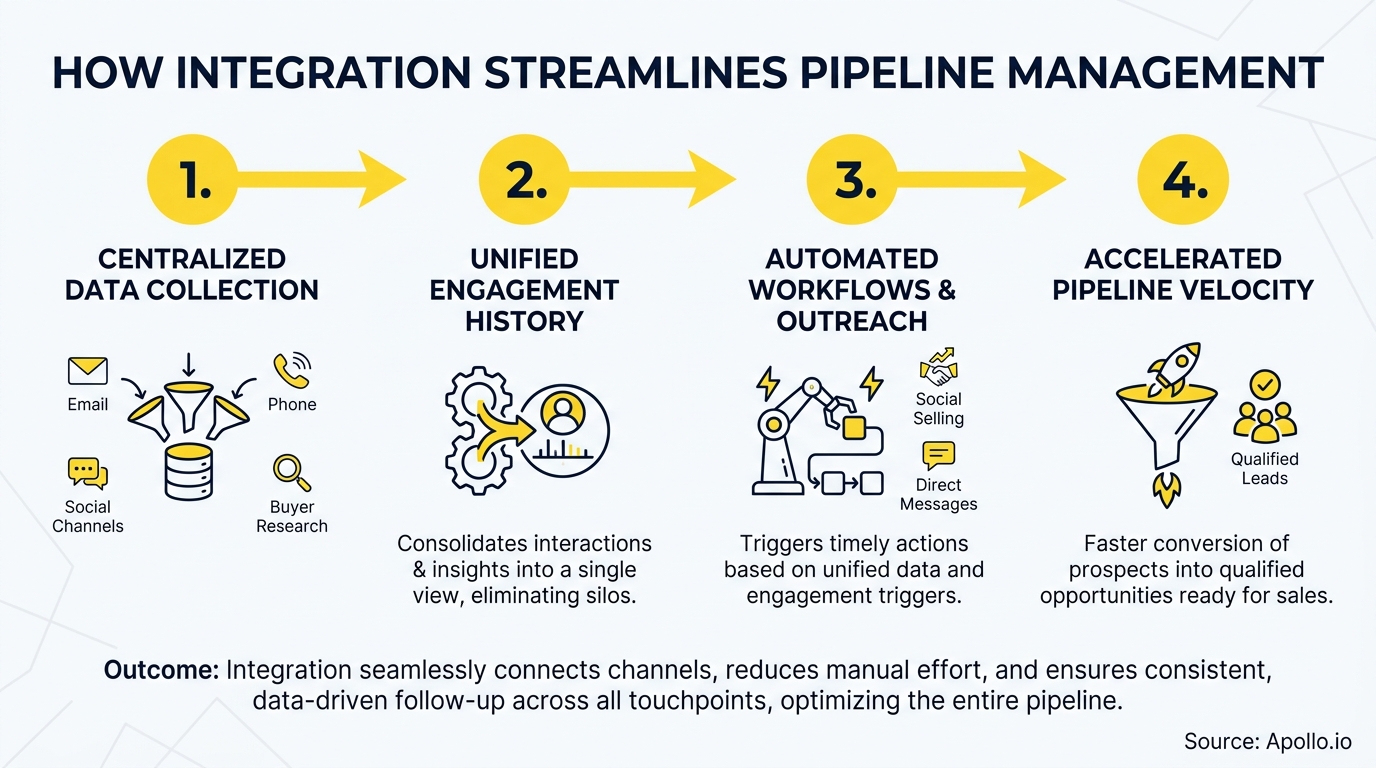
Integration streamlines pipeline management by eliminating data gaps between the systems that generate, qualify, and close revenue. Without connected tools, reps manually re-enter data, managers work from stale reports, and leads fall through handoff cracks.
Here are the specific pipeline functions that integration fixes:
- Lead routing: Automated assignment rules replace manual triage when CRM and marketing automation share field data.
- Contact capture: Conversation intelligence, email activity, and web visits write back to the opportunity record automatically.
- Lead scoring: Behavioral signals from multiple channels feed a single score instead of isolated platform scores.
- Forecast inspection: Revenue leaders see stage progression, activity, and risk flags in one view, not three dashboards.
- Attribution: Marketing can connect campaign spend to closed-won revenue when MAP and CRM share opportunity data.
- Follow-up SLAs: Trigger-based workflows enforce response time standards after events, demos, or inbound requests.
Research from Martal shows sales cycles are 23% longer than before, making proactive, integrated pipeline management critical for revenue growth. Integration shortens that cycle by keeping every team working from the same real-time data.
What Is the Pipeline Integration Maturity Model?
The Pipeline Integration Maturity Model describes four stages teams move through as they connect systems, govern data, and operationalize revenue workflows. Most mid-market teams sit at Stage 1 or 2.
| Stage | Description | Exit Criteria |
|---|---|---|
| Stage 1: Siloed | CRM, MAP, and engagement tools operate independently. Data is exported manually. | Native CRM sync is live for at least one key system (email or MAP). |
| Stage 2: Connected | Core systems sync bidirectionally. Basic routing and field mapping are in place. | Deduplication rules and field ownership are documented and enforced. |
| Stage 3: Governed | Data ownership, definitions, and KPIs are standardized across GTM teams. | Forecast accuracy is tracked and reviewed against integrated pipeline data weekly. |
| Stage 4: Orchestrated | AI-driven signals surface next-best actions. Revenue is managed as a single lifecycle across sales, marketing, and CS. | Pipeline coverage, win rate, and cycle time improve quarter over quarter with attributed causality. |
A 2025 State of RevOps report found that Gartner predicted 75% of the highest-growth companies would be deploying a RevOps model by 2025, with 79% of respondents having a formal RevOps function going into that year (source: State of RevOps 2025). Yet most organizations remain below Stage 3. The governance gap is the most common blocker. Understanding what revenue operations actually does is the first step to closing it.
How Do RevOps Teams Build a CRM Data Governance Checklist?
CRM data governance for pipeline management means assigning clear ownership, enforcing field definitions, and building deduplification rules before integration breaks down into noise.
Use this checklist before connecting any new system to your CRM:
- Data owner assigned: One named person owns each object type (contacts, accounts, opportunities).
- Field definitions documented: Every stage, status, and custom field has an agreed definition accessible to all GTM teams.
- Deduplication rules active: Match logic is configured to prevent duplicate contacts and accounts on import or sync.
- Routing rules tested: Lead assignment logic is validated against actual ICP criteria before go-live.
- KPI ownership mapped:Each team owns specific pipeline metrics: SDRs own meetings booked, AEs own stage progression, RevOps owns forecast accuracy.
- Sync frequency defined: Real-time, hourly, or daily sync intervals are chosen based on data sensitivity.
For teams connecting HubSpot or Salesforce, a practical CRM integration strategy starts with field mapping and escalation rules before any data flows. Skipping governance is the primary reason integrated pipelines degrade back into silos within six months.
Struggling to keep pipeline data clean across systems? Get complete pipeline visibility with Apollo's deal management and stop chasing stale opportunity records.

How Do SDRs and AEs Benefit Differently from Pipeline Integration?
SDRs and AEs interact with integrated pipeline data at different stages, and integration delivers distinct value to each role.
For SDRs: Integration means less time researching and more time prospecting. When CRM syncs with enrichment tools and engagement platforms, SDRs see up-to-date contact data, previous touchpoints, and intent signals in one workspace. They can prioritize outreach based on actual buyer behavior rather than static lists. Learning how data sync improves B2B sales and marketing ROI is directly relevant to SDR productivity.
For AEs: Integration surfaces deal risk earlier. When conversation intelligence, email activity, and product usage data write back to the opportunity, AEs can identify stalled deals before they slip the quarter. For Account Executives managing multiple active opportunities, a unified deal view replaces tab-switching across four tools. As one Cyera team member put it, "Having everything in one system was a game changer."
For RevOps leaders: Integration enables forecast inspection workflows that are based on real pipeline activity, not self-reported stage updates. Teams aligned on shared data definitions and routing rules spend less time reconciling reports and more time improving conversion rates. Sales analytics only becomes predictive when the underlying data is complete and consistent.
Turn Funnel Guesswork Into Pipeline Wins
Pipeline forecasting a guessing game because leads stall before they ever become opportunities? Apollo surfaces high-intent prospects and keeps your funnel moving with real data. Top teams close more, guess less.
Start Free with Apollo →What Are the Most Valuable Integration Use-Case Blueprints?
Three pipeline integration use cases consistently deliver the clearest ROI for B2B GTM teams.
Event-to-Pipeline Attribution: Webinar or event registrant data flows into MAP for lead scoring, then into CRM as a new opportunity with source attribution and a follow-up SLA trigger. Marketing can prove pipeline contribution; SDRs know exactly who to call and when.
Omnichannel Buyer Tracking: McKinsey's 2024 B2B Pulse found 51% of likely switchers cited lack of customer tracking across channels as a reason to leave. When email, call, and web behavior all write to the same contact record, sellers can personalize follow-up based on actual engagement, not guesswork. Intent data layered on top of this unified record sharpens prioritization further.
Job Change Alerts to Pipeline Wins: When a champion contact changes companies, an integrated CRM triggers an alert and creates a new opportunity at the new account automatically. Job change alerts turn routine CRM updates into warm pipeline without any manual research.
According to Partnerfleet, 84% of businesses consider integrations "very important" or a "key requirement" for their customers. These blueprints show why: integration creates the buyer experience that retains and converts accounts at higher rates.
Spending hours manually updating deal stages and pulling disconnected reports? Build a connected pipeline with Apollo and let your data work for you instead of the other way around.
How Does Apollo Consolidate Pipeline Integration Into One Platform?
Apollo consolidates prospecting, enrichment, engagement, and deal management into one unified workspace, reducing the need to connect and maintain multiple separate tools. For teams currently running a fragmented stack, this directly addresses the governance and data-quality problems that cause pipeline friction.
Key integration capabilities Apollo provides:
- Native CRM sync with HubSpot and Salesforce so contact, account, and activity data stays current without manual exports. See how to connect HubSpot, Salesforce, and Apollo fast.
- Contact enrichment that automatically fills CRM gaps with verified business data, keeping pipeline records accurate without rep effort. Learn more about how contact data enrichment drives ROI.
- Sales engagement sequences that trigger based on CRM stage changes, ensuring follow-up SLAs are met automatically.
- Deal management that gives AEs and RevOps a single view of opportunity health, stage progression, and next actions.
"We reduced the complexity of three tools into one," noted the team at Predictable Revenue. "We cut our costs in half," said Census. Apollo's all-in-one platform means fewer integrations to maintain, less data drift between systems, and more time for GTM teams to focus on revenue-generating work.

How to Get Started with Pipeline Integration in 2026
Integration streamlines pipeline management by connecting the systems where revenue signals live, enforcing governance so data stays reliable, and automating workflows so reps and managers act on facts instead of spreadsheets. The teams that win in 2026 are not those with the most tools.
They are those with the most connected, governed, and actionable pipeline data.
The practical starting point: audit your current stack for data gaps, assign ownership for each CRM object, and choose one high-impact integration use case (event-to-pipeline, job change alerts, or omnichannel tracking) to prove value before expanding. From there, the maturity model provides a roadmap to revenue orchestration.
Apollo gives B2B GTM teams the unified platform to run that roadmap without stitching together a fragmented stack. Trusted by nearly 100K paying customers including Anthropic, Smartling, and Redis, Apollo brings prospecting, enrichment, engagement, and pipeline tracking into one workspace.
Start a free trial with Apollo and see how integrated pipeline management drives faster, more predictable revenue growth.
Prove Pipeline ROI Before Next QBR
Budget approval stuck on unclear metrics? Apollo delivers measurable pipeline impact your leadership can't argue with. Teams like Built-In gained +10% win rates and +10% ACV — results that justify every dollar.
Schedule a Demo →Don't miss these
Sales
Inbound vs Outbound Marketing: Which Strategy Wins?
Sales
What Is a Sales Funnel? The Non-Linear Revenue Framework for 2026
Sales
What Is a Go-to-Market Strategy? The 2026 GTM Playbook
See Apollo in action
We'd love to show how Apollo can help you sell better.
By submitting this form, you will receive information, tips, and promotions from Apollo. To learn more, see our Privacy Statement.
4.7/5 based on 9,690 reviews
