
How Does Commission Work in Sales? Structures, Rates, and 2026 Trends
Sales commission is the variable pay a rep earns when they close a deal or hit a performance milestone. For SDRs, AEs, and revenue leaders alike, understanding how commission works in sales determines how you negotiate your package, design your team's plan, and ultimately how much you earn. Yet quota attainment rates remain stubbornly low, and most comp plans get redesigned every year. Understanding the mechanics behind commission is the first step to earning more and managing better. For a broader view of how compensation connects to revenue strategy, see What Is Revenue Operations and How Does It Drive Growth?

Research Less, Close More With Apollo
Tired of burning hours manually hunting down contact info instead of selling? Apollo delivers verified leads instantly, so your team spends time closing — not researching. Join 600K+ companies building pipeline faster.
Start Free with Apollo →Key Takeaways
- Sales commission is variable pay tied to performance, typically calculated as a percentage of deal value on top of a base salary.
- According to CaptivateIQ, most sales commissions fall between 5% and 20% of the sale value across industries.
- Commission structures include straight commission, base plus commission, tiered rates, accelerators, and SPIFFs, each designed to drive different seller behaviors.
- Quota attainment is the core trigger for most payouts, but secondary measures like MBOs and SPIFFs can boost earnings even when quota lags.
- In 2026, the biggest shifts in commission design are AI-assisted forecasting, pay transparency, and monthly payout cadences replacing annual bonuses.
What Is Sales Commission and How Is It Calculated?
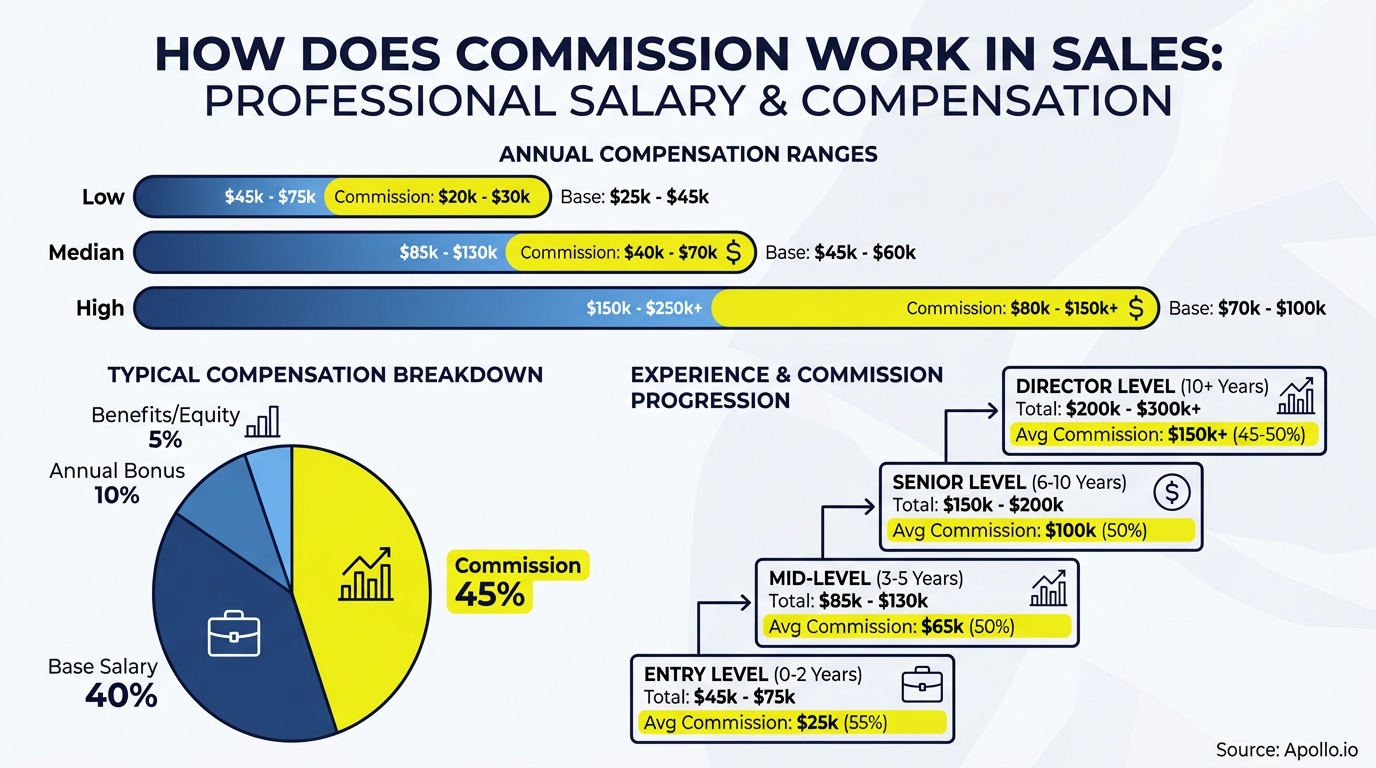
Sales commission is a performance-based payment calculated as a percentage of the revenue a rep generates. The basic formula is: Commission = Deal Value x Commission Rate.
For example, closing a $50,000 deal at a 7% commission rate yields $3,500.
Most B2B roles use a base salary plus variable structure. Research from BCG shows that variable compensation, including commissions and bonuses, represents on average around 40% of total sales compensation in B2B organizations and can reach 100% depending on role and industry.
The split between base and variable is often expressed as OTE (On-Target Earnings), the total a rep earns when hitting 100% of quota. A $120K OTE with a 60/40 split means $72K base and $48K at-risk variable pay.
What Are the Main Types of Commission Structures?
Different structures drive different behaviors. Choosing the right one depends on your sales cycle, deal size, and growth stage.
| Structure | How It Works | Best For |
|---|---|---|
| Straight Commission | 100% variable, no base salary | Independent contractors, high-ticket sales |
| Base + Commission | Fixed salary plus a % of closed revenue | Most B2B SDR, AE, and AM roles |
| Tiered Commission | Rate increases as you hit higher quota thresholds | Teams where you want to reward overperformance |
| Accelerators | Higher % rate kicks in above 100% quota attainment | AEs with long sales cycles and enterprise deals |
| SPIFF | One-time bonus for selling a specific product or in a time window | Product launches, quarter-end pushes |
| Draw Against Commission | Advance on future commissions, repaid from earnings | New reps during ramp periods |
For roles like Sales Engineers, compensation often mixes a higher base with lower variable since they support deals rather than own them outright.
Turn Funnel Guesswork Into Pipeline Clarity
Tired of watching marketing leads stall before they ever reach your pipeline? Apollo surfaces high-intent prospects and arms your team with the signals to act first. Nearly 100K paying customers stopped guessing and started closing.
Start Free with Apollo →What Commission Rates Are Typical in B2B Sales?
Rates vary significantly by industry, deal complexity, and role. According to Kennect, typical B2B sales commission rates generally range from 5% to 10% of deal value, though they vary based on industry, product complexity, and deal size.
- SaaS / Software: 8–12% of ACV (annual contract value)
- Financial Services: 3–7% depending on product margin
- Staffing / Recruiting: 15–25% of first-year placement fees
- Manufacturing / Distribution: 3–8% of order value
- High-ticket / Enterprise: Lower % rates but larger absolute payouts
For high-ticket sales, even a 2–3% rate can produce substantial commission checks. The key variable is always deal volume multiplied by average contract value.

How Does Quota Attainment Affect Commission Payouts?
Quota is the revenue target a rep must hit to earn their full variable pay. Most plans pay out on a sliding scale: below quota earns a reduced rate, at 100% earns the full target incentive, and above quota triggers accelerators.
The gap between quota setting and actual attainment is where most commission confusion lives.
Data from BookYourData shows that 73% of sales representatives missed their H2 quotas in 2023, and 69% were still falling short on average in 2024. This is why secondary measures, SPIFFs, and MBOs matter so much: they allow reps to earn meaningful variable pay even when their primary quota target is missed.
Common quota mechanics to understand:
- Threshold: Minimum attainment before any commission pays out (often 50–70%)
- Target incentive: Full variable earned at 100% quota
- Accelerator: Higher rate above 100%, rewarding overperformance
- Cap: Maximum commission payout ceiling (common in some industries, rare in SaaS)
- MBO: Management by Objective bonus tied to activities or milestones, not just closed revenue
Want better pipeline visibility to consistently hit quota? Track every deal with Apollo's pipeline management tools and stop leaving commission on the table.
How Do AEs and SDRs Earn Commission Differently?
Commission mechanics differ by role because the activities and sales cycle stages differ. Understanding your specific plan design is critical before you negotiate or accept an offer.
For Account Executives (AEs): Commission typically ties to closed-won revenue, often calculated on ACV or TCV. AEs in enterprise deals may see longer cycles but larger accelerator upside. Understanding the Sales Acceleration Formula helps AEs optimize their activity to close faster and earn more.
For SDRs/BDRs: Commission usually ties to meetings booked, qualified opportunities created, or pipeline generated, not closed revenue. SDR plans often include a small base-plus-bonus structure rather than percentage-based commission. Monthly payouts are common since SDR cycles are shorter.
For Account Managers and CSMs: Commission often ties to renewals, net revenue retention, or expansion ARR. These roles increasingly earn variable pay tied to churn prevention and upsell, not just new logo acquisition.
Struggling to build enough pipeline to hit your number? Build a predictable pipeline with Apollo's prospecting and engagement platform used by nearly 100K paying customers.
What Are the Biggest Commission Trends in 2026?
Commission design is evolving faster than ever. Three trends are reshaping how sales orgs structure and administer variable pay in 2026.
1. Paying for certainty: Xactly's 2026 State of Sales Compensation report found that orgs are concentrating richer accelerators and premium territories on proven top performers while pulling back OTE and quota expectations for newer AEs. The goal is reducing comp cost risk while rewarding predictable revenue generators.
2. Monthly commission cadence: The 2025 National Sales Compensation Survey confirms commissions are most commonly paid monthly, while bonuses tend to pay annually. Monthly cadence improves cash flow for reps and tightens the feedback loop between activity and reward.
3. Commission explainability and pay transparency: As pay transparency regulations spread, sales orgs face pressure to provide clear payout statements, auditable crediting rules, and real-time earnings dashboards. Spreadsheet-based commission tracking is being replaced by dedicated ICM (Incentive Compensation Management) systems that create audit trails and reduce disputes. For a RevOps lens on this, see What Is a Revenue Operations Framework?

How Should You Evaluate a Sales Commission Plan Before Accepting It?
Before signing an offer, ask these questions to understand your real earning potential:
- What % of reps hit quota last year? If fewer than 60% attain, the quota may be unrealistic.
- When does commission pay out? At contract signing, cash collection, or invoice? Delays erode the motivational value.
- Is there a clawback clause? Some plans recover commission if a customer churns within 90–180 days.
- What triggers the accelerator? Know the exact threshold before you plan your quarter.
- How are multi-touch deals credited? Overlay reps, SDRs, and AEs may all claim credit on the same deal.
- Is there a cap? Uncapped plans reward your best performance; capped plans limit upside.
Understanding sales analytics also helps you benchmark your own performance against quota attainment expectations before accepting a role.
Conclusion: Commission Is a System, Not Just a Number
Sales commission works best when it aligns rep behavior with company goals, pays out transparently, and adjusts for reality. Whether you are an SDR evaluating your first variable pay plan or a RevOps leader redesigning comp for a 50-person team, the fundamentals are the same: clear quota mechanics, fair rates, timely payouts, and explainable crediting rules.
The reps who consistently earn the most commission are the ones who hit quota reliably, and that starts with a full pipeline. Apollo gives B2B GTM teams the prospecting, engagement, and pipeline tools to build consistent revenue, all in one platform. Ready to earn more? Start Your Free Trial and see why nearly 100K paying customers trust Apollo to fill their pipeline.
Prove Pipeline ROI From Day One
ROI pressure killing your next budget approval? Apollo delivers measurable pipeline impact fast — so you walk into every review with proof, not promises. Leadium 3x'd revenue. Your turn.
Start Free with Apollo →Don't miss these
Sales
Inbound vs Outbound Marketing: Which Strategy Wins?
Sales
What Is a Sales Funnel? The Non-Linear Revenue Framework for 2026
Sales
What Is a Go-to-Market Strategy? The 2026 GTM Playbook
See Apollo in action
We'd love to show how Apollo can help you sell better.
By submitting this form, you will receive information, tips, and promotions from Apollo. To learn more, see our Privacy Statement.
4.7/5 based on 9,690 reviews
