
How AI Identifies and Suggests Cross-Selling Opportunities for Existing Clients
Your next cross-sell opportunity is probably hiding in your service tickets, not your sales pipeline. In 2026, AI converts existing-account data into scored, ranked, and routed expansion opportunities before a rep even opens their CRM. The result: account managers who use AI spot expansion before their competitors do. Understanding how sales analytics drives revenue growth is the foundation for making AI-driven cross-sell work at scale.

Research Less, Pipeline More With Apollo
Tired of burning hours verifying contact info that goes nowhere? Apollo delivers 230M+ accurate business contacts so your reps spend time selling, not searching. Start building real pipeline today.
Start Free with Apollo →Key Takeaways
- AI cross-sell works by unifying CRM, product usage, service, and external trigger data into ranked next-best-opportunity models delivered directly to sellers.
- Most B2B teams use AI broadly but rarely embed it inside CRM where customer context actually lives, leaving expansion revenue on the table.
- Sellers leveraging AI for buyer intelligence experience measurably higher account growth through improved cross-selling opportunities.
- Revenue uplift from AI cross-sell requires governance: clear KPIs, human-in-the-loop validation, and acceptance-rate feedback loops.
- Routing AI recommendations to the right team, with the right incentive structure, determines whether surfaced opportunities actually close.
How Does AI Suggest Cross-Sell Opportunities for Existing Clients?
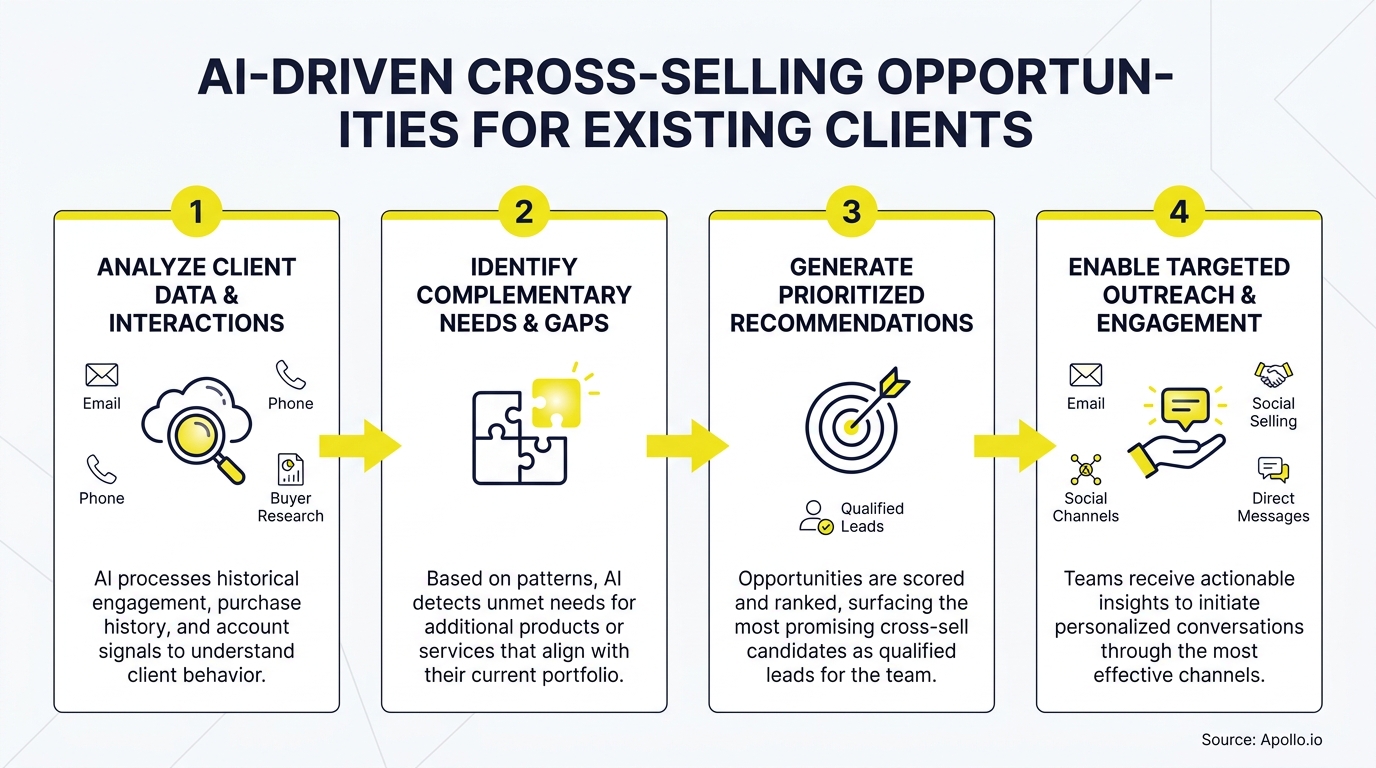
AI suggests cross-sell opportunities by analyzing unified account data, identifying behavioral and contextual signals, scoring propensity to buy additional products, and delivering ranked recommendations to sellers or CS teams inside their existing workflows. This is fundamentally different from manual rep intuition: the model processes hundreds of signals simultaneously and updates in near real time.
According to Cirrus Insight, sellers leveraging AI for buyer intelligence experience 5% higher account growth through improved upselling and cross-selling opportunities. The mechanism behind that lift is signal unification, not just smarter outreach.
What Data Does AI Need to Identify Cross-Sell Opportunities?
AI cross-sell models require four core data categories unified into a single account view with real-time consistency.
| Data Category | Examples | Why It Matters |
|---|---|---|
| CRM & Contract Data | Products owned, renewal dates, deal history, contract value | Defines current footprint and white space |
| Product Usage / Telemetry | Feature adoption, seat utilization, API calls, login frequency | Reveals readiness and friction points |
| Service & Support History | Open tickets, case resolution time, escalation patterns | Flags health risks and expansion blockers |
| External Triggers | Hiring signals, funding rounds, news, job changes | Indicates growth moments that create buying context |
The data-readiness gap is significant. A 2024 Adobe B2B report found only 43% of organizations say their customer data system provides consistent real-time data across touchpoints, and only 19% update offers in real time based on recent behavior.
Without unified, current data, AI recommendations become stale and inaccurate.
Keeping account data accurate is foundational. Customer data enrichment ensures the account records feeding your AI model reflect current firmographics, contacts, and intent signals rather than outdated snapshots.

What Does AI Actually Produce for Account Expansion?
AI cross-sell systems produce four types of actionable outputs, each suited to different expansion scenarios.
- Next-Best-Opportunity (NBO): A ranked list of accounts most likely to buy a specific additional product, with estimated deal value. Ideal for AEs and account managers prioritizing their book.
- Next-Best-Action (NBA): A specific recommended action (send case study, schedule EBR, offer trial) tied to a signal. Ideal for CS teams and SDRs working expansion plays.
- Service-Triggered Offers: Recommendations fired when a support event, feature-cap hit, or usage threshold is reached. Delivered in-product or via automated outreach.
- Pricing & Fit Guidance: Contextual product-fit scoring that helps AEs frame the commercial conversation with evidence rather than intuition.
A Reddit user shared a firsthand perspectiveon what makes AI cross-sell actually convert: "upsell works when it feels like advice not a pop up. tie offers to usage thresholds like seats hit or feature caps and show it inside the product at the moment of friction." The practitioner reported around 18% lift in 30 days using that approach. Timing and context, not just the recommendation itself, drive acceptance.
In May 2026, ServiceNow released Autonomous CRM features that surface future sales opportunities directly from service and fulfillment data, reflecting the broader industry shift toward embedding AI expansion signals where customer interactions already happen.
Turn Funnel Guesswork Into Pipeline Wins
Pipeline forecasting a guessing game because your leads never convert? Apollo surfaces high-intent prospects that actually become opportunities. Join 600K+ companies building pipeline they can predict.
Start Free with Apollo →How Do AEs and RevOps Teams Act on AI Cross-Sell Signals?
Account Executives and RevOps leaders get the most value from AI cross-sell when recommendations are embedded inside existing CRM workflows, not in a separate dashboard that requires context switching.
For Account Executives, AI surfaces a prioritized list of accounts with white-space gaps, suggested products, and a rationale. The AE validates fit, checks relationship health, and initiates a personalized outreach sequence.
For RevOps, the value is governance: ensuring AI recommendations are routed to the right team, tracked for acceptance, and fed back into the model to improve future scoring.
Incentive design matters as much as the technology. A CS professional wrote on Redditthat misaligned ownership destroyed their team's cross-sell output: when AEs received commission for CSM-surfaced opportunities without following up on smaller product lines, cross-sell ARR dropped to a fraction of prior performance. AI can surface the opportunity; the workflow and incentive structure determine whether it closes.
Struggling to keep expansion outreach coordinated across your AE and CS teams? Automate your expansion sequences with Apollo's multi-channel platform so no AI-surfaced opportunity goes dark.
How Do You Measure AI Cross-Sell Performance?
Cross-sell AI performance should be measured across three levels: recommendation quality, seller adoption, and revenue impact.
| KPI Layer | Metric | What It Tells You |
|---|---|---|
| Recommendation Quality | Acceptance rate, precision, recall | Is the model surfacing relevant opportunities? |
| Seller Adoption | Actions taken per recommendation, time-to-action | Are reps trusting and acting on AI signals? |
| Revenue Impact | Expansion ARR, NRR uplift, pipeline from existing accounts | Is cross-sell AI actually growing revenue? |
Research from Insight Mark Research shows companies implementing AI sales agents report 7% to 25% revenue increases. The range reflects how much governance and adoption discipline vary across implementations. Low acceptance rates signal a model accuracy problem or a workflow integration problem, not just a rep motivation problem.
Human-in-the-loop validation is non-negotiable. AI recommendations should include a confidence score and a rationale so sellers can override with context the model cannot see: relationship dynamics, competitor activity, internal politics, or strategic timing. RevOps teams that govern this feedback loop improve model performance over time rather than letting recommendation quality drift.
How Does AI Cross-Sell Connect to the Broader B2B Sales Tech Stack?
AI cross-sell does not work in isolation. It requires clean data flowing from CRM, product telemetry, and support systems into a model that pushes outputs back into the tools sellers already use.
Data sync between marketing and sales systemsis the connective tissue: when account records are stale or siloed, AI recommendations miss context. When data flows in real time, the model catches expansion signals faster than any rep could manually. A 2026 Workbooks study found that while 96% of B2B sales leaders use AI, only 10% use it inside CRM. That gap represents significant unrealized expansion revenue for teams that close it.
Optif.ai reports that 89% of revenue organizations now use AI-powered tools, up from 34% in 2023. The next competitive advantage is not adopting AI broadly but embedding it specifically where customer context lives: CRM, product usage data, and service history unified into a single account view.
Apollo consolidates prospecting, engagement, enrichment, and pipeline management into one workspace, eliminating the data fragmentation that breaks AI cross-sell models. "Having everything in one system was a game changer" (Cyera). Wondering how to build a stack that supports AI-driven expansion? This playbook for building a sales tech stack that scales revenue covers the architecture decisions that matter most.
Frequently Asked Questions About AI Cross-Sell Suggestions
What Data Does AI Use to Recommend Cross-Sells?
AI uses CRM records, product usage telemetry, support and service history, contract and renewal data, and external trigger signals such as hiring activity, funding events, and job changes. The more unified and real-time these sources are, the more accurate the recommendations.
Where Do AI Cross-Sell Recommendations Appear?
Recommendations appear inside CRM as prioritized account lists or opportunity alerts, within the product as in-app prompts tied to usage thresholds, and in seller workflow tools as next-best-action guidance. The most effective implementations embed recommendations where sellers already work rather than in separate dashboards.
How Is Model Trust and Governance Handled?
Governance includes confidence scores, rationale summaries, human override capability, and acceptance-rate tracking. RevOps teams should review recommendation precision monthly and feed seller feedback back into model inputs to prevent quality drift over time.
How Do You Measure NRR and ARR Uplift from AI Cross-Sell?
Track expansion ARR generated from AI-recommended accounts versus a control group, measure NRR change in accounts where AI-surfaced opportunities were acted on, and monitor time-to-close for expansion deals where AI provided rationale versus deals sourced purely from rep intuition.

Start Turning Existing Accounts into Expansion Pipeline
AI cross-sell is a mechanism, not a magic button. It works when account data is unified, recommendations are embedded in seller workflows, incentives align with the opportunities surfaced, and RevOps governs the feedback loop.
Teams that connect these layers will grow expansion revenue from existing clients faster than those still relying on rep memory and manual account reviews.
Apollo gives GTM teams a unified platform for enriching account data, running multi-channel expansion sequences, and tracking pipeline from existing clients without juggling five separate tools. Ready to put AI-driven expansion into practice? Start a free trial with Apollo and see how a consolidated GTM platform accelerates cross-sell from your existing book of business.
Prove Pipeline ROI Before Next Quarter
Struggling to show measurable returns while new reps ramp slowly and leadership demands proof? Apollo accelerates onboarding and surfaces pipeline impact fast. Leadium 3x'd revenue — see your ROI from day one.
Start Free with Apollo →Don't miss these
Sales
Inbound vs Outbound Marketing: Which Strategy Wins?
Sales
What Is a Sales Funnel? The Non-Linear Revenue Framework for 2026
Sales
What Is a Go-to-Market Strategy? The 2026 GTM Playbook
See Apollo in action
We'd love to show how Apollo can help you sell better.
By submitting this form, you will receive information, tips, and promotions from Apollo. To learn more, see our Privacy Statement.
4.7/5 based on 9,690 reviews
