
How RevOps Teams Standardize Tooling Across SDR, AE, and CS
Tool sprawl is quietly killing GTM execution. When SDRs, AEs, and CS teams each run on disconnected platforms with no shared data model, handoffs break, pipeline visibility disappears, and AI initiatives stall before they start. Revenue operations exists precisely to solve this — but standardizing tooling across all three functions requires a deliberate framework, not just a new software purchase.
According to the 2025 State of RevOps Survey, 71% of professionals admit their data quality has negatively impacted their GTM team's ability to execute. That number signals a systemic problem, and tooling fragmentation is usually the root cause.

Research Less, Close More With Apollo
Tired of burning hours verifying emails and hunting down contact info? Apollo delivers 230M+ accurate contacts so your reps spend time selling, not searching. Start building real pipeline today.
Start Free with Apollo →Key Takeaways
- RevOps standardizes tooling by defining a shared system of record, aligning lifecycle stages across SDR, AE, and CS, and enforcing data governance before layering on automation or AI.
- Data quality is a revenue risk, not just an ops inconvenience — poor CRM data directly undermines handoff quality and forecasting accuracy.
- AI readiness depends on clean, standardized data fields. RevOps teams that skip governance find AI features produce unreliable outputs.
- Platform consolidation reduces seller overload and admin burden, while improving cross-functional visibility into pipeline and renewals.
- SDRs, AEs, and CS managers each need role-specific tooling standards within a unified framework — standardization is not the same as identical tooling.
Why Do RevOps Teams Struggle to Standardize Tooling?
RevOps teams struggle because SDR, AE, and CS functions were historically built in isolation, each accumulating their own tools, fields, and workflows without a shared data model. Research from Upfront Operations shows that companies implementing RevOps see 10-20% greater sales output and 19% faster company growth — but that only happens when the stack is actually unified.
The most common failure modes:
- No single system of record: CRM data is duplicated or contradicted across engagement platforms and CS tools.
- Lifecycle stage misalignment: SDRs mark a lead "qualified" using different criteria than AEs use to accept an opportunity.
- Siloed reporting: Each team runs its own dashboards, making revenue attribution and handoff quality invisible.
- Tool accumulation without governance: New tools get added per team request, with no integration audit or decommission plan.
According to MarketingOps.com, only 20% of respondents whose tools don't integrate well are satisfied with their tech stack. Integration quality, not tool count, determines RevOps effectiveness.
What Is the RevOps Tooling Standardization Model?
The standardization model separates tooling into two layers: a system of record (CRM) and an engagement layer (sequences, dialers, CS platforms), with RevOps governing both through shared definitions and lifecycle-stage alignment.
| Layer | Function | Who Owns It |
|---|---|---|
| System of Record (CRM) | Single source of truth for contacts, accounts, opportunities, and health scores | RevOps |
| Engagement Layer (SDR) | Prospecting, sequencing, dialing, contact discovery | SDR/BDR team, governed by RevOps |
| Engagement Layer (AE) | Deal management, call intelligence, proposal tracking | AE team, governed by RevOps |
| Engagement Layer (CS) | Onboarding, health scoring, renewal workflows | CS team, governed by RevOps |
| Analytics Layer | Pipeline reporting, attribution, forecasting | RevOps |
Lifecycle stage alignment is the connective tissue. RevOps must define — and enforce — what "MQL," "SQL," "Opportunity," "Closed-Won," and "At-Risk" mean across all three functions so handoffs trigger correctly and reporting stays clean. Learn more about building cross-functional teams that execute on this model.

How Does RevOps Build a Data Governance Framework?
RevOps builds a data governance framework by defining mandatory fields per lifecycle stage, assigning data ownership by role, setting enrichment SLAs, and scheduling regular hygiene audits — all tied to revenue risk metrics.
A practical governance structure looks like this:
- Mandatory fields by stage: SDRs must populate industry, company size, and persona before an SQL is created. AEs must populate close date, deal value, and decision-maker contact before advancing to "Proposal."
- Deduplication rules: Define merge logic at the contact and account level. Assign a weekly dedup owner on the RevOps team.
- Enrichment SLAs: New contacts should be enriched within 24 hours of creation. Stale records (no activity in 90 days) trigger an automated re-enrichment workflow.
- Hygiene cadence: Monthly field-completion audits by team. Quarterly full CRM health reviews with RevOps, sales leadership, and CS leadership.
Tired of chasing reps for missing fields? Apollo's data enrichment automatically fills CRM gaps with verified business contact data — keeping your system of record accurate without manual effort.
For RevOps leaders who want to understand how data sync improves B2B sales and marketing ROI, the answer starts here: governance before automation.
How Do SDRs and AEs Benefit From Standardized Tooling?
SDRs benefit from standardized tooling through faster prospecting with pre-approved contact sources, cleaner handoff criteria, and sequences that are already integrated with CRM — eliminating duplicate data entry. AEs benefit from receiving opportunities with complete context: prior outreach history, contact roles, and enriched firmographic data all visible in one place.
For SDRs specifically, a standardized stack means:
- One approved prospecting source with defined ICP filters (no more individual reps pulling from different databases)
- Sequence templates governed by RevOps, with CRM sync active by default
- SQL handoff checklists that auto-validate required fields before a meeting is booked
For AEs, standardization delivers:
- Deal rooms or account views that pull SDR activity, email history, and call recordings automatically
- Stage-entry criteria enforced in CRM, reducing forecast inflation
- Consistent sales analytics that give managers visibility into conversion rates at each stage
Struggling to give AEs full deal context at handoff? Apollo's deal management gives AEs a unified view of every opportunity, contact, and prior touchpoint — from first SDR touch to close.
Turn Funnel Gaps Into Predictable Pipeline
Pipeline forecasting a guessing game because quality leads never convert? Apollo surfaces in-market buyers the moment they're ready, turning top-of-funnel chaos into a clean, conversion-ready pipeline. Join 600K+ companies that forecast with confidence.
Schedule a Demo →How Does AI Readiness Factor Into RevOps Tooling Standards?
AI readiness is a prerequisite for any AI feature in the GTM stack — agentic AI tools that recommend next actions, score leads, or summarize calls will produce unreliable outputs if the underlying CRM data is incomplete or inconsistently structured.
RevOps should gate AI adoption with a readiness checklist:
- Field completion rate: Core objects (contact, account, opportunity) should have mandatory fields populated at 90%+ before enabling AI scoring or recommendations.
- Activity capture: Email, call, and meeting activity must sync bidirectionally between engagement tools and CRM. AI agents need timestamped activity logs to generate accurate summaries.
- Identity resolution: Deduplication must be complete. AI tools that operate on duplicate records amplify errors rather than reduce them.
- Permission governance: Define which roles can write AI-generated data back to CRM fields — and audit those permissions quarterly.
This AI-readiness gating model also supports sales transformation initiatives where leadership wants to scale AI-assisted coaching or automated pipeline reviews. The data foundation has to exist first.
What Does a RevOps Tooling Standardization Scorecard Look Like?
A RevOps tooling standardization scorecard measures stack health across five dimensions: data quality, lifecycle alignment, integration coverage, AI readiness, and adoption. Each dimension gets a score (1-4) and an owner.
| Dimension | Key Metric | Target | Owner |
|---|---|---|---|
| Data Quality | Mandatory field completion rate | 90%+ | RevOps |
| Lifecycle Alignment | Stage definition agreement across SDR/AE/CS | Documented & signed off | RevOps + Sales Leadership |
| Integration Coverage | % of tools with bidirectional CRM sync | 100% of tier-1 tools | RevOps |
| AI Readiness | Activity capture rate + dedup completion | 95%+ activity logged | RevOps |
| Adoption | % of reps using approved tools vs. shadow tools | 95%+ on approved stack | Sales Enablement + RevOps |
Run this scorecard quarterly. Share results with sales, CS, and marketing leadership — not just the RevOps team.
When leaders see data quality linked to forecast accuracy, governance becomes a shared priority rather than an ops burden.
For teams building out their full sales tech stack, this scorecard serves as a decision filter: new tools only get approved if they improve at least one dimension without degrading another.
How Should RevOps Consolidate Tools Across the GTM Stack?
RevOps consolidates tools by auditing the current stack against the standardization model, identifying redundant or non-integrated point solutions, and replacing them with platforms that serve multiple functions — reducing admin overhead and improving data coherence.
The consolidation case is straightforward. As Collin Stewart at Predictable Revenue put it: "We reduced the complexity of three tools into one." That kind of simplification directly reduces the seller overload that undermines adoption.
Apollo operates as a unified GTM platform — combining prospecting, sales engagement, sales automation, data enrichment, dialing, and deal management in one workspace. For RevOps teams that want to cut their tech stack while improving data consistency across SDR, AE, and CS workflows, that consolidation model is the practical answer to fragmentation.
Teams like Census have reported cutting their costs in half after consolidating onto a unified platform, and Cyera noted that "having everything in one system was a game changer" for cross-functional visibility.

How Do RevOps Teams Get Started With Tooling Standardization?
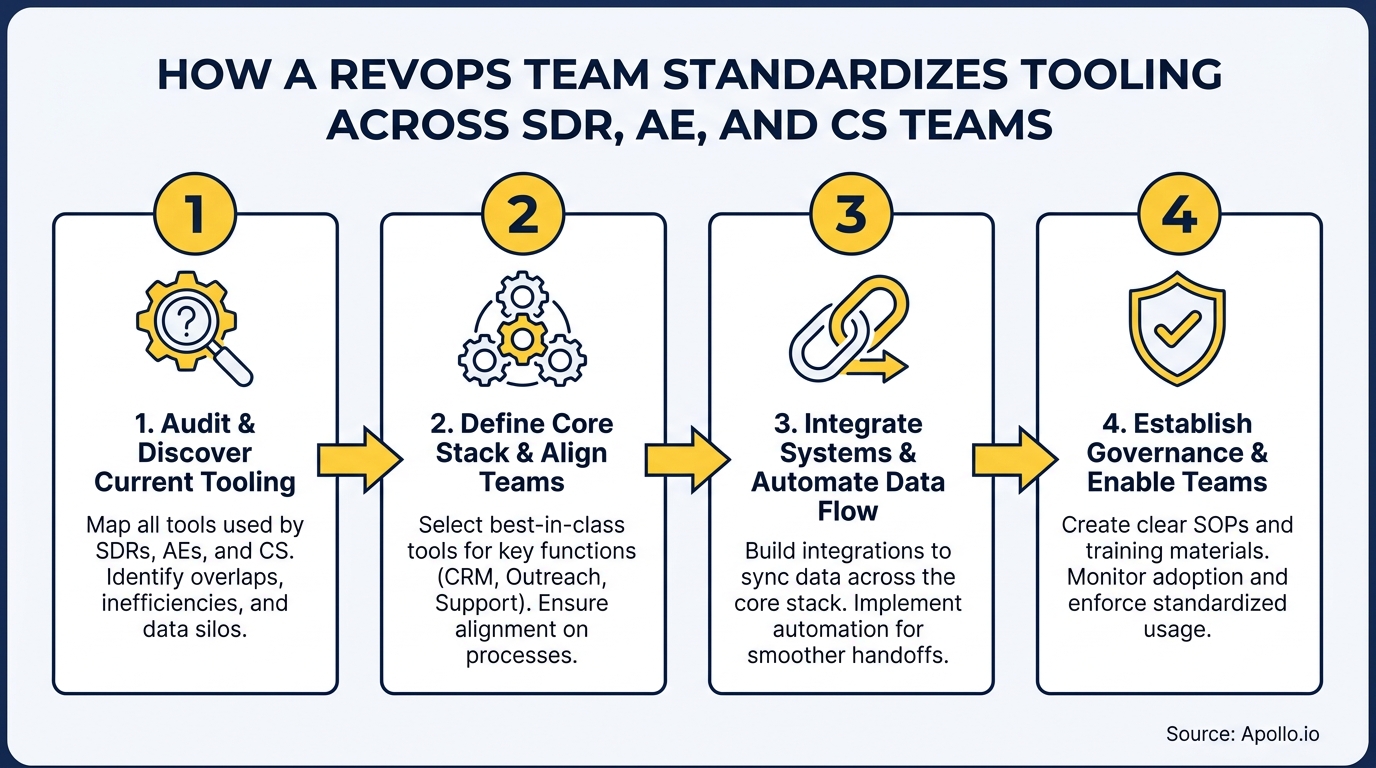
RevOps teams get started with tooling standardization by completing a stack audit, defining shared lifecycle stages, establishing data governance rules, and rolling out the scorecard — in that order.
90-day implementation roadmap:
- Days 1-30 (Audit): Inventory every tool in use across SDR, AE, and CS. Map integrations. Identify data gaps and duplicate sources.
- Days 31-60 (Define): Align on lifecycle stage definitions with all three team leads. Document mandatory fields per stage. Publish a data dictionary.
- Days 61-90 (Govern): Implement field validation rules in CRM. Set up enrichment workflows. Launch the standardization scorecard. Schedule first quarterly review.
The goal is not to force identical tooling on every role — SDRs need different engagement tools than CS managers. The goal is a shared data model, shared lifecycle definitions, and shared accountability for data quality. That foundation is what makes go-to-market execution predictable across every team.
According to Skaled, 79% of organizations now have a formal RevOps function — but having the function is not the same as having a standardized stack. The teams that pull ahead are the ones that treat tooling governance as a continuous operating discipline, not a one-time project.
Ready to consolidate your GTM stack and give every team a single source of truth? Start Your Free Trial and see how Apollo unifies prospecting, engagement, enrichment, and deal management in one platform.
Prove Pipeline ROI With Apollo
ROI pressure killing your next tool renewal? Apollo surfaces measurable pipeline impact fast — so you walk into budget reviews with hard numbers, not guesses. Leadium 3x'd annual revenue. You're next.
Start Free with Apollo →Don't miss these
Sales
Inbound vs Outbound Marketing: Which Strategy Wins?
Sales
What Is a Sales Funnel? The Non-Linear Revenue Framework for 2026
Sales
What Is a Go-to-Market Strategy? The 2026 GTM Playbook
See Apollo in action
We'd love to show how Apollo can help you sell better.
By submitting this form, you will receive information, tips, and promotions from Apollo. To learn more, see our Privacy Statement.
4.7/5 based on 9,690 reviews
