
How Do Revenue Teams Measure the Success of an Agentic GTM Approach in 2026?
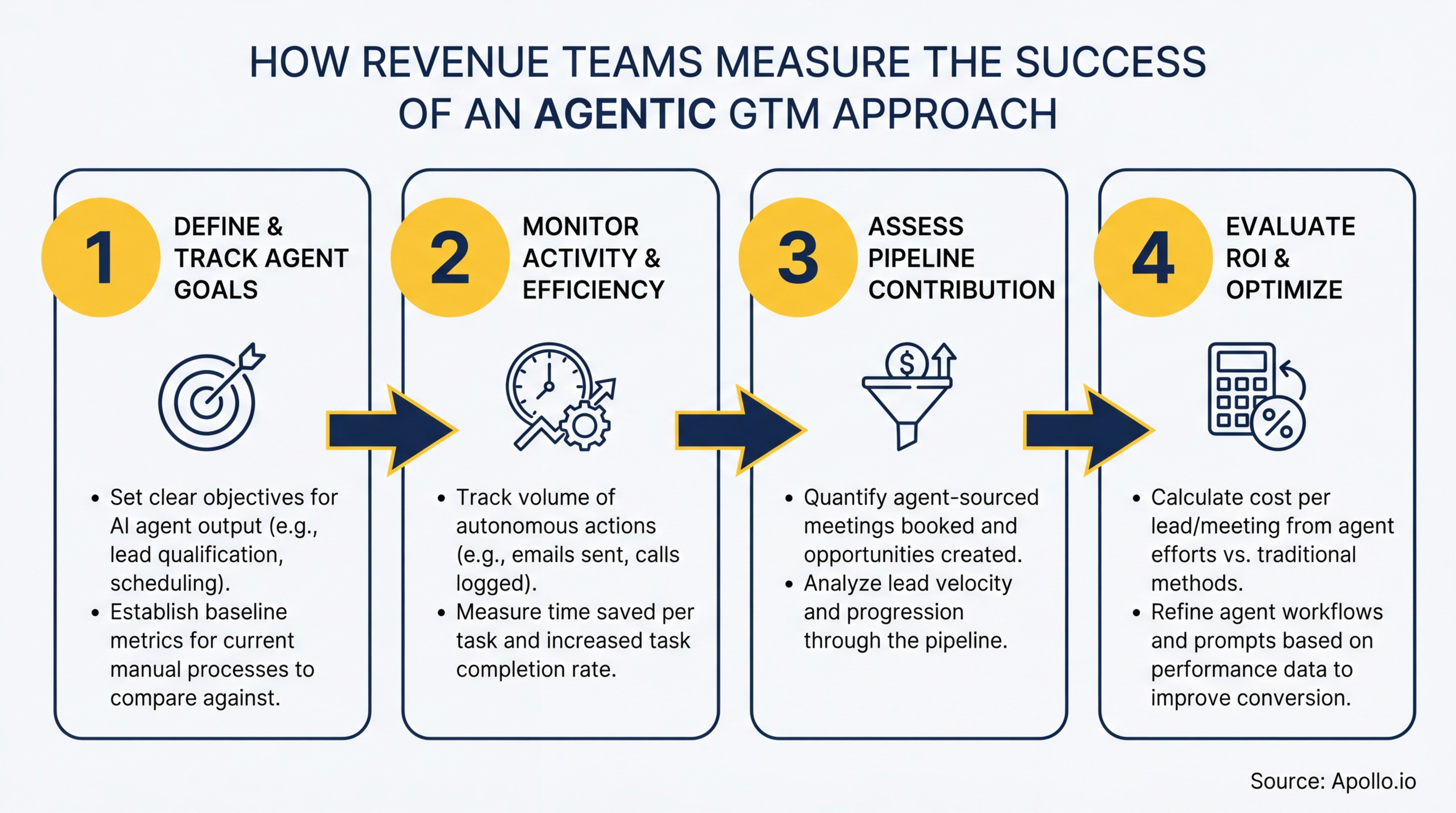
Agentic GTM is no longer experimental. AI agents now handle prospecting research, follow-up sequencing, CRM updates, and meeting prep autonomously. But as agents inflate activity volume, revenue leaders face a harder question: how do you know if it's actually working? The answer requires a shift from counting touches to measuring outcomes, and from gut-feel attribution to a structured KPI framework. Understanding what revenue operations is and how it drives growth is the foundation for getting this right.

Let Apollo Do The Research For You
Tired of your reps burning hours on manual lead research instead of selling? Apollo surfaces verified contacts instantly, so your team spends time closing — not digging. Join 600K+ companies building pipeline faster.
Start Free with Apollo →Key Takeaways
- Agentic GTM success is measured by outcome metrics (quota attainment, win rate lift, pipeline conversion) not activity volume, since agents can artificially inflate touches.
- RevOps teams need a five-KPI framework tied to CRM instrumentation to credibly attribute results to agentic workflows.
- Self-serve buyer behavior requires new measurement dimensions beyond outbound, including digital content attribution and rep-free conversion rates.
- Data readiness (CRM hygiene, contact match rates, unified platform) is a prerequisite for credible agentic GTM measurement.
- Cost per successful outcome is replacing cost per seat as the primary unit economics metric for agentic GTM investments.
What Core KPIs Do Revenue Teams Use to Measure Agentic GTM?
Revenue teams measure agentic GTM success through five outcome-focused KPIs: quota attainment rate, pipeline conversion rate, sales cycle length, win rate vs. baseline, and cost per qualified meeting. These replace pure activity metrics because AI agents can generate unlimited touches, making volume counts meaningless as a success signal.
| KPI | What It Measures | CRM Instrumentation |
|---|---|---|
| Quota Attainment Rate | % of reps hitting quota with vs. without agent assist | Custom field: agent_assist_enabled (Y/N) on User record |
| Pipeline Conversion Rate | Lead-to-opportunity and opportunity-to-close rates | Stage timestamps + source field: agentic_sequence_id |
| Sales Cycle Length | Days from first touch to closed-won | Created date vs. close date, segmented by workflow type |
| Win Rate vs. Baseline | Lift above the pre-agentic win rate benchmark | Closed-won / total opportunities, filtered by agent touchpoints |
| Cost per Qualified Meeting | Total agentic workflow cost / meetings booked | Workflow log costs + meeting outcome field |
According to BusinessWire, 41% of organizations adopting agentic AI have seen an increase in conversion rates, making pipeline conversion the most commonly validated KPI in early deployments.
How Do RevOps Leaders Set Baselines and Lift Targets?
RevOps leaders establish baselines by pulling 90 days of pre-agentic performance data from their CRM, then setting lift targets as percentage improvements against each KPI. Without a documented baseline, there is no credible way to attribute pipeline gains to agentic workflows versus other variables.
A practical governance cadence looks like this:
- Weekly: Agent workflow success rate, meetings booked, sequences completed vs. errored
- Monthly: Pipeline conversion lift, sales cycle trend, cost per outcome vs. target
- Quarterly: Quota attainment delta (agent-assisted vs. control group), win rate vs. baseline, ROI reconciliation
Research from Captivate Talent found that 84% of GTM professionals report significant or moderate productivity gains from using AI tools daily, reinforcing why RevOps teams are prioritizing these measurement cadences. Struggling to build a clean pipeline to measure against? Apollo's pipeline tools give your team a single source of truth for tracking agentic GTM outcomes.
How Should SDRs and AEs Track Agentic Workflow Impact?
SDRs should track meetings booked per agent-assisted sequence versus manual sequences, using separate sequence tags in their engagement platform. AEs managing deals should monitor whether agent-researched accounts have shorter time-to-first-meeting and higher discovery-to-demo conversion rates.
For SDRs, the key instrumentation fields are:
- Sequence type tag: agentic_research vs. manual
- Meeting outcome: qualified / unqualified / no-show
- Research quality score (1-5, rep-rated post-call)
For AEs, the relevant tracking points are deal velocity (days per stage), pre-meeting brief usage rate, and whether agent-generated talk tracks appeared in call notes. Tracking these metrics in a unified platform matters: as sales analytics best practices confirm, fragmented data across tools produces attribution gaps that undermine measurement credibility. Understanding the full revenue operations framework helps teams design the right instrumentation from day one.
Fill Your Funnel With Buyers Who Convert
Running out of qualified leads before the quarter ends? Apollo surfaces in-market prospects aligned to your ICP, so your pipeline stays full — not just busy. Nearly 100K paying customers use Apollo to turn outreach into opportunities.
Start Free with Apollo →What Self-Serve and Digital Attribution Metrics Matter?
Self-serve buyer journey metrics measure how often prospects advance through the pipeline without direct rep involvement, using content engagement, intent signals, and digital conversion events as leading indicators. This dimension is now essential: a Gartner survey of 632 buyers conducted in late 2024 found that 61% of B2B buyers prefer a rep-free buying experience, which means outbound activity volume alone cannot capture whether agentic GTM is serving modern buyers.
Key self-serve attribution metrics to instrument:
- Content-assisted pipeline: Opportunities where a prospect engaged with AI-personalized content before responding
- Digital conversion rate: Inbound form fills or demo requests attributed to agentic outreach sequences
- Rep-free advancement rate: % of deals that moved stages via digital interaction (email reply, content click, self-booked meeting) without a live call
- Intent signal response rate: How often agent-triggered outreach on active intent data signals converts to a booked meeting
Why Does Data Readiness Determine Measurement Credibility?
Data readiness determines measurement credibility because agentic systems act on whatever data exists in your CRM and contact database. Bad data produces confident-but-wrong automation, and the resulting metrics are uninterpretable.
Contact-to-account match rate, CRM field completion rate, and duplicate record rate are the three data health metrics that directly predict whether agentic GTM measurement will be reliable.
A Salesforce State of Sales report (fielded August-September 2025) found that over four in five sales teams without a single-platform strategy plan to consolidate tools, recognizing that fragmented stacks are the primary source of data quality failures that corrupt agentic GTM measurement. Teams that consolidate prospecting, engagement, and CRM data into one workspace eliminate the identity resolution gaps that undermine attribution.
As Cyera noted after consolidating their stack: "Having everything in one system was a game changer."
Spending too much time cleaning data before you can measure anything? Apollo's data enrichment keeps your contact records verified and current across 230M+ business profiles.
How Do Teams Measure Unit Economics for Agentic GTM?
Teams measure agentic GTM unit economics using cost per successful outcome rather than cost per seat, treating each completed agentic workflow as a variable cost unit. The three primary unit economics metrics are: cost per qualified meeting set, cost per opportunity created, and cost per closed-won deal attributed to agentic workflows.
This model matters because agent usage scales with volume. A workflow that costs $4 per research summary is cheap at 50 uses per week but expensive at 5,000. Revenue leaders should track:
- Total agentic platform cost / qualified meetings booked (weekly)
- Agent workflow error rate (failed completions that still consumed compute cost)
- Incremental revenue per dollar of agentic workflow spend (quarterly)
Teams using a consolidated sales tech stack report cleaner unit economics because there are fewer integration points where cost attribution breaks down. Predictable Revenue found that consolidating tools reduced complexity significantly: "We reduced the complexity of three tools into one."
How Do You Build a Measurement Dashboard for Agentic GTM?
A practical agentic GTM measurement dashboard has three layers: agent observability (workflow success rate, latency, error rate), pipeline outcomes (conversion rates, cycle length, win rate), and business impact (quota attainment, revenue attributed, cost per outcome). Each layer answers a different stakeholder question.
| Dashboard Layer | Primary Audience | Refresh Cadence |
|---|---|---|
| Agent Observability | RevOps, Sales Ops | Daily |
| Pipeline Outcomes | SDR Managers, AE Managers | Weekly |
| Business Impact | CRO, VP Sales, CFO | Monthly / Quarterly |
Data from Medium (LandbaseGTM) shows that 83% of sales teams using AI achieved revenue growth in the last year, compared to 66% of non-AI teams. That 17-point gap is exactly what the business impact layer of this dashboard is designed to surface and defend in budget reviews.
Conclusion: Build the Measurement Infrastructure Before Scaling Agents
Measuring agentic GTM success requires three things in place before you scale: a clean data foundation, CRM instrumentation tied to agentic workflow IDs, and a governance cadence that separates activity from outcomes. Revenue teams that skip the measurement infrastructure end up with impressive-looking activity dashboards and no credible attribution to revenue.
The winning formula is a five-KPI outcome scorecard (quota attainment, pipeline conversion, win rate lift, cycle length, cost per outcome), a self-serve attribution layer for rep-free buyer journeys, and weekly agent observability checks. Pair that with a consolidated GTM platform so your data is reliable enough to trust.
Apollo brings prospecting, engagement, data enrichment, and pipeline management into one unified workspace, giving RevOps and sales leaders the clean, attributed data they need to measure agentic GTM with confidence. Start Free with Apollo and build the measurement foundation your agentic GTM strategy requires.
Prove Pipeline ROI Before Next QBR
ROI pressure killing your tool budget before you can scale? Apollo delivers measurable pipeline outcomes your exec team can see. Leadium 3x'd annual revenue — start your free trial today.
Start Free with Apollo →Don't miss these
Sales
Inbound vs Outbound Marketing: Which Strategy Wins?
Sales
What Is a Sales Funnel? The Non-Linear Revenue Framework for 2026
Sales
What Is a Go-to-Market Strategy? The 2026 GTM Playbook
See Apollo in action
We'd love to show how Apollo can help you sell better.
By submitting this form, you will receive information, tips, and promotions from Apollo. To learn more, see our Privacy Statement.
4.7/5 based on 9,690 reviews
