
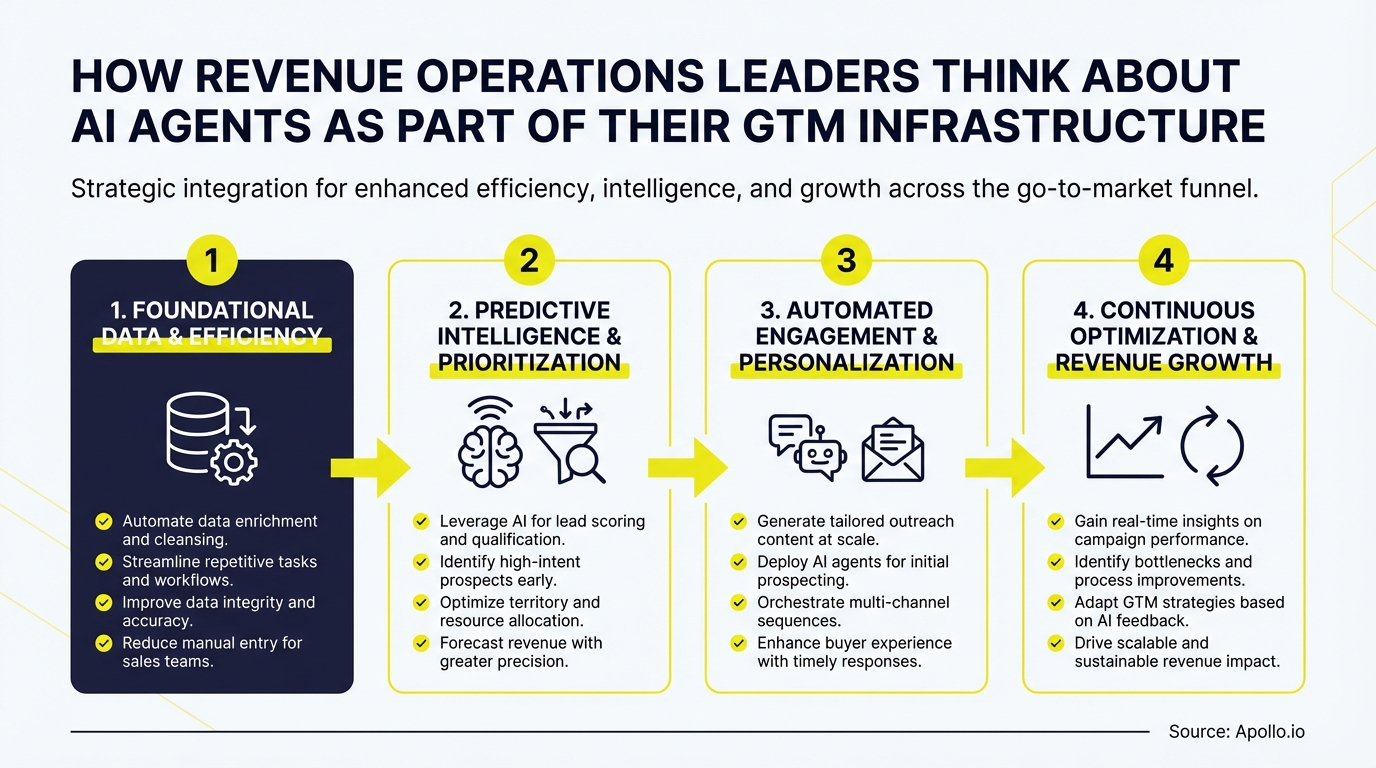
How Do Revenue Operations Leaders Think About AI Agents as Part of Their GTM Infrastructure?
Revenue operations leaders in 2026 are no longer asking whether to deploy AI agents across their GTM stack. They are asking how to deploy them safely, govern them rigorously, and measure their direct impact on pipeline. This shift from experimentation to infrastructure thinking is the defining RevOps challenge of the year. Understanding the fundamentals of revenue operations is the starting point, but agentic AI demands an entirely new operating model layer on top.
According to Revenue Wizards, 73% of organizations now operate past experimentation with AI, running it inside core GTM workflows and measuring direct revenue impact. The question is no longer adoption. It is architecture, governance, and bounded autonomy.

Research Less, Close More With Apollo
Tired of your reps burning hours on manual lead research instead of selling? Apollo surfaces verified contacts instantly, so your team spends time closing — not digging. Join 600K+ companies building pipeline faster.
Start Free with Apollo →Key Takeaways
- RevOps leaders treat AI agents as infrastructure, not a productivity feature, evaluating them on pipeline conversion and deal velocity rather than time saved.
- The dominant operating model in 2026 is bounded autonomy: agents with defined permissions, audit trails, and human escalation paths, not end-to-end automation.
- Data readiness is the primary constraint. Clean, permissioned, unified GTM data must exist before agents can act reliably across CRM, MAP, and enrichment systems.
- RevOps teams need formal governance frameworks covering agent identity, prompt versioning, QA workflows, and rollback procedures before scaling.
- Measurement shifts from activity metrics to agent-attributable pipeline outcomes: conversion rate lift, cycle time reduction, and win rate improvement.
What Is Bounded Autonomy and Why Do RevOps Leaders Prioritize It?
Bounded autonomy means deploying AI agents with explicitly defined permissions, action scopes, and human review checkpoints, rather than allowing end-to-end autonomous execution. RevOps leaders prioritize this model because it balances speed with control.
Most organizations operate on a spectrum: AI assistants that suggest actions, semi-autonomous agents that execute within guardrails, and fully autonomous agents that act without review. The majority land in the middle tier by design. Data from Default's 2025 AI Report shows nearly 45% of RevOps teams plan to expand AI use across GTM workflows, yet governance readiness consistently lags behind deployment ambition.
The bounded autonomy thesis: agents should be able to act faster than humans on routine tasks (enrichment, routing, scoring) while flagging edge cases for human review. This is the architecture RevOps leaders are building toward in 2026.
How Do RevOps Leaders Map AI Agents Across GTM Workflows?
RevOps leaders evaluate AI agents by workflow criticality and reversibility of action. High-frequency, low-risk tasks are first candidates for agent execution.
Customer-facing or revenue-critical actions require human-in-the-loop design.
| GTM Workflow | Agent Use Case | Autonomy Level | Human Checkpoint |
|---|---|---|---|
| Lead Enrichment | Auto-enrich inbound records from multiple sources | High | Exception flagging only |
| Lead Routing | Score and assign leads based on ICP fit and intent signals | Medium-High | Routing rule review quarterly |
| Pipeline Forecasting | Generate deal health scores and forecast variance alerts | Medium | RevOps/sales leader review weekly |
| Outreach Sequencing | Trigger personalized follow-up based on engagement signals | Medium | SDR/AE approval for first touch |
| Renewal Alerts | Flag at-risk accounts and draft renewal outreach | Low-Medium | CSM review before send |
| Quote Generation | Draft standard quotes from CRM opportunity data | Low | AE approval required |
Struggling to keep your pipeline data clean enough for agents to act on? Start with Apollo's verified contact and company enrichment to give your agents a trustworthy foundation.
As noted in Apollo's revenue operations framework guide, the most effective RevOps teams align their tooling and process layers before layering in automation. The same principle applies to agentic deployment.
Turn Funnel Gaps Into Pipeline Gold
Pipeline forecasting a guessing game? Apollo surfaces in-market buyers the moment they're ready, turning weak lead flow into a predictable revenue engine. Leading B2B teams book 46% more meetings with Apollo's AI Research Agent.
Schedule a Demo →What Architecture Do RevOps Leaders Need Before Deploying AI Agents?
The architecture prerequisite for agentic GTM is a unified, permissioned data layer. Agents cannot act reliably when they pull from fragmented CRM records, inconsistent MAP fields, or unenriched contact data.
The core architecture components RevOps leaders are building in 2026:
- Agent Identity and Permissions: Each agent gets a non-human identity with scoped access to specific systems and data fields. Agents should not have admin-level CRM access.
- Data Contracts: Defined agreements between CRM, MAP, CDP, and data warehouse on field ownership, update frequency, and trusted sources of record.
- Sandbox-to-Production Promotion: Agents are tested in a sandbox environment with synthetic or historical data before touching live pipeline records.
- Logging and Audit Trails: Every agent action is logged with timestamp, input context, output, and reviewer. This is non-negotiable for governance and debugging.
- Escalation Paths: Clear rules for when an agent pauses and routes to a human, including confidence thresholds and action-type restrictions.
This infrastructure layer is what separates organizations running governed agents from those running shadow AI. A well-structured sales tech stack provides the integration backbone agents need to operate across systems without creating data conflicts.
How Do RevOps Leaders Govern AI Agents at Scale?
RevOps governance for AI agents covers four domains: policy, prompt management, QA, and rollback. Without formal governance, agents produce inconsistent outputs, create compliance exposure, and erode rep trust in AI-assisted workflows.
A practical governance framework includes:
- Policy Templates: Document which agent actions are pre-approved, which require review, and which are prohibited (e.g., agents cannot send external customer emails without human approval).
- Prompt and Tool Versioning: Treat prompts like code. Version-control them, require review before promotion, and maintain a changelog.
- QA Workflows: Sample agent outputs weekly. Check for hallucinations in enriched fields, routing errors, and forecast anomalies.
- Rollback Procedures: Define how to revert agent actions when errors are detected, including CRM field restoration and notification workflows.
Research from RevOps Coop highlights that AI agents are shifting from point solutions to operational fabric, powering forecasting, deal health scoring, proposal generation, and data retrieval across the GTM stack. That level of integration demands governance infrastructure, not just tool configuration.

How Do RevOps Leaders Measure AI Agent Impact on Revenue?
RevOps leaders measure agent impact on pipeline outcomes, not activity volume. The metric shift is from tasks completed to conversion rate lift, cycle time reduction, and win rate improvement attributable to agent-assisted workflows.
Key KPIs for agentic GTM measurement:
- Lead-to-Opportunity Conversion Rate: Compare agent-routed leads vs. manually routed leads over the same period.
- Average Sales Cycle Length: Track deal velocity for opportunities where agents handled enrichment, scoring, or follow-up triggers.
- Forecast Accuracy: Measure variance between agent-generated forecasts and actual closed revenue by quarter.
- Pipeline Coverage Ratio: Monitor whether agent-assisted prospecting maintains required coverage multiples.
- Agent Action Audit Rate: Percentage of agent actions reviewed and overridden by humans (high override rate signals a calibration problem).
Attribution requires audit trails at the action level. RevOps teams that cannot trace which agent took which action on which record cannot isolate agent impact from rep activity.
Logging infrastructure is therefore both a governance requirement and a measurement prerequisite.
How Should RevOps Leaders Think About Vendor Evaluation for Agentic GTM?
RevOps leaders evaluate agentic GTM vendors on control plane capabilities first, not feature breadth. The critical evaluation criteria in 2026 reflect the governance-first mindset.
Vendor evaluation checklist for RevOps leaders:
- Does the platform support non-human agent identity with scoped permissions?
- Are all agent actions logged with full context and reversible?
- Does the vendor support sandbox environments for agent testing before production?
- Can the platform integrate with existing CRM, MAP, and data warehouse without creating duplicate records?
- Does the vendor provide prompt/workflow versioning and change management tooling?
- How does the platform handle agent failures, timeouts, and edge cases?
Platform consolidation is an emerging pressure point. Major CRM suites are bundling agent capabilities natively, reducing tolerance for standalone point solutions that cannot plug into centralized orchestration and governance layers.
RevOps leaders building on fragmented stacks face higher integration costs and greater governance complexity.
Platforms like Apollo consolidate prospecting, enrichment, engagement, and pipeline management into a unified GTM workspace. As Predictable Revenue noted, "We reduced the complexity of three tools into one." For RevOps teams evaluating where to deploy agents first, a unified GTM platform reduces the data contract complexity that otherwise blocks safe agent execution.

What Does This Mean for RevOps Leaders Building Their 2026 GTM Strategy?
Revenue operations leaders who treat AI agents as infrastructure, rather than tooling, will build GTM systems that compound over time. The organizations seeing measurable revenue lift from agentic workflows share three characteristics: clean unified data, formal governance frameworks, and measurement systems that isolate agent impact.
The path forward is not full autonomy. It is governed, bounded, and auditable execution at scale.
RevOps leaders who establish the architecture layer now, before agent proliferation forces reactive governance, will have a durable competitive advantage.
For teams ready to put this into practice, start with data quality and enrichment as the foundation. Explore how Apollo's GTM strategy resources and sales analytics capabilities support the measurement infrastructure agentic workflows require.
Ready to build the data foundation your AI agents need? Start free with Apollo and give your GTM infrastructure the verified, enriched data layer that makes bounded-autonomy agents work.
Prove Pipeline ROI Before Next QBR
ROI pressure killing your tool adoption? Apollo delivers measurable pipeline impact from day one — no guesswork, no waiting. Leadium 3x'd annual revenue. Get results your CFO can't argue with.
Schedule a Demo →Don't miss these
Sales
Inbound vs Outbound Marketing: Which Strategy Wins?
Sales
What Is a Sales Funnel? The Non-Linear Revenue Framework for 2026
Sales
What Is a Go-to-Market Strategy? The 2026 GTM Playbook
See Apollo in action
We'd love to show how Apollo can help you sell better.
By submitting this form, you will receive information, tips, and promotions from Apollo. To learn more, see our Privacy Statement.
4.7/5 based on 9,690 reviews
