
How Do Revenue Leaders Communicate the Value of Agentic GTM to Their Board or Investors in 2026
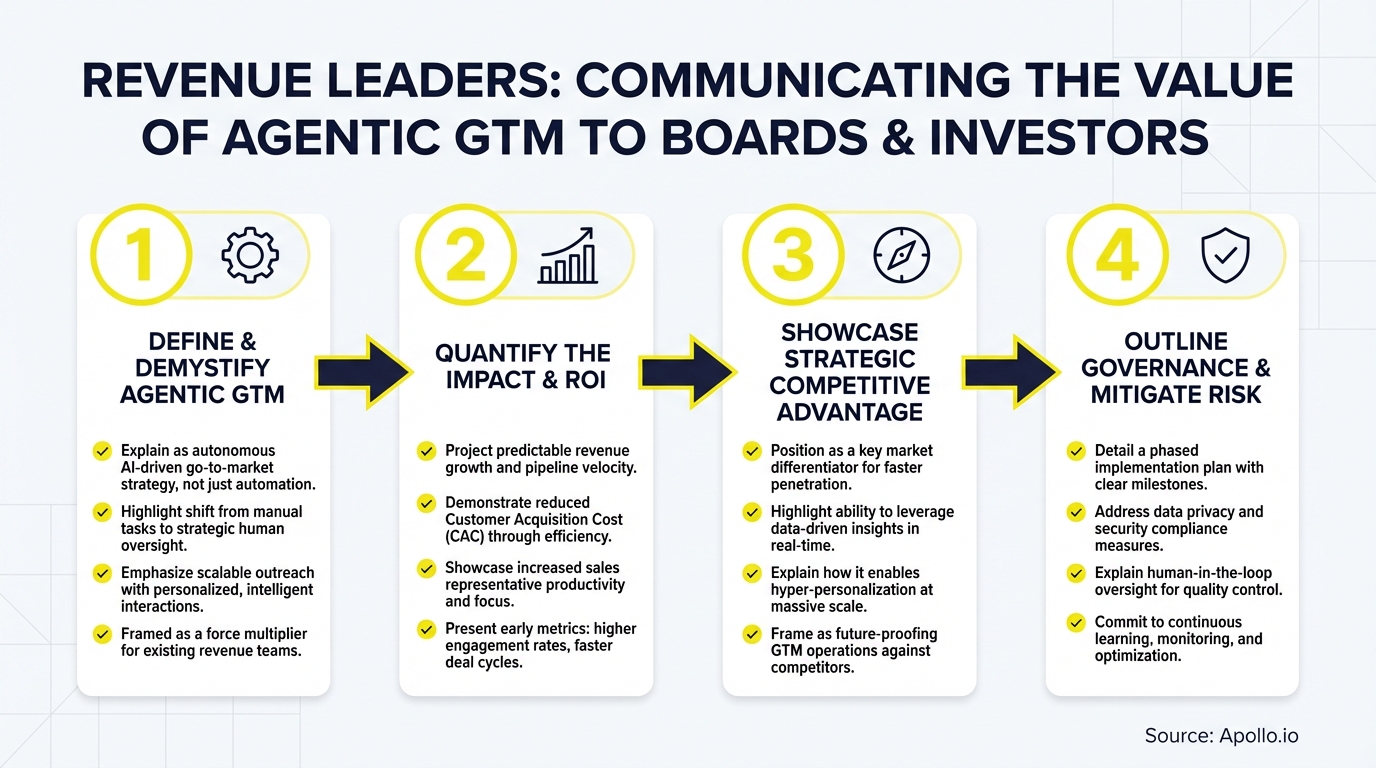
Boards and investors are no longer impressed by AI demos. They want unit economics: pipeline efficiency, CAC payback, and margin impact. Revenue leaders who can translate agentic GTM into those terms win budget and confidence. Those who can't get stuck in pilot purgatory. Building a credible, board-ready narrative requires three things: a clear ROI framework, a governance story, and a KPI scorecard tied to production outcomes. Your go-to-market strategy needs to reflect this shift from experimentation to measurable execution.

Research Less, Pipeline More With Apollo
Tired of burning hours verifying contacts that go nowhere? Apollo delivers 230M+ accurate business contacts so your team spends time selling, not searching. Join 600K+ companies building predictable pipeline.
Start Free with Apollo →Key Takeaways
- Boards respond to pipeline efficiency and CAC payback metrics, not AI feature lists. Frame agentic GTM in revenue language from slide one.
- Governance is now part of the value proposition. CFO, RevOps, and Security co-own these decisions alongside Sales and Marketing leaders.
- AI adoption in GTM is accelerating fast, creating a real first-mover window that boards and investors recognize.
- Data readiness and vendor accountability are the two biggest risk areas boards will probe. Address both proactively.
- A single-page KPI scorecard tied to production outcomes is the most effective tool for ongoing board communication.
What Is Agentic GTM and Why Do Boards Care Now?
Agentic GTM refers to AI systems that autonomously execute go-to-market tasks, such as prospecting, outreach sequencing, and lead qualification, without requiring step-by-step human direction. Boards care because adoption is accelerating and competitive advantage is compressing. According to the 2025 AI in GTM Report, 86% of GTM professionals already use AI tools daily. Revenue leaders who cannot explain why their team is or isn't deploying agents are increasingly on the defensive.
The shift from "interesting technology" to "board agenda item" happened because CFOs and RevOps leaders now co-own these decisions alongside Sales. That means the conversation must cover productivity, cost structure, and risk controls simultaneously. Understanding how revenue operations drives growth is the foundation for framing this argument credibly.
How Do Revenue Leaders Build the ROI Narrative for Their Board?
The strongest board-ready ROI narrative anchors agentic GTM to three measurable deltas: pipeline volume, rep productivity, and cost per qualified opportunity. Research from Aviso shows sales representatives using personalized AI agents for tasks like account planning and RFP management have seen productivity increases of up to 40%. That is a concrete, attributable number boards can evaluate against headcount costs.
Structure your ROI case around three scenarios:
| Scenario | Key Assumption | Board-Facing Metric |
|---|---|---|
| Base Case | Agents handle top-of-funnel qualification only | Pipeline coverage ratio improvement |
| Upside Case | Agents run full prospecting and nurture sequences | CAC reduction + rep capacity freed for closing |
| Risk Case | Data stack not fully ready at launch | Delayed time-to-value, higher integration cost |
Showing all three scenarios signals operational maturity. Boards reward leaders who plan for failure modes, not just upside. Pair this with your sales analytics framework to demonstrate how you will measure outcomes in production.
Struggling to show the pipeline impact of AI-driven prospecting? See how Apollo's AI-powered pipeline tools deliver measurable results from day one.
How Do RevOps Leaders Frame Buyer-Journey Acceleration for Investors?
RevOps leaders can make a compelling investor argument by connecting agentic GTM to earlier buyer engagement, not just internal efficiency. The core message: agents enable always-on coverage that captures buyers before competitors do. Landbase research projects agentic AI systems will achieve 20-60% productivity gains across various applications in early implementations.
For investors, translate this into speed-to-revenue metrics:
- Time from ICP signal to first outreach: Agents respond in minutes, not days
- Inbound response coverage: Percentage of qualified inbound leads contacted within SLA
- Pipeline velocity: Days from first touch to qualified opportunity, tracked before and after agent deployment
- Agent-attributed meetings: Meetings booked directly through agentic sequences vs. manual rep effort
These metrics work because they connect agent activity to revenue outcomes investors already track. Combine them with intent data signals to show your agents are targeting buyers who are already in-market, not just generating volume.
Turn Funnel Guesswork Into Qualified Pipeline
Pipeline forecasting a guessing game because marketing leads never convert? Apollo surfaces high-intent prospects so your team works deals worth closing. Nearly 100K paying customers stopped guessing and started growing.
Start Free with Apollo →What Governance Story Do Boards and Investors Expect?
Governance is now table stakes for any agentic GTM investment conversation. Boards will ask about data security, audit trails, and what happens when an agent makes a mistake.
Revenue leaders who treat governance as an afterthought will stall budget approval.
A credible governance narrative covers four areas:
- Data access controls: Which systems can agents read from and write to, and who approves changes?
- Audit trails: Can you show the board a log of every agent action and its outcome?
- Human escalation paths: What triggers a handoff from agent to human rep, and how is that enforced?
- Vendor accountability: What contractual commitments does your agent vendor provide on performance and security?
This matters operationally too. Solving data synchronization across business systems is a prerequisite for agents to function reliably. If your CRM, engagement platform, and enrichment data are out of sync, agents will act on stale information and produce outcomes that undermine your ROI narrative.

What KPI Scorecard Should Revenue Leaders Present to Their Board?
A board-ready KPI scorecard for agentic GTM should fit on a single page and track production outcomes, not activity metrics. Boards do not want to see email send volume or agent task completion rates.
They want to see pipeline, revenue, and efficiency deltas.
| KPI Category | Metric | Review Cadence |
|---|---|---|
| Pipeline Generation | Agent-attributed qualified opportunities per month | Monthly |
| Rep Productivity | Pipeline generated per rep (agent-assisted vs. baseline) | Quarterly |
| Efficiency | Cost per qualified opportunity (before and after) | Quarterly |
| Buyer Engagement | Average time from ICP signal to first qualified meeting | Monthly |
| Governance | Escalation rate and resolution time | Monthly |
Pair this scorecard with a brief risk register showing the two or three biggest execution risks and your mitigation plan for each. This combination, production KPIs plus risk controls, is the format boards and investors trust. It also aligns with how the sales acceleration formula structures predictable revenue growth around repeatable, measurable inputs.
Spending too much time on manual outreach while trying to prove AI ROI? Automate your GTM sequences with Apollo's AI sales automation and generate the production data your board wants to see.

How Do Revenue Leaders Avoid the Pilot Purgatory Trap?
Investors increasingly penalize endless experimentation. A pilot that never reaches production is a cost center, not a strategic investment.
Revenue leaders must set a clear production gate before the pilot begins: a defined outcome threshold that, once reached, triggers full deployment and budget commitment.
Three practices separate leaders who reach production from those stuck in pilots:
- Time-box the pilot: Set a 60-90 day window with predefined success criteria. No extensions without a board-approved rationale.
- Track a single primary metric: Choose one outcome metric for the pilot phase, such as agent-attributed meetings booked. Avoid metric proliferation that obscures real performance.
- Build the operating model before go-live: Define rep handoffs, territory rules, and compensation treatment for agent-sourced pipeline before agents go live. Ambiguity here kills adoption and corrupts your KPI data.
Companies that have moved agentic GTM into production are seeing real results. This mirrors what Predictable Revenue found when consolidating their GTM stack: "We reduced the complexity of three tools into one," which made it far easier to measure and report on outcomes at the board level.
How Should Revenue Leaders Conclude the Board Conversation?
Revenue leaders close the board conversation effectively by committing to a specific production milestone with a date. Vague promises of future value do not unlock budget.
A statement like "By Q3, agents will be responsible for 20% of qualified pipeline, and we will present the full ROI comparison at the Q3 board meeting" creates accountability and a clear evaluation moment.
The agentic GTM opportunity is real and the adoption window is open. Sales automation software is already delivering measurable results for teams that have moved from pilots to production. The leaders who win board confidence are those who speak in unit economics, demonstrate governance readiness, and commit to production timelines rather than perpetual evaluation.
Apollo gives revenue leaders a unified platform to generate pipeline, automate outreach, and track every outcome in one workspace. Teams like Cyera found that "having everything in one system was a game changer" for both execution and reporting. Try Apollo free and start building the production data your board and investors are asking for.
Prove Pipeline ROI With Apollo
ROI pressure killing your next budget approval? Apollo delivers measurable pipeline impact your leadership can act on — fast. Leadium 3x'd annual revenue. Your board wants proof. Apollo gives you the numbers.
Schedule a Demo →Don't miss these
Sales
Inbound vs Outbound Marketing: Which Strategy Wins?
Sales
What Is a Sales Funnel? The Non-Linear Revenue Framework for 2026
Sales
What Is a Go-to-Market Strategy? The 2026 GTM Playbook
See Apollo in action
We'd love to show how Apollo can help you sell better.
By submitting this form, you will receive information, tips, and promotions from Apollo. To learn more, see our Privacy Statement.
4.7/5 based on 9,690 reviews
