
How Do You Staff and Structure a GTM Engineering Function at a Series B Company?
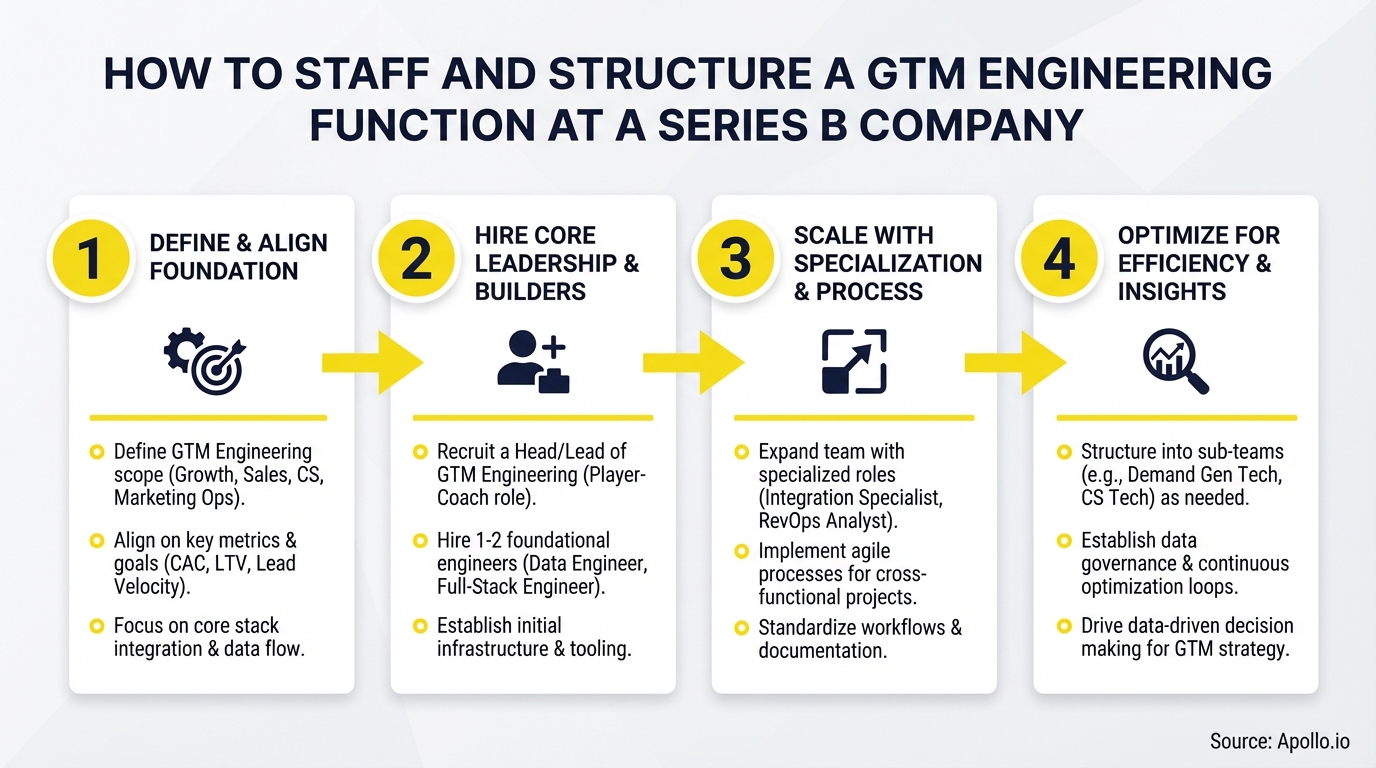
At Series B, you've proven product-market fit. Now the question shifts from "can we sell?" to "can we scale how we sell?" That's exactly where a GTM Engineer becomes a critical hire. But most founders and revenue leaders get this wrong by staffing the role too late, scoping it too narrowly, or confusing it with RevOps. This guide gives you a practical blueprint for building the function right from day one — including who to hire, how to structure reporting, and what systems to prioritize. If you're also thinking through how to structure your marketing team for revenue, the principles here apply directly.

Research Less, Pipeline More With Apollo
Tired of your reps burning hours verifying contacts instead of closing deals? Apollo delivers 230M+ verified contacts so your team spends time selling, not searching. Start building predictable pipeline today.
Start Free with Apollo →Key Takeaways
- Start with one GTM Engineer who is a revenue strategist first, systems builder second — not a tool-stitching technician.
- GTM Engineering sits best under the CRO or VP of Sales, not under Product or Engineering.
- The function's first 90 days should focus on TAM unification, scoring, and deliverability — not tool procurement.
- RevOps and GTM Engineering are complementary: GTM Engineering builds the system, RevOps maintains and tunes it.
- AI-assisted enablement is now a baseline expectation, not a differentiator — build it into the function from the start.
What Does a GTM Engineering Function Actually Do at Series B?
A GTM Engineering function designs and operates the systems that turn your go-to-market strategy into repeatable execution. It is not the same as RevOps, and it is not a glorified CRM admin role. The best GTM Engineers are revenue strategists who happen to know how to build — they translate ICP criteria into scored account lists, connect data sources into unified workflows, and ensure that what leadership decides actually shows up in what reps do. According to Flowla, the "GTM Engineer" role was popularized in early 2023, and by June 2025, approximately 100 GTME job listings were going live monthly — a clear signal that the function is maturing fast.
The core output is a system, not a campaign. Instead of launching a "healthcare vertical push" and rebuilding it next quarter, a GTM Engineering function builds an evergreen engine: score every account, sequence the top tier, measure what converts, adjust weights, repeat.
That compounding advantage is why Series B is precisely the right moment to invest.
How Many GTM Engineers Does a Series B Company Need?
At Series B, start with one senior GTM Engineer. That person should be able to own the full stack: TAM build, scoring model, messaging architecture, workflow automation, and reporting. SalesCaptain reports that demand for hybrid GTM/automation roles in SaaS grew 217% year-over-year in 2023 — which means competition for this talent is real, and scoping the role correctly is essential to attracting the right candidate.
A practical staffing model by segment:
| Stage | GTM Engineers | Supported AEs/SDRs | Primary Focus |
|---|---|---|---|
| Early Series B (0–12 months) | 1 (senior) | 5–15 reps | TAM, scoring, deliverability |
| Late Series B (12–24 months) | 2–3 | 15–40 reps | Buying-group enablement, AI workflows |
| Pre-Series C | 3–5 (team with specializations) | 40+ reps | Agentic workflows, analytics, governance |
Note: Revenue Operations Alliance found that as of November 2024, a quarter of RevOps professionals work as solo practitioners — meaning lean GTM infrastructure teams are the norm, not the exception, at this stage.
Where Should GTM Engineering Report in the Org?
GTM Engineering should report to the CRO, VP of Sales, or Head of Revenue — not to Product, not to Engineering, and not to Marketing alone. Revenue accountability is the core operating principle.
When the function sits too far from the sales motion, it optimizes for technical elegance rather than pipeline output.
The relationship with Revenue Operations is complementary, not competitive. GTM Engineering builds the system. RevOps maintains it, tunes signal weights, and monitors deliverability health. Both functions need a shared backlog and a weekly cadence to stay aligned. GTM Engineering also needs a tight loop with Marketing — inbound signals (webinar attendance, lead magnet downloads, pricing page visits) should flow directly into account scoring, making the cross-functional team design critical from day one.
What Does a Series B GTM Engineering RACI Look Like?
Ownership clarity prevents the function from becoming a catch-all for "anything involving a tool." Use this RACI as a starting point:
| Activity | GTM Engineer | RevOps | Sales Leadership | Marketing |
|---|---|---|---|---|
| TAM build and qualification | R/A | C | C | I |
| Account scoring model | R/A | C | A | C |
| Messaging architecture | R | I | A | C |
| Data orchestration workflows | R/A | R | I | I |
| Deliverability monitoring | C | R/A | I | I |
| Performance reporting | R | R | A | C |
Struggling to get your pipeline data into one place? Apollo's sales pipeline tools unify your GTM data so your team stops flying blind.

How Do RevOps Leaders and SDRs Operate Inside a GTM Engineering Function?
RevOps leaders own the system's ongoing health: scoring model tuning, signal weight adjustments, deliverability audits, and monthly optimization cycles. They are the operators who keep the engine running after the GTM Engineer has built it.
SDRs, meanwhile, shift from manual list-builders to judgment-layer reviewers. Instead of spending mornings on research, SDRs review AI-surfaced accounts, approve or refine draft messages, and focus their energy on high-priority conversations.
That shift in workflow is the primary productivity unlock at Series B.
The Human in the Loop (HITL) model is key here. AI handles research and drafting at scale. SDRs review the top-scored accounts, apply their expertise, and route approved accounts into sequences. This model also creates a feedback loop: SDR overrides and refinements improve the scoring model over time. For SDRs and AEs who want to sharpen their skills inside this new model, resources like demand generation best practices provide useful context on how signals translate to pipeline.
Turn Funnel Guesswork Into Pipeline Clarity
Pipeline forecasting a guessing game because leads stall before becoming opportunities? Apollo surfaces high-intent prospects and keeps your funnel moving with real-time signals. Nearly 100K paying customers stopped flying blind.
Start Free with Apollo →How Should GTM Engineering Approach the Tech Stack at Series B?
The most common mistake is treating the GTM Engineering hire as a license to expand the stack. The opposite instinct is correct. Growthlist notes that Series B companies are actively expanding their tech stacks with CRMs, data warehouses, and analytics solutions — but expansion without consolidation creates fragility, not velocity.
The best GTM Engineers build systems that consolidate workflow, not ones that require API babysitting across 14 tools. The goal is one elegant end-to-end system: unified TAM, scoring, messaging, sequencing, and reporting in one place. Apollo's GTM Engineering (GTME) Program is built around exactly this principle — collapsing the fragmented workflow into a single system that compounds over time rather than requiring constant rebuilding.
Spending too much time stitching tools together instead of executing? Apollo's AI sales automation consolidates your GTM workflows into one platform — no more brittle integrations.
What Should a GTM Engineering Function Build in the First 90 Days?
The first 90 days should produce a working system, not a strategy deck. Use this phased plan:
- Days 1–30 (Foundation): Build the complete TAM list with AI qualification. Map ICP criteria. Calculate deliverability infrastructure needs (domains, mailboxes, send limits). For guidance on market sizing, the TAM SAM SOM framework is a practical starting point.
- Days 31–60 (Intelligence): Build the scoring model. Define signal dimensions (fit, intent, timing, engagement). Assign weights. Integrate inbound signals from marketing (lead magnet downloads, webinar attendance, site visits). Connect intent data as a scoring layer.
- Days 61–90 (Execution): Build data orchestration workflows. Connect CRM, enrichment, and sequencing. Configure human review queues for top-scored accounts. Launch first sequences. Set up reporting dashboards tied to signal performance, not just campaign metrics.
The Apollo GTME methodology structures this as seven pillars — TAM, deliverability, scoring, messaging, data orchestration, human-in-the-loop, and reporting — each owned by a specific function and running on a defined cadence. It's a useful operational model for any Series B team standing up the function from scratch.
How Do You Measure GTM Engineering Performance at Series B?
Measure the system's health and output, not just pipeline volume. Key metrics fall into three categories:
- System health: TAM coverage percentage, deliverability rates (bounce rate, spam complaints), data refresh completeness, scoring model accuracy vs. actual wins.
- Execution performance: Reply rate by account score tier, meeting conversion by segment, time-to-first-touch for high-priority accounts, pipeline contribution from scored accounts vs. unscored.
- Efficiency: SDR time spent on research vs. conversations, market penetration rate (what percentage of your TAM has been contacted), iteration cadence (how quickly the team adjusts scoring weights based on outcome data).
The signal-to-outcome correlation model is the most powerful long-term metric. Track which signals actually predict closed-won deals, increase those weights, and prune signals that don't correlate.
That's how GTM Engineering compounds over time rather than resetting each quarter.

Ready to Build Your GTM Engine?
Staffing a GTM Engineering function at Series B is less about headcount and more about system design. One senior GTM Engineer reporting to the CRO, operating a unified platform, and building compounding workflows will outperform a larger team running disconnected tools every time.
The function succeeds when strategy flows directly into execution — when a leadership decision about ICP priorities shows up in what SDRs do the next morning, without interpretation or dilution.
Apollo is built for exactly this motion. Nearly 100K paying companies use Apollo to unify prospecting, scoring, sequencing, and reporting in one platform. Try Apollo free and see how fast your team can move when the system does the work.
Prove Pipeline ROI From Day One
ROI pressure killing your next budget approval? Apollo delivers measurable pipeline impact fast — teams like Leadium 3x'd annual revenue. Start free and show results before next review.
Start Free with Apollo →Don't miss these
Sales
Inbound vs Outbound Marketing: Which Strategy Wins?
Sales
What Is a Sales Funnel? The Non-Linear Revenue Framework for 2026
Sales
What Is a Go-to-Market Strategy? The 2026 GTM Playbook
See Apollo in action
We'd love to show how Apollo can help you sell better.
By submitting this form, you will receive information, tips, and promotions from Apollo. To learn more, see our Privacy Statement.
4.7/5 based on 9,690 reviews
