
How Do I Identify High-Value Prospects to Prioritize in 2026?
Most sales teams waste their best hours chasing the wrong accounts. The real question isn't how to find more prospects — it's how to identify which ones are worth your time before you spend a single minute on outreach. Understanding what intent data is and how it powers smarter B2B sales is the first step toward fixing that problem. This guide gives you a practical, buying-group-centric framework to surface and prioritize high-value accounts in 2026.

Apollo Turns Hours of Research Into Minutes
Tired of your reps burning the day verifying contact info instead of selling? Apollo delivers 230M+ accurate contacts so your team skips the manual grind and hits pipeline goals faster. Start prospecting smarter today.
Start Free with Apollo →Key Takeaways
- High-value prospects are identified at the account and buying-group level, not the individual lead level.
- Cross-channel signal fusion (web, events, communities, marketplaces) produces more accurate priority scores than single-channel scoring.
- Engagement density — multiple stakeholders from the same account showing interest — is one of the strongest prioritization signals available.
- Irrelevance is a disqualifier: sending the wrong message to the wrong account can permanently remove you from their consideration set.
- Organizations using lead scoring achieve significantly higher ROI on lead generation than those without scoring systems.
Why Does Buying-Group Prioritization Matter More Than Lead Scoring?
Traditional lead scoring ranks individual contacts. Buying-group prioritization ranks entire accounts based on collective signals from every stakeholder involved in the purchase decision.
This distinction matters because B2B purchases almost always involve multiple decision-makers — and a single champion who goes cold can stall a deal that looked certain.
McKinsey's 2024 B2B Pulse found that B2B customers now use an average of 10 interaction channels in their buying journey, up from 5 in 2016. Scoring a single lead from one channel misses the full picture.
Meanwhile, a Gartner survey (fielded Aug–Sep 2024) found that 73% of B2B buyers actively avoid suppliers sending irrelevant outreach — meaning poor targeting doesn't just underperform, it actively disqualifies you.
According to Landbase, organizations implementing lead scoring achieve 138% ROI on lead generation activities, compared to just 78% for companies without scoring systems. The gap widens further when scoring is applied at the account level.

What Signals Define a High-Value Account?
High-value accounts share a cluster of firmographic, behavioral, and intent signals. No single signal is sufficient — prioritization accuracy comes from combining them.
| Signal Type | Examples | Weight in Score |
|---|---|---|
| Firmographic Fit | Industry, headcount, revenue range, tech stack | Foundation (qualify in/out) |
| Buying Intent | Pricing page visits, competitor research, solution content consumption | High |
| Engagement Density | Multiple contacts from same account engaging across channels | Very High |
| Behavioral Signals | Webinar attendance, event participation, community activity | Medium-High |
| Trigger Events | Funding rounds, leadership changes, hiring surges | Medium |
Explore Apollo's buying intent signals to see how these data points surface in practice. Struggling to find qualified accounts that match your ICP? Search Apollo's 230M+ contacts with 65+ filters to pinpoint your best-fit prospects.
How Do SDRs and AEs Build a Cross-Channel Priority Score?
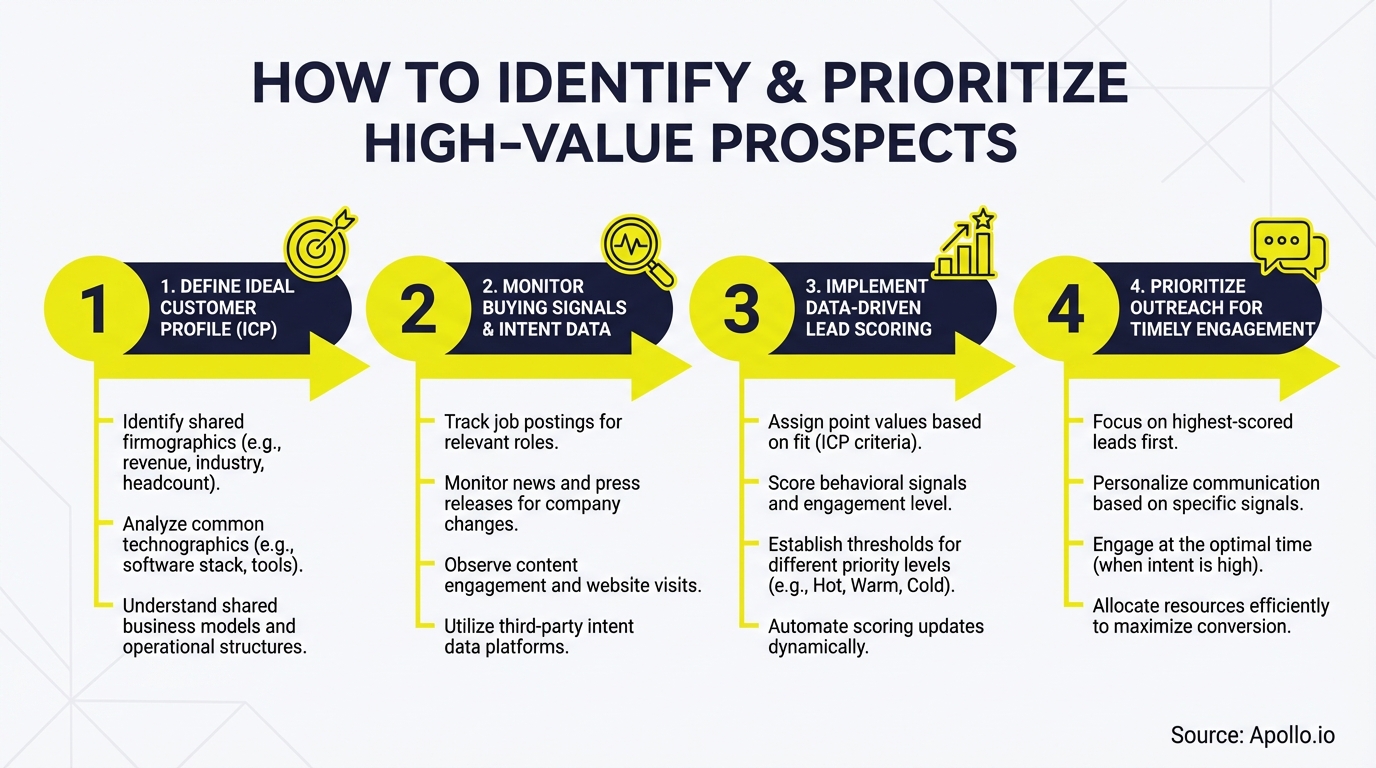
For SDRs and AEs, a cross-channel priority score translates raw signals into a ranked list of accounts to work. The goal is to fuse first-party data (your CRM, website analytics, email engagement) with third-party intent data to create a composite account score.
A practical starting framework:
- Step 1 — Firmographic gate: Confirm the account matches your ICP (industry, size, tech stack). Discard non-fits immediately.
- Step 2 — Intent layer: Add third-party intent data showing whether the account is actively researching your category. Learn how intent data is collected and what providers offer.
- Step 3 — Engagement density check: Has more than one person from this account engaged with your content, attended an event, or responded to outreach? This is a top-tier signal.
- Step 4 — Trigger event overlay: Layer in recent hiring activity, funding announcements, or leadership changes that indicate buying momentum.
- Step 5 — Score and rank: Combine weighted inputs into a priority tier (Tier 1 / Tier 2 / Tier 3) and assign accounts to the appropriate rep workflow.
Research from Tatvic shows that 70% of high-growth B2B companies have adopted predictive lead scoring as a core part of their sales strategy. AI-assisted scoring models are increasingly replacing static rule-based systems — giving RevOps teams more flexibility to update weights as market conditions change.
Turn Weak Leads Into Pipeline That Closes
Pipeline forecasting a guessing game because marketing leads never convert? Apollo surfaces in-market buyers with intent signals so your team reaches the right prospects before the window closes. 600K+ companies build predictable pipeline with Apollo.
Start Free with Apollo →What Is Engagement Density and Why Does It Matter?
Engagement density measures how many contacts from a single account are interacting with your brand across channels. One engaged contact signals curiosity.
Three engaged contacts from the same account signals an active buying committee.
This is a consensus signal — evidence that multiple stakeholders are evaluating your solution simultaneously. Accounts with high engagement density close faster and at larger deal sizes because the internal buying group is already aligned before your first conversation. For effective lead generation, tracking engagement density at the account level should be a standard RevOps practice.
Operationalizing this signal requires:
- Tagging all inbound activity by company domain (not just contact record)
- Setting account-level alerts when a second or third unique contact from the same domain engages
- Routing high-density accounts to senior AEs rather than SDR sequences
How Do RevOps Teams Prevent Irrelevance From Killing High-Value Accounts?
Irrelevance suppression is the governance layer that prevents your team from spamming accounts into avoidance. A Gartner survey published in June 2025 found that 73% of B2B buyers actively avoid suppliers that send irrelevant outreach. For RevOps leaders, this means prioritization is not just about who to contact — it's equally about who not to contact, and with what message.
A basic suppression governance policy includes:
- Content fit routing: Only send messaging that matches the account's confirmed stage and pain points
- Do-not-contact rules: Suppress accounts that have explicitly opted out, or that show no ICP fit signals
- Frequency caps: Limit touchpoints per account per rolling 30-day window to avoid fatigue
- Re-qualification gates: Require fresh intent signals before re-engaging dormant accounts
For AEs managing named accounts, pair suppression rules with optimal outreach timing to maximize response rates while staying relevant.
Spending too much time manually sorting which accounts to contact? Apollo's AI sales automation surfaces your highest-priority accounts and triggers the right sequence automatically.
How Does Prospect Prioritization Connect to Revenue Outcomes?
Prioritization decisions directly affect deal size, cycle length, and win rate. Accounts that enter the pipeline with strong buying-group signals and high engagement density tend to move faster and close larger. According to Reach Marketing, AI-driven lead scoring improves efficiency by 40% and reduces time spent on low-quality leads.
A simple prioritization-to-revenue model for sales leaders:
- Tier 1 accounts (high ICP fit + active intent + 2+ engaged contacts): Assign to senior AEs, personalized multi-channel sequences, executive-level content
- Tier 2 accounts (strong ICP fit + some engagement): Assign to mid-funnel nurture sequences with periodic SDR touchpoints
- Tier 3 accounts (ICP fit, no active signals): Move to long-cycle nurture or suppress until trigger events fire
For founders and revenue leaders tracking the impact, connect your return on sales metrics back to which tier accounts originated from. This closes the feedback loop and helps you continuously refine your scoring weights. Pair this with a strong sales intelligence platform to keep your account data fresh and actionable.

How Can You Start Prioritizing High-Value Prospects Today?
Identifying and prioritizing high-value prospects in 2026 requires a shift from individual lead scoring to buying-group-centric, cross-channel account prioritization. The frameworks above give you a starting point.
The fastest path to implementation is consolidating your prospecting, intent, and engagement data into one workspace — so your team spends time selling, not stitching together signals from disconnected tools.
As Cyera put it: "Having everything in one system was a game changer." Apollo brings together a 230M+ contact database, advanced filters for precise prospecting, buying intent signals, and multi-channel engagement in a single platform — cutting the tech stack that slows prioritization down.
Ready to find and prioritize your best accounts faster? Schedule a Demo with Apollo and see how GTM teams use it to build pipeline from their highest-value accounts.
Prove Pipeline ROI From Day One
ROI pressure killing your tool budget? Apollo delivers measurable pipeline impact fast — Leadium 3x'd annual revenue, Built-In gained +10% win rate. See your returns before the next budget review.
Start Free with Apollo →Don't miss these
Sales
Inbound vs Outbound Marketing: Which Strategy Wins?
Sales
What Is a Sales Funnel? The Non-Linear Revenue Framework for 2026
Sales
What Is a Go-to-Market Strategy? The 2026 GTM Playbook
See Apollo in action
We'd love to show how Apollo can help you sell better.
By submitting this form, you will receive information, tips, and promotions from Apollo. To learn more, see our Privacy Statement.
4.7/5 based on 9,690 reviews
