
How Do You Build a High-Performing Outbound Sales Sequence from Scratch in 2026?
Building a high-performing outbound sales sequence from scratch requires more than a 7-step email cadence and a contact list. In 2026, buyers are harder to reach, inboxes are more guarded, and generic outreach gets ignored or flagged. According to MarketingProfs, 78% of B2B sales and marketing decision-makers say outbound is essential to their growth strategy—yet most sequences fail because they prioritize volume over relevance. This guide gives you a concrete, deliverability-safe, signal-driven blueprint to build sequences that actually convert. Start with the fundamentals of what makes a sales sequence work before layering in the steps below.

Build Pipeline Faster With Apollo
Tired of hours lost to manual research and dead-end contact data? Apollo surfaces verified prospects and automates outreach so your team sells instead of searches. Join 600K+ companies generating predictable pipeline.
Start Free with Apollo →Key Takeaways
- Signal-based triggers (funding, hiring, job change) dramatically outperform static list cadences for relevance and reply rates.
- Deliverability is now a sequence design decision, not an ops afterthought—spam complaint rates must stay below 0.3%.
- Multi-channel sequences combining email, phone, and social outreach outperform single-channel approaches.
- SDRs and AEs who embed self-serve proof assets (ROI calculators, case studies) into their sequences reduce friction for buyer-led deals.
- AI governance—clear roles, QA checkpoints, and KPI alignment—separates scalable outbound from one-off wins.
What Is an Outbound Sales Sequence and Why Does It Matter?
An outbound sales sequence is a structured series of multi-channel touches (email, phone, social) sent to a prospect over a defined time window with the goal of earning a conversation. It is not a blast campaign, a drip series, or a newsletter.
The key difference: every touch is triggered by relevance, not a calendar date.
The business case is clear. Data from Martal shows nearly 28% of B2B revenue comes from outbound efforts. And BookYourData reports 82% of B2B buyers still accept meetings from outbound outreach—proof the channel works when done right. The problem is execution: most sequences are built around what's convenient for the seller, not what's relevant to the buyer.
How Do You Build the Foundation: ICP, Signals, and List Quality?
Every high-performing sequence starts with a tightly defined Ideal Customer Profile (ICP) and a verified, signal-enriched contact list. Without this foundation, even the best copy produces poor results.
- Define your ICP precisely: Industry, company size, tech stack, growth stage, and the specific pain your product solves.
- Use intent signals as entry gates: Trigger sequences from events like new funding rounds, recent hiring sprees, job changes, or technology installs—not just a static list upload. Learn more about how intent data powers smarter B2B outreach.
- Apply suppression logic: Exclude existing customers, recent opt-outs, active opportunities, and contacts touched within the last 90 days.
- Verify contacts before sending: Undeliverable emails damage domain reputation instantly.
Struggling to find and verify the right contacts at scale? Search Apollo's 230M+ verified contacts with 65+ filters to build ICP-matched, signal-enriched lists in minutes.
What Does a High-Converting Sequence Structure Look Like?
A modern outbound sequence runs 8–12 touches across 3–4 weeks, combining email, phone, and social channels. Each touch builds on the last and escalates in specificity. Here is a proven framework:
| Day | Channel | Purpose | Key Rule |
|---|---|---|---|
| 1 | Trigger-based intro | Reference the specific signal (e.g., "Saw you just raised a Series B") | |
| 2 | Phone | Voice touch | Leave a short, contextual voicemail tied to the email |
| 4 | Social | Warm the relationship | Comment on or share relevant prospect content |
| 7 | Value + proof asset | Link to a case study or ROI calculator—no ask yet | |
| 10 | Phone | Direct ask | Reference all prior context; ask for a specific 15-minute slot |
| 14 | Break-up / last value drop | Easy opt-out option included; preserve domain reputation |
Research from Callbox shows a multichannel approach can improve conversion rates by 300% compared to single-channel strategies.
For more real-world sequence examples with annotated templates, see Apollo's top-performing sequence breakdowns.

How Do SDRs and AEs Keep Sequences Deliverable and Compliant?
Deliverability is a sequence design decision, not an IT task. In 2026, inbox providers enforce strict spam complaint thresholds—the Validity 2025 Email Deliverability Benchmark confirms Gmail and Yahoo require complaint rates below 0.3%. Exceeding that threshold tanks domain reputation for all outbound, not just the offending campaign.
SDRs should follow these guardrails before launching any sequence:
- Confirm SPF, DKIM, and DMARC records are properly configured on your sending domain.
- Warm new domains gradually (start at 20–30 emails/day, scale over 4–6 weeks).
- Include a one-click unsubscribe in every email—not buried in footer text.
- Cap daily send volume per inbox to avoid triggering bulk-sender filters.
- Monitor spam complaint rates weekly; pause sequences if the rate climbs above 0.1% as an early warning.
For AEs running enterprise sequences, keep personalization genuine.
AI-generated copy is now detectable by both inbox filters and buyers.
Specificity (a real trigger, a real insight) outperforms any template.
See how sequence length and timing affect deliverability and reply rates.
Turn Funnel Guesswork Into Real Pipeline
Tired of forecasts built on stale data and leads that never convert? Apollo surfaces in-market buyers the moment they're ready, so your pipeline reflects reality. Nearly 100K paying customers stopped guessing and started closing.
Start Free with Apollo →How Does AI Fit into Outbound Sequence Design Without Creating Risk?
AI accelerates outbound sequence execution when it operates within a defined governance model. The risk is when AI replaces human judgment on ICP definition, value hypothesis, and quality review—those must stay human-owned.
Where AI adds clear value in sequences:
- Research and personalization at scale: Pulling trigger context (recent news, job changes, product launches) into first-line copy.
- Subject line and CTA testing: Generating variants for A/B testing without manual copywriting for each segment.
- Routing logic: Automatically moving engaged prospects to higher-touch follow-up or self-serve proof assets based on open and click behavior.
What stays human-owned: ICP definition, value hypothesis, sequence entry gates, suppression rules, and final QA review of AI-generated copy before sending. Teams using sales automation the right way treat AI as a force multiplier, not a replacement for strategic thinking.
Spending too much time building sequences manually? Automate your multi-channel outreach with Apollo's sales engagement platform and keep everything—contacts, sequences, and analytics—in one workspace.
How Do You Measure and Optimize Sequence Performance?
Sequence optimization requires tracking the right KPIs at each stage, not just open rates. Open rates are unreliable due to Apple Mail Privacy Protection and bot clicks.
Focus on metrics that indicate genuine buyer engagement.
| Metric | What It Tells You | Action Threshold |
|---|---|---|
| Reply rate | Messaging relevance | Below 2%: revise first-touch copy or entry signal |
| Positive reply rate | ICP fit and value prop clarity | Below 0.5%: revisit ICP or offer |
| Spam complaint rate | Deliverability health | Above 0.1%: pause and audit list quality |
| Meeting booked rate | Full-sequence effectiveness | Benchmark against prior 30-day cohort |
| Opt-out rate | Relevance of contact selection | Rising trend signals ICP or timing mismatch |
RevOps leaders find that tracking reply rate by entry signal (funding vs. job change vs. intent) quickly reveals which triggers produce the most qualified conversations. Use sales analytics to connect sequence activity to revenue outcomes and prioritize the signals worth scaling. Review sequence performance every two weeks, not monthly—outbound conditions shift fast.

Start Building Your Outbound Sequence Today
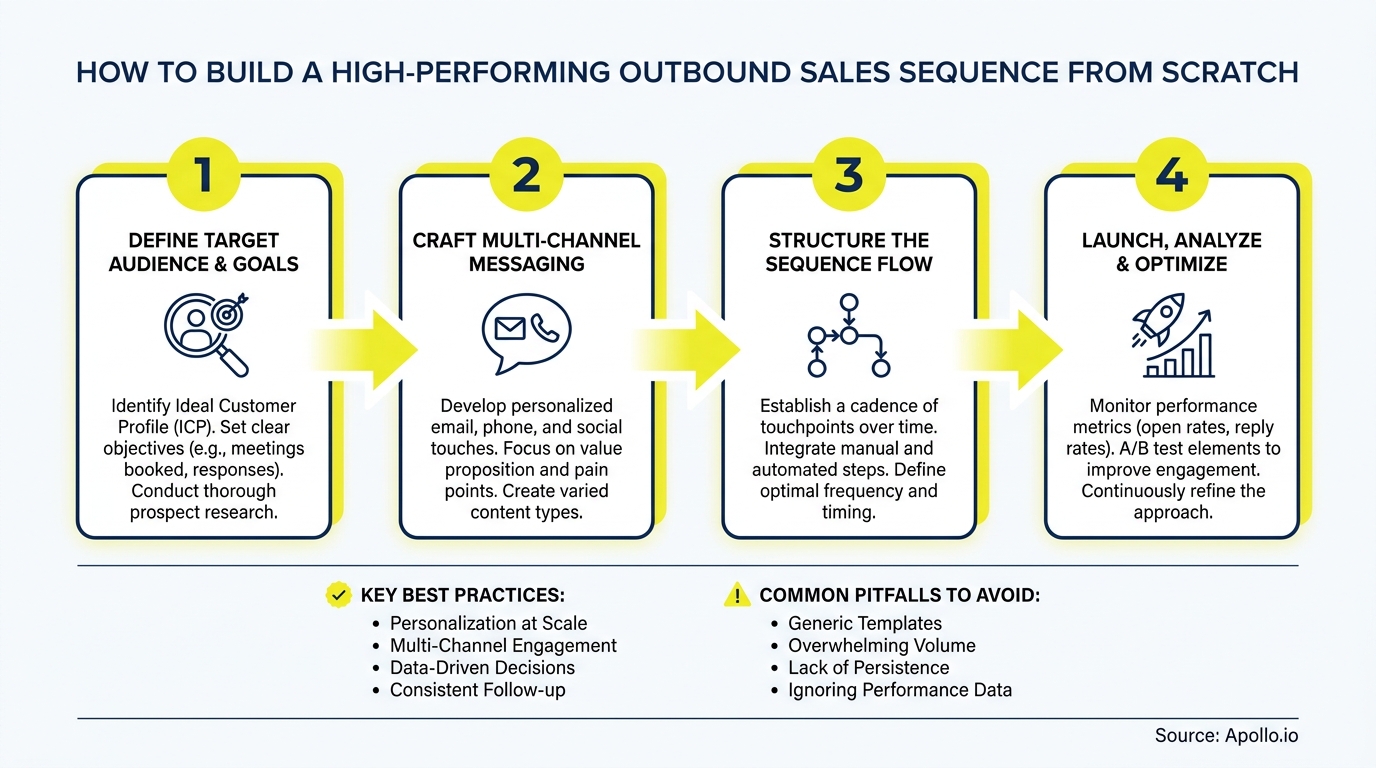
A high-performing outbound sequence in 2026 is built on four pillars: a verified ICP-matched list, signal-based entry triggers, deliverability-safe sending infrastructure, and multi-channel coordination. Teams that treat these as a unified system—not separate workstreams—consistently outperform those running generic cadences at volume.
Apollo gives SDRs, AEs, and RevOps teams a single platform to find verified contacts, trigger signal-based sequences, automate multi-channel outreach, and measure what's working.
As Cyera put it: "Having everything in one system was a game changer." Explore the full Apollo Outbound Sales Resource Kit for free templates and scripts, or schedule a demo to see how Apollo consolidates your entire outbound stack into one workspace.
Prove Pipeline ROI With Apollo
ROI pressure killing your tool budget? Apollo delivers measurable pipeline impact from day one — no lengthy ramp, no guesswork. Leadium 3x'd annual revenue. See your own ROI fast.
Start Free with Apollo →Don't miss these
Sales
Inbound vs Outbound Marketing: Which Strategy Wins?
Sales
What Is a Sales Funnel? The Non-Linear Revenue Framework for 2026
Sales
What Is a Go-to-Market Strategy? The 2026 GTM Playbook
See Apollo in action
We'd love to show how Apollo can help you sell better.
By submitting this form, you will receive information, tips, and promotions from Apollo. To learn more, see our Privacy Statement.
4.7/5 based on 9,690 reviews
