
How Do I Align Sales and Marketing Efforts in an Automated Workflow in 2026?
Sales and marketing alignment is no longer just a strategic goal — it's an operational requirement. The gap between sales and marketing costs revenue every quarter, yet most teams still treat alignment as a meeting agenda item rather than a system design problem. McKinsey's latest B2B Pulse research frames it bluntly: aligned commercial teams need shared data, shared definitions, and shared AI governance working together as a "commercial operating system" — not separate campaigns with occasional syncs.
The good news: automated workflows can close this gap permanently. This blueprint covers the buyer-signal triggers, message consistency requirements, and data architecture your team needs to make alignment systematic in 2026.

Let Apollo Find Your Leads Instantly
Tired of burning hours on manual research just to verify one contact? Apollo surfaces accurate business contacts so your reps spend time selling, not searching. Join 600K+ companies building pipeline faster.
Start Free with Apollo →Key Takeaways
- Alignment fails at the workflow level, not the strategy level — most teams collaborate on only a fraction of commercial activities that require joint input.
- Automated workflows must map buyer signals to specific sales actions, not just move leads from one queue to another.
- Message inconsistency between website content and seller communications is a critical buyer-experience failure that automation can prevent.
- Clean, unified data is the prerequisite for every automation trigger — bad data breaks alignment before AI agents can help.
- Companies with strong sales and marketing alignment generate measurably more revenue, higher win rates, and faster growth than misaligned teams.
Why Does Sales and Marketing Alignment Still Fail in 2026?
Alignment fails because most teams treat it as a cultural problem when it's actually a workflow problem. Gartner's 2024 B2B Commercial Strategy Survey of 412 senior leaders found teams typically collaborate on only 3 of 15 commercial activities, with 90% reporting conflicting functional priorities.
That's not a communication failure — it's a missing operating model.
The revenue cost is well-documented. According to Protocol80, companies with strong sales and marketing alignment generate 208% more marketing-sourced revenue. Meanwhile, Acceligize reports that well-aligned organizations experience 38% higher win rates and 27% faster revenue growth. Those numbers don't come from better meetings — they come from systems that keep both teams working from the same signals.
For RevOps leaders, this is the core problem to solve: replace manual handoffs and ad hoc collaboration with governed, automated workflows that trigger the right action at the right buyer stage.
What Does an Automated Sales-Marketing Workflow Actually Look Like?
An automated alignment workflow maps buyer signals to journey stages, content actions, and sales actions in a single governed sequence. Here's the core teardown:
| Buyer Signal | Journey Stage | Automated Content Action | Sales Action Triggered |
|---|---|---|---|
| First website visit, content download | Awareness | Enter nurture sequence (educational content) | None — marketing owns |
| Pricing page visit + 2+ content pieces | Consideration | Send case study + comparison content | SDR alert: warm prospect, initiate outreach |
| Intent data spike + multiple stakeholders active | Decision (buying group) | Trigger ABM ad sequence for buying group | AE assigned, personalized sequence launched |
| Demo request or form fill | Active evaluation | Confirmation + pre-meeting resource email | Immediate routing to AE; meeting scheduled |
| Deal goes dark (30+ days no activity) | Re-engagement | Re-nurture sequence with new content angle | RevOps review; SDR re-engagement task |
Intent data is the highest-leverage trigger in this model. Research from 6sense's 2025 B2B Buyer Experience Report found that first seller contact moved from 69% of the buying journey in 2024 to 61% in 2025 — buyers are engaging sellers earlier, which means your routing logic must fire faster and smarter than a form fill.
Spending hours on manual outreach while buyers are already in-market? Automate your multi-channel sequences with Apollo's sales engagement platform so SDRs act on signals in minutes, not days.

How Do RevOps Teams Build the Trigger and Routing Rules?
RevOps owns the trigger logic that converts buyer signals into sales actions. Without governed routing rules, leads fall through cracks and SDRs work cold accounts while hot ones sit idle.
Key routing rules to define and automate:
- MQL threshold: Define the exact score (behavioral + firmographic) that moves a lead from marketing nurture to sales queue.
- Account-level routing: Route by territory, segment, or named account list — not just lead owner. McKinsey reports B2B buyers now use an average of 10 channels across the journey, so account-level context matters more than individual lead scoring.
- SLA timers: Set automated escalations if a sales-accepted lead isn't contacted within a defined window (e.g., 4 hours for high-intent signals).
- Feedback loop triggers: When sales marks a lead as "not qualified," automatically update the segment in the marketing automation system and adjust scoring weights.
For sales transformation initiatives, these rules are the foundation. Define them in a shared document before configuring any automation — ambiguous definitions produce broken workflows.
How Do You Keep Website and Seller Messaging Consistent?
Message consistency means your website, nurture emails, sales decks, and call scripts all reflect the same value proposition, proof points, and positioning at every buyer stage. Gartner's 2025 buyer survey found 69% of B2B buyers see inconsistencies between vendor website information and seller-provided information — a direct trust killer.
Use this audit checklist before launching any automated workflow:
- Website vs. nurture email: Do the headline value props match? Are the same case studies referenced?
- Nurture email vs. sales deck: Does the messaging sequence build on what the prospect already received?
- Sales deck vs. call script: Do SDRs and AEs use the same proof points that appear in marketing content?
- Self-service resources vs. seller answers: If a buyer reads your pricing FAQ, does the sales team give a consistent answer on the same topic?
Automate the approval workflow: any content update to web pages or nurture sequences should trigger a review task for the sales enablement owner before going live. This prevents marketing from refreshing messaging that AEs haven't been briefed on. Building a unified sales tech stack that surfaces the same content library to both teams removes the version-control problem entirely.
Turn Funnel Gaps Into Pipeline Gold
Pipeline forecasting a guessing game? Apollo surfaces in-market buyers the moment they're ready, turning weak top-of-funnel into qualified opportunities. Leading teams book 46% more meetings using Apollo's AI Research Agent.
Schedule a Demo →What Data Architecture Powers Sales-Marketing Automation?
Every automated workflow depends on clean, unified data. The Salesforce 2026 State of Sales report found that 84% of data and analytics leaders say their data strategies need an overhaul to reach AI goals, and 46% of sales professionals with AI agents say data-quality issues directly hurt sales performance.
The minimum data model for aligned automation:
| Data Layer | Required Fields | Owner | Freshness SLA |
|---|---|---|---|
| Contact/Account | Job title, company, industry, employee count, tech stack | RevOps | Enriched on creation + quarterly refresh |
| Engagement | Email opens, page visits, content downloads, event attendance | Marketing Ops | Real-time sync to CRM |
| Intent | Topic clusters, competitor research, review site activity | RevOps / Demand Gen | Weekly update minimum |
| Sales Activity | Calls logged, emails sent, meeting outcomes, deal stage | Sales Ops | Logged within 24 hours |
| Lifecycle Stage | Subscriber, MQL, SAL, SQL, Opportunity, Customer | RevOps | Automated based on trigger rules |
Data sync between marketing and sales systems is the technical requirement that makes this model work. Without real-time field mapping between your CRM and marketing automation platform, triggers fire on stale data and routing rules break. Research from Trembi confirms that marketing automation drives a 14.5% increase in sales productivity and a 12.2% reduction in marketing overhead — but only when the underlying data is reliable.
Struggling with enrichment gaps that break your automation triggers? Keep your contact records current with Apollo's verified B2B data enrichment across 230M+ people and 30M+ companies.
How Do SDRs and AEs Operate Inside an Aligned Automated Workflow?
SDRs and AEs work most effectively when the workflow surfaces context, not just tasks. An aligned system tells an SDR why a prospect is flagged (which signals fired, what content they consumed, what stage they're at) — not just that they need to be called.
For SDRs, the workflow should:
- Auto-enroll high-intent accounts into a personalized outreach sequence with pre-populated context from marketing touchpoints.
- Surface the last marketing email opened and last page visited before the first call.
- Flag buying-group activity (multiple contacts from the same account engaging) for account-level outreach rather than single-contact follow-up.
For AEs handling active opportunities, the workflow should:
- Alert on re-engagement signals (prospect visits the pricing page mid-deal cycle).
- Automatically send relevant case studies or ROI content when a deal stage advances.
- Sync call notes and email activity back to the marketing system so nurture sequences pause during active sales cycles.
This is where sales analyticsbecomes a shared resource: both SDRs and marketing leaders should see the same pipeline conversion data to refine scoring models and content investments together.

How Do You Get Started Aligning Sales and Marketing in an Automated Workflow?
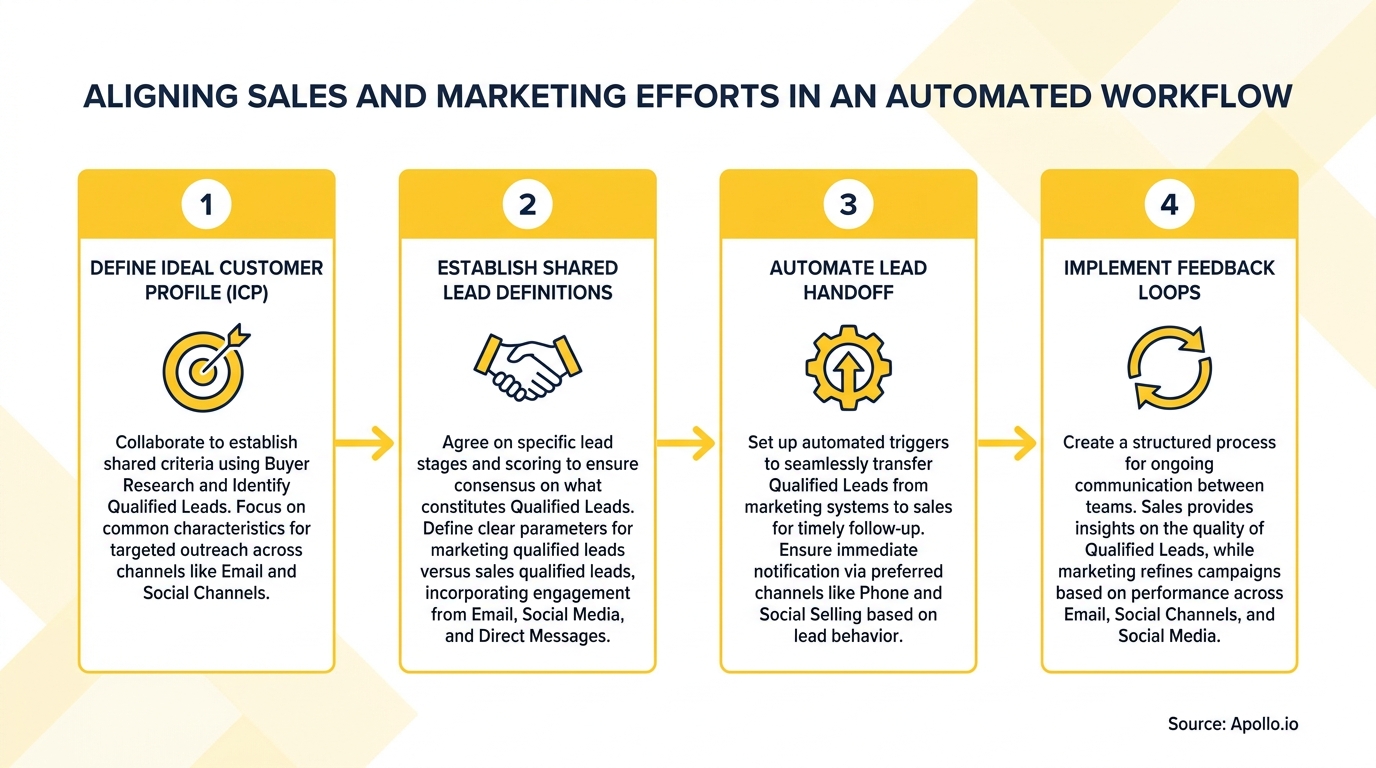
Start by aligning on definitions before touching any technology. Teams that skip this step build automation on top of conflicting assumptions — and the workflow amplifies the misalignment instead of fixing it.
A practical four-step launch sequence:
- Define shared lifecycle stages — agree on what MQL, SAL, and SQL mean in writing, with numeric criteria attached.
- Audit your data foundation — verify that CRM fields, engagement data, and enrichment are syncing correctly before building triggers.
- Map one buyer journey end-to-end — pick your highest-volume ICP segment and blueprint the buyer signal to sales action sequence for that segment first.
- Run a message consistency audit — compare your website, nurture sequence, deck, and call script for that segment before launch.
Apollo consolidates the data, prospecting, engagement, and workflow automation your team needs into one platform — so SDRs, AEs, and marketing operate from the same system instead of stitching together disconnected tools. As Cyera's team put it: "Having everything in one system was a game changer."
Ready to build an aligned GTM workflow that actually runs? Schedule a Demo and see how Apollo's unified platform connects your sales and marketing teams from first signal to closed deal.
Ramp Reps Faster, Prove ROI Sooner
ROI pressure killing your next budget approval? Apollo gets new reps producing pipeline from day one with scalable, repeatable processes. Leading teams like Leadium 3x'd annual revenue — results your CFO can't argue with.
Start Free with Apollo →Don't miss these
Sales
Inbound vs Outbound Marketing: Which Strategy Wins?
Sales
What Is a Sales Funnel? The Non-Linear Revenue Framework for 2026
Sales
What Is a Go-to-Market Strategy? The 2026 GTM Playbook
See Apollo in action
We'd love to show how Apollo can help you sell better.
By submitting this form, you will receive information, tips, and promotions from Apollo. To learn more, see our Privacy Statement.
4.7/5 based on 9,690 reviews
