
How Do Agentic Sales Workflows Differ from Traditional Sales Sequences in 2026?
Traditional sales sequences follow a fixed script: send email on day 1, call on day 3, follow up on day 7. That worked when buyers were patient. Today, sales automation has evolved far beyond step-based cadences into something fundamentally different: agentic workflows that perceive context, make decisions, and act autonomously across your entire pipeline.
The gap between these two approaches is growing fast. According to the Salesforce State of Sales 2026 report, 54% of sellers have already used AI agents, and nearly 9 in 10 plan to by 2027. If your team is still running rigid sequences, you're falling behind a shift that redefines what outreach even means.

Apollo Turns Research Into Revenue
Tired of your reps burning hours on data entry instead of closing deals? Apollo delivers verified contacts instantly, so your team spends time selling — not searching. Join 600K+ companies building pipeline on autopilot.
Start Free with Apollo →Key Takeaways
- Traditional sequences execute fixed steps in order; agentic workflows plan, act, observe, and adapt based on real-time signals.
- Agentic AI is autonomous: it can perceive context, decide when to engage, and execute multi-step outreach with minimal human input.
- Data quality and CRM integration are the top blockers to agentic adoption, not messaging or technology.
- SDRs and RevOps teams gain the most immediate lift from agentic workflows, especially in prospecting and follow-up execution.
- Guardrails and human-in-the-loop controls are non-negotiable for agentic workflows to operate safely at scale.
What Is the Core Difference Between Agentic Workflows and Traditional Sequences?
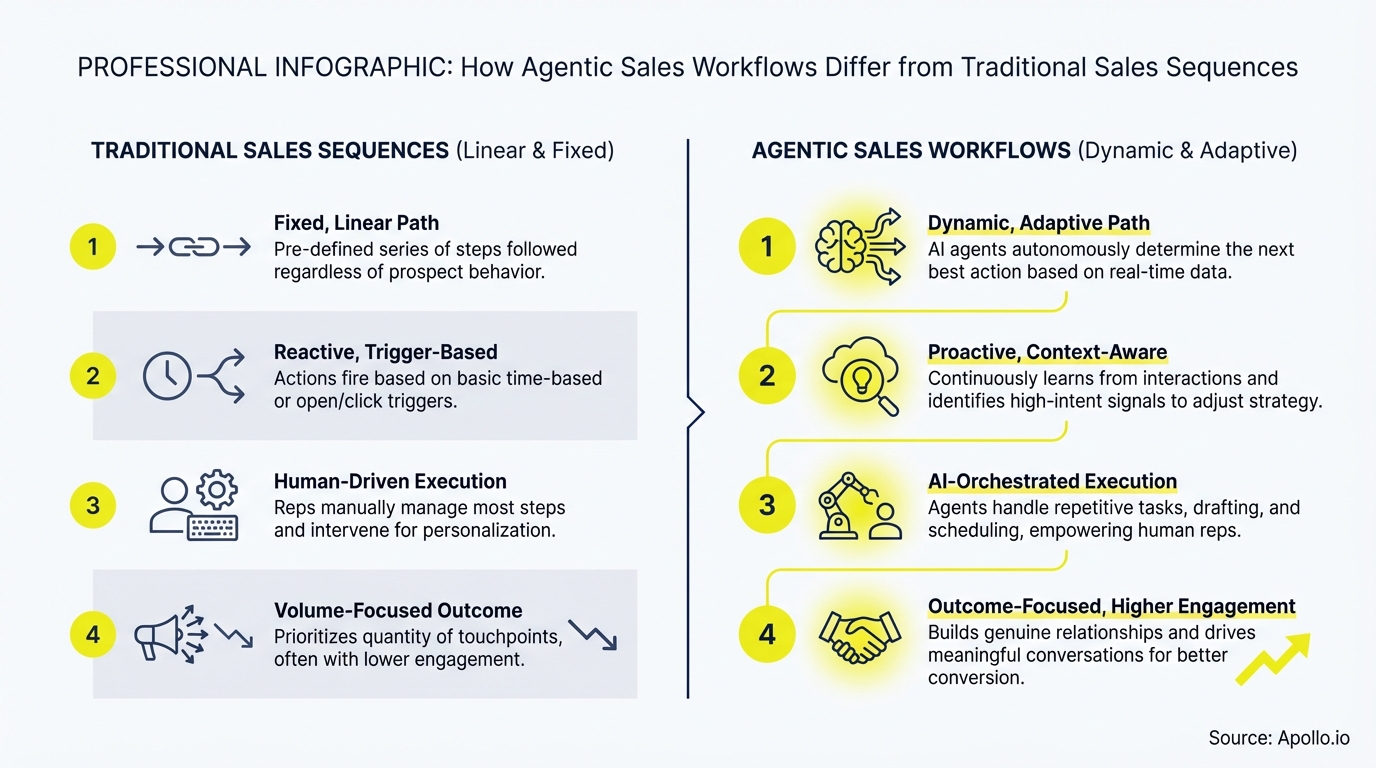
The core difference is autonomy versus scripting. Traditional sales sequences are pre-defined cadences: a rep or manager sets the steps, and the tool executes them regardless of what the buyer does in between.
Agentic workflows replace that script with a goal-driven loop: plan, act, observe, and iterate based on live signals.
| Dimension | Traditional Sequence | Agentic Workflow |
|---|---|---|
| Logic | Fixed step order (if time = day 3, send email) | Goal-driven (if intent signal detected, prioritize and act) |
| Personalization | Template variables (name, company) | Context-aware messaging from live research |
| Decision-making | Human-set rules | AI evaluates signals and decides next action |
| Channel selection | Pre-assigned (email → call → social) | Adaptive based on engagement history |
| Operation | Runs on a schedule | Runs continuously, event-triggered |
| Human role | Executes and monitors steps | Supervises exceptions and high-value accounts |
As described by Landbase, agentic AI frameworks are autonomous systems that can perceive, decide, and act to pursue a goal with minimal human input, proactively managing tasks across sales pipelines, from identifying opportunities to executing multi-step outreach. That is a fundamentally different operating model from a sequence tool.
Why Are Traditional Sequences Losing Effectiveness in 2026?
Traditional sequences are losing effectiveness because they scale generic outreach, and buyers have stopped tolerating it. A Gartner survey of 632 B2B buyers found that 73% actively avoid suppliers who send irrelevant outreach, and 61% prefer a rep-free buying experience overall.
The burden on reps compounds the problem. Sales professionals report spending 70% of their time on non-selling tasks, according to Salesforce research. Fixed sequences add to that load by requiring constant manual management. Agentic workflows are designed to absorb those repetitive tasks autonomously, freeing reps for high-value conversations.
Spending hours managing sequence steps manually? Explore Apollo's AI sales automation to let agents handle research, drafting, and follow-up while your team focuses on closing.

How Do SDRs and RevOps Teams Benefit Most from Agentic Workflows?
SDRs benefit most in prospecting and first-touch outreach, where agentic systems run continuously and personalize at scale. The Salesforce State of Sales 2026 report found 92% of sales professionals with AI agents say AI benefits prospecting, and 47% call cold outreach one of the worst parts of the job.
Agentic workflows remove that friction entirely for high-volume, low-complexity contacts.
RevOps leaders benefit at the systems level. MarketsandMarkets notes that AI agents can make decisions, learn from interactions, and improve over time, unlike static, rule-based automation. For RevOps, this means fewer brittle rules to maintain, cleaner CRM data, and a single source of truth across pipeline stages. See how revenue operations drives growth when workflows adapt in real time rather than running on a fixed clock.
For Account Executives managing late-stage deals, agentic workflows handle research, meeting prep, and follow-up tasks automatically, so AEs spend their time on negotiation and relationship-building rather than administrative work.
Fill Your Funnel With Buyers, Not Noise
Running out of qualified leads before the quarter ends? Apollo surfaces in-market prospects the moment they're ready to buy, so your pipeline stays full. Teams using Apollo's AI book 46% more meetings.
Start Free with Apollo →What Does an Agentic Readiness Checklist Look Like?
Agentic readiness depends more on data quality and integration than on AI capability. A Bain survey of 1,200+ senior commercial executives found 70% of companies struggle to integrate their sales plays into CRM and revenue technologies, and only about 20% have realized full value from AI investments. Integration is the bottleneck, not the AI itself.
Use this checklist before deploying agentic workflows:
- Data quality: Contact records are verified, deduplicated, and enriched with firmographic data
- CRM integration: Your CRM syncs bidirectionally with your engagement platform in real time
- Intent signals: You have access to intent data to trigger agent actions based on buying signals
- ICP definition: Your ideal customer profile is codified with filters your agent can apply autonomously
- Governance policy: You have defined which actions require human approval before execution
- Escalation paths: High-value accounts and late-stage deals route to humans, not agents
- Security review: Data access permissions for agents are scoped and auditable
The Salesforce State of Sales 2026 report found 51% of sales professionals said security concerns delayed their AI initiatives, and 46% said data quality issues hurt their sales results. Addressing these two blockers first unlocks the rest of the readiness stack.
How Do You Roll Out Agentic Workflows Without Breaking Your Pipeline?
Roll out agentic workflows in phases, starting with the highest-volume, lowest-risk functions first. This protects live pipeline while building organizational confidence in agent behavior.
- Weeks 1 to 6 (Pilot): Deploy agents on cold prospecting only. Agents research, score, and draft first-touch messages. Humans approve before send. Measure reply rate vs. existing sequences.
- Weeks 7 to 14 (Expand): Enable autonomous follow-up for non-responsive cold contacts. Add enrichment automation for inbound leads. SDRs review agent activity logs weekly.
- Weeks 15 to 24 (Scale): Integrate agents with CRM deal stages. Agents trigger research and meeting prep for AEs automatically. Governance review every 30 days.
The emerging hybrid model is instructive here: agents handle high-volume, low-risk work (research, enrichment, first drafts, follow-ups), while humans supervise exceptions, high-value accounts, and late-stage negotiation. This is not about replacing reps.
It is about redefining what they spend their time on.
Ready to build sequences that evolve into agentic workflows? Apollo's platform connects prospecting, enrichment, and engagement in one workspace, so your data and actions stay in sync from day one.
What Guardrails Do Agentic Sales Workflows Require?
Agentic workflows require explicit guardrails because agents take actions, not just generate suggestions. Without controls, agents can send premature outreach, contact suppressed accounts, or create compliance exposure.
As security professionals have noted, agentic AI poses governance challenges that static sequences never required.
Essential guardrails for agentic sales workflows:
- Human-in-the-loop approvals for any action involving enterprise accounts or active opportunities
- Suppression lists that agents check before any outreach action
- Audit logs showing every action taken, with the triggering signal and timestamp
- Confidence thresholds that pause agent actions when signal quality is low
- Escalation rules routing anomalies (unexpected replies, out-of-scope requests) to a human queue
- Output review windows for new agent deployments before full autonomy is granted
These guardrails are what separate safe agentic deployment from chaotic automation. Understanding how sales analytics drives revenue growth helps teams set the right KPIs to monitor agent performance and catch drift early.
How Do You Measure the ROI of Agentic Workflows vs. Traditional Sequences?
Measure agentic workflow ROI by comparing outcomes at the same pipeline stage, not just activity volume. Traditional sequence metrics (emails sent, open rate, click rate) measure effort.
Agentic workflow metrics measure efficiency and outcome quality.
| KPI | Traditional Sequence Benchmark | Agentic Workflow Target |
|---|---|---|
| Meetings booked per 100 contacts | Baseline from current sequences | Improvement measured against baseline |
| Rep time on non-selling tasks | High (research, logging, scheduling) | Reduced through autonomous task handling |
| Personalization score | Template-level | Context-driven, account-specific |
| Pipeline coverage per SDR | Limited by manual capacity | Expanded by continuous agent operation |
| Data quality score (CRM) | Degrades without active maintenance | Maintained automatically through enrichment |
Research from Everstage shows automation has helped top-performing B2B sales organizations free up about 20% of sellers' capacity and improve productivity by up to 30%. That freed capacity is the clearest early signal that your agentic rollout is working.

What Should GTM Teams Do Next to Adopt Agentic Workflows in 2026?
The shift from traditional sequences to agentic workflows is not a tool swap. It is an operating model change that requires clean data, integrated systems, defined guardrails, and a phased rollout.
Teams that treat it as another automation layer will hit the same 20% value ceiling that most organizations are stuck at today.
Apollo gives B2B GTM teams the unified platform to make this transition without rebuilding their entire stack. Prospecting, enrichment, engagement, and AI automation live in one workspace, so your agents have the data context they need to act accurately from day one.
As Cyera noted after consolidating their tools, "Having everything in one system was a game changer."
Struggling to find qualified leads without the manual research burden? Search Apollo's 230M+ verified contacts with 65+ filters and let AI agents prioritize the best-fit accounts automatically.
Start building your agentic foundation today. Try Apollo Free and see how one unified platform replaces the fragmented stack that makes agentic adoption so difficult for most teams.
Prove Pipeline ROI With Apollo
ROI pressure killing your tool budget? Apollo delivers measurable pipeline outcomes your executives can see — not just promises. Leadium 3x'd annual revenue after switching. Start free today.
Start Free with Apollo →Don't miss these
Sales
Inbound vs Outbound Marketing: Which Strategy Wins?
Sales
What Is a Sales Funnel? The Non-Linear Revenue Framework for 2026
Sales
What Is a Go-to-Market Strategy? The 2026 GTM Playbook
See Apollo in action
We'd love to show how Apollo can help you sell better.
By submitting this form, you will receive information, tips, and promotions from Apollo. To learn more, see our Privacy Statement.
4.7/5 based on 9,690 reviews
