
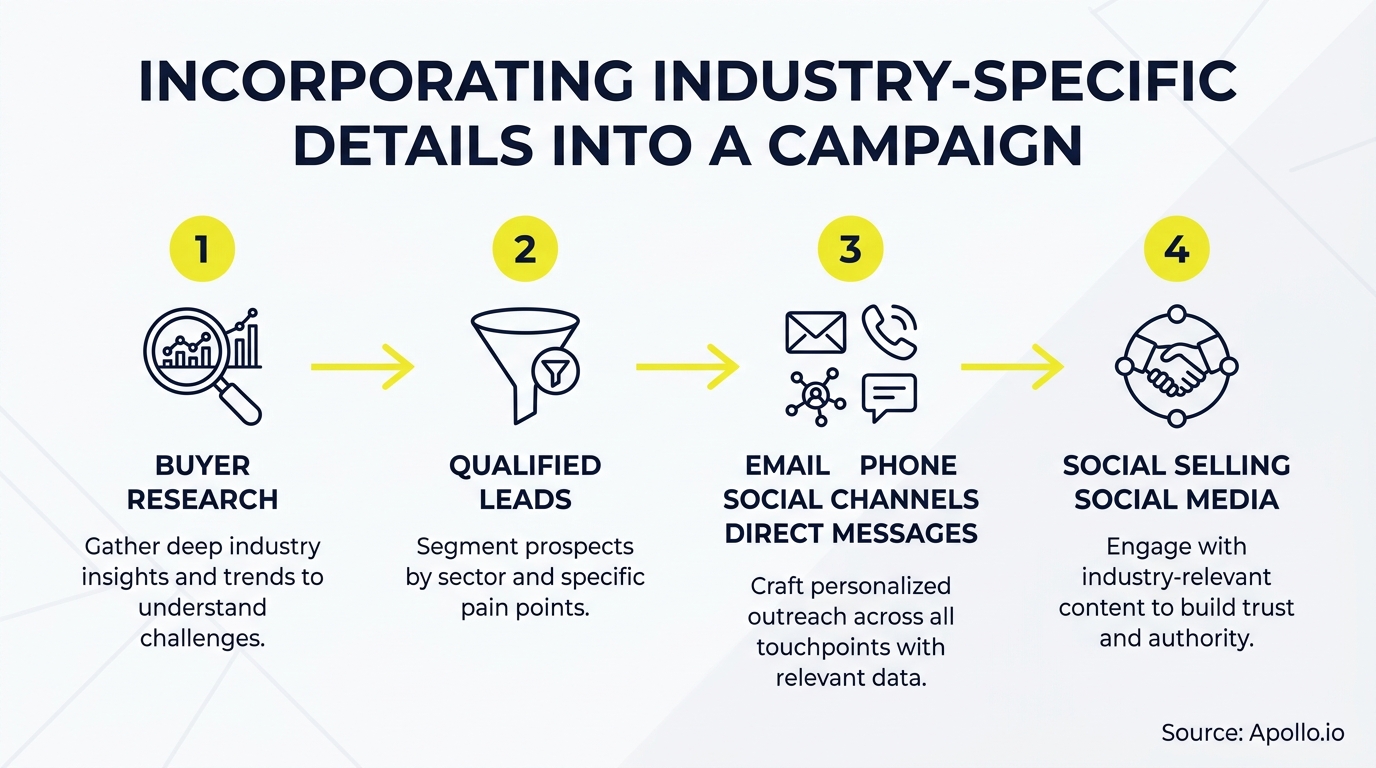
How Can I Incorporate Industry-Specific Details Into a Campaign? A 2026 Framework
Inserting a company name or job title into your outreach is not industry-specific personalization. It is table stakes. Real industry specificity means your campaign reflects a buyer's operating model, cost pressures, compliance landscape, and peer benchmarks — before they ever talk to a rep. According to Foleon, 94% of B2B marketers report that personalization boosted sales by 2024, yet most campaigns still rely on token-level swaps rather than genuine vertical context.
McKinsey's May 2026 Global B2B Pulse found that omnichannel and e-commerce are no longer differentiators — growth leaders now need AI-driven personalization at every step, combined with disciplined account-based targeting. If your campaign lacks vertical depth, it loses before the first sales call. This guide gives you a practical framework: build an industry evidence layer, govern message consistency across teams, and create ROI proof that closes deals. For stronger B2B marketing funnel performance, vertical depth is where the leverage lives.

Research Less, Pipeline More With Apollo
Tired of burning hours on manual lead research while your pipeline sits empty? Apollo surfaces verified contacts instantly so your team sells instead of searches. Join 600K+ companies building predictable pipeline.
Start Free with Apollo →Key Takeaways
- Industry-specific campaigns require five evidence types — not just a company name swap — to earn buyer trust and drive purchase decisions.
- Message consistency across marketing, SDR outreach, and AE conversations is a measurable gap: 69% of buyers report inconsistencies between vendor content and seller communication.
- ROI proof tied to industry benchmarks significantly influences vendor selection, particularly when buyers need to build an internal business case.
- Modular, vertical content assets outperform generic campaigns across engagement, open rates, and conversion — especially when structured for both human readers and AI search engines.
- Apollo's sales intelligence and engagement platform lets GTM teams segment, enrich, and activate industry-specific campaigns from one unified workspace.
What Is an Industry Evidence Layer and Why Does It Matter?
An industry evidence layer is a structured set of five proof types that make your campaign credible to a specific vertical: macro benchmarks, regulatory or cost pressures, role-level pain points, peer proof (case studies and social proof), and ROI metrics. Without it, personalization feels hollow. Instapage reports that approximately 83% of B2B marketers have observed improved lead generation through personalization — but only when that personalization reflects genuine industry knowledge.
| Evidence Type | What to Include | Example (SaaS Vertical) |
|---|---|---|
| Macro Benchmark | Industry growth rate, market size | Software publisher output projected to reach $896B by 2034 |
| Regulatory / Cost Pressure | Compliance requirements, budget constraints | SOC 2 audit costs, rising cloud spend |
| Role-Level Pain | Specific KPIs and frustrations by persona | SDR quota pressure, CRO pipeline visibility gaps |
| Peer Proof | Customer stories, third-party validation | Case study: 46% more meetings with AI Research Agent |
| ROI Metrics | Cost-of-inaction, payback period, business case | Revenue per SDR, cost per qualified meeting |
Build this evidence layer once per vertical, then reuse it across ads, landing pages, email sequences, and sales decks. Struggling to find the right contacts within a target vertical? Search Apollo's 230M+ contacts with 65+ filters including industry, seniority, and job function.
How Do SDRs and Marketers Align on Industry-Specific Messaging?
Message consistency governance means marketing, SDRs, and AEs use the same vertical language, proof points, and business case — adapted to their channel, not reinvented from scratch. Gartner's 2025 research found that 69% of B2B buyers report inconsistencies between website content and seller-provided information.
That gap destroys trust during the buying process.
A practical message consistency workflow has three gates:
- Gate 1 — Marketing: Publish the vertical evidence layer in a shared asset library (one-pager, landing page, ad creative, nurture email). All copy references the same benchmarks and proof points.
- Gate 2 — SDR Outreach: SDR sequences pull from approved vertical snippets: one macro stat, one role pain, one peer proof. No free-form industry claims. See email personalization best practices for sequence-level execution.
- Gate 3 — AE Handoff: The vertical business case (ROI assumptions, cost-of-inaction) transfers from the SDR handoff note into the AE discovery deck. The buyer hears one coherent story, not three different pitches.
RevOps leaders are best positioned to own this governance layer. A clean CRM with industry and persona fields is the foundation. For more on aligning your GTM systems, see what revenue operations actually drives.

How Do You Build an Industry ROI Proof Kit?
An industry ROI proof kit gives buyers the business-case ammunition they need to win internal approval — and it gives your campaign the credibility to influence vendor selection before a rep enters the picture. Research from Coalition Technologies shows highly personalized emails in B2B marketing campaigns achieve 30% higher open rates, but the real conversion lever is whether the content helps a buyer justify the purchase internally.
A functional ROI proof kit includes three components:
- Calculator Framework: Input assumptions specific to the vertical (average deal size, rep capacity, conversion rate by stage). Reference industry benchmarks where available — for example, return on sales benchmarks by industry give CFOs a credible starting point.
- Cost-of-Inaction Framing: Quantify what staying with the status quo costs per quarter. In legal services, where Predictable Profits reports average conversion rates of 7.4% versus 1.1% for B2B SaaS, the gap between a high-converting and low-converting funnel is a concrete dollar figure.
- Peer Validation: One customer story from the same vertical, with a named outcome. Generic testimonials do not move committees. Vertical-matched proof does.
Turn Weak Funnels Into Pipeline Gold
Pipeline forecasting a guessing game because quality leads never make it past the top of the funnel? Apollo surfaces verified, in-market buyers the moment they're ready to engage. Join 600K+ companies building predictable pipeline.
Start Free with Apollo →What Does an Industry-Specific Campaign Blueprint Look Like by Buying Stage?
An industry-specific campaign blueprint maps vertical content to each buying stage: awareness, consideration, and decision. Gartner's March 2026 research found 67% of B2B buyers prefer a rep-free experience, which means your assets must carry the vertical business case independently at every stage.
Build content as modular units that can be assembled by stage, role, and channel.
| Buying Stage | Content Type | Channel | Vertical Hook |
|---|---|---|---|
| Awareness | Industry benchmark report, vertical blog post | Paid search, social, email | Macro trend + cost pressure |
| Consideration | ROI calculator, vertical case study | Landing page, nurture, SDR sequence | Peer proof + role pain |
| Decision | Business case template, CFO one-pager | AE deck, proposal, email | ROI metrics + cost-of-inaction |
For the outreach layer, building email campaigns that close deals requires matching vertical proof points to the buyer's current stage — not blasting the same sequence to every contact. According to Martal, 79% of B2B marketers report that account-based marketing outperforms other marketing investments in terms of ROI, and the ABM advantage comes precisely from this stage-and-vertical alignment.
Spending hours manually researching industry context before each outreach sequence? Automate industry-targeted sequences with Apollo's multi-channel sales engagement platform and activate vertical campaigns at scale.
How Should AEs Use Industry-Specific Details During the Sales Process?
Account Executives should enter every discovery call with the vertical evidence layer already loaded: the buyer's industry macro trend, the role-specific KPIs their champion cares about, and one peer proof point from the same vertical. This is not generic research — it is the same evidence layer marketing built, applied at the conversation level.
For AEs, the most effective pattern is to lead with a benchmark, then connect it to the buyer's specific situation. For example: "We've seen [vertical] companies reduce their cost per qualified meeting by focusing on [specific workflow change] — is that a pressure you're dealing with?" This mirrors the consultative sales approach that consistently closes multi-stakeholder deals. Pair this with intent data to know which vertical accounts are actively researching solutions, so AEs prioritize the right conversations at the right time.
How Can You Measure Whether Industry-Specific Campaigns Are Working?
Measure industry-specific campaign performance at three levels: engagement signals, pipeline contribution, and win rate by vertical. Generic campaign metrics hide vertical performance differences that matter for optimization.
Track open rate, reply rate, and meeting rate separately per vertical segment — not blended across all outreach.
- Engagement: Vertical-segmented open and reply rates. Personalized email campaigns that go beyond name insertion achieve measurably higher engagement, as the benchmark cited above from Coalition Technologies illustrates.
- Pipeline Quality: Opportunities sourced from vertical campaigns versus generic outreach. Use marketing analytics to attribute pipeline by campaign type and vertical tag.
- Win Rate: Deals closed where vertical ROI proof was shared at the consideration or decision stage. This is the clearest signal that your industry evidence layer is working.
RevOps teams should build vertical-segmented dashboards in their CRM, not rely on aggregate funnel reports that flatten vertical performance differences.

Start Building Your Industry-Specific Campaign Framework Today
The difference between a generic campaign and a vertical campaign is not volume — it is the quality of evidence you carry into every touchpoint. Build your five-layer evidence library per vertical, govern message consistency from marketing through AE handoff, and arm buyers with ROI proof that survives committee review.
When 67% of buyers prefer to research without a rep, your campaign assets must do the selling before the first conversation.
Apollo gives B2B GTM teams — from SDRs and AEs to RevOps and marketing leaders — a unified platform to find, enrich, and engage industry-specific accounts without stitching together multiple tools. As Predictable Revenue put it: "We reduced the complexity of three tools into one." One workspace, full vertical context, no stack sprawl.
Start Your Free Trial and run your first industry-specific campaign with Apollo's 230M+ verified contacts, 65+ search filters, and built-in multi-channel engagement — all from a single platform.
Prove Pipeline ROI Before Next Budget Review
ROI approval stuck because you can't quantify pipeline impact? Apollo delivers measurable results fast — teams like Leadium 3x'd annual revenue after switching. Start your free trial and show leadership real numbers.
Start Free with Apollo →Don't miss these
Sales
Inbound vs Outbound Marketing: Which Strategy Wins?
Sales
What Is a Sales Funnel? The Non-Linear Revenue Framework for 2026
Sales
What Is a Go-to-Market Strategy? The 2026 GTM Playbook
See Apollo in action
We'd love to show how Apollo can help you sell better.
By submitting this form, you will receive information, tips, and promotions from Apollo. To learn more, see our Privacy Statement.
4.7/5 based on 9,690 reviews
