
How Can a Professional Services Firm Benefit from Automated Sales Engagement in 2026?
Your next buyer may meet your AI before they ever meet your partner. According to Gartner's May 2026 survey of 645 B2B buyers, 67% prefer a sales-rep-free experience and 70% prefer fully digital self-service—yet 69% still turn to sales reps to validate AI-generated insights. For professional services firms, this creates a precise opportunity: automate buyer education and nurture before the first human conversation, then route high-intent moments to your experts. That's how sales automation done right reclaims partner time and compounds revenue.

Research Less. Pipeline More With Apollo.
Tired of your reps burning hours verifying contacts instead of closing deals? Apollo delivers 230M+ accurate business contacts so your team sells from minute one. Start building pipeline today.
Start Free with Apollo →Key Takeaways
- Automated sales engagement frees expert capacity by handling admin-heavy tasks like follow-up, CRM updates, and nurture sequences without partner involvement.
- Sales force automation delivers measurable productivity gains—firms that implement comprehensive automation frameworks report 25–50% productivity increases.
- Buyers now use an average of seven information sources before engaging a rep; automated engagement ensures your firm is present across every touchpoint.
- Buying committees average 13 stakeholders across two or more departments—automation enables role-based, multi-channel nurture that no human team can manually sustain.
- Trust-safe automation (intent-gated, personalized, governed) outperforms volume-based sequences and protects your firm's reputation with risk-averse buyers.
What Is Automated Sales Engagement for Professional Services Firms?
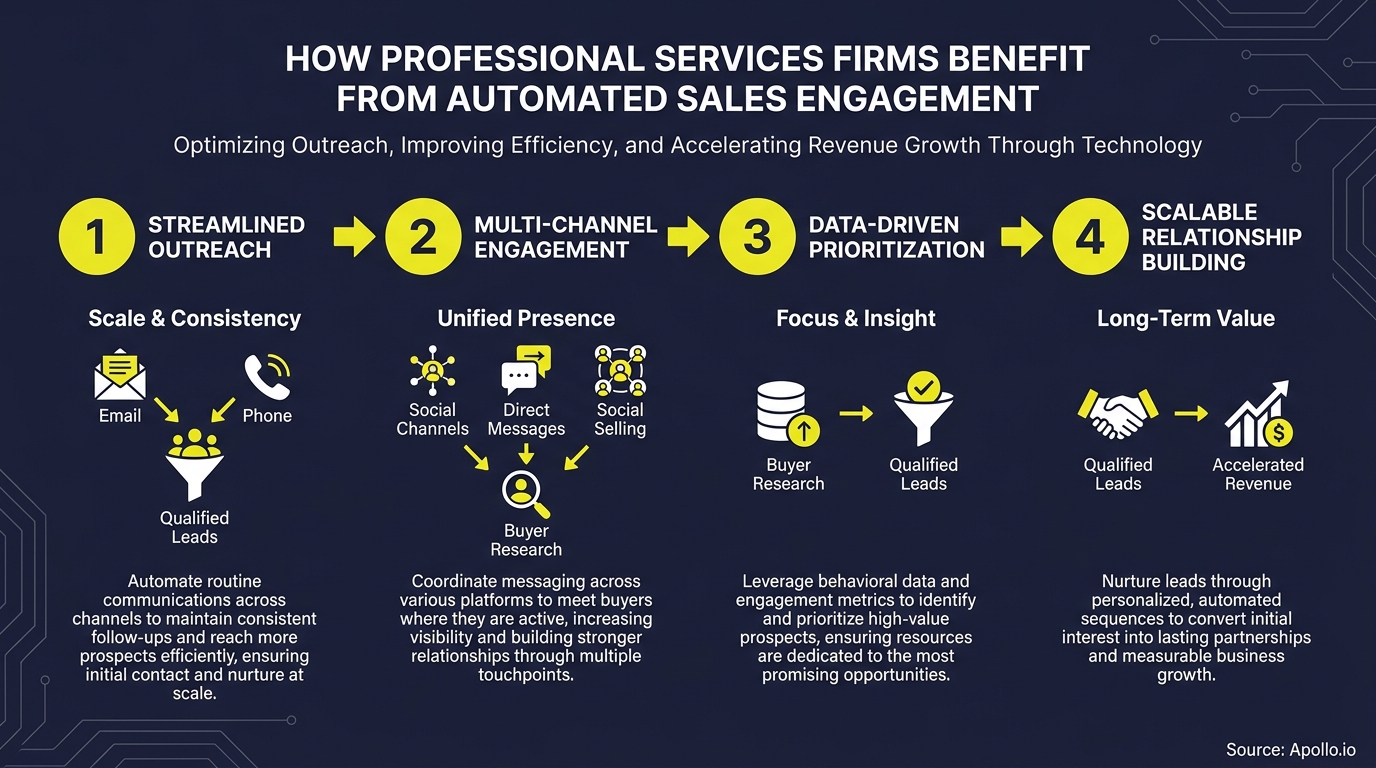
Automated sales engagement is the use of software to execute, sequence, and personalize outreach across email, phone, and social channels—triggered by buyer signals rather than manual effort. For professional services firms (consulting, legal, accounting, marketing services, IT services), the value is specific: partners and principals are the product, so every hour they spend on admin or generic follow-up is billable capacity lost. Winning sales sequences automate the repetitive work while preserving expert judgment for high-stakes conversations.
The category has also evolved. Automated engagement no longer means static email cadences. McKinsey's 2026 Global B2B Pulse Survey of nearly 4,000 decision-makers argues that AI-enabled personalization combined with governance is now the survival threshold for B2B growth—not a competitive advantage, but a baseline requirement.
Where Does Admin Drag Cost Professional Services Firms the Most?
Admin drag in professional services concentrates in five areas that automation directly addresses.
| Admin Task | Automation Solution | Who Benefits |
|---|---|---|
| Lead routing and qualification | Automated scoring and assignment rules | BD teams, RevOps |
| Proposal and contract follow-up | Timed sequences triggered by proposal send | AEs, Partners |
| CRM data entry | Auto-logging calls, emails, and meeting notes | SDRs, AEs, RevOps |
| Nurture between meetings | Multi-touch sequences with case studies and benchmarks | Marketing, BD |
| Meeting scheduling | Automated calendar links and reminders | All client-facing roles |
Research from ConvergeHub shows automated CRM tools save approximately 20–30% of administrative time for adopters, shifting that capacity to selling and client care. For a firm where senior expertise drives margin, that reclaimed time directly protects utilization rates.
Spending hours on manual follow-up and CRM updates? Automate your sequences with Apollo's multi-channel engagement platform and reclaim that expert time for billable work.

How Do SDRs and BD Teams Scale Outreach Without Sacrificing Trust?
SDRs and BD professionals in professional services firms face a unique tension: buyers are sophisticated, risk-averse, and quick to disengage from generic outreach. Gartner found that 73% of B2B buyers actively avoid suppliers sending irrelevant outreach.
Automation only creates value when it is signal-based and personalized—not when it increases volume alone.
A trust-safe automation framework operates on four rules:
- Intent gating: Trigger sequences only after a buyer signal (content download, page visit, event attendance, referral)—not cold list blasts.
- Role-based personalization: Match message content to the buyer's function (CFO receives ROI proof; operations lead receives process evidence; legal receives risk mitigation case studies).
- Message QA and approvals: Require partner or senior BD sign-off on any sequence template before activation. This prevents off-brand or inaccurate claims.
- Human handoff triggers: When a prospect replies, books a meeting, or visits a pricing/services page, immediately pause automation and alert the assigned expert.
According to Cirrus Insight, organizations implementing comprehensive automation frameworks report 25–50% increases in productivity—but the framework design is what separates firms that build pipeline from those that burn it.
Turn Weak Leads Into Pipeline With Apollo
Tired of marketing leads that never become real opportunities? Apollo's buyer signals surface ready-to-engage prospects at the right moment. Top-performing teams use Apollo to build predictable pipeline — not guesswork.
Schedule a Demo →How Does Automated Engagement Handle a 13-Person Buying Committee?
Automated engagement handles large buying committees by running parallel, role-specific nurture tracks simultaneously—something no human BD team can manually sustain. Forrester's 2024 State of Business Buying found an average of 13 people are involved in B2B purchase decisions, with 89% spanning two or more departments.
For professional services, where deals are high-value and politically complex, this is the norm.
A buying-committee playbook using automation looks like this:
- Economic buyer (C-suite): ROI benchmarks, peer case studies, risk-reduction proof points delivered via email and social touchpoints.
- Technical evaluator: Methodology overviews, credentials, and implementation timelines via targeted email sequences.
- Legal or compliance stakeholder: Contract templates, regulatory references, and client testimonials addressing risk.
- Champion or internal sponsor: Presentation-ready materials, competitive comparisons, and objection-handling content to support internal selling.
- End users or department leads: Process-level case studies and adoption evidence.
Learn how to structure the top sales sequences for multi-stakeholder deals with examples built for complex buying environments. For enterprise-level deal management across large committees, these enterprise sales strategies apply directly to professional services contexts.
What ROI Can a Professional Services Firm Expect from Sales Automation?
The ROI from automated sales engagement comes from three sources: reclaimed expert capacity, faster pipeline conversion, and improved lead quality. Data from Forecastio shows sales automation can free up to 25% of time spent on administrative tasks—time that maps directly to billable hours or higher-quality business development in a professional services context.
Use this simple ROI framework to size the opportunity for your firm:
| Input | Example Value | What to Measure |
|---|---|---|
| Partner/BD hours saved per month | Varies by firm size | Hours × blended hourly rate |
| Pipeline conversion rate improvement | Benchmark pre/post automation | Additional closed deals × average contract value |
| Lead qualification speed | Days from inquiry to first meeting | Reduction in sales cycle length |
| Follow-up consistency | % of proposals with structured follow-up | Win rate on proposals with vs. without follow-up |
Salesforce's 2026 State of Sales reports that 85% of reps using AI agents say AI frees them to focus on higher-value work. For professional services firms where senior expert time is both expensive and relationship-critical, that shift has direct margin implications. Track the right customer engagement metrics to attribute pipeline impact to specific automated sequences.
Struggling to build a measurable pipeline from your BD efforts? Build and track your professional services pipeline with Apollo—one platform for prospecting, sequences, and deal management.
How Should a Professional Services Firm Implement Automated Sales Engagement?
Implementation succeeds when it starts narrow, proves ROI quickly, and expands based on data. A phased roadmap prevents over-automation and protects buyer trust.
- Phase 1 (Weeks 1–4): Data foundation. Audit your CRM. Ensure contact records include role, seniority, account history, and last interaction. Clean data is the prerequisite for relevant automation. RevOps leaders find this step alone surfaces significant gaps in their current sales tech stack.
- Phase 2 (Weeks 5–8): Pilot one sequence. Choose a single high-value use case—proposal follow-up or post-event nurture. Build a 5–7 touch sequence. Measure open rate, reply rate, and meetings booked.
- Phase 3 (Weeks 9–12): Add committee tracks. Expand to role-based sequences for your top two buyer personas. Integrate proven cadence structures for outbound touchpoints.
- Phase 4 (Ongoing): Optimize and scale. Use sequence analytics to identify drop-off points. A/B test subject lines and content offers. Review sales analytics monthly to connect sequence performance to closed revenue.
Apollo consolidates prospecting, sequencing, dialer, and pipeline management into one platform—eliminating the need to stitch together separate tools for each step. As Cyera's team noted, "Having everything in one system was a game changer."

Start Automating Your Professional Services Sales Engine in 2026
Automated sales engagement gives professional services firms a way to scale expert-led growth without burning partner capacity on admin work. The firms winning new clients in 2026 are nurturing buyers before the first call, coordinating multi-stakeholder committees with role-specific content, and routing high-intent signals to the right expert at exactly the right moment.
Apollo brings prospecting, multi-channel outreach, AI automation, and pipeline management into a single platform—so your BD team spends less time on logistics and more time closing. Compare how Apollo stacks up against other platforms in the Apollo vs. Salesloft vs. Outreach breakdown to find the right fit for your firm's workflow.
Start Prospecting — build your first automated sequence free with Apollo today.
Prove Pipeline ROI From Day One
ROI pressure killing your tool budget? Apollo delivers measurable pipeline impact fast — teams like Leadium 3x'd revenue with Apollo's automation. Start your free trial and show results before the next budget review.
Start Your Free Trial →Don't miss these
Sales
Inbound vs Outbound Marketing: Which Strategy Wins?
Sales
What Is a Sales Funnel? The Non-Linear Revenue Framework for 2026
Sales
What Is a Go-to-Market Strategy? The 2026 GTM Playbook
See Apollo in action
We'd love to show how Apollo can help you sell better.
By submitting this form, you will receive information, tips, and promotions from Apollo. To learn more, see our Privacy Statement.
4.7/5 based on 9,690 reviews
