
How to Get Insurance Leads for His Agency in 2026
Most agency owners searching for how to get insurance leads for his agency are stuck buying the same shared internet leads as every competitor down the street. That's a race to the bottom on price, not a growth strategy.
The agencies winning in 2026 build a segmented lead engine matched to their line of business, capacity, and geography, not a generic list of phone numbers.
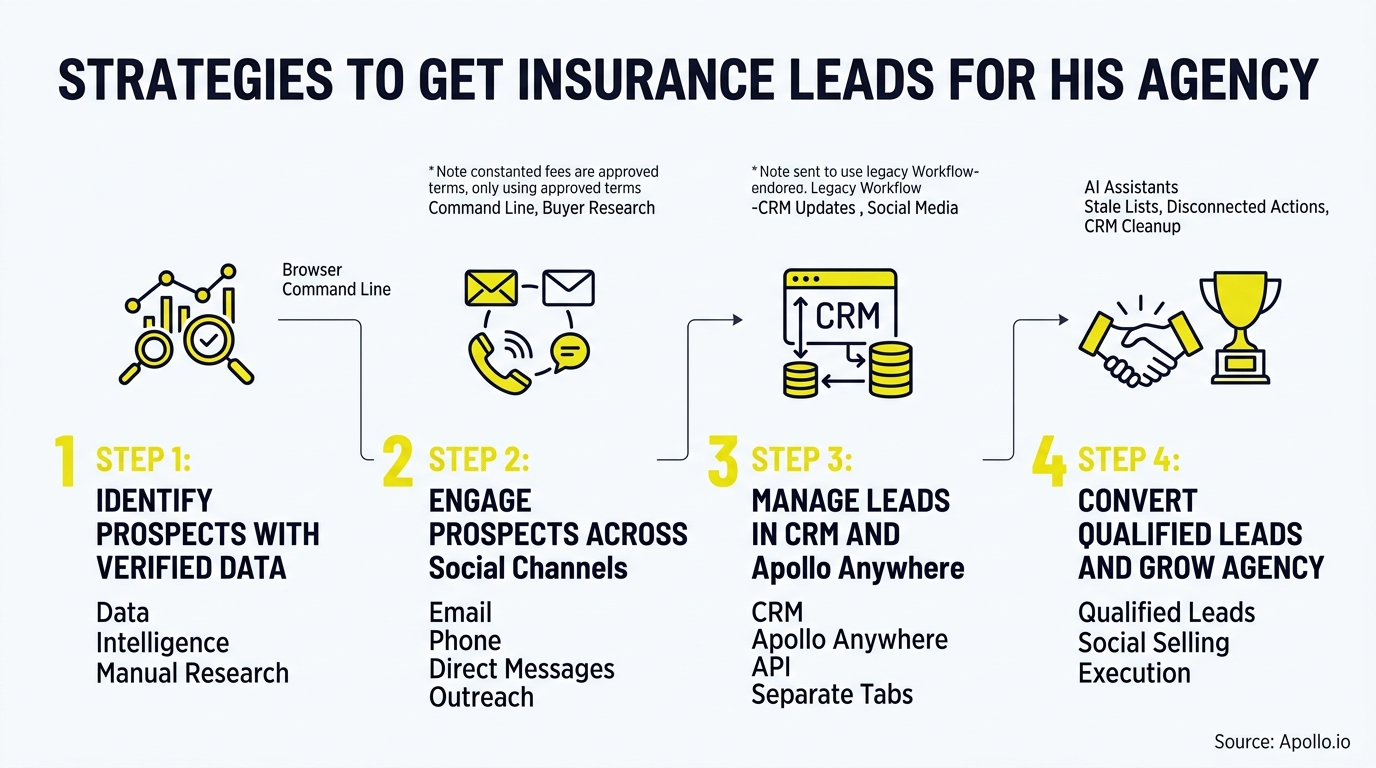

Apollo Ends Manual Lead Research For Good
Spending hours a day manually researching leads and chasing down phone numbers that don't connect? Apollo hands your team verified business contacts at 98% email accuracy, so reps spend time selling instead of searching.
Start Free with Apollo →Key Takeaways
- Match your lead sources to your line of business first. Auto/home, commercial, and life insurance each need different channels, sales cycles, and follow-up cadences.
- Digital shopping is now the default entry point, but most consumers still want a human agent involved before they buy.
- Renewal dates, rate increases, and life events (new home, new baby, new business) are higher-intent triggers than cold outreach.
- Track cost per bind, not just cost per lead. Cheap leads that never convert are more expensive than they look.
- A CRM and enrichment workflow that centralizes contact data prevents leads from going stale before an agent calls them.
What Should an Agency Diagnose Before Choosing Lead Sources?
An agency should diagnose its line of business, staff capacity, target geography, and growth goal before picking any lead channel. Skipping this step is why so many agencies waste budget on leads that don't match how they actually sell.
Run through these questions first:
- Line of business: Personal auto/home, commercial P&C, or life and health? Each has a different buyer, sales cycle, and ideal channel mix.
- Capacity: How many leads can your producers actually call within minutes, not hours? Buying more leads than you can work fast is wasted spend.
- Geography: Hyperlocal SEO and Google Business Profile work best for personal lines; commercial niche leads often extend regionally or nationally.
- Growth target: A 10% book growth goal needs a different lead volume and mix than a 40% growth target.
Independent agencies already hold a structural advantage here: they placed the majority of U.S. P&C premiums in 2024, including the vast majority of commercial-lines premiums, according to the Big "I" 2026 market share report. That access to multiple carriers is your differentiator against direct-to-consumer and embedded insurance options. Lead content should sell that choice, not just compete on premium price.
How Do You Get Insurance Leads for Personal Auto and Home?
You get personal auto and home insurance leads primarily by capturing shoppers during renewal, rate-increase, and life-event windows. Digital channels are now the primary starting point for these buyers, but a hybrid follow-up model still wins the sale.
Mini-playbook: Auto-Home Requote Engine
- Build a target list of prospects nearing policy renewal or recently hit with a rate increase using Apollo's lead database segmented by title, industry, or company for commercial-adjacent personal lines (business owners, contractors).
- Deploy a simple quote-comparison landing page with a clear callback promise inside a defined response window.
- Trigger automated email and SMS sequences the moment a form is submitted, then route hot leads to a live agent immediately.
J.D. Power's 2026 shopping study found that 53% of auto customers were actively shopping, obtaining a record average of 3.5 quotes each, with 48% of new policies purchased digitally. Speed to contact is what separates a bind from a lost lead in that comparison window. Struggling to reach shoppers before they compare you away? Automate your follow-up sequences across email and phone with Apollo.
How Do Agencies Generate Commercial Insurance Leads Through Niche Partnerships?
Agencies generate commercial insurance leads most efficiently by building referral partnerships with accountants, attorneys, and industry associations tied to a specific niche. Commercial buyers move slower and require more trust-building than personal lines shoppers.
Mini-playbook: Commercial Niche Partnership
- Pick 2-3 verticals where you already have carrier appetite and claims expertise (construction, healthcare practices, restaurants).
- Build a target account list of businesses in that vertical using firmographic filters, then segment and automate outreach to that list in Apollo.
- Partner with CPAs and business attorneys who serve the same niche for warm introductions.
Commercial insurance has a notably strong funnel once leads are qualified:First Page Sage reports an average lead-to-MQL conversion rate of 23% for commercial insurance, well above typical B2B benchmarks. That means the bottleneck for most agencies isn't finding commercial prospects, it's qualifying and following up on them consistently. Tired of manually researching every business prospect? Search Apollo's contact database with 65+ filters to build a targeted commercial prospect list in minutes.

How Do Agencies Generate Life Insurance Leads Through Education?
Agencies generate life insurance leads most effectively through educational content that closes the knowledge gap prospects have before they're willing to talk to an agent. Life insurance has one of the widest awareness-to-action gaps in the industry.
Mini-playbook: Life-Event Education
- Build short-form content (email series, video, social posts) triggered around specific life events: new home purchase, new baby, new business, career change.
- Use email list-building strategies to capture contact info from visitors before they leave your educational content.
- Follow every educational touchpoint with a direct, low-pressure consultation offer rather than a hard sales pitch.
This gap matters because most prospects delay action without direct outreach: financial professionals report that a large majority of clients who actually consult them go on to buy, showing that the drop-off happens before the conversation, not during it. Younger buyers are especially reachable through creator-style formats: Gen Z increasingly researches financial products through social media and podcasts rather than traditional insurer websites, according to LIMRA research on Gen Z and life insurance.
Find Sales-Ready Leads With Apollo
Marketing leads going cold before sales ever calls them? Apollo surfaces buying intent and prioritizes prospects who are actually ready to talk, so reps stop chasing names that never convert. Built-In saw a 10% lift in win rate using Apollo's scoring.
Start Free with Apollo →How Can Agency Owners Track Lead Quality Instead of Just Lead Volume?
Agency owners track lead quality by measuring cost per bind and contact rate, not just cost per lead. A cheap lead that never gets contacted or never converts costs more than an expensive one that binds.
Use this vendor and channel evaluation checklist before signing any new lead source:
| Evaluation Criteria | What to Ask |
|---|---|
| Exclusivity | Is this lead sold to one agency or shared across multiple competitors? |
| Consent documentation | Can the vendor show opt-in language and timestamp records? |
| Speed to delivery | How fast does the lead reach you after the prospect submits a form? |
| Line-of-business fit | Does the vendor specialize in your line (auto/home, commercial, life)? |
| Historical bind rate | What conversion rate do other agencies report for this source? |
Lead provenance has become a bigger compliance issue industry-wide. In August 2025, the FTC required Assurance IQ and MediaAlpha to pay a combined $145 million over allegations tied to deceptive health-insurance marketing and improper lead practices, according to the FTC's public announcement. Ask every vendor for consent documentation before you buy.
How Do SDRs and Agency Producers Build a Funnel Dashboard That Tracks What Matters?
SDRs and agency producers build an effective funnel dashboard by tracking five metrics from first contact through bind: contact rate, quote rate, speed-to-lead, bind rate, and cost per bind. Cost per lead alone hides whether your pipeline is actually profitable.
A simple dashboard template:
- Leads received (by source and line of business)
- Contact rate (% reached within your target response window)
- Quote rate (% of contacts who receive a quote)
- Bind rate (% of quotes that convert to a policy)
- Cost per bind (total source spend ÷ binds, not leads)
Marketing budgets are rising sharply across the industry, with average agency marketing spend increasing from roughly $14,300 in 2024 to $20,600 in 2026 and AI adoption tripling over the same period, according to the 2026 Agency Universe Study. That spending increase makes attribution non-negotiable. For Account Executives and producers managing multiple carriers and renewal dates, tracking every quote and bind in one pipeline view replaces scattered spreadsheets across carrier portals.
RevOps leaders at agencies with multiple producers find that consolidating lead sources, CRM data, and outreach sequencing into a single workspace eliminates the duplicate data entry that slows down follow-up. As one agency founder's experience shows, moving to a unified platform cuts the operational drag of managing separate lead, email, and CRM tools.
What Belongs on an Insurance Agency Landing Page and Follow-Up Checklist?
An insurance agency landing page and follow-up checklist should include a fast-loading quote form, clear coverage explanations, and a defined response-time commitment enforced by automated alerts. Most agencies lose leads to slow follow-up, not bad landing pages.
Minimum checklist before launching any lead campaign:
- Mobile-optimized quote form with fewer than 5 required fields
- Clear statement of which carriers/lines you write
- Automated confirmation email or text immediately after submission
- Producer alert triggered the moment a form is submitted
- Enrichment applied to incoming form fills so producers see business/household context before the first call
- Defined callback SLA (documented, not assumed)
Consumers still want a human in that loop: 87% consider access to a human agent important even as they use more digital tools, according to the Big "I"'s September 2026 survey. Your landing page should promise speed; your follow-up call should deliver the human expertise digital tools can't.
What Are the Most Common FAQs About Getting Insurance Leads for an Agency?
How Much Do Insurance Leads Cost?
Insurance lead costs vary widely by line of business, exclusivity, and geography, with commercial and life leads typically costing more than shared personal-lines leads. Rather than fixating on a flat number, evaluate cost per bind using the dashboard framework above.
Should an Agency Buy Exclusive or Shared Leads?
Exclusive leads cost more upfront but typically convert at a higher rate since they aren't being worked by competing agencies simultaneously. Shared leads are cheaper per unit but require faster follow-up to win the sale before a competitor reaches the prospect first.
How Fast Should an Agency Follow Up on a New Lead?
Agencies should follow up within minutes, not hours, since insurance shoppers are actively comparing an average of multiple quotes at once per the J.D. Power data cited above.
Automated alerts and pre-built sequences close this speed gap without adding headcount.
What Is the Best Lead Source for Insurance Agency Lead Generation?
The best source depends on your line of business: renewal and rate-trigger campaigns work best for auto/home, niche referral partnerships work best for commercial, and educational content works best for life insurance. There is no single universal source, which is why segmenting by line of business is the first step in any insurance agency lead generation strategy.

How Do You Build a Sustainable Insurance Lead Engine?
A sustainable insurance lead engine combines segmented channels by line of business, fast automated follow-up, and clear cost-per-bind tracking instead of chasing the cheapest lead source available. Start by diagnosing your capacity and growth goal, then build the specific playbook (requote, niche partnership, or education) that matches your line of business.
Centralizing your prospecting, enrichment, and outreach in one workspace removes the friction that kills fast follow-up. Predictable Revenue's team put it simply after consolidating their stack: "We reduced the complexity of three tools into one" — Collin Stewart, Predictable Revenue. Apollo brings B2B data, sales engagement, and AI-powered execution together in one connected system, so agency producers aren't stitching together separate tools for prospecting, follow-up, and pipeline tracking.
Ready to stop losing leads to slow follow-up and scattered tools? Start Your Free Trial and build a lead engine that tracks every quote from first contact to bind.
Apollo Turns Pipeline Into Provable ROI
Struggling to prove ROI before your renewal review? Apollo replaces scattered spreadsheets with one dashboard tying outreach to closed revenue, so budget approval stops being a guessing game. Leadium 3x'd revenue after automating their pipeline with Apollo.
Start Free with Apollo →Don't miss these
Sales
Inbound vs Outbound Marketing: Which Strategy Wins?
Sales
What Is a Sales Funnel? The Non-Linear Revenue Framework for 2026
Sales
What Is a Go-to-Market Strategy? The 2026 GTM Playbook
See Apollo in action
We'd love to show how Apollo can help you sell better.
By submitting this form, you will receive information, tips, and promotions from Apollo. To learn more, see our Privacy Statement.
4.7/5 based on 9,690 reviews
