
How to Generate Private-Sector Leads for Low-Current Systems Expansion
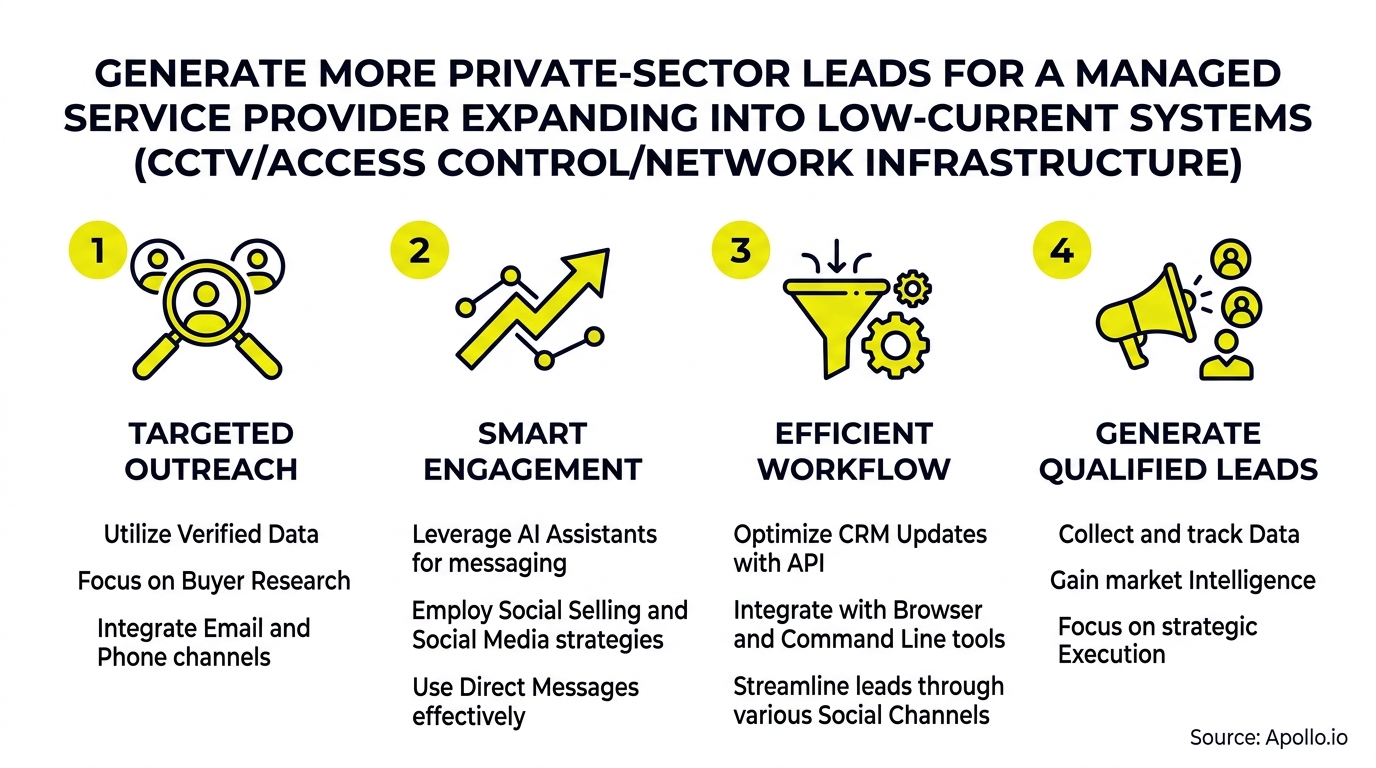
Expanding your MSP into CCTV, access control, and low-voltage network infrastructure means competing for budget against every other vendor promising to modernize a customer's building. The good news: demand is real. Modernization, not price, is the trigger driving most private-sector security spending right now, and buyers increasingly want cameras and access control to deliver operational intelligence, not just after-the-fact footage. Winning this pipeline requires a buyer-first approach that starts with a self-assessment framework and ends with a repeatable outbound motion built on qualified buyer leads, not cold lists.

Skip The Research, Apollo Verifies Contacts
Spending hours manually researching leads and chasing bad emails? Apollo hands your team verified business contacts instantly, with 98% email accuracy built in. Get back to selling instead of searching.
Start Free with Apollo →Key Takeaways
- Most private-sector security buyers are modernizing existing systems, not starting from zero, so lead generation should center on assessments and phased upgrades rather than full rip-and-replace pitches.
- Data-center construction, manufacturing expansion, and retail security investment are three high-intent verticals MSPs can target directly with account-based outreach.
- A hybrid migration offer (assess, remediate network, connect to cloud, replace selectively) removes the biggest buyer objection: disruption and upfront cost.
- Sales cycles for security-integration services move slowly unless MSPs create urgency with a documented self-assessment tool and a clear TCO comparison.
- Consolidating prospecting, enrichment, and outreach into one platform helps small MSP sales teams compete with larger integrators without adding headcount.
What Is A Managed Low-Current Systems Offering?
A managed low-current systems offering bundles CCTV, access control, and the underlying network infrastructure (PoE switching, VLANs, cabling) into a single recurring-revenue service instead of a one-time install. This differs from traditional low-voltage contracting, which typically ends at project handoff with no ongoing accountability.
MSPs are well-positioned for this shift because they already sell recurring IT services and understand SLAs, remote monitoring, and patch management.
The market supports this move. PR Newswire reports that businesses are moving away from standalone security hardware toward integrated, data-driven utility models, exactly the shift a managed-services wrapper is built to capture. IP cameras alone are expected to represent the vast majority of surveillance revenue by 2026, according to Data Insights Reports, which means most opportunities involve networked, IP-based equipment your team already understands.
How Do You Qualify a Prospect: Retain, Integrate, Phase, or Replace?
Qualify prospects using a four-path decision tree based on the condition of their existing system, not a generic sales pitch. This self-assessment lets your sales team (and the prospect) quickly agree on scope before a proposal is written, which shortens the sales cycle.
| Path | When It Applies | Typical Offer |
|---|---|---|
| Retain | System is under 3 years old, IP-based, vendor is not on a restricted list | Monitoring, maintenance, and network hardening only |
| Integrate | Mixed analog/IP system with usable cabling and panels | Add cloud bridge, unify video and access management, extend network |
| Phase | Aging system (5+ years), budget constrained, multiple sites | 3/12/36-month replacement roadmap tied to lease or budget cycles |
| Replace | End-of-life hardware, flagged equipment, no cabling to reuse | Full rebuild with managed network and lifecycle contract |
The FCC's October 2025 advisory urging organizations to review its Covered List for certain surveillance equipment gives MSPs a legitimate, non-alarmist reason to offer camera-inventory audits to regulated businesses and federal contractors, a strong entry point into the Replace or Phase paths.
What Does a 3/12/36-Month Migration Plan Look Like?
A phased migration plan spreads modernization across three checkpoints so buyers avoid a disruptive, budget-breaking rip-and-replace project. This structure directly answers the top objection uncovered in industry surveys: cost and disruption concerns slowing cloud and system upgrades.
| Phase | Scope | Buyer Benefit |
|---|---|---|
| 0-3 Months | Network and camera-estate audit, VLAN segmentation plan, quick-win access control fixes | Low cost, immediate risk visibility |
| 4-12 Months | Cloud bridge deployment, priority camera/panel replacement, staff access-policy training | Addresses tailgating and propped-door failures without full rebuild |
| 13-36 Months | Full hardware refresh, AI-enabled analytics rollout, managed SLA contract | Predictable monthly cost, ongoing support |
Include a simple TCO worksheet in your proposal comparing current maintenance and downtime costs against a flat monthly managed contract. For reference, small commercial CCTV installs (4-8 cameras) typically run $2,500 to $6,000, and low-voltage technician labor runs $75 to $150+ per hour, numbers worth showing buyers so they can compare a managed contract against DIY or one-off vendor costs.
Find Sales-Ready Buyers Before Rivals Do
Marketing leads going cold before sales ever picks up the phone? Apollo surfaces in-market buyers with intent signals so reps chase real opportunities, not dead ends. Built-In saw a 10% higher win rate using Apollo's scoring.
Start Prospecting →Which Private-Sector Verticals Should MSPs Target First?
Manufacturing, warehousing/logistics, and data centers are the strongest near-term verticals because construction spending and operational risk are both rising in these segments. Southern U.S. manufacturing and logistics corridors are seeing outsized private construction growth, making them efficient targets for account-based outreach.
- Manufacturing: Sell operational-intelligence framing, loading-dock monitoring, safety-compliance video, and access control tied to shift schedules, not just perimeter cameras.
- Warehouses/Logistics: Position remote video monitoring and access control as a way to reduce shrinkage and monitor dock throughput.
- Data Centers: U.S. data-center construction has surged, creating demand for fiber, structured cabling, network segmentation, access control, and surveillance as one bundled scope. Build target lists around developers, colocation operators, and electrical contractors active in this build-out.
Retail chains are a fourth vertical worth watching. Regional multisite retailers are increasing investment in cameras and access control in response to theft and loss trends, a pattern that favors standardized, repeatable packages across locations.

How Do SDRs and BDRs Find These Buyers Faster?
SDRs and BDRs find qualified security-modernization buyers by filtering for facilities, IT, and operations titles at companies showing construction, expansion, or compliance signals, not by cold-calling generic company lists. Since physical security purchases now regularly involve both security and IT stakeholders, reps need contact data spanning both departments.
Struggling to find qualified leads in niche verticals like data centers and manufacturing? Search Apollo's 240M+ contacts with 65+ filters to build account lists by industry, headcount, and location, then layer in facilities directors, IT managers, and operations VPs in one search.
This matters because The Hacker News reports that 77% of MSPs cite a lack of client urgency as their biggest sales challenge, meaning outbound needs to reach the right stakeholder with the right trigger event (a permit filing, a compliance deadline, an aging-system audit finding) rather than a generic pitch.
How Can RevOps and Sales Leaders Build a Repeatable Pipeline?
RevOps and sales leaders build a repeatable pipeline by combining trigger-based prospecting, a phased-offer sales motion, and multi-channel nurture sequences in one workflow. Security-integration sales cycles are typically long and technical, so consistency across email, phone, and social touchpoints matters more than volume.
Spending hours manually researching construction permits and facility expansions? Automate your outreach sequences with Apollo's sales engagement platform so reps spend time on qualified conversations instead of manual list-building.
Because most B2B buying groups research and shortlist vendors before ever speaking to sales, MSPs also need supporting content: vertical landing pages for manufacturing and data centers, documented response-time SLAs, and case studies. Pair this inbound content with inbound lead conversion tools and form optimization to capture and qualify site visitors before a competitor does. For teams juggling separate tools for prospecting, enrichment, and outreach, consolidating helps: Collin Stewart of Predictable Revenue said, "We reduced the complexity of three tools into one."
What Should a Sample Managed-Service Scope Include?
A sample managed-service scope should combine hardware coverage, network health, and response commitments into one contract, not separate line items. This makes the offer easy for buyers to compare against a break-fix vendor or a DIY approach.
- 24/7 remote video health monitoring and alerting
- Access control credential management and audit logging
- Network segmentation (VLANs) and firmware patch management for cameras and panels
- Defined response-time SLA for outages or tampering alerts
- Quarterly system-health and compliance review
- Annual lifecycle and replacement-roadmap update
Pricing this correctly requires knowing your blended customer acquisition cost. First Page Sage puts blended CPL for security integration at roughly $805, a useful benchmark for calculating your marketing and outbound budget per closed account. Track this against your CAC payback period so leadership can see when the managed contract becomes profitable.
How Do Account Executives Shorten the Sales Cycle?
Account Executives shorten low-current systems sales cycles by walking prospects through the self-assessment (Retain/Integrate/Phase/Replace) live during discovery calls instead of waiting for a separate technical audit. This gives buyers an immediate, credible next step and removes the ambiguity that stalls security-integration deals.
AEs managing multiple site visits and technical stakeholders also benefit from clean deal visibility. Use Apollo's deal management tools to track where each multisite opportunity sits in the phased-offer pipeline, from initial audit through contract signature. This is especially useful for retail chains or manufacturing groups with several locations moving through the assessment at different speeds.

Getting Started: Turn Modernization Demand Into Booked Meetings
The private-sector opportunity for MSPs expanding into CCTV, access control, and network infrastructure is built on a clear pattern: buyers want modernization, not replacement, and they want a single accountable vendor instead of three separate contractors. Lead with the self-assessment framework, price with a phased 3/12/36-month plan, and target manufacturing, logistics, and data-center accounts where construction and compliance triggers create urgency.
Winning this pipeline consistently means pairing a strong offer with the right prospecting and outreach stack. Explore finding B2B leads by title, industry, or company and review free lead generation strategies to build your first target list this week.
Justify Spend With Apollo's Fast Payback
Struggling to prove pipeline impact before the budget review? Apollo replaces scattered outreach tools with one platform so results show up in weeks, not quarters. Leadium tripled annual revenue after consolidating with Apollo.
Start Free with Apollo →Don't miss these
Sales
Inbound vs Outbound Marketing: Which Strategy Wins?
Sales
What Is a Sales Funnel? The Non-Linear Revenue Framework for 2026
Sales
What Is a Go-to-Market Strategy? The 2026 GTM Playbook
See Apollo in action
We'd love to show how Apollo can help you sell better.
By submitting this form, you will receive information, tips, and promotions from Apollo. To learn more, see our Privacy Statement.
4.7/5 based on 9,690 reviews
