
How to Generate Leads for Your Insurance Agency and Automate Outreach
Finding new commercial accounts is the top challenge for independent agencies today. The 2024 Agency Universe Study found that 57% of independent agencies named finding new markets their biggest growth obstacle, even though 75% reported revenue gains the prior year. The fix isn't more cold emails. It's a system that finds the right businesses, at the right moment, and reaches them the right way.
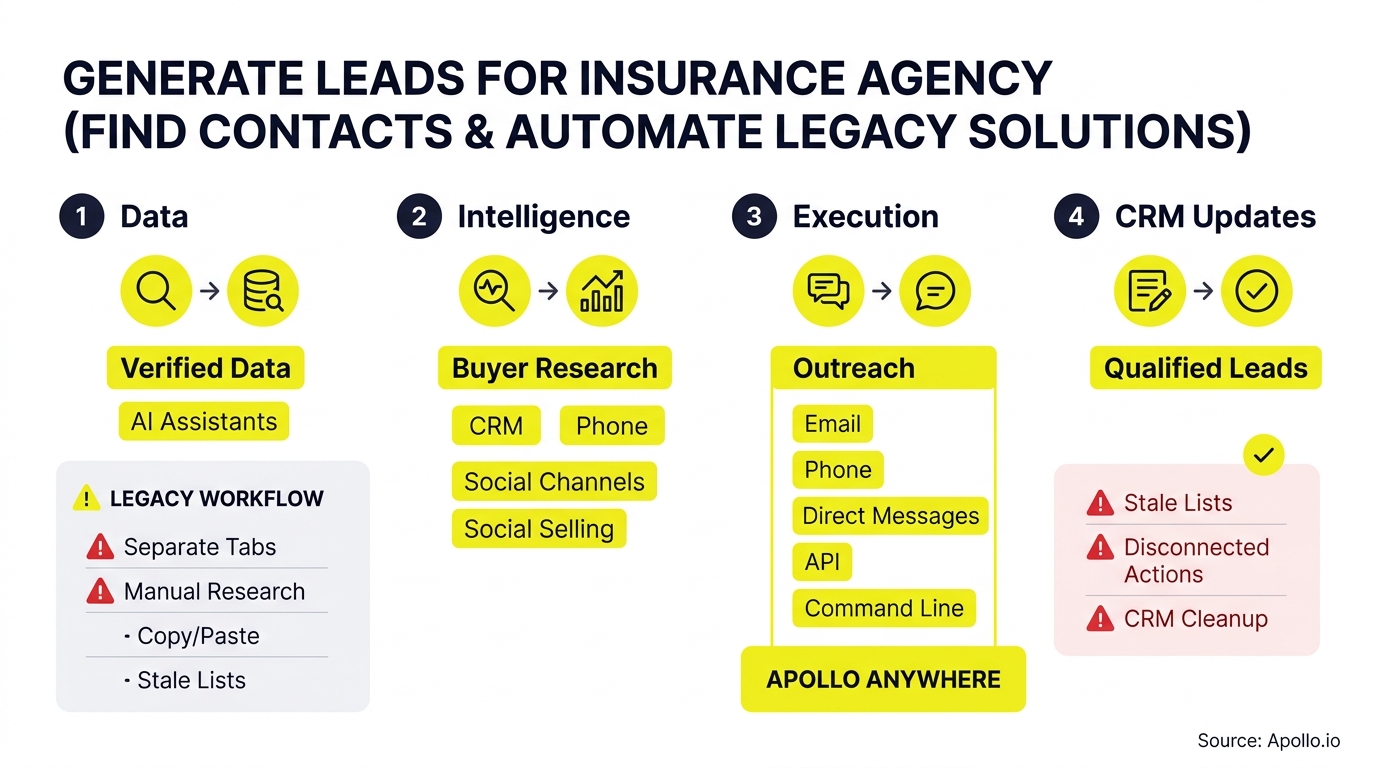

Apollo Ends Manual Lead Research For Good
Spending hours a day verifying emails and phone numbers instead of selling? Apollo hands your team verified contacts with 98% email accuracy, so reps prospect of playing data detective. Join 600K+ companies building pipeline faster.
Start Free with Apollo →Key Takeaways
- Agencies that win more commercial accounts target by industry, employee count, and coverage trigger instead of blasting generic lists.
- Relevance beats volume: most B2B buyers actively avoid vendors sending irrelevant outreach, so message quality determines reply rates more than send count.
- AI adoption among independent agencies has jumped sharply in two years, but compliance (consent, DNC, CAN-SPAM) has to be built in from day one, not bolted on later.
- A 7-step operating system, ICP, triggers, contacts, enrichment, education, outreach, handoff, measurement, turns scattered prospecting into a repeatable pipeline.
- Tracking quote-to-bind rate and revenue per source matters more than counting raw leads.
What Is A Commercial Insurance Lead Generation System?
A commercial insurance lead generation system is a repeatable process that identifies target businesses, finds the right decision-makers, enriches their contact data, and engages them through compliant, multichannel outreach until they book a conversation with a producer. It is not a single tool or a purchased list.
It's a connected workflow: ICP definition, trigger monitoring, contact discovery, enrichment, sequenced outreach, and handoff to a licensed agent for advice and closing.
This matters because independent agencies compete in a market of roughly 34.8 million U.S. small businesses, according to SBA data. Without segmentation, agencies waste outreach on businesses that will never buy.
With a system, every dollar of outreach effort targets a business that actually needs coverage right now.
How Do You Build An Ideal Customer Profile For Commercial Insurance?
You build an ICP for commercial insurance by scoring prospects on industry risk, company size, geography, and buying triggers, then excluding accounts that don't match your appetite. Start with a scorecard instead of a generic list.
| ICP Factor | High-Fit Signal | Exclude If |
|---|---|---|
| Industry (NAICS code) | Matches carrier appetite (construction, healthcare, trucking, tech) | Outside carrier risk tolerance |
| Employee count | 10-250 employees (sweet spot for most commercial lines) | Fewer than 5 or already enterprise-insured |
| Geography | Licensed state/region | Unlicensed jurisdiction |
| Growth signal | New location, hiring surge, recent funding | Declining headcount or closure filings |
| Renewal timing | Policy renewal within 60-90 days | Locked into multi-year contract |
Use this scorecard to build a target account list you can segment and automate, rather than working a flat spreadsheet.
What Triggers Signal A Business Needs New Insurance Coverage?
Buying triggers signal that a business has an active or upcoming insurance need, and they're more reliable than cold outreach alone. Monitor these events to time your outreach when relevance is highest.
- New business formation: Newly registered LLCs and corporations need general liability and workers' comp fast.
- New location or expansion: Additional property, vehicles, or employees change coverage needs.
- Hiring surges: Rapid headcount growth often triggers workers' comp and benefits reviews.
- Policy renewal windows: The 60-90 day window before renewal is when businesses shop competing quotes.
- Cyber incidents in their industry: Peer breaches often prompt a cyber liability review.
- Leadership changes: New CFOs or risk managers frequently re-evaluate vendor relationships.
Struggling to find qualified leads before your competitors do? Search Apollo's 240M+ contacts with 65+ filters to build trigger-based lists by industry, headcount, and location in minutes.
How Do You Find And Verify Business Owner Contact Information?
You find and verify business owner contacts by combining firmographic search filters with a waterfall enrichment process that checks multiple sources before returning a business email or phone number. Start by identifying the actual decision-maker: owner, office manager, or risk manager, not just a generic info@ inbox.
A usable contact record needs more than a name and email. Build each record with:
- Full name, title, and verified business email
- Direct business phone line (not a shared front-desk number)
- Company NAICS code, employee count, and location
- Current carrier and renewal date, if known
- Consent/opt-in source and timestamp
- Do Not Call and CAN-SPAM suppression status
Tired of chasing outdated contact info? Apollo's data enrichment refreshes firmographic and contact fields so your CRM reflects current job titles and company details.
See Every Deal's Real Status With Apollo
Marketing leads going quiet the moment sales takes over? Apollo's unified workflow shows exactly where every prospect stands, so nothing stalls between handoff and close. Turn guesswork into forecasts you can actually trust.
Schedule a Demo →How Can Agencies Automate Outreach Without Sounding Robotic?
Agencies automate outreach effectively by using sequenced, multichannel campaigns that combine automated timing with personalized message content pulled from real trigger data. Automation should handle the repetitive parts, send timing, follow-up cadence, CRM logging, while producers handle the actual conversation.
According to Cirrus Insight, automation adoption has shifted from a competitive edge to a baseline requirement for revenue operations. That shift applies directly to insurance: manual list-building and one-off emails can't keep pace with trigger-based prospecting at scale.
This matters because relevance drives replies. Gartner's 2025 report found that 73% of B2B buyers actively avoid vendors that send irrelevant outreach. A generic "are you happy with your current insurance?" email fails; a message referencing a specific trigger (new location, upcoming renewal) performs better.
For SDRs and account managers running commercial books, sequences might look like:
- Day 1: Email referencing the specific trigger (new location, hiring news)
- Day 3: Phone call from a producer, not a script-reading bot
- Day 7: Follow-up email with a relevant case study or coverage checklist
- Day 14: Final email offering a no-obligation coverage review
Spending hours a week on manual follow-up? Automate your sequences with Apollo's multi-channel platform and keep every touchpoint logged in one place instead of juggling separate tools for email, calls, and tracking.

How Do RevOps Leaders And Producers Stay Compliant While Automating Outreach?
RevOps leaders stay compliant by maintaining auditable consent records, running Do Not Call checks before every call, and logging opt-out status in real time across every channel. This isn't optional.
The FTC's 2025 action against MediaAlpha, which alleged misleading advertising used to collect and resell contact data to telemarketers, shows regulators are scrutinizing both lead sellers and buyers.
A compliance checklist for agency outreach:
- Verify each contact's consent source before adding them to a call or SMS list
- Scrub lists against the National Do Not Call Registry before dialing
- Log every opt-out immediately and suppress across all channels
- Keep CAN-SPAM-compliant unsubscribe links in every email (violations can carry penalties up to $53,088 per message)
- Document AI-assisted call scripts so producers control final advice and closing conversations
The Eleventh Circuit's January 2025 ruling vacated the FCC's proposed one-to-one consent rule, but existing TCPA consent and DNC obligations still apply. Users control who they call and how they use outreach tools.
Customer selects the numbers to call; nothing here is automated or random dialing.
How Can SDRs And Producers Measure Lead Generation ROI Beyond Cost Per Lead?
SDRs and producers measure ROI by tracking the full funnel from first touch to bound policy, not just cost per lead. Cost per lead tells you what you spent; it doesn't tell you what converted.
| Metric | What It Measures |
|---|---|
| Reply rate | Message relevance and timing |
| Qualified conversation rate | Fit between ICP and actual prospect need |
| Quote-to-bind rate | Producer effectiveness in closing |
| Revenue per source | Which channel (referral, outbound, inbound) drives premium |
| Retention/renewal rate | Long-term account value |
Insurance-native platforms are already shifting this way. Arity launched a platform in September 2026 connecting lead sources, agent workflows, and downstream outcomes, reflecting demand to evaluate sources by conversion and lifetime value rather than cost per lead alone.
Account Executives managing renewal books should apply the same logic: track which trigger types and sequences actually produce bound policies, then double down there.
For pipeline visibility across every stage from first touch to bound policy, a deal management view keeps producers and RevOps aligned on what's actually converting.
What Does A 30-Day Plan Look Like For A Small Agency?
A 30-day lean rollout gets a small agency from zero to a working outreach engine without a big tech investment. Here's the sequence:
- Week 1: Build your ICP scorecard and pull your first trigger-based list (new formations, upcoming renewals) in your target NAICS codes.
- Week 2: Enrich contacts with verified business emails and direct phone lines; scrub against DNC and set up consent logging.
- Week 3: Launch a 4-touch sequence referencing specific triggers; route replies to producers for calls.
- Week 4: Review reply rates, qualified conversations, and early quote activity; refine ICP filters based on what converted.
Agency Equity reports that AI adoption among independent agencies jumped from 15% in 2024 to 46% in 2026, so agencies that build this system now are ahead of most of the market, not behind it. This lean approach also mirrors the broader lead-generation playbook in Apollo's automated lead generation system guide, adapted for commercial insurance triggers and compliance needs.

Getting Started: Turning Prospecting Into Bound Policies
A commercial insurance growth engine comes down to five moves: define your ICP tightly, monitor real triggers, verify contact data before you reach out, automate the repetitive parts of your sequence, and measure results from reply through bound policy. Skipping any one of these steps either wastes outreach on the wrong businesses or creates compliance exposure you don't want.
Agencies juggling separate tools for prospecting, enrichment, and outreach often find the fragmentation itself is the bottleneck. Predictable Revenue's Collin Stewart put it simply: "We reduced the complexity of three tools into one." Apollo brings B2B data, sales engagement, and AI-powered execution together in one connected go-to-market system, so agencies don't have to stitch together separate vendors for research, outreach, and analysis. Explore how agencies use Apollo to scale client acquisition in this agency lead generation case study.
Ready to build a compliant, relevance-first outreach engine instead of another cold-email machine? Get Leads Now.
Turn Tool Spend Into Numbers Leadership Trusts
Can't quantify pipeline impact when budget review comes around? Apollo tracks outreach-to-revenue in one workspace, so every dollar spent shows up as a dollar of pipeline. Teams report faster ramp and clearer wins to bring to leadership.
Start Free with Apollo →Don't miss these
Sales
Inbound vs Outbound Marketing: Which Strategy Wins?
Sales
What Is a Sales Funnel? The Non-Linear Revenue Framework for 2026
Sales
What Is a Go-to-Market Strategy? The 2026 GTM Playbook
See Apollo in action
We'd love to show how Apollo can help you sell better.
By submitting this form, you will receive information, tips, and promotions from Apollo. To learn more, see our Privacy Statement.
4.7/5 based on 9,690 reviews
