
How to Find and Engage Sustainability and Energy Manager Leads
Grant awards, benchmarking ordinances, and building-performance-standard deadlines are now public buyer-intent signals hiding in plain sight. Sales teams that only search job titles like "Sustainability Manager" miss the local governments and multi-site commercial portfolios that are actively funded and compliance-pressured right now.
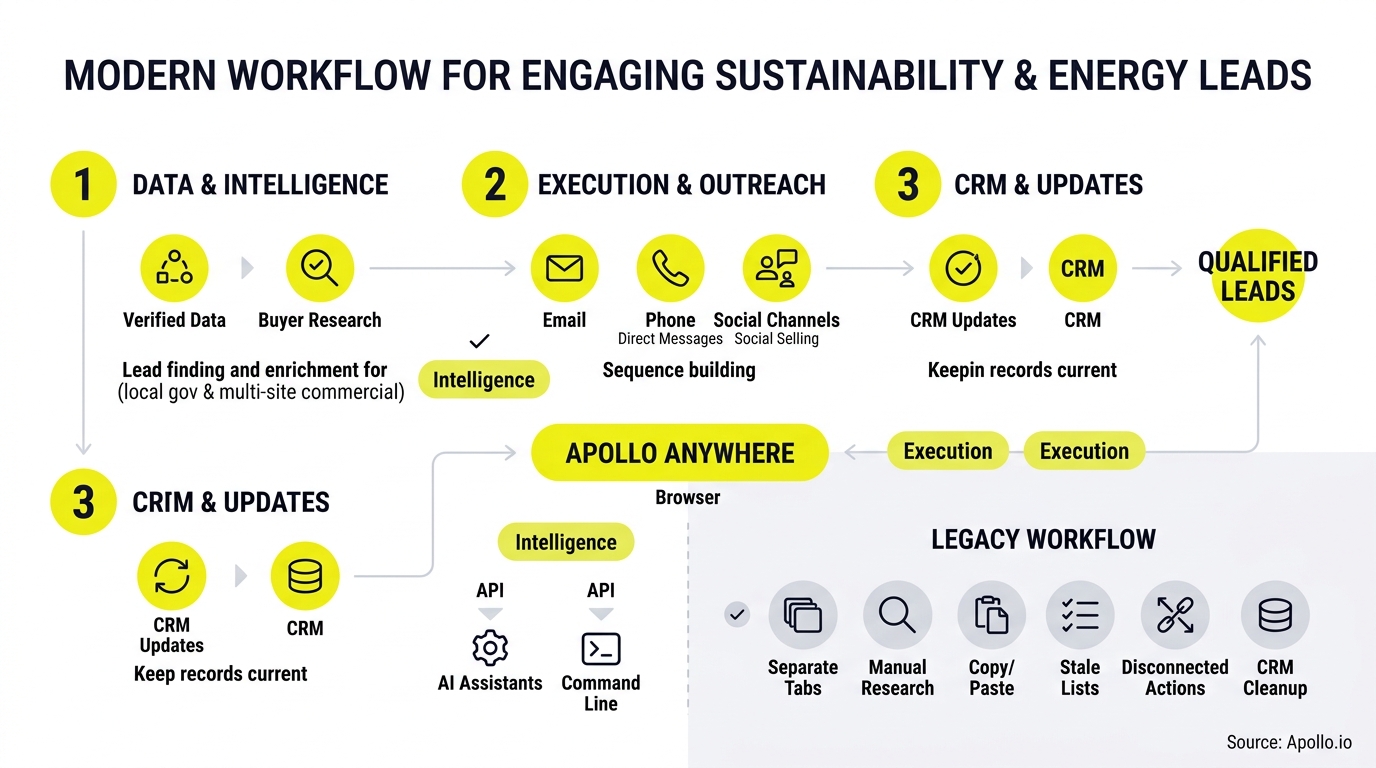
This guide shows SDRs, AEs, and RevOps teams how to build a trigger-to-sequence system that finds these accounts, enriches the buying group, verifies contactability, and launches sequences before competitors even open their CRM.

Apollo Verifies Contacts So Reps Can Sell
Still burning hours hunting down emails and phone numbers that bounce anyway? Apollo hands your team verified contact data instantly, with 98% email accuracy built in. Spend the day selling, not searching.
Start Free with Apollo →Key Takeaways
- Grant award databases and building-performance-standard (BPS) filings are more predictive of buyer intent than job titles alone.
- Municipal and commercial energy roles rarely map to clean, consistent titles, so enrichment around department and project activity matters more than title-matching.
- B2B energy and sustainability purchases involve large buying groups spanning facilities, finance, procurement, and executive stakeholders, not a single champion.
- Email verification and suppression rules must run before sequencing, since inbox placement and deliverability rules have gotten stricter.
- Local-government procurement timing (budget cycles, RFPs) and multi-site commercial compliance motions (BPS deadlines, portfolio benchmarking) require separate outreach cadences.
Where Do You Find Public-Sector and Sustainability Buyer Signals?
You find these signals by monitoring federal and state funding trackers, compliance filings, and portfolio benchmarking data rather than relying on generic firmographic search alone. Start with a source map:
- DOE Energy Efficiency and Conservation Block Grant program: identifies eligible local governments and award recipients.
- EPA Climate Pollution Reduction Grants and Priority Climate Action Plans: state, metro, and Tribal implementation plans tied to funding.
- EPA Portfolio Manager Data Explorer: benchmarking data for commercial and multifamily properties.
- Local BPS ordinance trackers: jurisdiction-level compliance deadlines and penalties.
- State energy office award pages: named recipients and project types (HVAC, geothermal, solar, weatherization).
- Municipal budgets and procurement portals: capital plans and open RFPs signaling near-term spend.
For example, Maryland's May 2026 announcement of $56.8 million across 127 building-energy projects named specific recipients, project types, and award amounts, turning a funding announcement into a ready-made target list. Building-performance-standard trackers showing Lakewood, Colorado's new benchmarking ordinance and adjusted enforcement deadlines in New Orleans and Madison work the same way: each entry is a covered-building account with a compliance clock attached.
Why Are Job Titles Unreliable for Sustainability and Energy Manager Prospecting?
Job titles are unreliable because many local governments and commercial portfolios assign sustainability and energy responsibilities to staff without a matching title, or create the role only after receiving grant funding. Some state programs, including 2026 staffing grants in Wisconsin, fund entirely new sustainability-lead positions in communities that didn't previously have one.
That means the contact you need may not exist in a title-based search yet.
Build your account list around departments and active projects instead of titles alone:
- Public works, facilities management, or general services departments
- Named recipients on grant award or capital improvement plans
- Staff associated with benchmarking filings or BPS compliance reports
- Sustainability, energy, or environmental committees listed in public meeting minutes
Struggling to find qualified leads when titles don't match your ICP? search Apollo's database with 65+ filters to combine department, seniority, and company signals instead of guessing at titles.

How Do You Score Accounts for Buyer Intent?
You score accounts by combining funding status, compliance exposure, and portfolio scale into a single weighted model, not by treating any one signal as sufficient on its own. Use a table like this to prioritize outreach:
| Signal | Weight | Example Trigger |
|---|---|---|
| Active grant award | High | Named recipient on a state or DOE award list |
| BPS compliance deadline within 12 months | High | Jurisdiction ordinance with upcoming filing date |
| Portfolio benchmarking gap | Medium | Building underperforming vs. Portfolio Manager peers |
| Recent sustainability hire or new role | Medium | Staffing grant or job posting for new position |
| Website/content intent | Low-Medium | Visits to compliance or incentive pages |
| Funding status change | Variable | Award delayed, reinstated, or litigated |
Track funding status as a dynamic field, not a one-time checkbox. Clean-energy programs can move from award to delay, cancellation, or reinstatement, so a stale "received grant" tag will misdirect your sequencing.
How Do You Enrich and Map the Buying Group?
You enrich and map the buying group by identifying every stakeholder role tied to an energy or sustainability decision, not just the single named contact on a grant filing. Forrester reported in December 2024 that an average B2B purchase involves 13 people across at least two departments, and that most purchases stall before close.
For public-sector and multi-site commercial energy deals, that buying group typically includes:
- Facilities or public works director (project owner)
- Sustainability or energy manager (technical evaluator)
- Finance or budget officer (funding approval)
- Procurement officer (RFP and vendor process)
- City manager, CFO, or VP of operations (executive sign-off)
Tired of dirty, incomplete contact records for these roles? start free with Apollo's verified business contact database to fill in the full buying committee before you send a single email. Predictable Revenue's Collin Stewart described the impact of consolidating tools this way: "We reduced the complexity of three tools into one" — Predictable Revenue.
See Every Deal Stage Before It Stalls
Marketing leads going cold before sales even follows up? Apollo scores and prioritizes prospects in real time, so reps chase deals that are actually ready to move. Built-In saw a 10% higher win rate using Apollo's signals.
Schedule a Demo →Why Does Email Verification Matter Before Sequencing?
Email verification matters because unverified lists damage deliverability and waste your window of opportunity on a time-sensitive compliance or funding trigger. Validity's 2025 benchmark found that one in six marketing emails failed to reach the inbox, with global inbox placement at 83.5%.
Gmail and Microsoft have also tightened bulk-sender requirements, rejecting noncompliant high-volume traffic that lacks proper authentication.
Before enrolling any public-sector or commercial energy contact in a sequence:
- Verify deliverability status (valid, catch-all, risky, invalid)
- Confirm SPF/DKIM/DMARC authentication on your sending domain
- Suppress bounced, unsubscribed, or role-based addresses (info@, clerk@)
- Check job-change or department-move flags for municipal contacts, since public-sector turnover disrupts records fast
Apollo's email verification workflow checks deliverability at the point of enrichment, so RevOps teams don't discover a bad domain after a sequence is already live.
How Do You Build Sequences for Local Government vs. Multi-Site Commercial Accounts?
You build separate sequences because local-government buyers move on budget-cycle and RFP timing while commercial portfolio buyers move on compliance-deadline and ROI timing. Treating both groups the same wastes the specificity that makes a trigger-based approach work.
Local Government Sequence (grant/RFP-triggered):
- Email 1: Reference the specific award or plan (e.g., named grant program) and ask about implementation timeline
- Email 2: Share a relevant case study or compliance resource tied to their project type
- Call: Reference budget cycle and procurement calendar directly
- Email 3: Offer a scoped next step tied to their RFP or capital plan milestone
Multi-Site Commercial Sequence (BPS/compliance-triggered):
- Email 1: Reference the specific jurisdiction's ordinance and filing deadline
- Email 2: Share portfolio benchmarking gap data and cost-of-inaction framing
- Call: Speak to VP of operations or facilities lead about penalty exposure
- Email 3: Propose a portfolio-wide assessment ahead of the deadline
Spending hours building these sequences manually? automate multi-channel sequencing with Apollo so reps can trigger the right cadence the moment an account hits your intent score threshold. See our guide on outbound prospecting for more cadence-building tactics.
How Can SDRs and AEs Prioritize These Accounts in Their CRM?
SDRs and AEs prioritize these accounts by tagging CRM records with structured fields for funding stage, compliance deadline, and buying-group completeness, not just company name and industry. A usable schema includes:
- Account type: Local government / Multi-site commercial
- Trigger source: Grant award, BPS ordinance, benchmarking gap, staffing grant
- Funding stage: Announced, obligated, in dispute, reinstated
- Compliance deadline: Date and jurisdiction
- Buying group completeness: Number of verified stakeholder contacts out of 5 target roles
- Intent score: Weighted score from the table above
For SDRs booking first meetings, this schema turns a cold list into a ranked queue. For AEs managing later-stage deals, it flags which accounts have incomplete buying groups before a stalled deal becomes a lost one.
Sales & Revenue Leaders can use the same fields to build territory plans around jurisdictions with the nearest compliance deadlines instead of splitting territory by geography alone.
What Are the Most Common Questions About This Prospecting Approach?
How Do You Find Leads Tied to Government Grant Awards?
You find these leads by monitoring DOE, EPA, and state energy office award announcements, then matching recipient organizations to contact records in your sales intelligence platform. Cross-reference named recipients against your CRM and enrich any new accounts immediately, since award lists are public and competitors can access them too.
Why Is Email Verification Especially Important for Municipal Contacts?
Email verification is especially important for municipal contacts because public-sector staff turnover and inconsistent domain structures increase bounce risk. A verification step before sequencing protects your sender reputation and keeps your outreach compliant with tightened inbox provider rules.
How Do You Sequence a Multi-Stakeholder Public-Sector Buying Group?
You sequence a multi-stakeholder buying group by running parallel, role-specific cadences (facilities, finance, procurement, executive) that reference the same trigger event but tailor the message to each stakeholder's concern. This keeps outreach relevant, which matters since buyers increasingly disengage from suppliers whose messaging feels generic.
What Data Sources Confirm Building-Performance-Standard Compliance Exposure?
BPS compliance exposure is confirmed through jurisdiction-level ordinance trackers, EPA's Portfolio Manager benchmarking data, and public compliance filings that list covered buildings, deadlines, and penalties.

Turn Public-Sector and Sustainability Signals Into Pipeline
Grant awards, compliance deadlines, and benchmarking gaps are publicly available signals that most sales teams still treat as background noise instead of a prioritization system. Building a trigger-to-sequence workflow, complete with account scoring, buying-group enrichment, email verification, and jurisdiction-specific cadences, turns that public data into a repeatable pipeline motion for SDRs, AEs, and RevOps teams alike.
Apollo brings B2B data, sales engagement, and AI-powered execution together in one connected go-to-market system, so teams don't have to stitch together separate vendors for research, outreach, and analysis. As Cyera put it, "Having everything in one system was a game changer" — Cyera. Explore more tactics in our guide to building targeted email lists or learn how to write sales emails that get responses once your account list is ready.
Prove ROI Fast, Scale Outreach With Apollo
Struggling to justify tool spend when pipeline impact takes months to show up? Apollo automates outreach at scale so reps book more meetings without adding headcount. Leadium tripled annual revenue after automating their pipeline.
Start Free with Apollo →Don't miss these
Sales
Inbound vs Outbound Marketing: Which Strategy Wins?
Sales
What Is a Sales Funnel? The Non-Linear Revenue Framework for 2026
Sales
What Is a Go-to-Market Strategy? The 2026 GTM Playbook
See Apollo in action
We'd love to show how Apollo can help you sell better.
By submitting this form, you will receive information, tips, and promotions from Apollo. To learn more, see our Privacy Statement.
4.7/5 based on 9,690 reviews
