
What Is Driving Sales in 2026? Strategies, Tools, Best Practices
Driving sales in 2026 means creating predictable revenue growth through data-backed prospecting, automated outreach, and tools that consolidate your entire go-to-market motion. Modern sales teams face a transformed buying landscape where Corporate Visions reports 61% of B2B buyers prefer an overall rep-free buying experience. To win deals, you need sales analytics that drive revenue growth and systems that work when buyers research independently.

Stop Hunting Contacts—Apollo Finds Them Fast
Tired of spending 4+ hours daily hunting for contact info? Apollo delivers 224M verified contacts with 96% email accuracy. Join 550K+ companies closing more deals.
Start Free with Apollo →Key Takeaways
- Driving sales requires omnichannel strategies that support self-serve, remote, and in-person buyer preferences simultaneously
- AI-powered automation and verified contact data cut prospecting time while boosting conversion rates
- Sales teams using consolidated platforms report faster ramp times and measurable cost savings versus fragmented tool stacks
- Effective sales motion tracks leading indicators like pipeline velocity and contact accuracy, not just closed revenue
- Modern buyers contact sellers earlier in their journey, creating opportunities for proactive engagement
What Does Driving Sales Mean in 2026?
Driving sales means generating consistent revenue through repeatable systems that identify prospects, engage them across multiple channels, and move deals forward with speed. The global B2B e-commerce market reached $32.11 trillion in 2025 and is expected to grow at a CAGR of 14.5%, reaching $36.16 trillion by 2026, according to Sellers Commerce. Sales teams must adapt to buyers who research independently and expect self-service options.
For SDRs and BDRs, driving sales starts with prospecting efficiency. Instead of manually searching for contacts, top performers use verified databases and automation to book more meetings.
Account Executives focus on deal velocity, using real-time intelligence to personalize outreach and shorten sales cycles. RevOps leaders track pipeline health across the entire funnel, ensuring data accuracy and process consistency.
How Do Sales Teams Drive Revenue Growth?
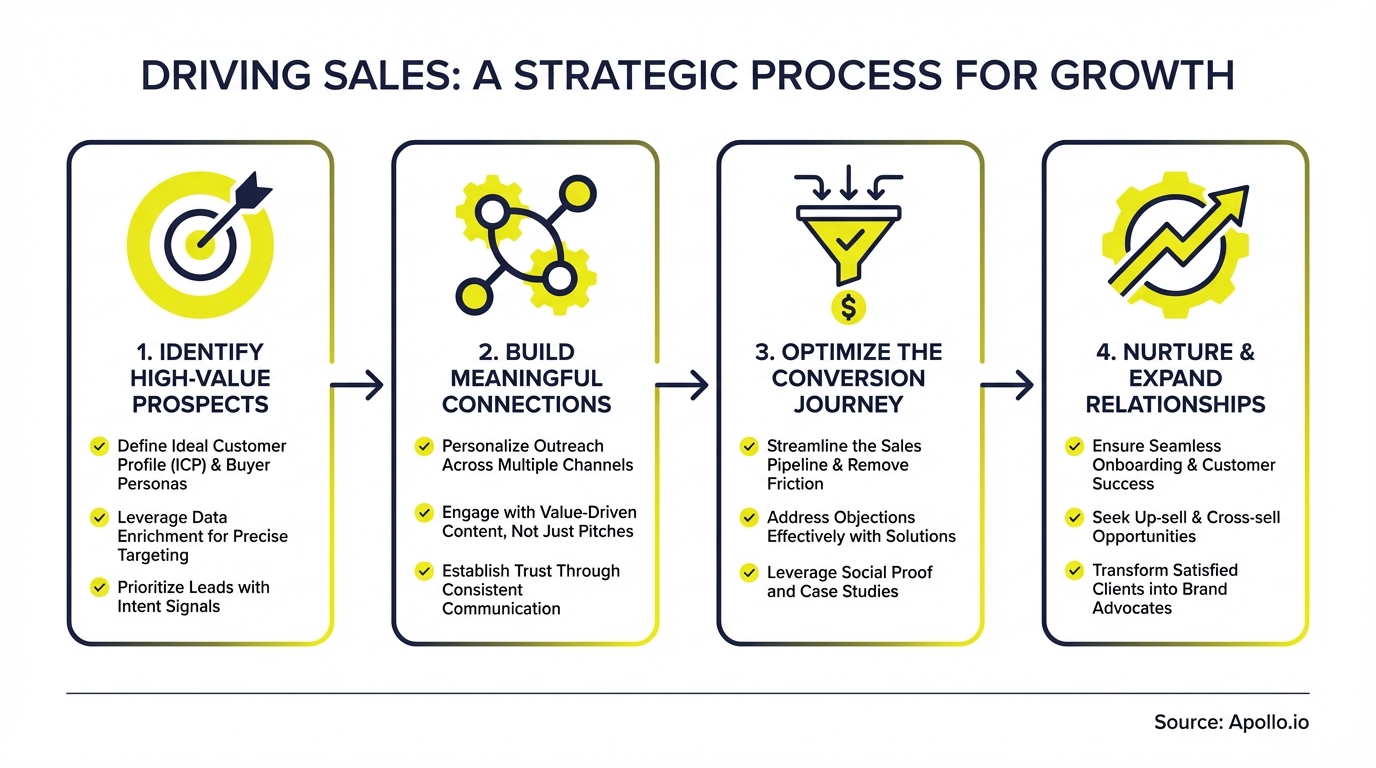
Sales teams drive revenue by optimizing three core activities: prospecting qualified accounts, engaging buyers through their preferred channels, and managing deals with clear visibility. Each stage requires specific tools and metrics to measure performance.
What Are the Core Components of a Sales-Driving System?
| Component | Purpose | Key Metrics |
|---|---|---|
| Prospecting & Data | Identify and qualify target accounts | Contact accuracy, list size, ICP match rate |
| Engagement & Outreach | Multi-channel sequences (email, phone, social) | Reply rate, meeting booking rate, sequence completion |
| Pipeline Management | Track deals from qualification to close | Pipeline velocity, win rate, average deal size |
| Analytics & Reporting | Measure performance and forecast revenue | Quota attainment, activity metrics, conversion rates |
Research from professional networks shows sales professionals using AI daily are 2x as likely to exceed their targets. Automation eliminates manual tasks like data entry and follow-up scheduling, letting reps focus on conversations that close deals.
Why Do Modern Buyers Demand Self-Service Options?
Buyers in 2026 research solutions, compare vendors, and evaluate pricing before ever contacting sales. They want control over the buying process and expect instant access to product information, case studies, and ROI calculators. According to 6sense, the point of first contact between buyers and sellers is happening earlier, shifting from 69% of the journey in 2023–2024 to 61% in 2025, which translates to buyers contacting sellers roughly 6 to 7 weeks sooner.
This shift creates opportunity for proactive sales teams. By engaging accounts showing intent signals earlier, SDRs can influence decisions before competitors enter the picture.
Sales Leaders benefit from visibility into which accounts are in-market, allowing them to allocate resources strategically. The key is balancing self-service content with human touchpoints at critical moments.
Struggling to identify in-market accounts? Search Apollo's 224M+ contacts with 65+ filters to find prospects showing buying intent.
Spot Ready Buyers Before Forecasts Fail
Pipeline forecasting a guessing game? Apollo reveals which deals will close with real-time signals and buyer intent data. Built-In increased win rates 10% using Apollo's scoring.
Start Free with Apollo →How Do SDRs and AEs Drive More Pipeline?
SDRs drive pipeline by booking qualified meetings through targeted outreach. The best SDRs use social selling to build trust and listen before pitching. They research prospects thoroughly, personalize messaging, and follow up persistently across multiple channels.
Account Executives convert pipeline into revenue by understanding buyer pain points and demonstrating clear ROI. Top AEs leverage proven sales pitch techniques and maintain deal momentum through consistent communication. They use conversation intelligence tools to capture insights from calls and identify objections early.
For both roles, success depends on accurate data and efficient workflows. "We reduced the complexity of three tools into one," reports Collin Stewart from Predictable Revenue. Consolidated platforms eliminate context-switching and ensure reps spend time selling, not managing software.

What Tools Actually Drive Sales Results?
The most effective sales tools consolidate prospecting, engagement, and analytics into one workspace. According to DBS, sellers who leverage AI tools are 3.7x more likely to meet their quotas than those who don't. Modern sales platforms combine verified contact databases, multi-channel sequences, AI-powered automation, and real-time analytics.
Sales automation eliminates repetitive tasks like manual email follow-ups and data entry. Sales automation software can trigger actions based on prospect behavior, ensuring timely outreach without constant manual oversight. RevOps teams benefit from unified data across the tech stack, making it easier to track sales KPIs and forecast accurately.
Key features that drive results include:
- Verified Contact Data: Access to accurate emails and phone numbers reduces bounce rates and wasted outreach
- Multi-Channel Sequences: Automated email, phone, and social touchpoints increase response rates
- AI Call Assistance: Real-time transcription and next-step recommendations improve call outcomes
- Pipeline Visibility: Clear deal tracking helps managers coach reps and identify bottlenecks
- Native Integrations: CRM sync ensures data flows seamlessly across systems
Tired of juggling multiple tools? Build your entire sales pipeline in Apollo's all-in-one platform.

How Do Sales Leaders Measure What Drives Revenue?
Sales Leaders in 2026 track leading indicators that predict revenue outcomes, not just lagging metrics like closed deals. Revenue operations teams monitor pipeline coverage, average deal velocity, and win rates by segment. These metrics reveal whether the team has enough qualified opportunities to hit targets.
Activity metrics matter for coaching. Tracking calls made, emails sent, and meetings booked helps identify top performers and coach underperformers.
Conversion rates at each funnel stage highlight where deals stall. For example, if qualified leads convert to opportunities at high rates but stall during negotiation, the issue might be pricing objections or competitor positioning.
Advanced teams use AI-powered analytics to predict deal outcomes and prioritize high-value opportunities. AI sales tools analyze historical win/loss patterns and recommend next actions. Sales trainers use these insights to develop targeted coaching programs that address specific skill gaps.
What Are the Biggest Challenges in Driving Sales Today?
The primary challenges are data quality, tool fragmentation, and buyer skepticism. Inaccurate contact data wastes time and damages sender reputation.
Sales teams using multiple disconnected tools struggle with context-switching and data silos. Meanwhile, buyers receive hundreds of generic outreach messages and ignore most of them.
Budget constraints also create pressure. Founders and CEOs expect sales teams to do more with less, requiring smarter tool investments. "We cut our costs in half," reports Census after consolidating their sales tech stack. Teams that streamline operations can reallocate budget toward high-impact activities like high-ticket sales strategies and enterprise account targeting.
Another challenge is adapting to buyer preferences. Some prospects want detailed product demos, while others prefer to explore independently.
Sales teams need omnichannel strategies that support all buyer types without overwhelming reps with complexity.
Start Driving Sales Growth Today
Driving sales in 2026 requires verified data, automated workflows, and unified platforms that eliminate tool sprawl. The best sales teams focus on early buyer engagement, multi-channel outreach, and data-driven decision-making.
By consolidating your tech stack and empowering reps with AI-powered tools, you can accelerate pipeline growth and close deals faster.
Whether you're an SDR booking meetings, an AE closing enterprise deals, or a Sales Leader building a scalable revenue engine, success starts with the right foundation. Modern buyers expect seamless experiences across every touchpoint.
Your sales motion must adapt to their preferences while maintaining efficiency and predictability.
Ready to consolidate your sales tech stack and drive more revenue? Try Apollo Free and discover how 90K+ paying customers use one platform for prospecting, engagement, and analytics.
Prove Apollo's ROI In Your First 30 Days
Budget approval stuck on unclear metrics? Apollo tracks every touchpoint from prospect to closed deal. Built-In increased win rates 10% and ACV 10% using Apollo's scoring and signals.
Start Free with Apollo →Don't miss these
Sales
Inbound vs Outbound Marketing: Which Strategy Wins?
Sales
What Is a Sales Funnel? The Non-Linear Revenue Framework for 2026
Sales
What Is a Go-to-Market Strategy? The 2026 GTM Playbook
See Apollo in action
We'd love to show how Apollo can help you sell better.
By submitting this form, you will receive information, tips, and promotions from Apollo. To learn more, see our Privacy Statement.
4.7/5 based on 9,690 reviews
