
Apollo vs Clay: Deal Sourcing and Portfolio Company Lead Generation Compared
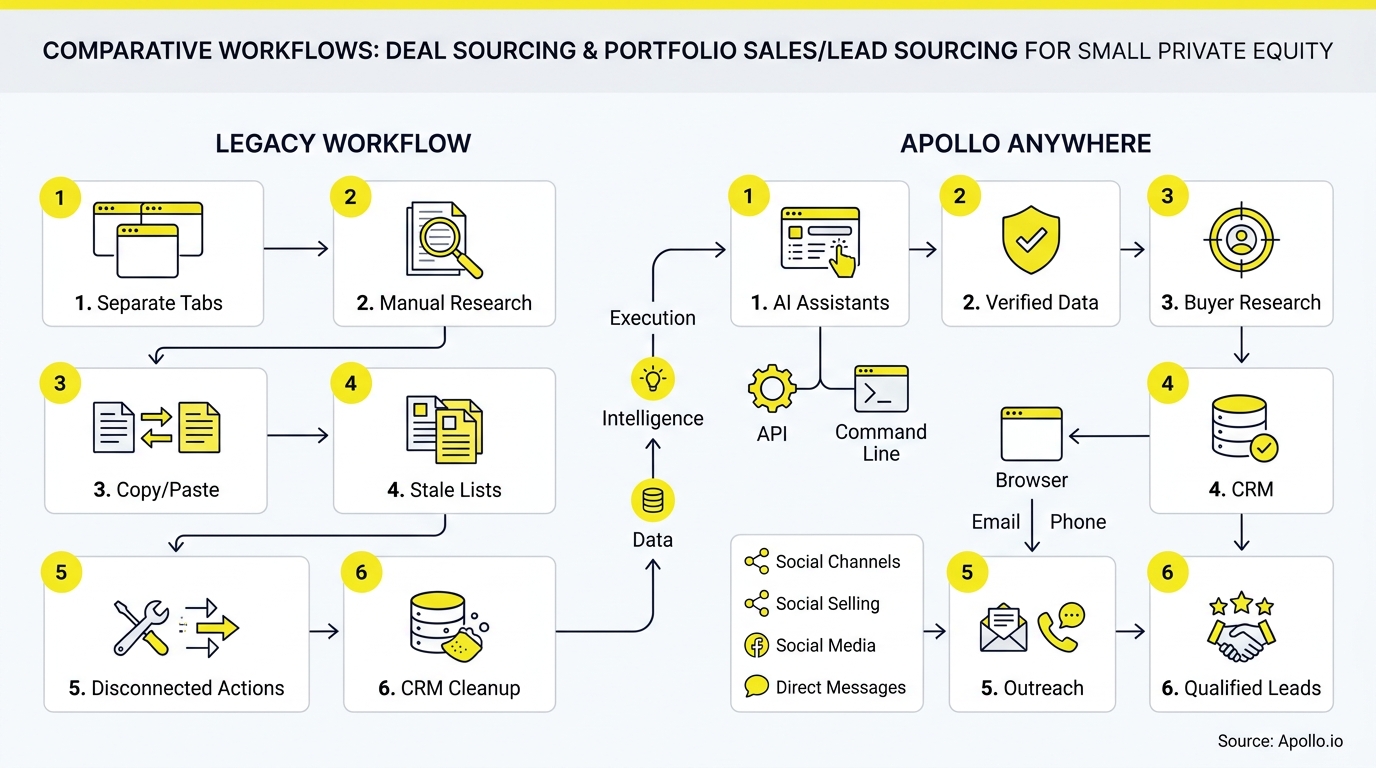
A small PE firm's origination team and a portfolio company's sales team are chasing two different funnels, but most firms try to solve both with one tool or none at all. Deal partners need a verified universe of acquisition targets and warm paths to founders.
Portfolio company RevOps and SDR teams need pipeline volume, clean CRM data, and repeatable outbound. Getting this wrong wastes budget and stalls both funnels at once.
This guide gives you a decision framework for deal sourcing and lead sourcing across both use cases, a head-to-head on Apollo vs Clay pricing and workflows, and a 30-day benchmark plan you can run starting this quarter.

Apollo Ends The Manual Research Grind
Burning hours verifying emails and numbers before a single deal gets sourced? Apollo delivers 98% accurate contact data instantly, so your team spends time closing, not searching. Nearly 5M users skip the manual grind entirely.
Start Free with Apollo →Key Takeaways
- PE deal sourcing and portfolio company lead sourcing are two distinct funnels that need different data depth and outreach cadence, even when run from the same tech stack.
- Apollo works as a ready-made system for teams that need contact data, enrichment, and sequencing in one workspace without heavy setup.
- Clay works best when a fund or portfolio company needs to stitch together niche signals from 150+ providers into a custom research workflow.
- Apollo and Clay now integrate directly, so the real decision is which platform leads execution and which supports it, not choosing only one.
- A 30-day benchmark comparing cost per qualified contact, meetings booked, and CRM hygiene beats picking a platform on features alone.
What Is The Difference Between PE Deal Sourcing And Portfolio Company Lead Sourcing?
PE deal sourcing identifies acquisition targets and decision-makers before a banker-led process begins, while portfolio company lead sourcing builds a repeatable pipeline of buyers for an operating business. Deal sourcing prioritizes precision over volume: a small fund may only need a few hundred qualified targets per quarter, but each one requires verified ownership, financial signals, and warm intro paths.
Portfolio lead sourcing prioritizes volume and repeatability: SDRs and AEs need hundreds of fresh contacts weekly, fast enrichment, and sequences that run without manual research.
According to Axial, the median PE firm covers only 17.6% of its relevant deal flow, which means most funds are sourcing from a fraction of the addressable market. That coverage gap is a data and workflow problem, not a headcount problem, and it applies differently to each funnel.
Apollo Vs Clay For Private Equity: Which Platform Fits Which Funnel?
Apollo fits teams that need an integrated system for contact discovery, enrichment, and outreach without heavy engineering setup, while Clay fits teams building custom, multi-source research workflows. Apollo combines a database of 240M+ people and 30M+ companies with 65+ search filters, built-in sequencing, and deal management in one workspace.
Clay provides access to 150+ data providers and configurable workflows, which suits teams assembling niche target universes from job postings, websites, and custom signals, but requires more setup time.
| Factor | Apollo | Clay |
|---|---|---|
| Best for | PE origination + portfolio company sales in one workspace | Custom research workflows and niche signal sourcing |
| Data model | 240M+ people, 30M+ companies, 65+ filters, 98% email accuracy | Enrichment from 150+ providers via waterfalls |
| Setup effort | Low: search, enrich, sequence in one login | Higher: workflows built provider-by-provider |
| Outreach execution | Native sequences, dialer, deal management included | Requires Apollo or another execution tool to send outreach |
| Seats | Per-user pricing on paid plans | Unlimited seats included on paid plans |
Struggling to find qualified targets across a fragmented deal universe? Search Apollo's 240M+ contacts with 65+ filters to build both your acquisition and portfolio outreach lists in one place.
What Does Apollo Vs Clay Pricing Look Like For A Small Fund?
Apollo's paid plans start at $49 per user per month billed annually, while Clay's Launch plan starts at $167 per month billed annually or $185 billed monthly, based on Apollo's pricing page and Clay's pricing page. Apollo's Free tier is $0. Organization-tier Apollo runs $119 per user per month billed annually with a 3-user minimum, aimed at teams needing advanced routing and governance.
Clay bills per workspace with unlimited seats, which can be efficient for a fund where multiple deal partners share one research workflow. Apollo bills per user, which scales cleanly as a portfolio company adds SDRs.
A three-person deal team and a five-person portfolio sales team will land in different pricing tiers depending on which platform leads execution versus research. Check Apollo's official pricing page for current plan details before budgeting either funnel.
Know Which Deals Are Real, Not Just Hoped For
Forecasting off gut feel because deal stages never match reality? Apollo surfaces buying signals and engagement data so you know which prospects are actually ready to move. Built-In improved win rates using Apollo's scoring and signals.
Schedule a Demo →How Do Apollo-Only, Clay-Led, And Hybrid Workflows Compare?
An Apollo-only workflow covers search, enrichment, and outreach in one workspace with the lowest setup effort, a Clay-led workflow maximizes data source flexibility at the cost of more configuration time, and a hybrid workflow uses Clay for research and Apollo for execution.
- Apollo-only: Search 240M+ contacts, enrich with waterfall data, launch sequences, and manage deal stages without leaving one login. Best for lean teams that need speed over customization.
- Clay-led: Build custom research tables pulling from 150+ providers, job boards, and firmographic signals, then push qualified records to a separate outreach tool. Best for funds sourcing niche target universes no single database covers well.
- Hybrid: Use Clay to enrich and score records from multiple sources, then sync qualified contacts into Apollo for sequencing, dialing, and deal tracking. An April 2026 integration upgrade increased Apollo enrichment rate limits inside Clay by at least fivefold and lets teams trigger Apollo sequences through Clay's API, according to Clay's integration announcement.
For most small funds and single-portfolio-company teams, Apollo-only covers both funnels without added engineering overhead. Larger platforms running multiple portfolio companies with dedicated RevOps may prefer the hybrid model for specialized signal capture.

How Can RevOps Leaders Build A Governed Sourcing Stack Across A Portfolio?
RevOps leaders build a governed sourcing stack by standardizing one data source, one suppression list, and one CRM sync rule across every portfolio company rather than letting each team pick its own tools. RevSearch reports that PE firms are now treating RevOps as a portfolio-wide capability rather than a back-office function, which means sourcing governance can't be left to individual portfolio company discretion.
A practical governance checklist:
- One shared contact database and enrichment source across portfolio companies to avoid duplicate outreach to the same prospect from two portfolio brands.
- A shared suppression list synced through CRM integration with HubSpot or Salesforce so reps never contact opted-out or already-engaged accounts.
- Standardized sequence templates reviewed quarterly, reducing the "n RevOps teams operating in sales transformation mode find that a single source of truth cuts onboarding time for new portfolio company hires.
How Do SDRs And AEs Use Apollo For Portfolio Company Pipeline?
SDRs use Apollo to find, enrich, and sequence portfolio company prospects in one workflow, while AEs use the same data to prep for calls and manage deal stages without switching tools. An SDR working a portfolio company's target list can filter by 65+ firmographic and technographic attributes, verify emails at 98% accuracy, and launch a multi-channel sequence without exporting to a separate outreach platform.
For Account Executives managing late-stage opportunities, deal management tools keep pipeline visibility centralized so a portfolio company's leadership team can see stage-by-stage progress without a separate BI report. Collin Stewart of Predictable Revenue said, "We reduced the complexity of three tools into one," describing how consolidating research, outreach, and pipeline tracking into a single system removed friction from the team's daily workflow.
Spending too many hours manually researching portfolio company prospects? Automate your sequences with Apollo's multi-channel engagement platform and give SDRs and AEs one workspace for research and outreach.
What Does A 30-Day Benchmark Plan Look Like?
A 30-day benchmark plan compares cost per qualified target, verified owner rate, meetings booked, and CRM data quality between your current workflow and a new one before committing to a full-year contract. Run this structure across both funnels simultaneously:
- Week 1: Define your ICP for both PE targets and portfolio buyers. Pull an initial list from Apollo or Clay and measure verified owner/contact match rate.
- Week 2: Launch outreach sequences. Track reply rate and meetings booked per 100 contacts touched.
- Week 3: Calculate cost per qualified contact: total platform spend divided by contacts that passed your qualification bar.
- Week 4: Audit CRM sync accuracy, suppression list adherence, and time spent on manual data cleanup.
Research from Surface shows the median B2B visitor-to-lead conversion rate sits at 2.9%, giving portfolio company teams a baseline to compare against their own outbound-sourced conversion rates during the benchmark window.
What Are Common Questions About Apollo Vs Clay For PE And Portfolio Sourcing?
Can A Small PE Firm Use One Platform For Both Deal Sourcing And Portfolio Sales?
Yes, a small PE firm can use one platform for both funnels if that platform combines verified contact data, enrichment, and outreach execution in a single workspace. Apollo supports this by letting a deal team search for acquisition targets and a portfolio company's SDR team run outbound sequences from the same underlying database, reducing the need for separate subscriptions and duplicate data entry.
Does Apollo Or Clay Integrate Better With Salesforce And HubSpot?
Both platforms integrate with Salesforce and HubSpot, but Apollo's native CRM integration includes built-in sequencing and deal management, so records sync without a separate orchestration layer. Clay typically pushes enriched records into a CRM or a separate outreach tool, adding a step to the workflow.
How Should A Portfolio Company Handle CAN-SPAM And Data Quality Compliance?
Portfolio companies should maintain a suppression list, honor opt-outs promptly, and confirm their prospecting vendor's approach to data provenance and deletion requests. Since August 1, 2026, covered California data brokers must process deletion requests at least every 45 days, so RevOps teams should confirm how their sourcing platform handles suppression and CRM sync before scaling outbound volume.
Is A Hybrid Apollo-Clay Stack Worth The Added Complexity For A Small Fund?
A hybrid stack is worth it only if a fund's target universe requires niche signals Apollo's core database doesn't cover well, such as highly specific job posting or website technographic triggers. For most small funds and single-portfolio-company sales teams, an Apollo-only workflow covers both sourcing funnels with less setup time and lower total cost.

Get Started With A Governed Sourcing Stack
Small PE firms and their portfolio companies don't need to choose between database depth and outreach execution. Apollo brings B2B data, sales engagement, and AI-powered execution together in one connected go-to-market system, so deal teams and portfolio SDRs don't have to stitch together separate vendors for research, outreach, and analysis.
Whether you're sourcing acquisition targets or building portfolio company pipeline, running both funnels through one governed data source cuts duplicate spend and keeps your CRM clean.
Explore Apollo's go-to-market platform to see how deal sourcing and portfolio lead sourcing can run from one workspace. Start Your Free Trial today.
Apollo Turns New Reps Into Quota-Hitters Fast
New reps taking months to ramp while your best process lives in someone's head? Apollo builds shared playbooks and sequences into one workspace so every rep prospects like your top performer on day one. Prove the ROI with pipeline you can actually measure.
Start Free with Apollo →Don't miss these
Sales
Inbound vs Outbound Marketing: Which Strategy Wins?
Sales
What Is a Sales Funnel? The Non-Linear Revenue Framework for 2026
Sales
What Is a Go-to-Market Strategy? The 2026 GTM Playbook
See Apollo in action
We'd love to show how Apollo can help you sell better.
By submitting this form, you will receive information, tips, and promotions from Apollo. To learn more, see our Privacy Statement.
4.7/5 based on 9,690 reviews
