
What Is the Average Sales Commission? Rates, Models, Benchmarks (2026)
Sales commission structures directly impact revenue outcomes and rep performance. In 2026, with quota attainment challenges and evolving compensation models, understanding commission benchmarks helps sales leaders design plans that drive results. According to Rachel Krug's analysis, up to 70% of B2B sales representatives missed their annual quota in 2024, meaning only 30% hit their target. This reality demands smarter commission design. This guide covers commission benchmarks by role, industry rates, payout models, and practical frameworks for revenue operations teams building compensation plans that align seller behavior with business goals.

Research Less, Close More With Apollo
Tired of your reps burning hours hunting down contact info that bounces? Apollo delivers verified business emails and numbers so your team spends time selling, not searching. Join 550K+ companies building pipeline that actually converts.
Start Free with Apollo →Key Takeaways
- Sales commission rates typically range from 5-15% depending on role, industry, and deal complexity
- Two-thirds of companies are shifting to pay-for-performance models with higher variable compensation
- RevOps roles saw compensation increase by 5% year-over-year, outpacing most sales positions
- Commission structures must account for quota attainment reality and multi-stakeholder buying complexity
- Modern compensation plans increasingly tie payouts to margin, not just revenue
What Is Sales Commission and How Is It Calculated?
Sales commission is variable compensation paid to sellers based on closed deals or revenue generated. It creates a direct financial incentive tied to performance outcomes.
The calculation method varies by company, but most structures use one of three bases: total deal value, gross margin, or collected revenue.
The most common formula multiplies the commission rate by the deal value. For example, a 10% commission on a $100,000 deal pays $10,000.
However, sophisticated plans layer in accelerators (higher rates above quota), decelerators (lower rates below quota), and gates (minimum performance thresholds before any payout).
In 2026, commission plans increasingly account for deal profitability. Research from Kennect shows that in high-margin industries such as SaaS, commissions can go as high as 12%. This reflects the complexity of deals and longer sales cycles that characterize enterprise software sales.
What Are Average Sales Commission Rates by Role?
Commission rates vary significantly by sales role, with higher rates for roles requiring longer cycles and more complex deal management. Here's the breakdown for key positions in 2026:
| Sales Role | Typical Commission Rate | Base:Variable Split | Notes |
|---|---|---|---|
| SDR/BDR | Variable bonus structure | 70:30 to 80:20 | Paid on meetings booked or SQLs generated, not closed deals |
| Account Executive | 8-12% of deal value | 50:50 to 60:40 | Higher rates for enterprise/complex sales, lower for transactional |
| Sales Manager | 3-7% of team quota | 70:30 to 80:20 | Paid on team performance, not individual deals |
| RevOps/Sales Ops | Bonus structure | 85:15 to 90:10 | Tied to company metrics, not individual quotas |
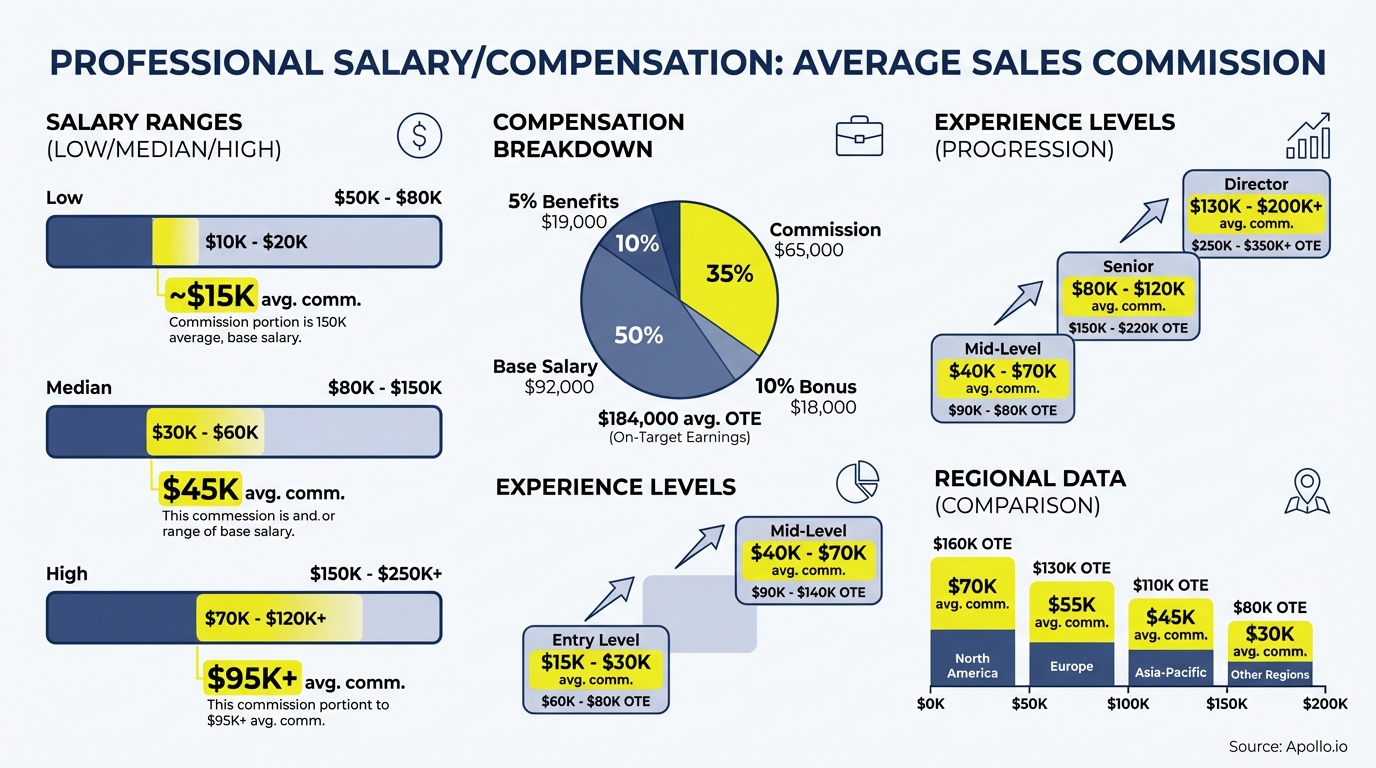
For Account Executives specifically, the median on-target earnings (OTE) structure in 2026 reflects a 53:47 base-to-variable split, with commission representing nearly half of total compensation. This makes commission design critical for attraction and retention.
According to QuotaPath, RevOps roles are experiencing a steady upward trend in compensation, with a reported 5% year-over-year salary increase, outpacing the projected 4% average across industries. Additional pay such as bonuses or commissions adds approximately $26,000 to $49,000 for these roles.
How Do Commission Structures Differ Across Industries?
Industry economics drive significant variation in commission rates. High-margin, complex-sale industries pay higher commissions to reflect longer sales cycles and deal complexity.
Low-margin, transactional industries use lower rates with higher velocity expectations.
| Industry | Average Commission Rate | Key Factors |
|---|---|---|
| SaaS/Software | 10-12% | Long cycles, high margins, recurring revenue |
| Financial Services | 7-10% | Regulatory complexity, relationship-based selling |
| Manufacturing | 5-8% | Lower margins, technical specifications |
| Retail/E-commerce | 3-6% | High volume, transactional, lower deal values |
| Professional Services | 8-15% | Project-based, margin varies by scope |
Research from Incentivate Solutions confirms this higher rate is attributed to the complexity of deals and longer sales cycles in the SaaS industry. For Sales Leaders designing compensation, industry benchmarks provide a starting point, but company-specific factors like gross margin, deal cycle length, and competitive dynamics should drive final rate decisions.
Turn Blind Forecasts Into Pipeline Clarity
Pipeline forecasting a guessing game because deal stages shift without warning? Apollo surfaces real-time buyer signals so your team always knows what's moving and what's stalled. Join 550K+ companies forecasting with confidence.
Schedule a Demo →What Commission Models Work Best in 2026?
Modern commission plans move beyond simple percentage-of-revenue models. The most effective structures in 2026 incorporate multiple design elements that align seller behavior with business priorities.
What Are the Core Commission Model Types?
- Flat-rate commission: Fixed percentage on all deals (e.g., 10% on everything)
- Tiered commission: Rates increase as performance rises (e.g., 8% up to quota, 12% above quota)
- Gross margin commission: Percentage of profit, not revenue (e.g., 20% of gross margin)
- Revenue commission with gates: Payouts only after minimum thresholds (e.g., no commission until 70% of quota)
- Multi-metric models: Weighted across deal value, margin, and strategic objectives
According to WorldatWork, two-thirds of companies (66%) are increasing the "pay-for-performance" focus in their sales compensation plans, including more pay at risk, higher pay for over-performance, and lower pay for under-performance.
Struggling to track deal performance across your team? Get complete pipeline visibility with Apollo's deal management.

How Do SDRs and AEs Structure Commission Differently?
SDRs and Account Executives require fundamentally different commission approaches because they own different parts of the sales process. SDRs focus on pipeline generation, while AEs close deals.
This distinction shapes payout timing, metrics, and compensation ratios.
How Do SDRs Earn Commission?
SDRs typically work on bonus structures tied to activity and pipeline metrics rather than traditional commission on closed deals. Common metrics include meetings booked, Sales Qualified Leads (SQLs) generated, and pipeline created.
The typical SDR compensation structure uses a 70:30 or 80:20 base-to-variable split, with lower variable risk than AEs.
For example, an SDR might earn $500 per qualified meeting that shows up, or $1,000 per SQL that enters the pipeline. Some companies layer in team-based bonuses when the AE team hits quota, creating alignment between prospecting and closing functions.
How Do Account Executives Structure Commission?
Account Executives earn commission on closed deals, with rates typically between 8-12% of Annual Contract Value (ACV). The median commission rate at 100% of quota is 11.5% of ACV in B2B SaaS, based on benchmark data from 170+ companies.
AEs use a 50:50 or 60:40 base-to-variable split, with commission representing roughly half of total compensation.
AE plans increasingly include accelerators above quota and decelerators below quota. For example, an AE might earn 10% commission up to 100% of quota, 15% from 100-125% of quota, and 20% above 125% of quota.
This creates strong incentive to exceed targets while maintaining baseline expectations.
For sales analytics tracking performance by role, visibility into individual and team attainment becomes critical for compensation accuracy and dispute resolution.
What Payout Timing and Governance Rules Should You Use?
Commission payout timing impacts cash flow, seller motivation, and company risk. The three common approaches are: payout at booking, payout at cash collection, and milestone-based payouts.
Each has tradeoffs between seller satisfaction and financial prudence.
Payout at booking means sellers receive commission when the deal closes, regardless of when the customer pays. This maximizes seller motivation but creates risk if deals churn or customers don't pay.
Payout at collection delays commission until cash arrives, protecting company margins but frustrating sellers who closed deals months earlier.
Milestone-based payouts split commission across multiple events: partial payout at booking, additional payout at implementation, final payout at renewal. This approach aligns seller incentives with customer success but adds administrative complexity.
In 2026, with budget pressure and payment delays increasing, more companies gate commission payouts to collections or use clawback provisions for early churn. Sales Leaders should clearly document these rules in commission plans and communicate them during onboarding.
How Should RevOps Teams Design Commission Plans in 2026?
RevOps teams own compensation plan design, administration, and optimization. The role requires balancing seller motivation, company profitability, and operational simplicity.
In 2026, RevOps professionals report that seller overwhelm with complex tools and metrics directly impacts quota attainment.
The best commission plans follow these principles:
- Simplicity: No more than 2-3 metrics per role to reduce cognitive load
- Transparency: Real-time visibility into earnings and quota progress
- Alignment: Metrics that directly connect to company revenue and margin goals
- Flexibility: Ability to adjust rates quarterly based on market conditions
- Fairness: Consistent rules across reps with documented exception processes
RevOps teams increasingly use commission management software to automate calculations, provide seller visibility, and generate audit trails for disputes. This technology reduces administrative burden and improves plan compliance. According to DealHub, entry-level positions in Sales Operations saw an 8.44% growth in 2024, reflecting increased demand for these specialized skills.
For teams managing complex commission structures across multiple products and regions, consolidation into a unified platform reduces errors and improves seller trust. As one revenue operations framework customer shared: "Having everything in one system was a game changer" (Cyera).
Can't track commission-eligible deals across your pipeline? Build a single source of truth with Apollo's pipeline management.
Conclusion: Build Commission Plans That Drive Performance
Average sales commission rates range from 5-15% depending on role, industry, and deal complexity, but the most effective plans in 2026 go beyond simple percentages. With 70% of reps missing quota and two-thirds of companies shifting to pay-for-performance models, commission design directly impacts both seller motivation and company profitability.
The key is balancing competitive rates with sustainable economics. Use industry benchmarks as a starting point, then adjust based on your gross margin, sales cycle length, and strategic priorities.
Layer in accelerators for over-performance, gates to protect against non-performance, and clear payout governance to manage cash flow risk.
For RevOps teams building these plans, simplicity and transparency matter more than sophisticated multi-metric formulas. Sellers who understand exactly how they earn and can track progress in real-time consistently outperform those working under complex, opaque structures.
Ready to give your sales team the tools they need to hit quota and maximize commission? Start your free Apollo trial and consolidate your prospecting, engagement, and pipeline management into one platform that helps reps focus on selling, not wrestling with disconnected tools.
Prove Pipeline ROI With Apollo
Struggling to justify your sales tool spend when leadership demands hard numbers? Apollo delivers measurable pipeline impact from day one. Leadium 3x'd their annual revenue — see what Apollo can do for your team.
Start Free with Apollo →Don't miss these
Sales
Inbound vs Outbound Marketing: Which Strategy Wins?
Sales
What Is a Sales Funnel? The Non-Linear Revenue Framework for 2026
Sales
What Is a Go-to-Market Strategy? The 2026 GTM Playbook
See Apollo in action
We'd love to show how Apollo can help you sell better.
By submitting this form, you will receive information, tips, and promotions from Apollo. To learn more, see our Privacy Statement.
4.7/5 based on 9,690 reviews
