
What Is AOV in Sales? Definition, Formula, and Strategies to Increase It in 2026
Average order value (AOV) in sales measures the average revenue generated per transaction. For B2B teams, AOV is more than a metric — it's a signal of deal quality, pricing strategy, and how well your content and packaging convert high-intent buyers. According to Atwix, B2B transactions average $134,000, compared to just $147 for B2C — making AOV optimization a board-level priority, not a nice-to-have. Understanding which sales KPIs to track in 2026 starts with getting AOV right.

Research Less, Pipeline More With Apollo
Tired of burning hours verifying contacts and chasing dead-end leads? Apollo delivers 230M+ verified contacts so your team spends time selling, not searching. Join 600K+ companies building predictable pipeline.
Start Free with Apollo →Key Takeaways
- AOV in B2B is dramatically higher than B2C, averaging $134,000 per transaction — and it's increasingly decided before a rep ever enters the conversation.
- 61% of B2B buyers now prefer a rep-free buying experience, shifting AOV influence to content, packaging, and self-serve enablement.
- Inconsistent messaging between your website and your sellers suppresses AOV — 69% of B2B buyers report experiencing this disconnect.
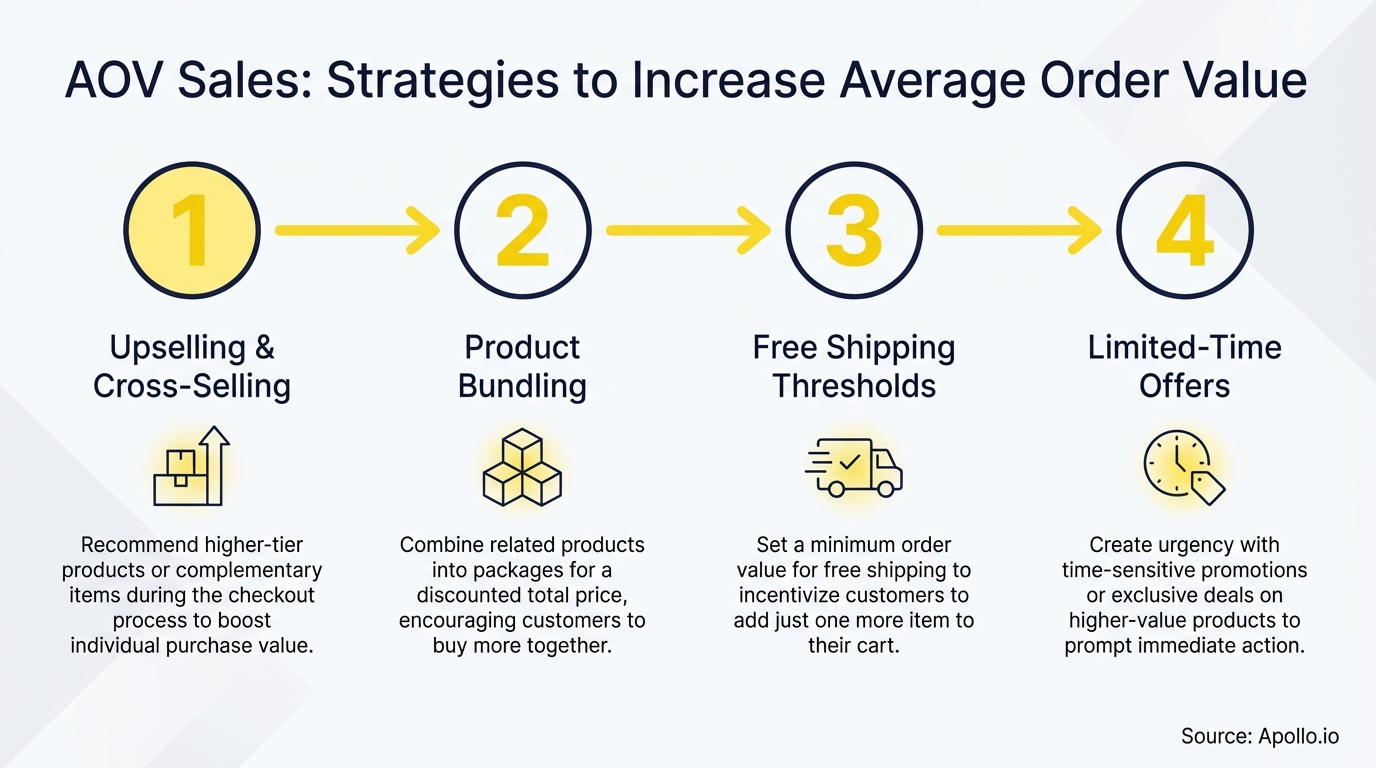
- AOV is best improved through bundling, cross-sell enablement, transparent pricing, and buyer journey content — not discounting.
- AEs and RevOps teams that align deal structure with buyer self-service see stronger deal expansion and shorter sales cycles.
What Is AOV in Sales and How Is It Calculated?
AOV (average order value) is the average dollar amount customers spend per transaction. The formula is straightforward:
AOV = Total Revenue / Number of Orders
For example, if your team closes $500,000 in revenue across 10 deals in a month, your AOV is $50,000. B2B teams should track AOV alongside deal velocity and win rate to get a complete picture of revenue health. It's a core input for sales analytics that drive revenue growth.
| Metric | What It Measures | AOV Relationship |
|---|---|---|
| AOV (Average Order Value) | Revenue per transaction | Core metric |
| ACV (Annual Contract Value) | Annual revenue per customer | AOV x contract term |
| ARR (Annual Recurring Revenue) | Recurring revenue across all accounts | Driven by AOV at scale |
Why Is AOV a Critical B2B Sales KPI in 2026?
AOV is moving upstream. A November 2025 survey found that 94% of B2B buyers now use AI in the buying process, meaning vendor shortlisting and deal sizing happen before a rep ever makes contact.
By the time Sales gets involved, buyers have already anchored on a price range and feature set.
This fundamentally changes AOV strategy. Discounting late in the cycle barely moves the number — but strong packaging, transparent pricing pages, and bundled offers at the top of the funnel do. Research from Speed Commerce confirms that AOVs in the hundreds to thousands of dollars are standard for B2B e-commerce, making every percentage point of lift meaningful.
The global B2B e-commerce market is projected to reach $36 trillion by 2026, according to Shopify — reinforcing why AOV optimization is now a digital commerce imperative, not just a sales tactic.

What Suppresses AOV — and How Do You Fix It?
The biggest AOV killers in B2B are trust gaps and friction. A Gartner survey found that 69% of B2B buyers report inconsistencies between a vendor's website content and what their sellers say.
That misalignment kills upsell and expansion conversations before they start.
Common AOV suppressors and their fixes:
- Inconsistent pricing pages: Publish clear, tiered pricing with self-serve configurators. Buyers won't expand what they can't understand.
- Missing ROI/TCO content: High-ticket buyers need proof before they commit. Build ROI calculators and TCO comparisons into your buyer journey.
- No bundling logic: Standalone SKUs underperform. Package complementary products and services together with clear value framing.
- Rep-only upsell paths: With 61% of buyers preferring rep-free experiences, your digital experience must do the upsell work. Add "frequently reordered" and "commonly added" prompts.
- Procurement friction: Security questionnaires, SLA documentation, and implementation guides should be self-serve — not gated behind a sales call.
Struggling to identify which deals have the highest expansion potential? Get complete pipeline visibility with Apollo's deal management tools and prioritize the accounts most likely to expand.
Turn Funnel Guesswork Into Pipeline Wins
Pipeline forecasting a guessing game while quality leads stall before they ever reach your AEs? Apollo surfaces in-market buyers at the right moment, so your funnel moves with confidence. Nearly 100K paying customers stopped forecasting blind.
Schedule a Demo →How Do AEs and RevOps Teams Increase AOV Systematically?
For Account Executives, AOV growth comes from deal structure — not pressure tactics. The goal is to enter deals with the right packaging and exit with expansion already planned.
For RevOps leaders, AOV is a systems problem: pricing logic, CRM data quality, and content alignment all feed into it.
Proven AOV-lifting tactics by role:
| Role | AOV Lever | Tactical Action |
|---|---|---|
| Account Executive | Bundle positioning | Lead with multi-product proposals; anchor on TCO, not unit price |
| SDR/BDR | ICP targeting | Prioritize accounts with higher budget signals and multi-stakeholder structures |
| RevOps | Data hygiene + pricing governance | Ensure CRM reflects deal structure accurately; eliminate pricing inconsistencies |
| Sales Leader | Deal review cadence | Review AOV distribution weekly; coach reps on expansion conversations |
For AEs handling high-ticket sales, the playbook shifts toward multi-stakeholder enablement, procurement-ready documentation, and risk-reduction content. Gartner also notes that 75% of B2B buyers may prefer human-led experiences for complex deals by 2030 — meaning AEs remain critical for the highest-AOV opportunities even as self-serve expands.
SDRs and BDRs can directly influence AOV at the top of funnel by targeting accounts that match the profile of your highest-value deals. Use firmographic and technographic filters to prioritize companies most likely to buy at scale. Search Apollo's 230M+ contacts with 65+ filters to build prospecting lists focused on your highest-AOV segments.

How Does Content Strategy Directly Impact AOV in B2B?
In rep-free buying environments, content IS the sales motion. Buyers research, shortlist, and often size their budget before your team knows they exist.
The content you publish determines whether they arrive at a conversation anchored high or low.
AOV-optimized content by buyer stage:
- Research stage: Comparison pages, ROI calculators, and use-case libraries that frame your solution's full value
- Shortlist stage: Transparent pricing tiers, bundle configurators, and "what's included" breakdowns
- Validation stage: Security documentation, SLA details, implementation playbooks, and customer case studies
- Expansion stage: "Add-on" product pages, renewal enablement content, and reorder flows
This aligns with findings from the enterprise sales playbook: the biggest deals are won before the first formal meeting through positioning, proof, and packaging — not pitch decks.
How Should You Measure and Optimize AOV Over Time?
AOV isn't a set-it-and-forget-it metric. B2B teams should build a measurement cadence that connects AOV to pipeline inputs and deal structure decisions.
- Track AOV by segment: Break down by industry, company size, and deal type to find where your highest-value patterns live
- Monitor AOV by channel: Inbound, outbound, and self-serve deals often have different AOVs — optimize each independently
- Set AOV thresholds for deal reviews: Flag deals below your target AOV for coaching and restructuring before close
- A/B test pricing and bundle pages: Small changes to packaging presentation can shift how buyers anchor on price
- Connect AOV to your revenue operations framework: AOV should feed into forecasting, capacity planning, and compensation design
RevOps leaders who integrate AOV tracking into their revenue operations strategy gain a cleaner signal for where to invest in pricing, content, and sales enablement.
Start Growing AOV with the Right Sales Foundation
AOV in sales is a compounding metric. Small improvements in deal structure, content quality, and buyer enablement stack up into meaningful revenue gains — without adding headcount or increasing discounting pressure.
The teams winning on AOV in 2026 share one thing: they treat it as a cross-functional KPI owned by Sales, Marketing, and RevOps together. They build self-serve buying paths, eliminate content inconsistencies, and target the right accounts from the start.
Apollo gives B2B GTM teams a unified platform to identify high-AOV prospects, run targeted multi-channel outreach, and manage deals from first touch to close — all in one workspace. As Cyera put it: "Having everything in one system was a game changer."
Request a Demo and see how Apollo helps your team build a pipeline optimized for higher average order value.
Prove Pipeline ROI Before Next Quarter
ROI pressure killing your next tool renewal? Apollo delivers measurable pipeline impact fast — Leadium 3x'd annual revenue, Built-In gained +10% win rate. See your ROI before the next budget conversation.
Schedule a Demo →Don't miss these
Sales
Inbound vs Outbound Marketing: Which Strategy Wins?
Sales
What Is a Sales Funnel? The Non-Linear Revenue Framework for 2026
Sales
What Is a Go-to-Market Strategy? The 2026 GTM Playbook
See Apollo in action
We'd love to show how Apollo can help you sell better.
By submitting this form, you will receive information, tips, and promotions from Apollo. To learn more, see our Privacy Statement.
4.7/5 based on 9,690 reviews
