
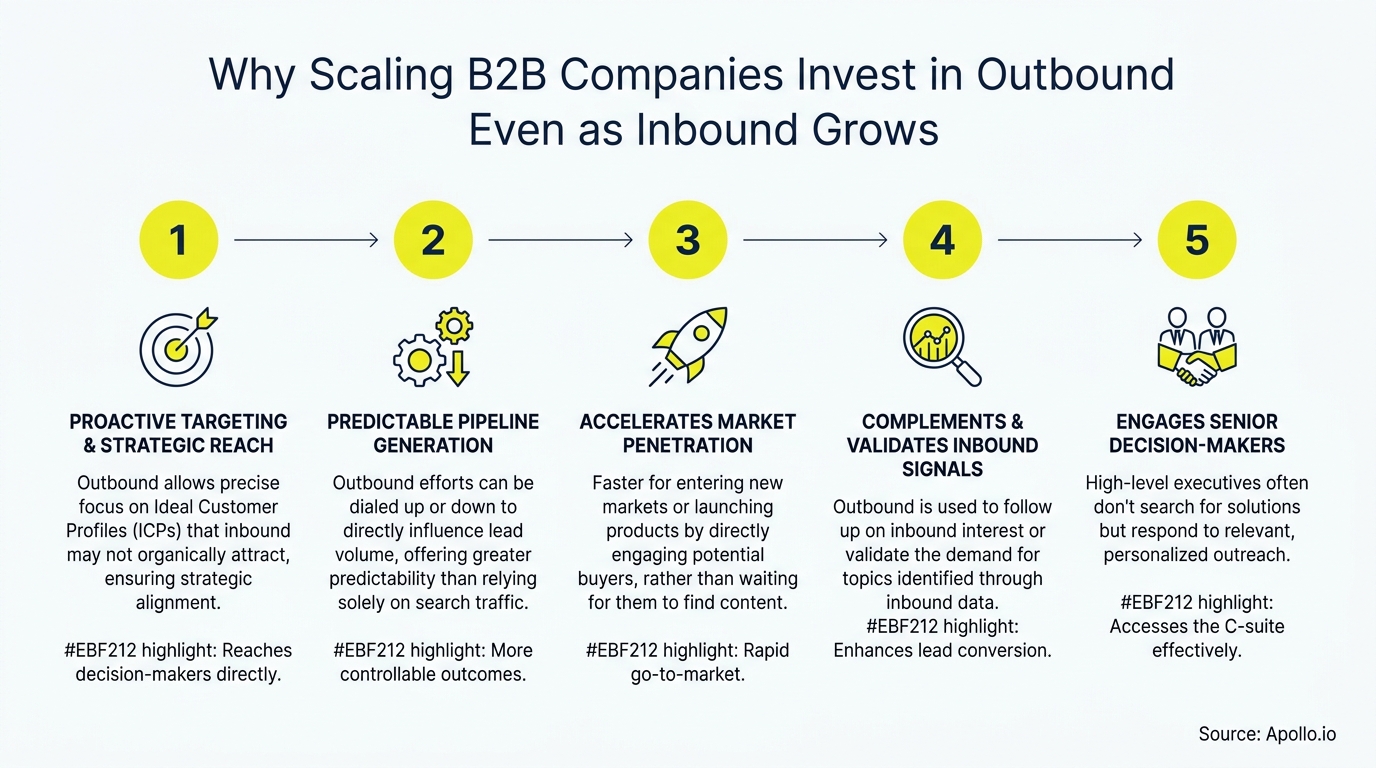
Why Scaling B2B Companies Invest in Outbound Even as Inbound Grows
Inbound is growing. Content pipelines are full. Form fills are up. So why are the fastest-scaling B2B companies doubling down on outbound at the same time? Because inbound volume and outbound necessity are not opposites. They are parallel requirements for any team that wants predictable, scalable revenue. Understanding how inbound and outbound marketing work together is the starting point for every modern GTM strategy.

Research Less, Close More With Apollo
Tired of your reps burning hours on manual lead research instead of selling? Apollo delivers verified contacts instantly, so your team spends time closing — not digging. Join 600K+ companies building pipeline faster.
Start Free with Apollo →Key Takeaways
- Buyers complete most of their research before ever talking to a rep, which means inbound alone cannot influence the shortlist.
- B2B buying committees are large and journeys are long, requiring outbound to multithread and coordinate stakeholders inbound cannot reach.
- Outbound gives SDRs, AEs, and RevOps teams control over pipeline timing and volume, which inbound cannot guarantee.
- Signal-based outbound (triggered by intent, job changes, and firmographic shifts) is now the standard, replacing high-volume blasting.
- Scaling companies use outbound as the bridge between marketing demand and sales execution, closing the collaboration gap that inbound growth exposes.
Why Does Inbound Growth Not Replace Outbound?
Inbound growth does not replace outbound because buyers make vendor decisions before sales reps ever enter the picture. According to Trinity42, while 72% of B2B buyers begin their purchasing journey with a search engine, a significant portion also prefer a rep-free buying experience and 73% actively avoid irrelevant outreach. Inbound captures buyers who are already searching. Outbound reaches buyers who fit your ICP but have not yet started searching for you.
This is the core gap. By the time a high-fit account fills out a form, they may already have a preferred vendor. Outbound lets teams get upstream, shape requirements, and influence the shortlist before anonymous research locks in a decision. That is why outbound prospecting remains a non-negotiable motion at scale.
How Do Multi-Stakeholder Deals Make Outbound Essential?
Multi-stakeholder deals make outbound essential because inbound typically captures one contact, while the buying decision involves many. Research from TryKondo shows buying committees now average 10 to 13 people globally, making it essential for outreach and content to address multiple stakeholders. A single inbound lead from a mid-level manager does not represent the full buying group.
Outbound lets AEs and SDRs proactively map and engage each stakeholder: the economic buyer, the technical evaluator, the end user, and the executive sponsor. Without deliberate multithreading through outbound sequences, deals stall when a single champion goes quiet. For B2B sales techniques that close complex deals, multi-contact outbound is the execution layer inbound cannot provide.
| Buying Journey Factor | Inbound Coverage | Outbound Coverage |
|---|---|---|
| Captures first-touch research | Strong | Weak |
| Reaches non-searching ICP accounts | Weak | Strong |
| Influences shortlist before vendor selection | Weak | Strong |
| Multithreads across buying committee | Weak | Strong |
| Provides pipeline timing predictability | Weak | Strong |
| Nurtures known engaged leads | Strong | Moderate |
How Does Outbound Give Scaling Teams Pipeline Predictability?
Outbound gives scaling teams pipeline predictability because it puts the timing and volume of new opportunities under the team's control. As Outbound Republic notes, this predictability is crucial for hitting revenue targets consistently. Inbound volume fluctuates with algorithm changes, seasonality, and content performance. Outbound volume is a function of headcount, sequences, and ICP targeting.
For RevOps leaders building a revenue operations framework, this matters enormously. You can model outbound output. You can adjust sequencing cadence, expand ICP targeting, or add SDR capacity when pipeline coverage drops. Inbound does not offer the same levers. As Martal observes, this indicates a need for more robust pipeline generation strategies, which outbound can provide.
Struggling to find the right accounts to target? Search Apollo's 230M+ contacts with 65+ filters to build your outbound list in minutes.
Forecast With Confidence, Not Guesswork
Pipeline forecasting a guessing game because deal stages shift by the hour? Apollo's real-time signals surface exactly where opportunities stand — so your team acts fast, not blind. Join 600K+ companies building predictable revenue.
Schedule a Demo →How Should SDRs and AEs Adapt Outbound as Buyers Go Rep-Free?
SDRs and AEs should adapt outbound by shifting from first-touch lead generation toward upstream shortlist shaping and late-stage deal assurance. The goal is not to force a meeting.
It is to be present and relevant at the moments in the buyer journey where human input actually changes the outcome.
In practice, this means three shifts:
- Earlier intervention: Outbound triggered by intent signals, job change alerts, and firmographic events reaches buyers before they finalize requirements.
- Enablement-first messaging: Sequences that lead with insights, benchmarks, and risk framing rather than product pitches earn engagement from self-educating buyers.
- Stakeholder coordination: AEs use outbound to map and connect with every member of the buying committee, not just the original inbound contact.
Using intent data to power smarter B2B outreach is now the baseline for teams that want outbound to land at the right moment rather than interrupt at the wrong one.

What Is the Right Outbound Playbook for Scaling B2B Teams?
The right outbound playbook for scaling B2B teams prioritizes ICP precision, signal-based triggers, and tight multi-channel sequences over raw volume. As noted by Trembi, outbound is particularly valuable for entering new industries or regions, testing ICPs and offers quickly, and pursuing high-value accounts that may not engage through inbound channels.
A practical outbound playbook for scaling teams includes:
- ICP narrowing: Define firmographic, technographic, and behavioral filters before building any list. More filters, fewer wasted touches.
- Signal-based triggers: Launch sequences when accounts show intent signals, funding events, leadership changes, or hiring patterns.
- Multi-channel sequences: Combine email, phone, and social outreach across 8 to 12 touches over 3 to 4 weeks. See how to build winning outbound sequences for cadence guidance.
- Capacity planning: Set weekly activity targets per SDR based on ICP account volume, not arbitrary dials-per-day quotas.
- Feedback loops: Route reply data and objection themes back to marketing to improve inbound content and messaging alignment.
Spending too much time building lists manually? Automate your multi-channel outbound sequences with Apollo's sales engagement platform.
How Does Outbound Close the Marketing and Sales Collaboration Gap?
Outbound closes the marketing and sales collaboration gap by acting as the operational bridge between demand creation and revenue execution. As inbound programs grow, they often surface a structural problem: marketing generates awareness while sales executes independently, with little shared process in between.
SDR and ABM programs are where this gap closes in practice. When outbound sequences are built on shared ICP definitions, use marketing-created content as touchpoints, and feed engagement signals back into campaign targeting, both functions operate from the same data. This is the foundation of a mature B2B sales funnel and a prerequisite for scaling revenue without proportionally scaling headcount. For teams measuring the right outcomes, aligning on B2B marketing metrics that drive revenue growth ensures outbound effort connects directly to pipeline and closed-won results.

Why Scaling B2B Companies Keep Investing in Both Channels in 2026
Scaling B2B companies invest in outbound alongside growing inbound because the two motions solve different problems. Inbound attracts buyers who are already searching.
Outbound reaches high-fit accounts that are not yet searching, multithreads across buying committees that inbound captures only partially, and provides the pipeline timing control that revenue teams need to hit quarterly targets.
In 2026, the winning outbound model is signal-led, ICP-precise, and tightly integrated with inbound content. Volume alone no longer works.
Relevance and timing do. Teams that consolidate prospecting, sequencing, and pipeline tracking into a unified GTM platform execute this model faster and at lower cost.
As Cyera's team put it, "Having everything in one system was a game changer."
Apollo gives B2B GTM teams from startups through enterprise a single platform for prospecting, outbound sequences, intent signals, and pipeline management, replacing the fragmented stack that slows scaling teams down. Try Apollo free and see how your team can run a smarter outbound motion alongside your growing inbound program.
Prove Pipeline ROI From Day One
ROI pressure killing your tool budget before it proves its worth? Apollo delivers measurable pipeline impact fast — 46% more meetings with AI, real results your leadership can't ignore. Start free today.
Start Free with Apollo →Don't miss these
Sales
Inbound vs Outbound Marketing: Which Strategy Wins?
Sales
What Is a Sales Funnel? The Non-Linear Revenue Framework for 2026
Sales
What Is a Go-to-Market Strategy? The 2026 GTM Playbook
See Apollo in action
We'd love to show how Apollo can help you sell better.
By submitting this form, you will receive information, tips, and promotions from Apollo. To learn more, see our Privacy Statement.
4.7/5 based on 9,690 reviews
