
Why Revenue Leaders at Growing Companies Are Investing in AI Sales Assistants Now
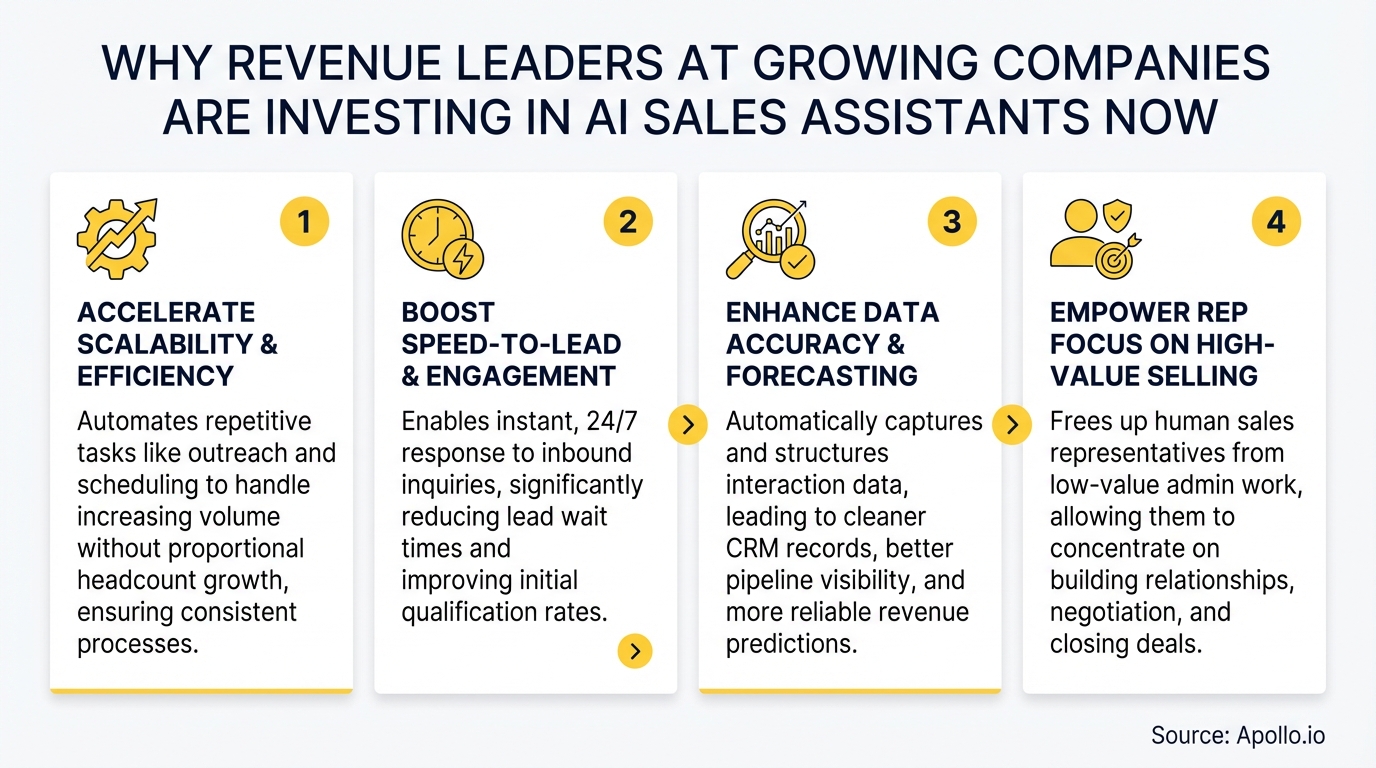
Revenue leaders at growing companies are investing in AI sales assistants in 2026 because the data on quota attainment is unambiguous. A Gartner survey of 1,026 B2B sellers found that sellers who effectively partner with AI tools are 3.7x more likely to meet quota than those who do not. For a VP of Sales or CRO under board-level pressure, that figure alone justifies budget allocation. Understanding how sales automation software drives revenue is the first step toward making that case internally.
Tools like Apollo's AI Sales Assistant represent the new category standard: an end-to-end GTM assistant that helps revenue teams research accounts, build prospect lists, generate messaging, and launch multi-channel workflows from plain-language instructions. No prompt engineering required.

More Leads, Less Research With Apollo
Tired of sorting bad leads instead of closing deals? Apollo delivers verified contacts so your team spends time selling, not searching. Join 600K+ companies building predictable pipeline.
Start Free with Apollo →Key Takeaways
- AI partnership correlates directly with quota attainment, making investment a strategic necessity rather than a nice-to-have.
- Seller overload is a measurable drag on revenue, and AI assistants reduce that load by automating research, sequencing, and follow-up.
- Organizations that used AI in 2024 reported meaningfully higher sales growth than those that did not, according to verified industry data.
- The market is shifting from AI features to agentic workflows, meaning late adopters face compounding competitive disadvantage.
- Consolidating tools into a single AI-native platform reduces tech debt and improves rep adoption, which is where most AI pilots fail.
What Is the Business Case for AI Sales Assistants in 2026?
The business case rests on three pillars: quota attainment, seller productivity, and revenue growth. A Gong report via PR Newswire found that revenue organizations that utilized AI in 2024 reported 29% higher sales growth compared to counterparts who did not implement AI. That is a board-level number, not a productivity footnote.
The seller overload problem compounds the ROI story. The same Gartner 2024 survey found 72% of sellers feel overwhelmed by the skills required, and 50% are overwhelmed by the technology they manage.
Overwhelmed sellers are 45% less likely to attain quota. AI assistants reduce that cognitive burden by collapsing research, personalization, and sequencing into single workflows.
Spending hours building prospect lists manually? Search Apollo's 230M+ contacts with 65+ filters and let AI do the shortlisting.
Why Are SDRs and AEs the Primary Beneficiaries?
SDRs and AEs benefit most because AI assistants eliminate the non-selling tasks that consume their workdays. According to Tami.ai, manual prospecting traditionally consumes 40% of a sales rep's week. AI-driven research tools are rapidly reclaiming that time for actual selling.
For SDRs, the highest-value AI use cases include:
- ICP-matched list building via web-powered search and lookalike account discovery
- Automated sequence creation with personalized messaging grounded in account signals
- Lead scoring and prioritization so reps call the right accounts first
For AEs, AI shifts effort toward deal advancement. Pre-meeting research and insights surface decision-maker priorities and past objections before the call starts. Conversation intelligence extracts key takeaways and next steps without manual note-taking. The result is more deals progressed per rep, per week.
Erik Fernando Nieto, BDR at JumpCloud, summarized the practical impact: "Apollo's AI Assistant filters and cleans prospect data for me, so I can find the right people faster and run better searches. It saves me about an hour per prospecting session."

How Do Revenue Leaders Avoid the AI Pilot-to-Production Trap?
Most AI investments fail not at the idea stage but at the production stage. The pattern is consistent: pilots show promise, then adoption stalls when AI outputs are generic, disconnected from CRM, or require reps to manually move work between systems.
The fix is workflow-native AI, not standalone tools. Revenue leaders are prioritizing assistants that execute inside existing workflows rather than requiring reps to context-switch into a separate chat interface.
The key selection criteria for 2026:
| Criterion | What to Look For |
|---|---|
| CRM Integration | Writes back to CRM, creates tasks, updates fields automatically |
| Data Grounding | Outputs based on real account signals, not generic templates |
| End-to-End Execution | Handles the full workflow: research, list, sequence, send |
| Governance Controls | Approval gates, credit transparency, auditability |
| Rep Adoption | No prompt engineering; plain-language instructions work |
Apollo's Outbound Copilot addresses this directly: it finds ICP-matched prospects, adds them to sequences, and runs on a set cadence with manual or automatic approval before contacts are enrolled. RevOps leaders can set governance rules without blocking rep velocity.
Turn Funnel Guesswork Into Closed Deals
Pipeline forecasting a guessing game because leads stall before they ever become opportunities? Apollo surfaces high-intent prospects and fills your funnel with contacts that actually convert. Nearly 100K paying customers stopped guessing and started closing.
Start Free with Apollo →What ROI Metrics Should Revenue Leaders Track?
Finance-ready ROI from AI sales assistants maps to four measurable outcomes. Use this framework when building your internal investment case or presenting to a board.
| Metric | AI Impact | Measurement Approach |
|---|---|---|
| Quota Attainment Rate | Tied to AI partnership effectiveness | % reps at or above quota, AI users vs. non-users |
| Pipeline Coverage | More accounts worked per rep | Accounts touched per SDR per week |
| Response Rate | Personalized outreach outperforms generic | Reply rate on AI-generated vs. manual sequences |
| Sales Cycle Length | Faster follow-up and pre-meeting prep | Average days from first touch to closed-won |
Research from Cirrus Insight shows over 80% of sales teams leveraging AI solutions anticipate increased revenue, compared to 66% of teams operating without AI. That gap in forward-looking confidence reflects the competitive pressure revenue leaders are responding to.
Around 70% of sales professionals who employ AI for prospect outreach report achieving higher response rates, according to iCumulus. Higher response rates directly compress sales cycles and improve pipeline conversion.

How Does Apollo Consolidate the AI Sales Stack?
Apollo consolidates sales intelligence, outreach automation, conversation intelligence, and AI-powered workflows into a single platform, eliminating the tool fragmentation that kills adoption. This matters because disconnected point tools force reps to manually transfer data between systems, which is where AI value leaks out.
The consolidation story resonates across Apollo's customer base. "Having everything in one system was a game changer" (Cyera). "We cut our costs in half" (Census). "We reduced the complexity of three tools into one" (Predictable Revenue).
The AI Content Center grounds every output in your company's value proposition, ICP, and differentiators. The Apollo AI Overview details how each AI layer connects: research, scoring, sequencing, conversation intelligence, and follow-up all operate inside one workspace. Learn more about building a sales tech stack that scales revenue without adding tool sprawl.
Tory Kindlick, Head of Revenue Ops at RapidSOS, captured the platform effect: "Work that would've taken me hours was done before I even got off the train."
Spending too much time on manual outreach across too many tools? Automate your multi-channel sequences with Apollo's all-in-one sales engagement platform.
Why Should Revenue Leaders Invest Now Rather Than Wait?
The competitive window for early-mover advantage is narrowing. Salesforce's 2025 State of Sales survey of 4,050 sales professionals found 54% of sellers have already used AI agents, with nearly 9 in 10 planning to use agents by 2027.
Teams that standardize on AI workflows in 2026 will have compounding advantages in rep productivity, pipeline coverage, and response speed by the time laggards begin piloting.
The 2026 capacity gap is real: growth targets are rising while headcount growth stays constrained. AI assistants are the primary mechanism for scaling pipeline coverage without linear SDR additions. For sales leaders managing team performance and quota pressure, that math is the core of the investment thesis. Explore what a revenue operations framework looks like when AI is embedded at every stage.
The question is no longer whether AI sales assistants deliver ROI. The question is whether your team captures that ROI before your competitors do. Request a Demo to see how Apollo's AI Sales Assistant can help your team research, prospect, and execute outbound from a single platform.
Ramp New Reps Faster With Apollo
Quota pressure mounting while new reps take months to hit stride? Apollo gives every rep a repeatable, AI-powered playbook from day one. Nearly 100K paying customers scaled without the ramp time drag.
Start Free with Apollo →Don't miss these
Sales
Inbound vs Outbound Marketing: Which Strategy Wins?
Sales
What Is a Sales Funnel? The Non-Linear Revenue Framework for 2026
Sales
What Is a Go-to-Market Strategy? The 2026 GTM Playbook
See Apollo in action
We'd love to show how Apollo can help you sell better.
By submitting this form, you will receive information, tips, and promotions from Apollo. To learn more, see our Privacy Statement.
4.7/5 based on 9,690 reviews
