
Sales Intelligence Platform Accuracy: Which Has the Best Data for Your Use Case?
No sales intelligence platform is independently certified as the single most accurate across all segments. Accuracy is field-specific, geography-specific, and motion-specific. The better question is: which platform produces the most accurate data for your use case? Understanding that distinction separates high-performing GTM teams from those burning budget on bounced emails and wrong numbers.
If you're evaluating sales intelligence tools, this framework will help you measure what actually matters, run a proper vendor comparison, and pick the right data foundation for your team.

Get Verified Contacts That Actually Convert
Tired of burning hours chasing bad emails and dead numbers? Apollo delivers 97% email accuracy so your team spends time selling, not searching. Nearly 100K paying customers trust Apollo to fill their pipeline fast.
Start Free with Apollo →Key Takeaways
- No single platform wins on accuracy across all fields and geographies. Accuracy is segment-specific: email, mobile, firmographics, and intent data each have different quality leaders.
- Data freshness matters as much as accuracy. Stale records from people who changed jobs are a hidden cost center that static databases cannot solve.
- The modern buying pattern is waterfall enrichment: sequencing multiple verification sources to hit deliverability thresholds, not relying on one provider's claims.
- SDRs and RevOps leaders should measure accuracy through outcomes: bounce rate, connect rate, and CRM match rate, not vendor marketing copy.
- Apollo combines a 230M+ person database with 97% email accuracy and built-in waterfall enrichment, consolidating prospecting, engagement, and enrichment in one platform.
Why Is Sales Intelligence Data Accuracy So Hard to Compare?
Data accuracy in sales intelligence is hard to compare because every vendor measures it differently, and most buyers don't measure it at all. According to Fortune Business Insights, only 8% of marketing representatives report that their sales and marketing data is 91-100% accurate, which means the majority of teams are operating on imprecise foundations regardless of which platform they use.
Vendor accuracy claims are self-reported benchmarks, not independent audits. A MarketsandMarkets buyer's guide notes that leading platforms aim for 95% or higher accuracy through triple-verification and AI-powered validation, but these figures apply to specific field types under specific conditions, not universally.
The sales intelligence market is also expanding rapidly, with Fortune Business Insights projecting growth from $4.85B in 2025 to $5.37B in 2026. More vendors entering the market means more competing accuracy claims, making independent evaluation even more critical.
What Are the Four Dimensions of Data Accuracy That Actually Matter?
Sales intelligence accuracy breaks into four measurable dimensions, each relevant to a different part of your GTM motion.
| Dimension | What It Measures | Who Cares Most | Proxy Metric |
|---|---|---|---|
| Email Accuracy | Valid, deliverable business email addresses | SDRs, Outbound Teams | Bounce rate (<2% target) |
| Mobile/Phone Accuracy | Direct dials that connect to the right person | SDRs, AEs doing cold calls | Connect rate |
| Firmographic Accuracy | Company size, industry, revenue, tech stack | RevOps, Marketing, ABM teams | ICP match rate |
| Freshness/Timeliness | How recently records were verified | All GTM roles | Job-change detection lag |
The most common failure mode is buying a platform that excels at one dimension while assuming it covers the others. An SDR-heavy team running phone-first sequences needs different accuracy than a RevOps leader building inbound routing rules.
Matching accuracy type to motion is the starting point.
Turn Funnel Guesswork Into Closed Deals
Pipeline forecasting a guessing game because quality leads never make it past stage one? Apollo surfaces in-market buyers with verified contact data so your funnel stops leaking. Nearly 100K paying customers finally forecast with confidence.
Schedule a Demo →How Do SDRs and RevOps Teams Measure Data Quality in Practice?
SDRs measure data quality through deliverability outcomes: bounce rate, reply rate, and connect rate on cold calls. RevOps leaders measure it through CRM hygiene: duplicate rate, field completion percentage, and enrichment match rate on inbound leads.
The trust gap is significant. Research from Rev Empire found that only 35% of sales professionals completely trust the accuracy of their CRM data. That low confidence directly erodes outreach volume, forecast reliability, and pipeline attribution.
Practical measurement steps for any GTM team:
- Run a sample test: Export 200-500 records from a vendor's trial, send a small sequence, and measure bounce rate directly.
- Check last-verified timestamps: Records without a recent verification date are higher risk regardless of the headline accuracy claim.
- Compare CRM overwrite conflicts: If enriched data conflicts with existing CRM data at a high rate, the source's firmographic accuracy may be low for your segment.
- Track connect rate by data source: For phone-heavy motions, tag calls by source and measure answer rates over 30-day windows.
Tired of bounced emails and bad data polluting your pipeline? Start free with Apollo's verified B2B contact database and run your own accuracy test on real records.

Why Is Data Freshness Now More Important Than Static Accuracy Scores?
Data freshness matters more than static accuracy scores because people change jobs, titles, and email domains constantly. A contact verified six months ago carries meaningfully higher risk than one verified last week, regardless of which platform provided it.
This is why waterfall enrichment has become the default buying pattern in 2026. Instead of relying on one provider's database, teams sequence multiple verification sources to maximize match rate and minimize bounce risk.
Apollo's waterfall enrichment feature sequences multiple data sources automatically, and Apollo's 2025 release notes report teams saw approximately 45% fewer bounces after enabling it by default.
The shift away from static list purchases toward continuous verification workflows reflects a broader market reality. Dun & Bradstreet's 10th Annual B2B Data Report found that almost 70% of respondents increased investment in data quality over the prior 12 months, signaling that one-time list accuracy is no longer sufficient for GTM teams under revenue pressure.
For RevOps and sales performance management, this means building enrichment into workflows rather than treating it as a one-time import step.

How Does Apollo's Data Accuracy Compare to Other Platforms?
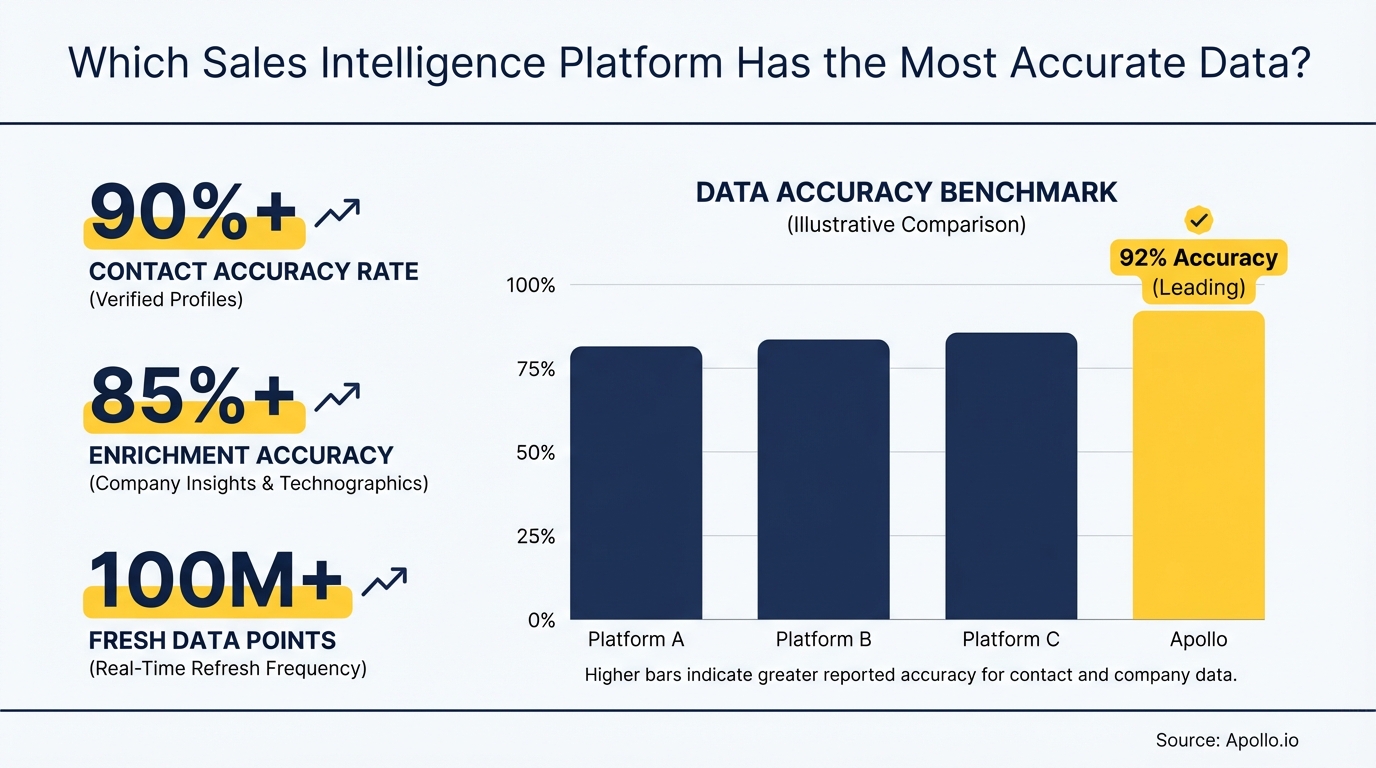
Apollo delivers 97% email accuracy across its 230M+ person database, verified through multi-source cross-checking and real-time validation at the point of export. This combines breadth of coverage with built-in verification, rather than requiring a separate enrichment tool.
Apollo also integrates prospecting and enrichment in a single workspace, which removes the accuracy degradation that happens when data passes between disconnected tools. Census replaced their sales tech stack with Apollo specifically for this reason: "We cut our costs in half," the team reported, consolidating what had been multiple tools into one platform.
For teams evaluating Apollo alongside other options, the Apollo vs ZoomInfo comparison at Census provides a real-world case study on data quality, coverage, and total cost of ownership.
Key accuracy differentiators to compare across platforms:
- Email verification method (real-time vs. batch)
- Waterfall enrichment availability (native vs. requiring third-party tools)
- Mobile/direct dial verification and sourcing
- Job-change detection and refresh cadence
- Confidence scoring and last-verified timestamps on individual records
What Is a Practical Bakeoff Blueprint for Evaluating Data Accuracy?
A vendor data accuracy bakeoff is a structured test comparing two or more platforms on the same target account list, measured by identical outcome metrics over a fixed time window.
Follow this five-step process:
- Define your ICP segment: Pick 500 target contacts that match your real buying profile. Segment by geography, industry, and seniority since accuracy varies across these dimensions.
- Pull the same list from each vendor: Use identical filters across platforms to ensure you're comparing equivalent data sets.
- Check provenance signals: For each record, note whether a last-verified date, confidence score, or source attribution is available. Platforms that surface these signals are easier to govern.
- Send a small test sequence: Run 100-200 email sends per vendor batch and measure hard bounce rate. Below 2% is the current deliverability standard for inbox protection.
- Score and select: Rank vendors on bounce rate, CRM match rate, firmographic fill rate, and mobile connect rate. Weight the dimensions by your team's primary outreach motion.
Struggling to find qualified leads with reliable data behind every contact? Search Apollo's 230M+ contacts using 65+ filters and run your own bakeoff on a free account.
Which Sales Intelligence Platform Should You Choose in 2026?
The right platform depends on your motion, segment, and measurement maturity. No single vendor is the most accurate across every field and geography.
The platform with the most accurate data for your team is the one that produces the lowest bounce rate, highest connect rate, and best CRM match rate on your specific ICP.
That said, Apollo stands out for teams that need accuracy and consolidation. With 97% email accuracy, 230M+ verified contacts, native waterfall enrichment, and built-in multi-channel sales engagement, Apollo removes the accuracy degradation that happens when data moves between disconnected tools. As Cyera's team put it: "Having everything in one system was a game changer."
For teams evaluating their options, the Apollo on-demand demo shows exactly how data verification, enrichment, and outreach work together in a single platform. Or explore what top market intelligence tools look like side by side before running your own bakeoff.
Stop guessing which platform is most accurate. Test it on your data. Start Prospecting with Apollo for free and measure accuracy where it counts: in your pipeline.
Prove Pipeline ROI With Apollo
ROI pressure killing your tool budget? Apollo delivers measurable pipeline impact your leadership can see — fast. Leadium 3x'd annual revenue. Get results you can defend in any budget meeting.
Start Free with Apollo →Don't miss these
Sales
Inbound vs Outbound Marketing: Which Strategy Wins?
Sales
What Is a Sales Funnel? The Non-Linear Revenue Framework for 2026
Sales
What Is a Go-to-Market Strategy? The 2026 GTM Playbook
See Apollo in action
We'd love to show how Apollo can help you sell better.
By submitting this form, you will receive information, tips, and promotions from Apollo. To learn more, see our Privacy Statement.
4.7/5 based on 9,690 reviews
