
What Is the Setup Process for a New Sales Automation Platform?
Setting up a new sales automation platform is no longer just a CRM configuration project. In 2026, it is a data governance and AI enablement initiative that determines whether your team hits quota or stalls on day one. The good news: a structured rollout, starting with clean data and agent-ready workflows, produces measurable results fast. According to Cirrus Insight, 75% of organizations globally already use sales automation in some form, meaning the competitive gap between those who set it up well and those who don't is widening. Learn more about what sales automation is and how to use it the right way before diving into implementation.

Let Apollo Find Your Leads Instantly
Tired of burning hours on manual research just to get bounced emails? Apollo delivers verified contacts so your team sells instead of searches. Nearly 100K paying customers have already made the switch.
Start Free with Apollo →Key Takeaways
- Modern sales automation setup is a data and AI governance project first, a feature configuration project second.
- AI adoption in sales has surged dramatically, making agent-readiness a day-one setup requirement, not an afterthought.
- A phased 30/60/90-day rollout beats big-bang launches by delivering quick wins while building toward full orchestration.
- Data quality and stakeholder buy-in are the two most common reasons implementations stall before delivering value.
- Consolidating your tech stack into one unified platform shortens setup time and reduces ongoing maintenance overhead.
Why Is Sales Automation Setup More Complex in 2026?
Sales automation setup has grown more complex because AI agents, data governance requirements, and cross-system interoperability now sit inside the implementation scope. Research from CloudApps shows AI adoption in sales surged from 39% in 2023 to 81% in 2025, creating a market expectation that platforms are agent-ready from the start.
This shift means setup teams must now define agent use cases, data access permissions, and human-in-the-loop controls before building sequences and templates.
Skipping this step is what causes most automation disappointments: the tools work, but incomplete or dirty data feeds them the wrong context.
- Old setup model: Configure fields, import contacts, build sequences
- New setup model: Unify data, govern agent access, then build workflows
- Key risk: AI agent behavior is only as good as the data it operates on
What Are the Four Phases of a Sales Automation Rollout?
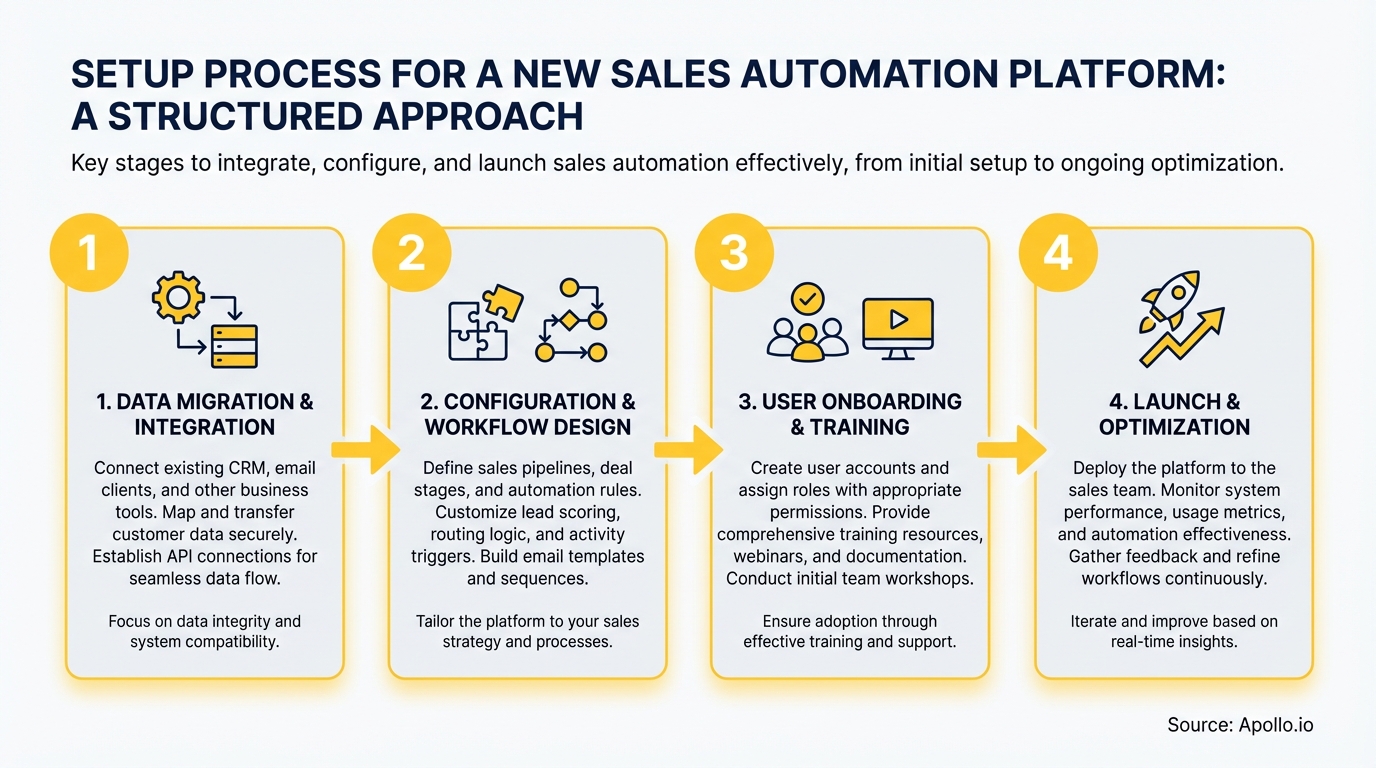
A phased rollout is the most reliable approach for deploying a new sales automation platform, with distinct goals for each 30-day window.
| Phase | Timeline | Primary Goal | Key Deliverables |
|---|---|---|---|
| Foundation | Days 1–30 | Data readiness and governance | Data model, deduplication plan, user permissions, integration health check |
| Activation | Days 31–60 | First workflows live | Prospecting sequences, activity capture rules, pipeline hygiene automation |
| Optimization | Days 61–90 | AI agents enabled | Agent use-case catalog, QA checklists, messaging guardrails, metrics dashboard |
| Scale | Day 90+ | Full orchestration | Cross-functional playbooks, forecasting, revenue operations alignment |
Prioritizing activity capture and pipeline hygiene rules in Phase 2 delivers early, visible wins for the team.
The Apollo Workflow Engine is designed to activate these wins quickly, with pre-built automation templates that reduce configuration time significantly.

How Do SDRs and RevOps Leaders Each Approach Setup Differently?
SDRs and RevOps leaders have different setup priorities, and a successful implementation addresses both simultaneously.
For SDRs and BDRs: The immediate value comes from automated prospecting workflows. Landbase reports that 92% of sales teams plan to boost their AI investment in 2026, largely because manual prospecting remains a top time drain.
SDRs need sequences, messaging templates, and AI-assisted research running within the first 30 days to see value.
Struggling to build pipeline from day one? Automate your outreach sequences with Apollo's multi-channel engagement platform.
For RevOps leaders: Setup success means a single source of truth, clean CRM data, and workflows that enforce process without manual oversight. According to TryKondo, 48% of sales professionals express concerns over tool complexity, and 94% of sales organizations planned tech stack consolidation. RevOps teams find that consolidating onto one platform reduces integration maintenance and provides cleaner attribution data. As the team at Predictable Revenue put it: "We reduced the complexity of three tools into one."
Turn Funnel Gaps Into Qualified Pipeline
Pipeline forecasting a guessing game because quality leads keep stalling before they ever reach your AEs? Apollo surfaces in-market buyers with precision targeting so your funnel fills with opportunities that actually convert. Nearly 100K paying customers have already replaced the guesswork.
Schedule a Demo →What Data Governance Steps Are Required Before Launch?
Data governance is the foundational setup step that determines whether every downstream automation and AI feature works correctly. Skipping it creates compounding problems that are expensive to fix post-launch.
- Deduplication: Merge or suppress duplicate contact and company records before importing
- Identity resolution: Define how contacts, accounts, and leads map across your CRM and engagement platform
- Access controls: Set user-level and role-based permissions before enabling AI agents or connectors
- Field mapping: Confirm which fields sync bidirectionally between your CRM and automation platform
- Retention policies: Document how long contact data is stored and how deletion requests are handled
Teams connecting AI agents to their stack should also document data lineage: what data each agent can read, write, and act on. This documentation doubles as a customer-facing security artifact when prospects ask about data handling. Connecting Apollo to HubSpot or Salesforce is straightforward with native integrations that maintain field-level sync without manual mapping overhead.
What Are the Most Common Setup Mistakes to Avoid?
Most sales automation implementations fail due to process and people problems, not technology limitations. Identifying these risks early prevents costly restarts.
According to Gestisoft, businesses frequently begin implementation without defined goals or key performance indicators, making it impossible to measure success. Trantorinc adds that successful deployment heavily relies on active participation from leadership, department heads, and end-users, and insufficient involvement from any of these groups derails rollouts.
- No baseline KPIs: Define target metrics (meeting rate, pipeline velocity, win rate) before go-live
- Rep resistance: Involve reps in workflow design so the platform feels like a productivity tool, not a surveillance system
- Heavy customization first: Start with standard workflows, then customize based on real usage data
- Skipping integration health checks: OAuth drift and domain changes can silently break CRM syncs post-launch
- No change management plan: Assign a dedicated internal champion and communicate rollout milestones across the org
Explore sales performance management strategies to align your implementation goals with measurable revenue outcomes from the start.
How Does Apollo Simplify the Sales Automation Setup Process?
Apollo simplifies setup by consolidating prospecting, engagement, data enrichment, and AI automation into a single unified platform, eliminating the multi-vendor integration work that slows most rollouts.
Instead of configuring separate tools for contact data, sequencing, and pipeline tracking, teams get one workspace.
As Cyera reported: "Having everything in one system was a game changer." Census added: "We cut our costs in half." Apollo's AI sales automation platform includes guided setup workflows, native CRM integrations, and pre-built sequence templates so teams reach their first active workflow in days, not weeks.
Key setup advantages for B2B GTM teams:
- 230M+ verified contacts ready to use on day one, no data import required
- 65+ search filters for precise ICP targeting without separate prospecting tools
- Native HubSpot and Salesforce sync with field-level mapping pre-configured
- AI-powered messaging with guardrails built in, reducing QA overhead
- Workflow automation for activity capture, lead routing, and pipeline hygiene out of the box
For sales leaders managing teams, Apollo provides team-level visibility, coaching tools, and quota tracking within the same platform, removing the need for a separate analytics layer.

What Does a Successful Setup Look Like After 90 Days?
A well-executed 90-day rollout produces a fully operational sales automation environment with active AI agents, clean data, and measurable pipeline impact.
By day 90, teams should have:
- At least two active prospecting sequences running with defined entry and exit criteria
- AI agents configured for prospecting research, with approved messaging templates and QA review cycles
- A metrics dashboard tracking meeting booked rate, sequence reply rate, and pipeline created per rep
- A documented agent governance policy covering data access, human review steps, and audit logs
- Cross-functional alignment between Sales, Marketing, and RevOps on shared lifecycle stage definitions
The most successful teams treat the 90-day mark as the beginning of optimization, not the end of setup. Reviewing the types of sales automation available in Apollo at this stage reveals additional workflow opportunities that compound results over time.
Ready to skip the painful multi-tool setup and go live faster? Get Leads Now and see how Apollo's unified GTM platform gets your team to first workflow in days, not months.
Prove Pipeline ROI With Apollo
ROI pressure killing your tool budget approval? Apollo delivers measurable pipeline impact from day one — quantifiable wins your leadership can't ignore. Leadium 3x'd annual revenue. Your CFO wants numbers. Apollo gives you them.
Start Free with Apollo →Don't miss these
Revenue Operations
Top Market Intelligence Tools for B2B Teams in 2026
Revenue Operations
Sales Operations Analyst Salary: 2026 Compensation Guide and Benchmarks
Revenue Operations
Sales Compensation Software: How to Automate Commission Management
See Apollo in action
We'd love to show how Apollo can help you sell better.
By submitting this form, you will receive information, tips, and promotions from Apollo. To learn more, see our Privacy Statement.
4.7/5 based on 9,690 reviews
