
What's the Right Ratio of AI SDRs to Human SDRs on an Outbound Team?
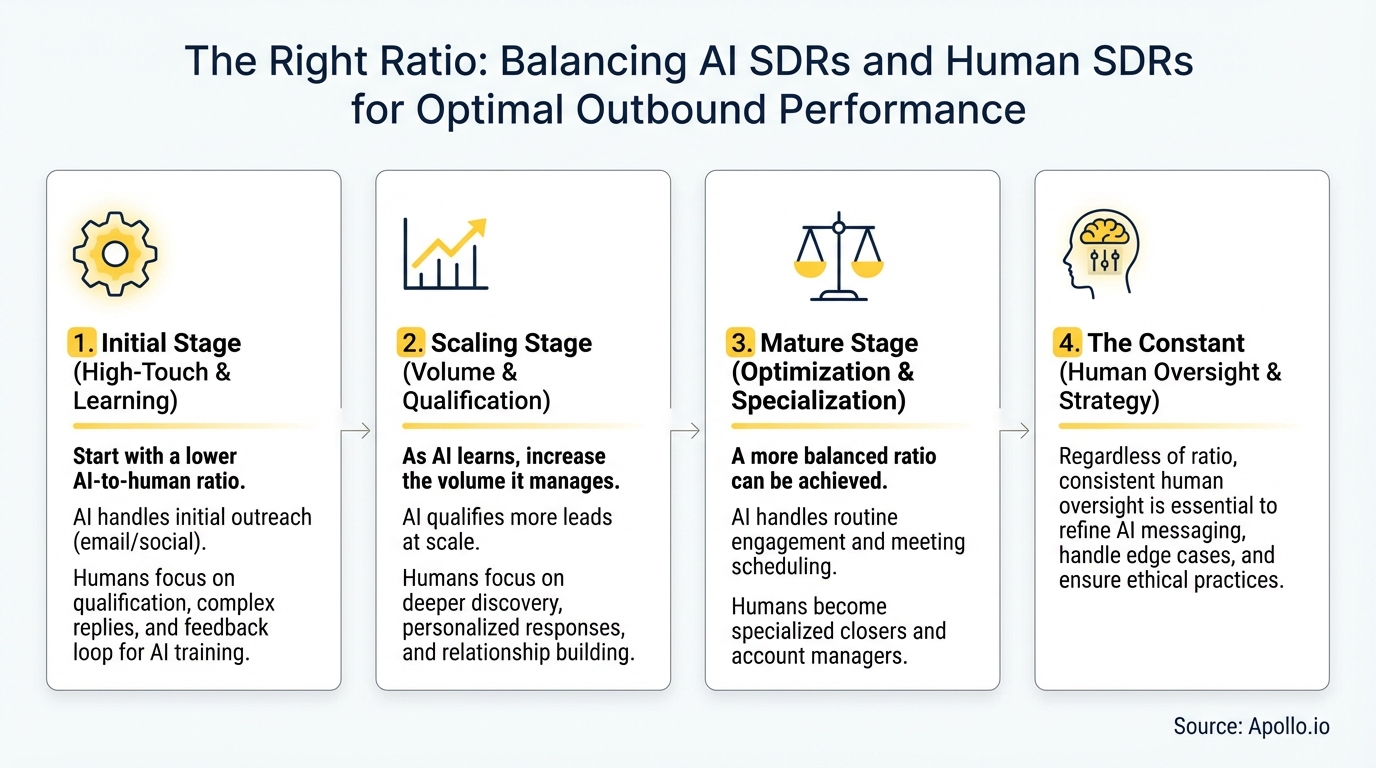
There is no single correct ratio of AI SDRs to human SDRs. The right balance depends on your team's adoption maturity, ICP complexity, deal size, and governance readiness. Tools like Apollo's AI Sales Assistant are accelerating this shift by handling research, list building, and sequence creation end-to-end, allowing human SDRs to focus on conversations that require judgment and relationship-building.
Rather than a fixed headcount formula, leading teams are adopting a maturity-based framework: start with AI as a copilot, expand coverage as governance matures, and scale toward agent-led workflows where volume and repeatability justify it. Read our Sales Acceleration Formula for more context on structuring high-performance outbound teams.

Research Less, Close More With Apollo
Tired of your reps burning hours on manual lead research instead of selling? Apollo surfaces verified contacts instantly so your team spends time closing, not digging. Join 600K+ companies building pipeline faster.
Start Free with Apollo →Key Takeaways
- No universal AI-to-human SDR ratio exists — the right mix scales with your team's adoption stage and sales motion complexity.
- Research confirms the hybrid model is now the majority approach, with AI handling high-volume tasks and humans owning conversations and strategy.
- AI functions best as a copilot multiplying each human SDR's output, not as a one-for-one headcount replacement.
- Governance, deliverability oversight, and brand risk management set a practical floor on human involvement regardless of AI capability.
- SDR roles are evolving: fewer manual reps, more strategic SDRs and agent ops roles managing AI quality and routing.
What Does the Data Say About AI SDR Adoption in 2026?
AI adoption on outbound teams accelerated sharply in recent years but remains uneven. According to Cirrus Insight, a HubSpot 2024 survey showed AI adoption among sales representatives nearly doubled from 24% in 2023 to 43% in 2024. Data from Thriwin indicates that by 2025, 75% of B2B sales teams were expected to utilize AI to enhance sales performance.
Despite this growth, full replacement is still the exception. Salestools.io reports that as of 2025, only 22% of teams had fully replaced human SDRs with AI agents, while Outbound System found 45% of sales teams were employing a hybrid AI-plus-human SDR model. The dominant pattern is augmentation, not substitution.
What Is the Maturity-Based Framework for AI SDR Ratios?
The right AI-to-human SDR ratio is a function of your team's adoption stage, not an industry benchmark. Use this three-stage model to calibrate coverage:
| Stage | AI Role | Human Role | Suggested AI Coverage |
|---|---|---|---|
| Pilot | Research, first drafts, list building | All outreach, strategy, QA | 1 AI copilot per 3-5 SDRs |
| Expansion | Sequences, follow-ups, scoring | Live calls, exceptions, multi-threading | 1 AI copilot per 1-2 SDRs |
| Scale | High-volume initial touches, inbound routing | Strategic accounts, deals, governance | AI-led with human review layer |
High-volume SMB motions can move to the scale stage faster. Enterprise and complex-deal segments remain more human-intensive at every stage due to multi-threading requirements and longer sales cycles. Explore how outbound prospecting strategy shifts across these motions.
Turn Blind Forecasts Into Pipeline Clarity
Pipeline forecasting a guessing game because no one agrees on where deals actually stand? Apollo's real-time signals cut through the noise so your team acts on facts, not gut feel. Join 600K+ companies building predictable revenue.
Schedule a Demo →How Do SDRs and RevOps Leaders Use AI to Multiply Output?
The most accurate framing is not AI SDRs replacing human SDRs — it is AI copilots multiplying each human's capacity. SDRs using AI tools report meaningful time savings on research, personalization, and inbox management, freeing them for the high-judgment work that drives pipeline. Erik Fernando Nieto, BDR at JumpCloud, put it directly: "Apollo's AI Assistant filters and cleans prospect data for me, so I can find the right people faster and run better searches. It saves me about an hour per prospecting session."
RevOps leaders benefit differently. They use AI to enforce ICP scoring, route accounts consistently, and maintain data quality without adding headcount. Apollo's Scores feature auto-generates lead scores based on website signals and prospecting activity, giving RevOps a scalable prioritization layer. Struggling to automate your outbound sequences? Apollo's AI sales automation handles list building, sequencing, and follow-ups in one workflow.

What Governance and Guardrails Does an AI-Heavy Team Need?
Governance is the binding constraint that determines how quickly teams can shift the ratio toward AI. Even advocates of AI-first outbound acknowledge that data quality, deliverability risk, and brand consistency create a practical floor for human oversight.
Fully autonomous outbound without human review introduces compliance exposure and message-quality variance that most teams cannot accept at scale.
Minimum governance requirements for any AI-heavy outbound team include:
- Deliverability monitoring: Human review of send volumes, bounce rates, and domain health
- Message QA: Spot-checking AI-generated sequences for accuracy and brand alignment before launch
- ICP guardrails: Defined filters and exclusion lists to prevent AI from contacting off-limits segments
- Content governance: A shared content center grounding all AI outputs in approved messaging and value propositions
Apollo's AI Content Center centralizes these guardrails, ensuring every AI-generated email, call script, and follow-up reflects your current positioning. This is the operational infrastructure that makes scaling the AI ratio sustainable. Learn how to build winning outbound sequences that balance automation with quality.
What KPIs Should Sales Leaders Track When Shifting the AI-Human Ratio?
Shifting the ratio without adjusting your measurement framework produces misleading results. AI-heavy teams generate more activity volume, but volume metrics alone do not reveal whether the shift is creating pipeline.
Sales leaders and RevOps need a balanced scorecard that covers both AI efficiency and human conversion quality.
| KPI Category | What to Measure | Why It Matters |
|---|---|---|
| Volume efficiency | Touches per rep per week, sequence launch time | Validates AI productivity lift |
| Quality signals | Reply rate, positive reply rate, meeting acceptance | Confirms AI messaging is resonating |
| Pipeline contribution | Meetings held, opportunities created per SDR | Ties AI activity to revenue outcomes |
| Governance health | Bounce rate, unsubscribe rate, domain reputation | Flags deliverability risk before it compounds |
For deal-level visibility, Apollo's deal management connects pipeline tracking directly to outbound activity, so leaders can see which AI-assisted sequences are actually converting to revenue. See also how a revenue operations framework structures these metrics across the GTM team.
How Are SDR Team Structures Evolving in 2026?
The SDR role is polarizing. Fewer junior reps are doing purely manual prospecting work. More teams are moving toward senior strategic SDRs who handle objections, events, and partner motions, alongside new agent ops roles managing AI prompt quality, routing logic, and performance monitoring. According to SaaStr, 36% of companies decreased SDR and BDR headcount in the past year, the highest reduction among all sales functions, while only 19% increased it.
This does not mean teams are abandoning human SDRs. It means the work is shifting. Human SDRs who understand how to direct, review, and amplify AI workflows are becoming more valuable, not less. Harry Gable-Newkirk, Enterprise Sales Development Manager at YipitData, describes the shift: "Apollo's AI Assistant helped me instantly qualify or disqualify accounts using the right signals, saving me at least a full day's work." Teams consolidating their tools through Apollo report fewer manual handoffs and cleaner data as a direct result. Learn more about how sales operations functions within modern organizations to support this transition.

Start Building Your Hybrid Outbound Team with Apollo
The right AI-to-human SDR ratio is the one that matches your current adoption stage, scales with governance maturity, and measures quality alongside volume. Most teams succeed by starting with AI as a copilot amplifying each human SDR's output, then expanding automation as playbooks and guardrails prove out.
Apollo brings prospecting, AI research, sequencing, scoring, and conversation intelligence into one platform, so your team can shift the ratio without adding tool sprawl. As Tory Kindlick, Head of Revenue Ops at RapidSOS, said: "Work that would've taken me hours was done before I even got off the train." Explore the AI Assistant guide to see how your team can put this into practice today.
Start Free with Apollo and build the AI-human outbound team your pipeline needs.
Prove Pipeline ROI With Apollo
ROI pressure killing your tool budget approvals? Apollo delivers measurable pipeline impact so you walk into every review with hard numbers, not gut feel. Leadium 3x'd annual revenue — your results start free.
Start Free with Apollo →Don't miss these
Sales
Inbound vs Outbound Marketing: Which Strategy Wins?
Sales
What Is a Sales Funnel? The Non-Linear Revenue Framework for 2026
Sales
What Is a Go-to-Market Strategy? The 2026 GTM Playbook
See Apollo in action
We'd love to show how Apollo can help you sell better.
By submitting this form, you will receive information, tips, and promotions from Apollo. To learn more, see our Privacy Statement.
4.7/5 based on 9,690 reviews
