
What's the Ideal Cadence for a Multi-Channel Outbound Sequence in 2026?
The days of blasting 15 emails and hoping for a reply are over. In 2026, the ideal cadence for a multi-channel outbound sequence is defined by channel rotation, buyer signals, and enablement assets — not raw touch volume.
Email deliverability rules tightened significantly after Microsoft began enforcing bulk-sender requirements in May 2025, making high-frequency, email-heavy sequences a liability rather than a strategy. The winning approach combines fewer, higher-quality touches across email, phone, and social — timed around what buyers actually do, not what reps find convenient.
If you're building or rebuilding your outbound motion, start with the Sales Cadence Secrets playbook for sequence length benchmarks, then use the framework below to design cadences that actually convert.

Research Less. Pipeline More With Apollo.
Tired of burning hours verifying contact info that goes nowhere? Apollo delivers 230M+ accurate business contacts so your team sells instead of searches. Start building pipeline today.
Start Free with Apollo →Key Takeaways
- The ideal multi-channel outbound sequence runs 8–18 touches over 2–6 weeks, tiered by account value and intent signal strength.
- Phone calls are re-emerging as the primary meeting-creation channel — email and social reinforce, not replace, call steps.
- Buyer enablement assets (ROI calculators, short demos, comparison templates) should be embedded in mid-sequence touches to serve buyers who prefer self-serve research.
- Cadence today is signal-led, not calendar-led — triggers like intent data, job changes, and site visits should accelerate or re-route sequences.
- SDRs and BDRs who consolidate prospecting, sequencing, and call tasks into one platform consistently outperform those juggling multiple disconnected tools.
What Is the Ideal Touch Count for a Multi-Channel Outbound Sequence?
The right number of touches depends on deal size and account tier, not a universal rule.
According to Tendril, research suggests 8–12 contacts deliver the best results for a well-laid-out B2B sales cadence.
For larger deals, the bar rises:Fundraise Insider recommends 10–12 touches over four to six weeks for mid-market targets, and 12–18 touches over eight to twelve weeks for enterprise targets.
A practical tiering model:
| Account Tier | Touch Count | Duration | Primary Channels |
|---|---|---|---|
| SMB / High Intent | 6–10 | 10–14 days | Email + Phone |
| Mid-Market | 10–12 | 4–6 weeks | Email + Phone + Social |
| Enterprise | 12–18 | 8–12 weeks | Email + Phone + Social + Direct Mail |
One critical persistence insight:SendTrumpet reports that 80% of sales require five or more follow-ups to close, yet many reps abandon prospects after only two or three attempts.
Front-loading your sequence with tighter early spacing (Day 1 call + Day 2 email) and widening intervals in later steps is the structural fix.
How Should SDRs Structure a Multi-Channel Sequence Day by Day?
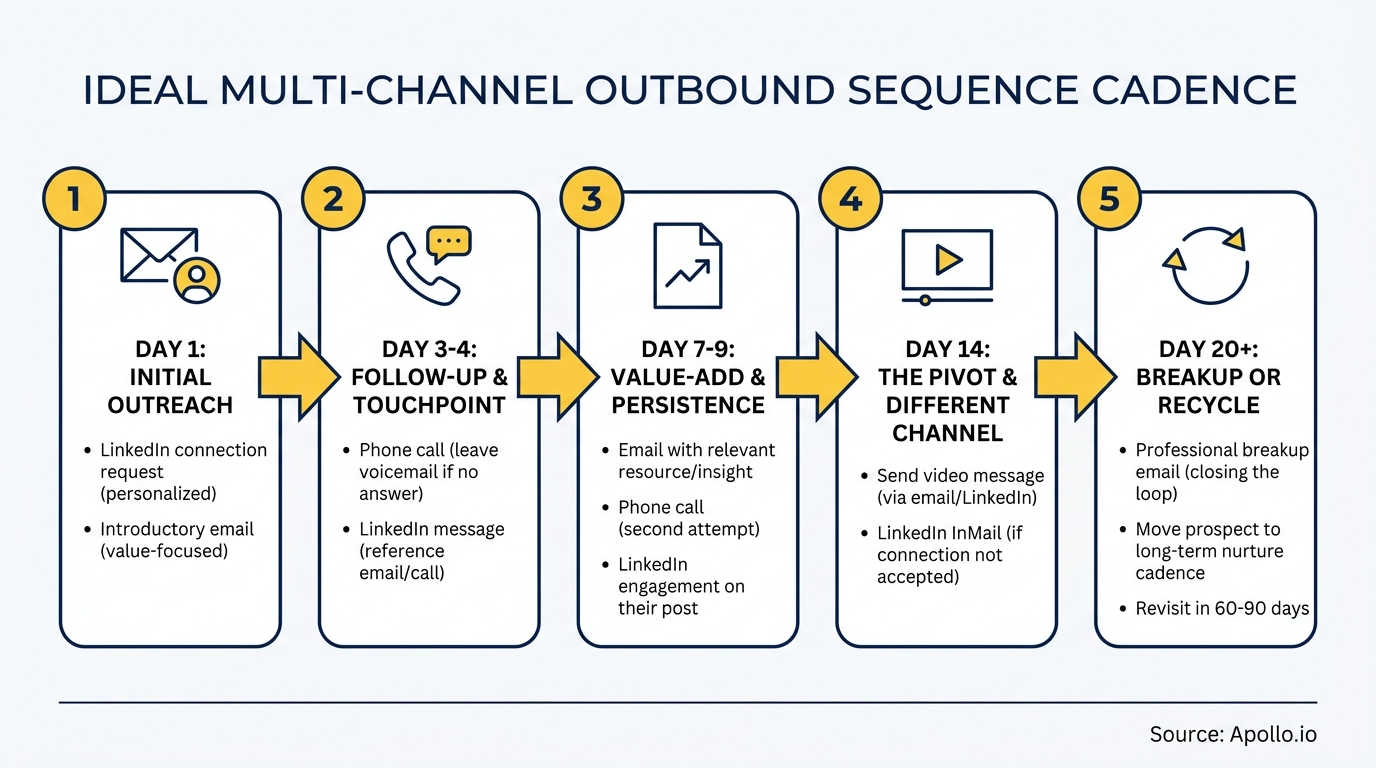
SDRs should open every sequence with a phone call on Day 1, supported by a same-day email — this front-loaded approach captures interest while it's fresh.
Here's a practical 12-touch mid-market cadence template:
- Day 1:Phone call + personalized intro email (reference a specific trigger: hiring, funding, content)
- Day 3: Follow-up email with a self-serve asset (ROI calculator, short video walkthrough, or comparison template)
- Day 5: Phone call + voicemail
- Day 8: Social touch (connection request or comment on their post)
- Day 10: Email — share a relevant case study or industry insight
- Day 14: Phone call
- Day 18: Email with a low-friction ask ("Is this even on your radar?")
- Day 22: Social engagement or direct message
- Day 28: Phone call + breakup email option
The key shift for 2026: calls are the backbone, not an add-on. Benchmark data shows phone contributes the majority of meetings booked in multi-channel programs, with email and social playing a supporting role. See cold calling best practices for scripts and timing strategies that convert.
Spending hours building sequences manually? Automate your multi-channel sequences with Apollo's sales engagement platform — email, calls, and social steps in one workspace.
Turn Funnel Guesswork Into Closed Deals
Tired of watching marketing leads stall before they ever reach your pipeline? Apollo surfaces high-intent prospects so your team focuses on buyers ready to convert. Nearly 100K paying customers stopped guessing and started closing.
Start Free with Apollo →What Buyer Enablement Assets Should Each Touch Include?
Buyer enablement assets are self-serve resources embedded in outbound touches that let prospects evaluate your solution on their own terms.
This matters because a significant share of B2B buyers prefer to complete research without scheduling a call — making asset-rich sequences more effective than sequences that only push for meetings.
Map assets to sequence stage:
- Early touches (Days 1–5): Short personalized video (60 seconds), one-page problem brief, relevant blog post
- Mid touches (Days 8–18): ROI calculator, comparison framework, customer case study, interactive demo link
- Late touches (Days 22–28+): Pricing overview, peer review summary, "what implementation looks like" one-pager
For AEs managing larger accounts, mid-sequence assets that address specific buying committee objections (security, integration, ROI) dramatically reduce friction before the first call.
Pair video assets with your outreach using the Vidyard + Apollo integration to increase meeting rates.
Address objections proactively with proven sales objection handling frameworks.

When Should You Abandon or Restart a Sequence?
A sequence should be paused or ended when engagement signals flatline — not when a fixed number of days passes.
Diminishing returns in outbound follow a predictable pattern: response probability drops sharply after the first 3–5 touches if no engagement occurs, and additional touches without channel variation add noise without signal.
Practical go/no-go rules:
- Pause after touch 5 with zero engagement: Switch to a nurture track or lower-frequency social-only sequence
- Re-engage after 60–90 days: Use a new trigger (funding round, role change, product update) to reopen the sequence
- Fast-track on positive signals: If a prospect opens an email 3+ times or clicks an asset link, move the next call step up immediately — don't wait for the scheduled day
- Escalate on high-intent signals: Website visits, demo requests, or intent data spikes should trigger a Tier 1 (high-touch) sequence immediately
RevOps leaders can enforce these rules at scale by building signal-based branching logic into their sequence platform, so reps aren't making manual judgment calls on every contact.
Learn more about signal-led sales cadence design.
How Do Account Executives Adapt Cadence for Late-Stage Buyers?
Account Executives should shorten cadence length and increase personalization depth for late-stage buyers, since most B2B buyers are already well into their evaluation before a vendor reaches them.
A late-stage buyer doesn't need awareness content — they need comparison data, peer validation, and implementation confidence.
AE-specific cadence adjustments:
- Lead with a phone call referencing a specific trigger (competitor switch, RFP signal, intent spike)
- Replace generic follow-up emails with stakeholder-specific assets (CFO ROI model, IT security one-pager)
- Compress the timeline: 6–8 high-quality touches over 10–14 days beats 15 generic touches over 6 weeks
- Include a mutual action plan link in touch 3 or 4 to create structure around the buying process
Struggling to identify which accounts are actively in-market? Use Apollo's 65+ filters to surface high-intent accounts and contacts before building your sequence.
Pairing the right ideal customer profile with intent signals ensures every sequence starts with the right target.
What Are the Key Metrics for Measuring Cadence Performance?
Cadence performance is measured by conversion at each step, not just overall reply rate.
The metrics that matter most in 2026 are time-to-first-conversation, drop-off touch (where prospects exit the sequence), and meeting-to-sequence-start rate.
| Metric | What It Tells You | Action If Low |
|---|---|---|
| Time-to-first-conversation | Speed of sequence activation | Front-load call steps earlier |
| Drop-off touch | Where engagement dies | Rewrite or replace that touch's channel/asset |
| Meeting-to-sequence rate | Overall sequence effectiveness | Test ICP targeting, not just messaging |
| Sequence completion rate | Rep compliance and list quality | Audit list hygiene and rep workflows |
| Reply rate by channel | Channel ROI | Shift budget/effort to highest-performing channel |
Run a 90-day cadence test cycle: set a baseline in month 1, test one variable per sequence in month 2 (channel order, asset type, or subject line), and implement the winning variant in month 3.
Review sales cadence examples and best practices to benchmark your results against proven templates.

Build Smarter Multi-Channel Sequences in 2026
The ideal cadence for a multi-channel outbound sequence isn't a fixed recipe — it's a tiered, signal-responsive system that rotates channels, embeds buyer enablement assets, and knows when to stop.
SDRs, AEs, and RevOps leaders who standardize on a tiered cadence model (high-intent, mid-market, enterprise) and measure drop-off rather than just reply rates will consistently outperform teams still running static email blasts.
Apollo gives GTM teams everything needed to run this playbook in one place: contact intelligence, multi-channel sequencing, built-in dialer, and AI-powered personalization.
As Cyera put it, "Having everything in one system was a game changer." Explore top-performing Apollo sequence templates or review how Apollo compares to other platforms in the Apollo vs.
Salesloft vs.
Outreach comparison.
Ready to put this framework into action? Request a Demo and see how Apollo's all-in-one GTM platform helps your team run smarter, tiered multi-channel sequences without the tool sprawl.
Prove Pipeline ROI Before Next QBR
ROI pressure killing your tool budget? Apollo delivers measurable pipeline impact from day one — no lengthy ramp required. Nearly 100K paying customers justified the investment fast.
Start Free with Apollo →Don't miss these
Sales
Inbound vs Outbound Marketing: Which Strategy Wins?
Sales
What Is a Sales Funnel? The Non-Linear Revenue Framework for 2026
Sales
What Is a Go-to-Market Strategy? The 2026 GTM Playbook
See Apollo in action
We'd love to show how Apollo can help you sell better.
By submitting this form, you will receive information, tips, and promotions from Apollo. To learn more, see our Privacy Statement.
4.7/5 based on 9,690 reviews
