
What Programming and Technical Skills Should a GTM Engineer Have in 2026?
The GTM Engineer role is one of the fastest-growing in B2B sales, with job postings increasing by 205% year-over-year in 2025 according to Bloomberry. But the role is widely misunderstood. Too many GTM Engineers are hired as tool administrators, stitching together 14-tool Frankenstacks and calling it a workflow. The best ones are revenue strategists who build systems that produce pipeline at scale.
The technical skills that matter are not about mastering every tool in the martech landscape. They're about building elegant, compounding systems.
Here's what actually separates a great GTM Engineer from a great tool configurator.

Let Apollo Do The Research For You
Tired of your reps burning hours on manual lead research instead of selling? Apollo surfaces verified contacts instantly, so your team spends time closing — not digging. Join 600K+ companies building pipeline faster.
Start Free with Apollo →Key Takeaways
- SQL, Python, and API integrations are now non-negotiable baseline skills for GTM Engineers in 2026.
- AI fluency is table stakes: approximately 60% of new GTM talent actively uses AI, and AI-driven process design is becoming non-negotiable.
- Data quality and governance skills matter more than tool breadth — nearly half of marketing data is incomplete or outdated.
- The best GTM Engineers build one elegant system, not elaborate multi-tool workflows that require constant maintenance.
- RevOps leaders and SDR managers both depend on GTM Engineers to translate strategy into automated, measurable execution.
What Core Programming Skills Does a GTM Engineer Need?
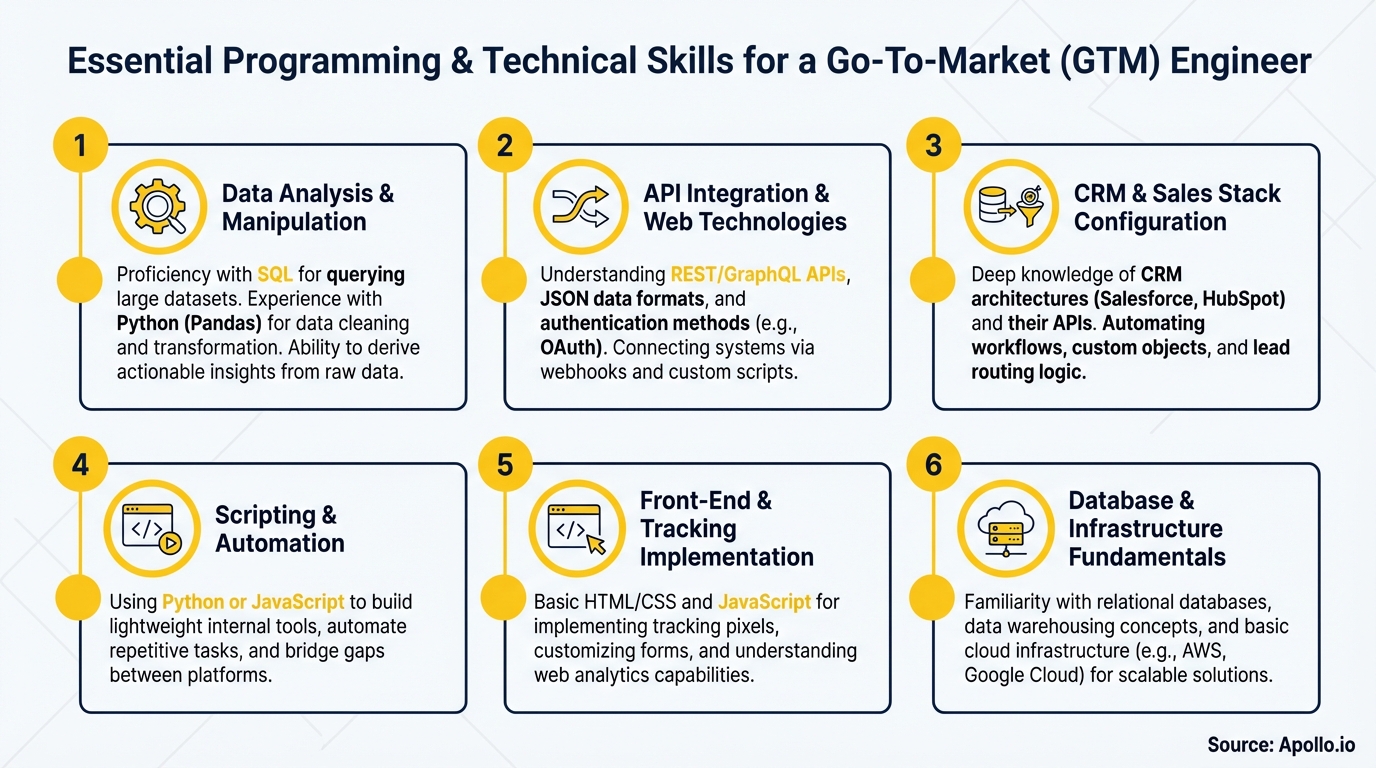
The minimum viable GTM Engineer skill set in 2026 centers on three technical foundations: SQL, Python, and API integrations. According to GTM Engineer Club, SQL, Python, and JavaScript are considered non-negotiable for GTM Engineers. These are not nice-to-haves — they are the difference between configuring tools and building systems.
- SQL: Essential for querying CRMs, data warehouses, and product data. GTM Engineers use SQL to build attribution models, audit lead quality, and surface pipeline insights that dashboards miss.
- Python: Used for data transformation, enrichment automation, custom scoring logic, and connecting APIs. A GTM Engineer who can write Python scripts can build what no off-the-shelf tool offers.
- JavaScript / webhooks: Critical for front-end tracking, form logic, and event-based triggers in marketing and sales systems.
- APIs and REST integrations: Every modern GTM stack runs on APIs. Engineers who understand REST, authentication, and webhook design can build reliable data pipelines — not just click-and-connect integrations.
A 2025 talent analysis of 1,570 new GTM Engineer profiles found growing mentions of Python, SQL, and API integrations, confirming that the role is shifting from tool administration toward custom solution building.
What Data Engineering Skills Should a GTM Engineer Have?
Data pipeline skills are core to effective GTM engineering. As M Accelerator notes, strong experience in building and maintaining sales and marketing data pipelines is vital for the role.
This matters because data quality is materially broken across most GTM teams. The skills that directly address this include:
- Data validation and QA testing: Writing automated checks that catch bad data before it corrupts CRM records or scoring models.
- Deduplication and identity resolution: Merging records across systems so sales and marketing operate from one version of truth.
- Enrichment pipeline design: Building workflows that automatically append firmographic, technographic, and intent signals to accounts.
- Reverse ETL patterns: Pushing cleaned, scored data from a data warehouse back into CRM and engagement tools for activation.
- Event schema design: Structuring tracking events so attribution is reliable and pipeline reporting can be trusted.
Struggling to keep contact data clean at scale? Apollo's data enrichment automatically keeps your records accurate and complete — so your scoring models work with real signals, not stale data.
How Do GTM Engineers Use AI and Automation Skills?
AI fluency is no longer optional. Research from Fullfunnel.co found that approximately 60% of new GTM talent actively uses AI, and by 2026, AI-driven process design will be non-negotiable.
For GTM Engineers, AI skills go well beyond using a chatbot. The practical competencies include:

- Prompt engineering: Writing structured prompts that reliably produce account research, qualification outputs, and persona-specific messaging at scale.
- AI workflow design: Connecting LLM outputs to downstream systems — scoring models, sequencing tools, CRM fields — so AI-generated insights actually drive action.
- Human-in-the-loop (HITL) design: Building review queues so SDRs can approve, edit, or reject AI-drafted messages before they send. This catches hallucinations and keeps brand voice consistent.
- Evaluation and governance: Defining what "good" looks like for AI outputs, and building checks to catch errors before they reach prospects.
- Agentic workflow architecture: As revenue tooling evolves toward autonomous execution, GTM Engineers need to design systems with guardrails, permissions, and observability built in from the start.
Fill Your Funnel With Buyers Who Convert
Running out of qualified leads before the quarter ends? Apollo surfaces in-market prospects aligned to your ICP, so your pipeline stays full — not just busy. Nearly 100K paying customers use Apollo to turn outreach into opportunities.
Start Free with Apollo →What Integration and Stack Architecture Skills Matter for GTM Engineers?
Integration engineering is a core GTM skill in an era of tool sprawl. The martech landscape reached 15,384 tools in 2025, creating constant pressure to evaluate, connect, and rationalize vendor relationships.
The GTM Engineers who win are not the ones who know the most tools. They're the ones who build the most resilient, consolidated systems. Key integration skills include:
| Skill Area | What It Enables |
|---|---|
| CRM data modeling | Consistent object definitions across sales and marketing |
| iPaaS / middleware | Reliable data sync without brittle point-to-point connections |
| Webhook design | Real-time event triggers that power scoring and sequencing |
| Vendor evaluation | Choosing fewer, better-connected tools vs. adding complexity |
| Migration planning | Moving between platforms without losing data or breaking workflows |
| API orchestration | Building agentic workflows with proper testing and monitoring |
The best GTM strategy demands execution velocity, not integration overhead. A GTM Engineer who builds a 14-tool workflow has created a fragile system that breaks every time a vendor changes an API or raises prices. Platform consolidation is not a limitation — it is a strategic advantage.
How Do RevOps Leaders and SDRs Work With GTM Engineers?
RevOps leaders depend on GTM Engineers to translate strategic priorities into automated, measurable systems. SDRs depend on them to surface the right accounts with the right context at the right time — without manual research burning half the day.
For RevOps teams, the most valuable GTM Engineer skills are scoring model design, deliverability infrastructure management, attribution instrumentation, and monthly optimization cadences. RevOps leaders find that well-designed systems let them answer questions that were previously impossible: What is our actual TAM? Which signals predict pipeline? What percentage of our market have we reached?
For SDRs and BDRs, the GTM Engineer's output is a daily review queue: prioritized accounts with AI-researched context and draft messaging ready for approval. Instead of two hours of manual research, SDRs spend 30 minutes reviewing and approving — then focus the rest of the day on conversations that actually convert. This is what the GTM Engineering (GTME) Program is built to deliver.
Want your SDRs spending more time selling and less time on research? Apollo's AI sales automation surfaces prioritized accounts with research and draft messaging built in — so your team focuses on judgment, not data entry.
What Is the GTM Engineer Skills-to-Outcomes Framework?
Every technical skill a GTM Engineer develops should map to a measurable business outcome. The skills-to-outcomes framework below connects the most critical competencies to the GTM problems they solve.
| Technical Skill | GTM Problem It Solves | Measurable Outcome |
|---|---|---|
| SQL + attribution modeling | Measurement distrust across marketing and sales | Reliable pipeline attribution leadership can act on |
| Data validation and enrichment | Incomplete or inaccurate contact and account data | Higher deliverability, cleaner CRM, better scoring |
| AI prompt + workflow design | Manual research consuming SDR selling time | More conversations per rep per day |
| Scoring model design | Inconsistent account prioritization across the team | Faster time-to-meeting for highest-fit accounts |
| API integration + CRM modeling | Fragmented data across disconnected tools | One source of truth for sales and marketing |
| Web tracking + product analytics | Buyers preferring self-serve evaluation paths | Inbound signals feeding outbound prioritization |
For more context on how these skills connect to broader revenue strategy, see what actually works in demand generation and how to align sales KPIs with the systems GTM Engineers build.
How Should GTM Engineers Think About Platform Consolidation vs. Tool Breadth?
The most common mistake in GTM engineering is treating technical skill as the ability to integrate more tools. Many GTMEs wear a badge of honor around how many disparate tools they've strung together — the irony being that seamless and 14-tool Frankenstack are an oxymoron by definition.
The endgame for GTM engineering is agentic execution: a system where targeting, scoring, messaging, and follow-up run autonomously, with humans making judgment calls on the highest-value accounts. The GTM Engineer who wins long-term is the one who deploys the most elegant strategy at the highest velocity — not the one who builds the most elaborate workflow.
This is why platform thinking matters as much as any individual technical skill. Understanding CRM integration strategy and being able to evaluate when to consolidate versus when to add a vendor is a differentiating competency. "Having everything in one system was a game changer" — Cyera. "We reduced the complexity of three tools into one" — Predictable Revenue.
How Do You Start Building GTM Engineering Skills in 2026?
Building GTM engineering skills is a structured progression, not a checklist to complete all at once. Start with the foundations that unlock everything else, then layer in specialization.
- Foundation: SQL proficiency, REST API basics, CRM data modeling (HubSpot or Salesforce objects), webhook fundamentals.
- Intermediate: Python scripting for data transformation, prompt engineering for account research, scoring model design, enrichment pipeline setup.
- Advanced: Attribution instrumentation, reverse ETL patterns, agentic workflow architecture with guardrails, vendor migration planning.
For teams that want a structured path from scattered GTM execution to a fully operational system, the GTME Program delivers a dedicated GTM Engineer who builds the seven-pillar system alongside your team over 12 weeks — including scoring models, AI-powered messaging, and data orchestration workflows. The GTME methodology provides the framework that makes every technical skill purposeful rather than additive.
GTM engineering is also increasingly relevant for understanding roles adjacent to it — including technical sales representatives and sales engineers who collaborate closely with GTM systems.
Start Building a Smarter GTM System Today
The technical skills that define a great GTM Engineer — SQL, Python, APIs, AI workflow design, data governance, and platform consolidation — are all in service of one goal: a system that produces pipeline at scale without constant manual intervention. The best GTM Engineers are not tool sommeliers.
They are revenue strategists who build once and compound forever.
Apollo gives GTM Engineers a single platform for prospecting, scoring, sequencing, enrichment, and AI-powered outreach — collapsing the stack into one elegant workflow. Ready to see what a unified GTM system looks like in practice? Schedule a Demo and see how Apollo's platform supports the skills GTM Engineers use every day.
Prove Pipeline ROI Before Next QBR
ROI pressure killing your tool budget before you can scale? Apollo delivers measurable pipeline outcomes your exec team can see. Leadium 3x'd annual revenue — start your free trial today.
Start Free with Apollo →Don't miss these
Sales
Inbound vs Outbound Marketing: Which Strategy Wins?
Sales
What Is a Sales Funnel? The Non-Linear Revenue Framework for 2026
Sales
What Is a Go-to-Market Strategy? The 2026 GTM Playbook
See Apollo in action
We'd love to show how Apollo can help you sell better.
By submitting this form, you will receive information, tips, and promotions from Apollo. To learn more, see our Privacy Statement.
4.7/5 based on 9,690 reviews
