
Cold Prospecting vs. Inbound Lead Generation: Key Differences Explained
Most B2B teams treat cold prospecting and inbound lead generation as an either/or decision. They're not.
They're two distinct motions with different economics, different timelines, and different roles in your pipeline. Understanding how they differ is the first step to running both effectively.
This breakdown covers the core differences, the benchmarks that matter in 2026, and how SDRs, RevOps leaders, and marketing teams can combine both approaches to build a more predictable revenue engine. For a broader look at how these strategies fit into the bigger picture, see the difference between sales and marketing.

Research Less, Pipeline More With Apollo
Tired of burning hours verifying contacts before a single email goes out? Apollo surfaces accurate, ready-to-reach prospects so your reps spend time selling — not searching. Nearly 100K paying customers scaled pipeline without scaling headcount.
Start Free with Apollo →Key Takeaways
- Cold prospecting interrupts; inbound attracts. Each has a distinct role in the buyer journey.
- Cold outreach benchmarks are tightening: response rates and dial-to-meeting conversions are low, making targeting and deliverability non-negotiable.
- Inbound leads tend to have lower acquisition costs but carry a higher risk of buyer regret if content doesn't reduce uncertainty.
- In 2026, the most effective GTM teams run inbound and outbound as complementary, signal-driven motions rather than separate silos.
- SDRs and RevOps leaders need clear MQL/SQL definitions and routing logic to convert leads from either channel efficiently.
What Is the Difference Between Cold Prospecting and Inbound Lead Generation?
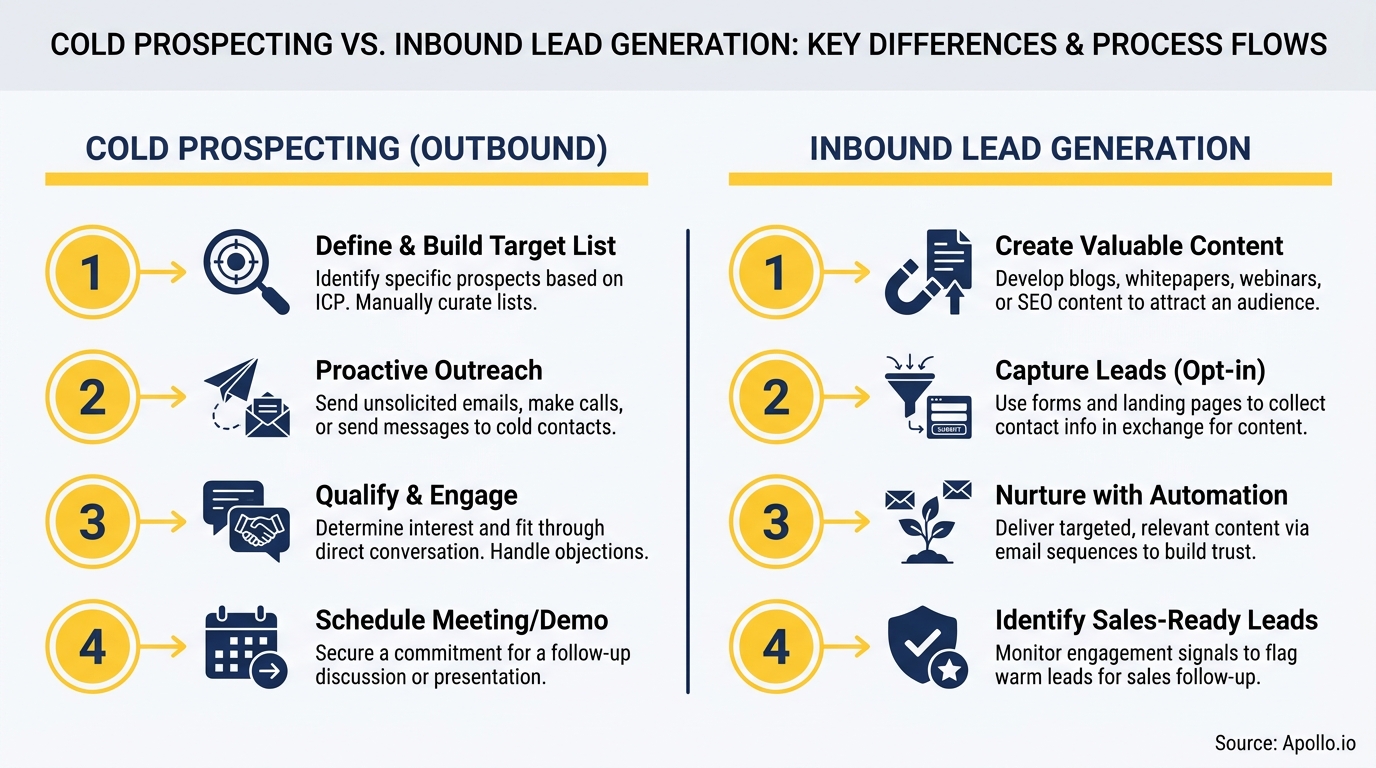
Cold prospecting is a seller-initiated motion: your team identifies target accounts, finds contact information, and reaches out without prior interaction. Inbound lead generation is a buyer-initiated motion: prospects discover your brand through content, search, or referrals and raise their hand by engaging with your assets.
| Dimension | Cold Prospecting | Inbound Lead Generation |
|---|---|---|
| Who initiates contact | Seller | Buyer |
| Lead intent level | Low to unknown | Medium to high |
| Time to first pipeline | Days to weeks | Weeks to months |
| Cost structure | Variable (per rep activity) | Compounding (content builds over time) |
| Scalability | Scales with headcount | Scales with content and distribution |
| Primary owners | SDRs, BDRs, AEs | Marketing, RevOps, demand gen |
For a deeper look at how demand creation fits alongside lead capture, see demand generation vs. lead generation.
What Are the Real Benchmarks for Cold Prospecting in 2026?
Cold prospecting benchmarks reveal a clear pattern: volume alone does not drive results. Precision, personalization, and deliverability compliance now determine whether outbound works.
- According to Belkins, the average cold B2B email reply rate dropped from 6.8% in 2023 to 5.8% in 2024, reflecting increased inbox fatigue and competition.
- Research from SalesHive shows the average dial-to-meeting conversion rate for pure cold outbound calling is around 2-3% in 2025, with top performers reaching 5-8%.
- Data from Insight Mark Research indicates personalized cold emails see a 32% higher response rate compared to generic content.
The deliverability environment has also shifted. Google and Yahoo sender requirements (effective February 2024) mandate SPF/DKIM/DMARC authentication, one-click unsubscribe, and complaint rates below 0.3%. Cold prospecting at scale now requires deliverability operations as a core competency, not an afterthought. Struggling to reach the right contacts with verified data? Search Apollo's 230M+ contacts with 65+ filters to target with precision before you send a single email.
For a full guide to running outbound prospecting effectively, including ICP targeting and sequencing strategy, Apollo's playbook covers the end-to-end process.

How Does Inbound Lead Generation Work in 2026?
Inbound lead generation attracts buyers through content, SEO, paid media, webinars, and referrals so they self-identify as interested before a rep ever contacts them.
The motion is shifting, though. Inbound is no longer just about ranking for keywords and capturing form fills.
In 2026, buyers increasingly discover brands through AI answer engines and copilots rather than traditional search. The inbound playbook now includes visibility in AI-generated answers, not just organic search rankings.
There is also a quality risk to manage. Buyers who complete purchases through self-service channels report higher purchase regret than those guided by a rep. Inbound content must go beyond awareness: it needs to address objections, clarify implementation, and reduce uncertainty at every stage of the buyer journey. See lead generation best practices for a framework on building content that converts, not just attracts.
For teams building or scaling their inbound motion, Apollo's inbound lead conversion solution helps capture, qualify, and route inbound leads without adding headcount.
Turn Funnel Guesswork Into Pipeline Wins
Quota stress mounting while marketing leads stall before they ever reach sales? Apollo surfaces high-intent prospects and fills your funnel with buyers who are ready to convert. 600K+ companies stopped guessing and started closing.
Start Free with Apollo →How Do SDRs and RevOps Teams Bridge Cold and Inbound Effectively?
SDRs and RevOps leaders get the most pipeline when cold prospecting and inbound lead generation are connected by shared data, clear definitions, and consistent routing logic.
The most common breakdown happens at the MQL-to-SQL handoff. Marketing sends over a lead; sales doesn't know the context; the lead goes cold.
Fixing this requires agreed definitions and a routing playbook:
- ICP definition: Firmographic and behavioral criteria that qualify an account for outbound targeting or inbound escalation.
- MQL definition: Inbound engagement threshold (e.g., content downloads + page visits + company size) that triggers a sales touchpoint.
- SQL definition: Two-way confirmation of fit and intent, either through a discovery call or a demo request.
- Routing rules: Who owns what, how fast (SLA), and through which channel based on lead source and score.
SDRs using Apollo report that having contact data, engagement history, and sequencing in one workspace removes the friction of switching between tools. As Cyera put it, "Having everything in one system was a game changer." Spending too much time managing disconnected tools? Automate your outbound sequences and inbound follow-up with Apollo's unified sales engagement platform.
For more on nurturing leads from either channel through to close, see 6 proven prospect nurturing strategies.
When Should You Use Cold Prospecting vs. Inbound Lead Generation?
The choice depends on your stage, timeline, and target market. Most B2B teams need both, but the weighting shifts based on context.
| Situation | Recommended Motion |
|---|---|
| Early-stage company, no brand presence | Cold prospecting (faster to first revenue) |
| Entering a new market segment | Cold prospecting (proactive ICP targeting) |
| Scaling a proven product with market demand | Inbound (compound returns over time) |
| High-ACV enterprise deals | Both (inbound signals trigger outbound) |
| Volume SMB motion | Inbound + automated outbound sequences |
| Account-based plays on named accounts | Cold prospecting with intent signal triggers |
Only 18% of marketers believe outbound lead generation practices provide high-quality leads on their own, according to BookYourData. That figure underscores why the best-performing teams use cold outreach to open accounts that inbound content then warms and advances. For more on what this looks like in practice, see data-driven prospecting strategies and lead generation examples for 2026.
How Do You Run Both Motions Without a Bloated Tech Stack?
Running cold prospecting and inbound lead generation in parallel typically requires multiple tools: a contact database, a sequencing platform, a CRM, an enrichment service, and a routing tool. That complexity adds cost and creates data gaps between teams.
Apollo consolidates all of these into a single GTM platform: contact search and enrichment, multi-channel sequences, inbound routing, deal management, and AI-powered workflows. Predictable Revenue noted, "We reduced the complexity of three tools into one," and Census reported, "We cut our costs in half."
RevOps leaders managing both channels benefit from a single source of truth for contact data, engagement history, and pipeline visibility. Apollo's 230M+ contact database, 97% email accuracy, and built-in sales engagement tools mean less integration overhead and more time running the plays that generate revenue. See how to build an automated lead generation system for a step-by-step framework using a unified platform.

What Is the Bottom Line for B2B GTM Teams in 2026?
Cold prospecting and inbound lead generation are not competing strategies. Cold prospecting creates pipeline now; inbound compounds over time and feeds higher-intent leads to your outbound motion.
The teams winning in 2026 treat outbound signals and inbound behaviors as inputs to the same system, not outputs from separate departments.
Cold outreach still works when it is precise, deliverable, and personalized. Inbound still works when content actively reduces buyer uncertainty rather than just generating clicks.
And both work best when they share data, definitions, and routing logic inside a unified platform.
Ready to run both motions from one place? Schedule a Demo and see how Apollo's all-in-one GTM platform connects your inbound and outbound pipeline into a single, measurable revenue system.
Prove Pipeline ROI From Day One
ROI pressure killing your tool budget before it even gets approved? Apollo delivers measurable pipeline impact fast — so you walk into every budget review with numbers, not guesses. Nearly 100K paying customers already closed the case.
Start Free with Apollo →Don't miss these
Sales
Inbound vs Outbound Marketing: Which Strategy Wins?
Sales
What Is a Sales Funnel? The Non-Linear Revenue Framework for 2026
Sales
What Is a Go-to-Market Strategy? The 2026 GTM Playbook
See Apollo in action
We'd love to show how Apollo can help you sell better.
By submitting this form, you will receive information, tips, and promotions from Apollo. To learn more, see our Privacy Statement.
4.7/5 based on 9,690 reviews
