
Leads, Contacts, and Accounts: Key Differences in a Sales Database
Your CRM has three distinct record types: leads, contacts, and accounts. Confusing them doesn't just create messy data — it breaks routing, corrupts attribution, and blocks the AI workflows modern GTM teams depend on. Understanding B2B sales database structure is foundational to pipeline efficiency.

Research Less, Pipeline More With Apollo
Tired of your reps burning hours hunting down contact info instead of closing deals? Apollo delivers verified business contacts instantly, so your team spends time selling. Join 600K+ companies building predictable pipeline.
Start Free with Apollo →Key Takeaways
- A lead is an unqualified prospect; a contact is a verified person tied to a known company; an account is the company itself.
- Mixing these objects breaks routing, attribution, and AI-assisted qualification workflows.
- Leads are a staging ground — qualify them first, then convert to contact + account once they're worth pursuing.
- Poor object hygiene is a governance risk, not just an ops inconvenience.
- RevOps teams using clean account/contact foundations unlock ABM, intent data, and AI enrichment at scale.
What Is the Difference Between a Lead, Contact, and Account?
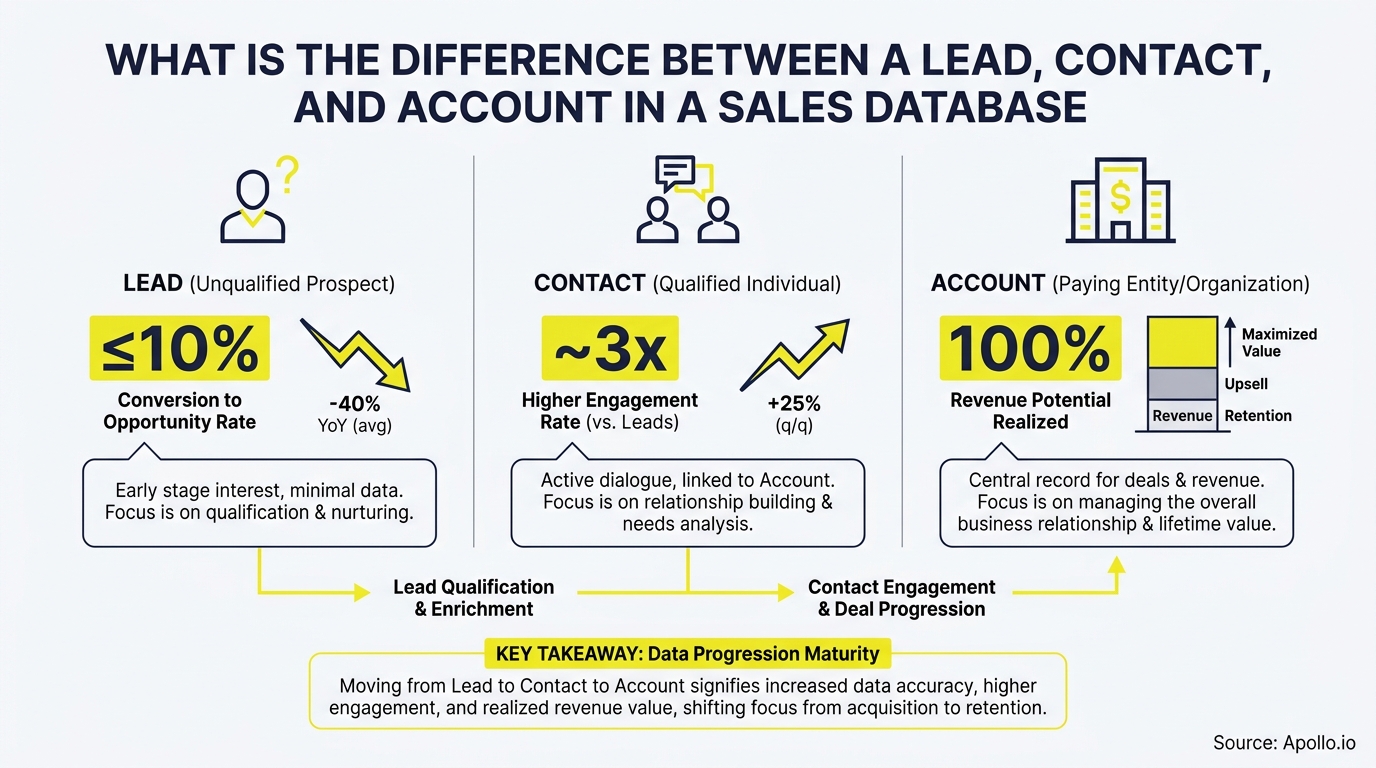
In a sales database, a lead is an unqualified individual or business that has shown early interest but has not yet been vetted. As KPI.com defines it, a lead represents an individual or business entity that has shown initial interest in a product or service but has not yet been qualified. A contact is a verified person with a confirmed relationship to a known company. An account is the company (or organization) itself — the parent record that anchors contacts and opportunities.
| Object | What It Represents | CRM Status | Owned By |
|---|---|---|---|
| Lead | Unqualified individual or company signal | Pre-qualification staging | Marketing / SDR |
| Contact | Verified person tied to an account | Active relationship | Sales / AE |
| Account | The company being targeted or sold to | Ongoing business entity | AE / RevOps |
According to PhoneIQ, once a lead is converted, the account becomes the central record for the ongoing business relationship, acting as the parent record for contacts and opportunities. That hierarchy matters: accounts contain contacts, and contacts generate opportunities.
How Does the Lead-to-Account Conversion Process Work?
Lead conversion is the structured process of promoting a qualified lead into three linked records: a contact, an account, and (optionally) an opportunity. This is not a cosmetic change — it signals that a prospect has passed qualification gates and is ready for active sales engagement.
A sales professional shared a firsthand perspective on Redditthat captures the practical logic well: "My preference is straight to Accounts and Contacts if you know the account is a business you want to target. I use leads as a staging ground for stuff that might have a lot of junk in it — inbound form submits, attendee lists from a trade show. Drop all the crap into Leads and then convert the stuff you actually want to work into an Account with Contacts."
Conversion criteria to enforce before promoting a lead:
- Valid business email confirmed (not a personal or generic address)
- Company name, size, and industry verified
- Decision-maker or influencer role confirmed
- Fit against ICP criteria validated
- No duplicate contact or account already exists in CRM
Data from Root Digital shows that on average, 13% of B2B leads convert to opportunities, with the conversion process taking about 84 days. Sloppy lead-to-contact promotion inflates that timeline and corrupts funnel metrics.

Why Does Object Hygiene Matter for RevOps and SDR Teams?
Clean object separation directly determines how well your pipeline routing, attribution, and forecasting work. For RevOps leaders, blurred boundaries between leads, contacts, and accounts produce duplicate records, broken workflows, and unreliable reports.
A user wrote on Redditabout the cost of bending the Lead object to act like an Account: "We converted back to using leads as leads. The whole purpose of the lead process is about identifying the decision maker and making that person the lead. Then convert to an account when they're interested." The lesson: fighting the data model creates technical debt that compounds quickly.
For SDRs, unclear object definitions mean they can't tell whether a prospect has already been contacted by another rep, whether an account already has an open opportunity, or whether their outreach duplicates existing pipeline. That ambiguity wastes selling capacity — and revenue operations teams spend significant time untangling it.
Struggling to keep contact data clean across your pipeline? Start free with Apollo's 230M+ verified business contacts and enrich records automatically.
Turn Funnel Guesswork Into Pipeline Wins
Pipeline forecasting a guessing game because leads stall before they ever become opportunities? Apollo surfaces high-intent buyers and moves them forward — fast. Nearly 100K paying customers stopped guessing and started closing.
Start Free with Apollo →How Do ABM and Buying-Group Models Change Lead vs. Account Definitions?
Account-based marketing (ABM) shifts the unit of measurement from individual leads to entire buying committees within a target account. This makes clean account/contact separation non-negotiable.
In an ABM motion, an account is the strategic target; contacts are the stakeholders within that account; and "lead" becomes a qualification workflow state, not a permanent object identity.
Teams moving toward ABM or buying-group GTM models are increasingly measuring engagement at the account level — tracking how many contacts within a target account have engaged, not just whether a single lead responded. This approach relies on having contacts correctly associated to accounts, with accurate firmographic data attached to both. Explore how intent data powers this kind of account-level signal detection.
For Account Executives managing multi-stakeholder deals, the contact-to-account relationship is how they track multi-threading. If contacts aren't properly linked to accounts, AEs lose visibility into who else is involved in the buying decision.
What Is the Governance Checklist for Managing Leads, Contacts, and Accounts?
Governance rules define when a record enters each object, what fields are required, and who owns the record at each stage. Without these rules, data quality degrades rapidly across the lead-to-revenue funnel.
Lead object rules:
- Required fields: first name, last name, company, business email, lead source
- Auto-assign ownership based on territory or round-robin logic
- Set a maximum lead age (e.g., 30 days) before archiving or recycling
- Block conversion if duplicate contact or account already exists
Contact object rules:
- Required fields: verified email, job title, linked account, phone (optional)
- Must be linked to a parent account at creation
- Ownership transfers from SDR to AE at opportunity creation
Account object rules:
- Required fields: company name, industry, employee count, website
- Dedupe check mandatory before creating new account record
- Account owner defined by territory or named account assignment
Understanding the difference between sales and marketing ownership of these objects is also critical — marketing typically owns leads, while sales owns contacts and accounts. Ambiguous ownership is a leading cause of record duplication and missed follow-up.
How Does Data Quality in Each Object Affect AI Readiness?
AI-assisted qualification, enrichment, and routing only work when records are clean and properly structured. Fragmented or misclassified data blocks these workflows at the source.
Modern CRMs are accelerating the push toward connecting person and company identity earlier in the lifecycle, reducing the time a record can exist as an "orphan lead" with no account association. This trend reinforces why contacts and accounts — not leads — are the canonical records that AI tools operate against. The sales intelligence tools that power enrichment and intent signals depend on stable account and contact records to function accurately.
For RevOps leaders evaluating AI adoption: clean lead/contact/account separation is a prerequisite, not a nice-to-have. Teams that skip this foundation find that AI outputs are only as reliable as the data beneath them.
Ready to build a cleaner pipeline from the start? Search Apollo's 230M+ contacts with 65+ filters to find and qualify the right prospects before they enter your CRM.
How Should SDRs and AEs Think About These Three Objects Day-to-Day?
For SDRs, leads are the inbox: unvetted, potentially valuable, requiring qualification before any meaningful sales motion begins. The SDR's job is to qualify leads quickly, discard the junk, and convert the rest into contacts linked to accounts. Tracking demand generation vs. lead generation metrics helps SDRs understand which lead sources produce the highest conversion rates.
For Account Executives, the contact and account are the working units. AEs use contact records to track stakeholder engagement, manage multi-threading, and log activity history.
The account record gives them the full picture: existing relationships, open opportunities, revenue history, and account health signals.
Research from TryKondo found that for inbound marketing-generated leads, approximately 10% convert to qualified opportunities, while outbound sequences produce lower conversion rates of 2-5% of cold prospects to opportunities. Those numbers only hold when leads are properly staged and converted — not when the objects are used interchangeably.

Start With Clean Data, Build Toward Predictable Revenue
The difference between a lead, contact, and account isn't just a CRM configuration question — it's a data quality and GTM strategy decision. Teams that enforce clear object definitions see cleaner attribution, faster routing, better AI output, and more reliable forecasting.
Those that don't spend significant RevOps time untangling duplicate records and broken workflows.
Apollo consolidates prospecting, enrichment, and engagement in one unified platform, so your records start clean and stay clean. Trusted by nearly 100K paying customers including Anthropic, Smartling, and Redis, Apollo gives GTM teams from startups through enterprise a single workspace for finding, enriching, and engaging the right contacts at the right accounts. "Having everything in one system was a game changer" — Cyera.
Try Apollo Free and build your lead-to-revenue foundation on verified data from day one.
Prove Pipeline ROI From Day One
ROI pressure killing your next budget approval? Apollo delivers measurable pipeline impact fast — with 46% more meetings and 35% more bookings using AI. Nearly 100K paying customers justified the spend. You can too.
Start Free with Apollo →Don't miss these
Sales
Inbound vs Outbound Marketing: Which Strategy Wins?
Sales
What Is a Sales Funnel? The Non-Linear Revenue Framework for 2026
Sales
What Is a Go-to-Market Strategy? The 2026 GTM Playbook
See Apollo in action
We'd love to show how Apollo can help you sell better.
By submitting this form, you will receive information, tips, and promotions from Apollo. To learn more, see our Privacy Statement.
4.7/5 based on 9,690 reviews
