
What Is Sales Management? The 2026 Blueprint for Modern Revenue Teams
Sales management is the discipline of planning, directing, and optimizing a sales team's activities to hit revenue targets. But in 2026, it means something more: removing friction, governing data quality, and leading through constant change. Understanding sales performance management starts with recognizing that the manager's job is no longer just coaching reps — it's redesigning the operating model so reps can actually sell.

Research Less, Close More With Apollo
Tired of your reps burning hours on manual lead research instead of selling? Apollo surfaces verified contacts instantly so your team spends time closing, not digging. Join 550K+ companies building pipeline faster.
Start Free with Apollo →Key Takeaways
- Sales management covers strategy, process design, team coaching, pipeline governance, and data quality — not just headcount and quota.
- Misaligned sales and marketing teams cost B2B companies 10% or more of revenue per year, making cross-functional alignment a core management responsibility.
- Modern sales managers must govern AI tools, set data standards, and reduce tech overload — not just inspect pipelines.
- Win rates are declining industry-wide, so the manager's job is creating structural advantages through process, not just motivating reps.
- Unified platforms beat fragmented stacks: fewer tools with tighter integration outperform adding point solutions.
What Is Sales Management?
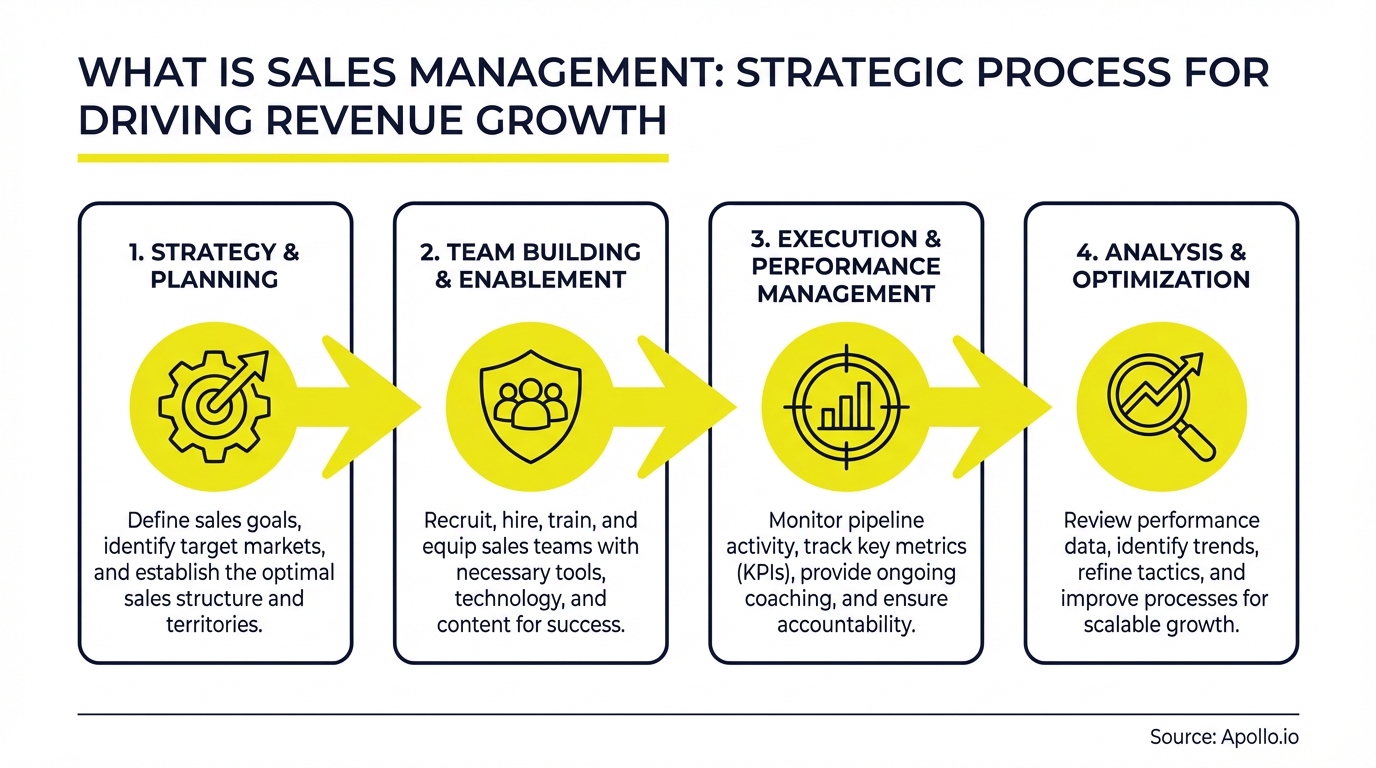
Sales management is the process of leading a sales team to consistently achieve revenue goals. It encompasses four core domains: strategy (territory design, quota setting, ICP definition), process (pipeline stages, qualification criteria, handoff rules), people (hiring, coaching, performance reviews), and technology (stack decisions, data governance, workflow automation).
It is not the same as selling. A sales manager's output is team performance, not individual deals. Confusing the two is one of the most common reasons high-performing reps fail when promoted to management.
| Domain | Manager's Responsibility |
|---|---|
| Strategy | Territory design, quota setting, ICP definition |
| Process | Stage exit criteria, pipeline governance, handoff rules |
| People | Hiring, coaching, performance management |
| Technology | Stack decisions, CRM data standards, AI governance |
Why Is Sales Management Critical to Revenue Growth?
Poor sales management creates compounding losses. According to LXA Hub, B2B companies' inability to align sales and marketing teams around the right processes and technologies costs 10% or more of revenue per year. That's a structural tax on every deal in your pipeline.
Win rates are also under sustained pressure. Research from Everstage shows B2B win rates declined 18% year-over-year in 2023 and 27% compared to 2021. When win rates fall across the board, individual rep effort is not the solution — better sales management is.
Struggling to track pipeline health in one place? Get complete pipeline visibility with Apollo's deal management.

What Are the Core Responsibilities of a Sales Manager?
Sales managers are accountable for outcomes their teams produce, not the activities themselves. The role spans six key responsibilities:
- Quota design: Setting realistic, data-informed targets that motivate without creating structural failure
- Pipeline governance: Defining stage criteria, required fields, and exit conditions so forecasts are trustworthy
- Coaching cadences: Weekly 1:1s, deal reviews, and call reviews tied to specific skill gaps — not generic feedback
- Hiring and onboarding: Defining the rep profile, building a repeatable interview process, and ramping new hires to productivity
- Cross-functional alignment: Bridging sales, marketing, and customer success around shared lifecycle definitions and handoff rules
- Technology governance: Choosing, simplifying, and maintaining the sales stack so reps spend time selling, not wrestling with tools
For deeper insight into what drives rep-level performance, see what factors affect sales performance and ROI.
Turn Weak Funnels Into Pipeline With Apollo
Tired of marketing leads that never become real opportunities? Apollo surfaces verified, in-market contacts so your team stops chasing dead ends and starts building real pipeline. Join 90K paying customers closing with confidence.
Start Free with Apollo →How Do Sales Leaders and RevOps Teams Manage Pipeline in 2026?
Pipeline management has evolved from periodic inspection to continuous data governance. Sales leaders and RevOps teams now own CRM data standards — required fields, activity capture rules, and stage exit criteria — because AI forecasting outputs are only as reliable as the data underneath them.
According to Corefactors RevOps, companies using revenue intelligence are nearly 3x more likely to forecast with 95% accuracy, and 59% report improved win rates after RevOps adoption. That's why RevOps leaders are increasingly embedded in sales management, not siloed in operations.
Key pipeline governance actions for 2026:
- Define mandatory CRM fields at each stage (enforced, not optional)
- Set automated alerts for stalled deals past a defined age threshold
- Review pipeline coverage ratios weekly, not just at quarter-end
- Audit AI-generated forecasts against manual manager judgment monthly
Track the right numbers from day one. Pair pipeline governance with the right sales KPIs for 2026 so every metric ties to a revenue outcome.
How Does AI Change Sales Management Responsibilities?
AI adoption is no longer optional. Salesforce's 2026 State of Sales report (fielded Aug–Sep 2025, n=4,050) found 87% of sales organizations use some form of AI.
That shifts the manager's role from tool buyer to AI governance lead.
Sales managers now need to define: what AI agents can do autonomously, when they escalate to a human, how outputs are audited, and which data standards make AI recommendations trustworthy. This is policy design, not just software configuration.
The practical AI governance checklist for sales managers:
- Document which workflows AI handles vs. which require human approval
- Set data quality thresholds before enabling AI scoring or forecasting
- Build AI adoption into coaching reviews — not just activity metrics
- Establish accountability when an AI-suggested action leads to a lost deal
For B2B sales teams in particular, AI governance is becoming a competitive differentiator — not just an IT task.
What Sales Management Mistakes Do Sales Leaders Make Most Often?
The most damaging sales management mistakes are structural, not tactical. They compound over quarters before leadership notices.
| Mistake | Impact | Fix |
|---|---|---|
| Promoting top reps to manager without training | Lose a top producer, gain a struggling manager | Build a management readiness framework before promoting |
| Inspecting pipeline without improving it | Forecasts improve, outcomes don't | Add deal coaching to every pipeline review |
| Adding tools instead of simplifying | Rep overwhelm, low adoption, bad data | Audit the stack quarterly; remove before adding |
| Setting quotas without market data | Structural miss rates, rep attrition | Anchor quotas to historical win rates and deal velocity |
| Ignoring sales-marketing misalignment | Revenue leakage on every lead | Define shared SLAs, lead definitions, and handoff criteria |
Spending too much time on manual prospecting instead of coaching your team? Search Apollo's 224M+ verified contacts with 65+ filters and let your SDRs focus on conversations, not list-building.
What Sales Management Tools Do High-Performing Teams Use?
The trend in 2026 is consolidation, not expansion. High-performing teams use fewer tools with tighter integration rather than best-of-breed point solutions that create data silos and rep confusion.
The minimal effective sales stack includes:
- CRM: Single source of truth for deals, contacts, and activity
- Sales intelligence: Verified contact and account data with intent signals
- Engagement platform: Multi-channel sequences (email, phone, and social) with activity sync back to CRM
- Analytics and forecasting: Pipeline dashboards, conversion metrics, and call intelligence
Apollo consolidates prospecting, engagement, and analytics into one workspace. As Cyera's team put it: "Having everything in one system was a game changer." And Predictable Revenue noted: "We reduced the complexity of three tools into one." That's the standard modern sales productivity now demands.
Sales managers looking at enterprise sales solutions should evaluate platforms on workflow integration and data quality — not feature count alone.

What Is the Modern Definition of Sales Management in 2026?
Sales management in 2026 is a productivity and transformation discipline. It means designing a system where reps spend the majority of their time selling, data is clean enough to trust, AI tools operate within defined guardrails, and the team can absorb continuous change without losing effectiveness.
The managers who win are not the ones who work the hardest. They're the ones who remove the most friction from their team's path to revenue.
Apollo gives sales managers a unified platform to build pipeline, run sequences, track deals, and coach reps — all without stitching together five separate tools. Schedule a Demo and see how 90,000+ paying customers use Apollo to manage revenue more effectively.
Apollo Proves ROI Before Budget Review
Budget approval stuck on unclear pipeline metrics? Apollo delivers measurable wins fast — teams like Leadium 3x'd annual revenue and GTM Ops drove 4x more meetings. Start free and show results before your next review.
Start Free with Apollo →Don't miss these
Sales
Inbound vs Outbound Marketing: Which Strategy Wins?
Sales
What Is a Sales Funnel? The Non-Linear Revenue Framework for 2026
Sales
What Is a Go-to-Market Strategy? The 2026 GTM Playbook
See Apollo in action
We'd love to show how Apollo can help you sell better.
By submitting this form, you will receive information, tips, and promotions from Apollo. To learn more, see our Privacy Statement.
4.7/5 based on 9,690 reviews
