
What Is Sales Experience? Definition, Benefits, and Best Practices
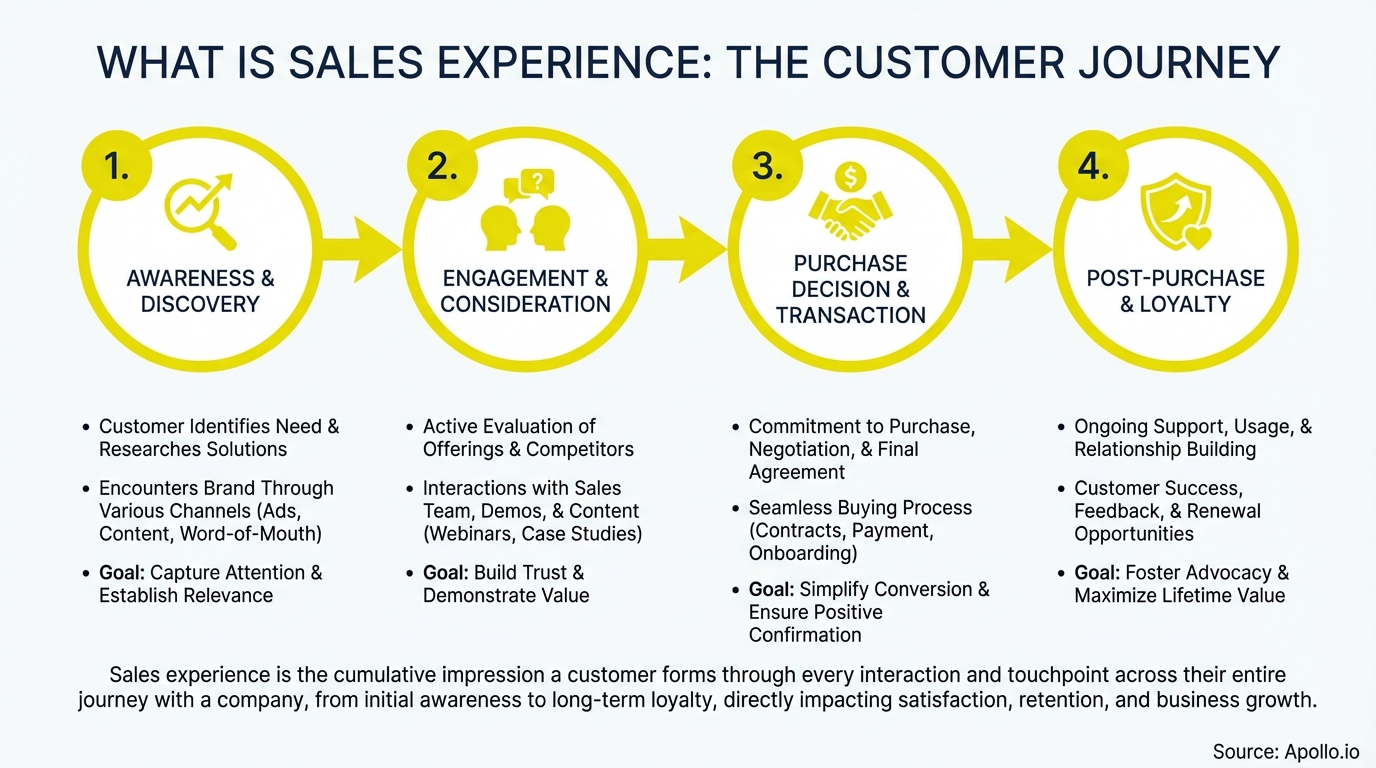
Sales experience is the cumulative journey of interactions, touchpoints, and engagements that prospects and customers have with your sales team across every stage of the buyer journey. In 2026, it encompasses everything from initial discovery and outreach to post-sale relationships, blending human expertise with AI-powered automation and digital self-service channels. A strong sales experience builds trust, reduces friction, and drives revenue by meeting buyers where they are with personalized, value-driven interactions.

Skip Manual Research—Apollo Finds Contacts Fast
Spending 4+ hours daily hunting for contact info. Apollo delivers 224M verified contacts with 96% email accuracy instantly. Join 550K+ companies who turned research time into selling time.
Start Free with Apollo →Key Takeaways
- Sales experience combines every buyer interaction with your team, from prospecting to closing and beyond
- 80% of B2B buyers now expect B2C-level personalization and seamless digital engagement
- Modern sales experience integrates AI automation, hyper-personalization, and self-service to meet evolving buyer preferences
- SDRs and AEs who optimize sales experience report higher conversion rates and shorter sales cycles
- Consolidating tools into one platform improves consistency and reduces friction across touchpoints
What Is Sales Experience?
Sales experience is the end-to-end perception prospects and customers form through their interactions with your sales organization. It includes outreach quality, response speed, personalization depth, product knowledge, problem-solving ability, and post-sale support.
Unlike isolated transactions, sales experience focuses on the cumulative emotional and practical impact of every touchpoint.
According to Gitnux research, 80% of B2B buyers expect a purchasing experience similar to B2C, which means seamless, personalized interactions across digital channels. This shift has elevated sales experience from a nice-to-have to a competitive differentiator in 2026.
The best sales experiences blend human expertise with technology. Modern sales development teams use data, automation, and AI to deliver relevant, timely outreach without sacrificing authenticity.
Why Is Sales Experience Important in 2026?
Sales experience directly impacts revenue outcomes. Buyers have more options, more information, and higher expectations than ever before.
A poor sales experience drives prospects to competitors, while an exceptional one builds loyalty and accelerates deals.

Research by Gitnux shows that 67% of B2B buyers prefer not to interact with a sales representative as their primary information source. This means your sales experience must provide value beyond basic product information through insights, problem-solving, and strategic guidance.
For RevOps leaders and sales executives, sales experience impacts key metrics:
- Win rates: Personalized, consultative experiences close deals faster
- Deal size: Trust-based relationships expand contract values
- Customer lifetime value: Positive experiences drive renewals and upsells
- Sales cycle length: Frictionless processes reduce time to close
Struggling to deliver consistent experiences across your team? Automate your sequences and standardize outreach with Apollo's sales engagement platform.
How Do Sales Teams Deliver Great Experiences?
Exceptional sales experiences require alignment across people, processes, and technology. Here's how top-performing teams structure their approach:

| Component | What It Includes | Impact on Experience |
|---|---|---|
| Personalization | Research, context, tailored messaging | Shows you understand buyer pain points |
| Speed | Fast response times, efficient processes | Respects buyer time and maintains momentum |
| Consistency | Aligned messaging, unified handoffs | Builds trust through reliable interactions |
| Value | Insights, education, problem-solving | Positions you as strategic partner vs vendor |
| Digital Access | Self-service content, on-demand resources | Meets buyers where they prefer to engage |
SDRs using these principles report higher meeting acceptance rates. AEs applying consultative approaches see shorter sales cycles and larger deal sizes. The key is integrating proven sales techniques with modern technology to scale personalization.
Turn Forecast Guesswork Into Revenue Confidence
Forecasts falling apart because deal data isn't real-time. Apollo tracks every prospect interaction and deal stage automatically, giving you the visibility top revenue teams rely on. Join 550K+ companies with predictable pipelines.
Start Free with Apollo →What Role Does AI Play in Sales Experience?
AI transforms sales experience by automating repetitive tasks and surfacing insights that enable hyper-personalization at scale. In 2026, AI handles research, message drafting, follow-up sequencing, and call analysis so reps focus on strategic conversations.
For SDRs and BDRs, AI eliminates hours of manual prospecting and research. Instead of building lists and writing cold emails from scratch, reps use AI to identify ideal prospects, draft personalized outreach, and optimize send times based on engagement patterns.
Account Executives benefit from AI-powered pre-meeting intelligence that surfaces buyer signals, competitive insights, and relevant case studies. During calls, AI call assistants transcribe conversations, identify action items, and suggest next steps without reps taking notes.
Sales Leaders gain visibility into team performance and coaching opportunities through AI-generated analytics. They can identify which messages resonate, which objection handling approaches work, and where reps need support.
Tired of manual research eating up your prospecting time? Search Apollo's 224M+ verified contacts with 65+ filters and AI-powered recommendations.
How Do SDRs Create Better Sales Experiences?
SDRs shape first impressions and set the tone for the entire buyer journey. The best SDRs in 2026 combine rigorous research with authentic, value-driven outreach that solves problems rather than pitches products.
Start with precise targeting. Use firmographic and technographic filters to identify accounts with the highest propensity to buy.
Then research individual prospects to understand their role, challenges, and recent company initiatives before reaching out.
Craft messages that demonstrate understanding. Reference specific pain points relevant to their industry or role.
Share insights or data that helps them think differently about their challenges.
Avoid generic templates that sound like mass blasts.
Use multi-channel sequences that respect preferences.
Some buyers prefer email, others respond better to social outreach or phone calls. Test different approaches and track what works for different personas and industries.
Platforms that unify prospecting, outreach, and tracking help SDRs deliver consistent experiences without juggling multiple tools. As the team at Predictable Revenue noted, consolidating from three tools into one unified workspace improved both efficiency and experience quality.
What Sales Experience Metrics Should Teams Track?
Measuring sales experience requires tracking both quantitative performance metrics and qualitative feedback indicators. Here are the key metrics RevOps teams monitor:
- Response rate: Percentage of prospects who reply to outreach
- Meeting acceptance rate: Conversion from outreach to booked meetings
- Time to first response: How quickly reps engage new leads
- Sales cycle length: Days from first touch to closed deal
- Win rate: Percentage of opportunities that close won
- Customer satisfaction scores: Post-sale feedback on sales process
- Net Promoter Score (NPS): Likelihood to recommend based on sales experience
Leading indicators like response rates and meeting acceptance reveal whether your outreach resonates. Lagging indicators like win rates and customer satisfaction show whether your entire sales process delivers value.
For Founders and CEOs building outbound motions, these metrics provide early signals about product-market fit and go-to-market effectiveness. Track them weekly to identify trends and adjust strategy quickly.
How Does Tool Consolidation Improve Sales Experience?
Fragmented tech stacks create inconsistent experiences and operational inefficiency. When SDRs use one tool for prospecting, another for email, and a third for tracking, data silos emerge and buyers receive disjointed interactions.
Unified platforms eliminate context switching and ensure every team member has access to the same prospect intelligence. Reps spend less time managing tools and more time having meaningful conversations.
Handoffs between SDRs and AEs become seamless when all activity lives in one system.
Census cut costs in half by consolidating their sales tech stack. Cyera found that having everything in one system was a game changer for maintaining consistency across their growing team.
These benefits compound as organizations scale.
For RevOps teams, fewer integrations mean less maintenance overhead and cleaner data. Single-platform architectures reduce the risk of sync errors, duplicate records, and misaligned workflows that degrade buyer experiences.
Start Delivering Better Sales Experiences Today
Sales experience in 2026 combines human expertise with AI-powered automation to deliver personalized, efficient buyer journeys. The best teams focus on understanding buyer needs, providing value at every touchpoint, and using unified platforms to maintain consistency across channels.
Whether you're an SDR looking to book more meetings, an AE focused on shortening sales cycles, or a Sales Leader building scalable processes, improving sales experience starts with the right foundation. Consolidate your tech stack, leverage AI for research and automation, and measure what matters to continuously optimize.
Ready to transform your sales experience? Start a free trial with Apollo and see how our all-in-one platform helps teams deliver exceptional buyer experiences while cutting costs and complexity.
Prove Apollo's ROI In Your First 30 Days
Budget approval stuck on unclear metrics? Apollo tracks every touchpoint from first contact to closed deal—quantifying exactly how much pipeline and revenue you're generating. Built-In increased win rates 10% and ACV 10% with measurable Apollo impact.
Start Free with Apollo →Don't miss these
Sales
Inbound vs Outbound Marketing: Which Strategy Wins?
Sales
What Is a Sales Funnel? The Non-Linear Revenue Framework for 2026
Sales
What Is a Go-to-Market Strategy? The 2026 GTM Playbook
See Apollo in action
We'd love to show how Apollo can help you sell better.
By submitting this form, you will receive information, tips, and promotions from Apollo. To learn more, see our Privacy Statement.
4.7/5 based on 9,690 reviews
