
What Is Sales Automation Software and How Does It Help Outbound Teams?
Sales reps are losing the battle against their own calendars. According to Cirrus Insight, sales reps spend only 28% of their time actively selling, with administrative tasks consuming nearly half the workweek. That means the majority of your team's day goes to data entry, prospect research, and scheduling — not pipeline. Sales automation software exists to fix exactly that problem.

Get Verified Data That Actually Converts
Tired of generic outreach because your contact data is incomplete or outdated? Apollo enriches every prospect with deep firmographic and technographic context so your team stops guessing and starts connecting. 97% email accuracy. Start closing.
Start Free with Apollo →Key Takeaways
- Sales automation software handles repetitive tasks so reps spend more time in actual sales conversations.
- The biggest outbound problems it solves: low sell-time, inconsistent follow-up, poor data quality, and compliance risk.
- SDRs and AEs benefit differently — automation frees SDRs for prospecting volume; it frees AEs for deal acceleration.
- Agentic AI workflows are now executing multi-step tasks autonomously, not just assisting reps with suggestions.
- Consolidating tools into one platform reduces cost, governance burden, and context-switching for the whole GTM team.
What Is Sales Automation Software?
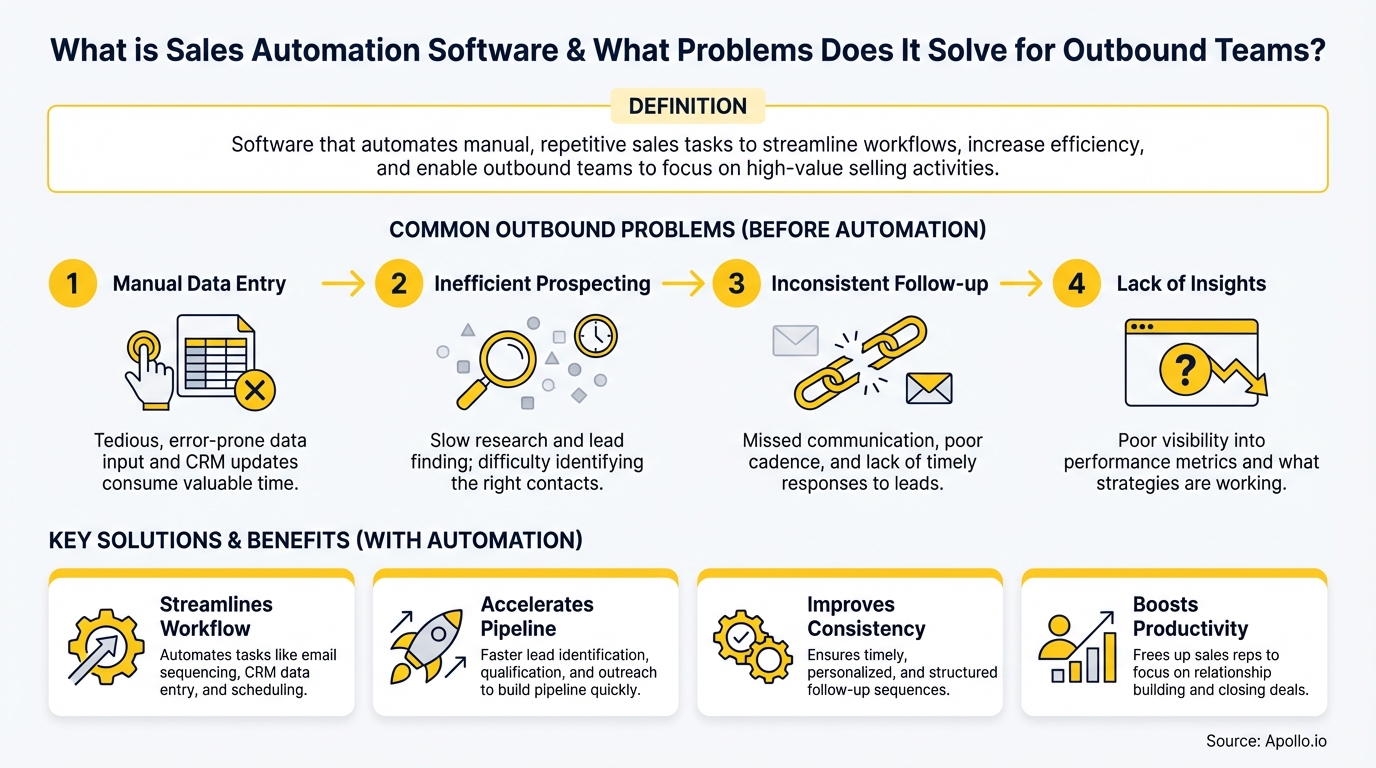
Sales automation software uses technology, including artificial intelligence, to streamline and automate repetitive tasks within the sales process, aiming to enhance efficiency, boost productivity, and enable personalized customer communication at scale. As IBM defines it, the goal is to remove manual friction so sales teams can focus on revenue-generating activities.
It covers a broad range of functions: lead capture and qualification, email and call sequencing, CRM data updates, meeting scheduling, and performance reporting. Modern platforms have expanded well beyond basic sequencing into end-to-end outbound execution, combining data, dialing, engagement, analytics, and coaching in a single workspace.
What Problems Does It Solve for Outbound Teams?
Outbound teams face five core problems that automation directly addresses.
| Problem | What Automation Does |
|---|---|
| Low sell-time (reps buried in admin) | Automates data entry, routing, and follow-up triggers |
| Inconsistent outreach cadences | Enforces structured multi-channel sequences automatically |
| Poor or stale contact data | Enriches and verifies records continuously |
| Compliance risk (unsubscribes, suppression) | Manages opt-outs, audit trails, and suppression lists |
| No visibility into what's working | Surfaces sequence analytics and pipeline metrics in real time |
According to ElectroIQ, automation tools can increase salesperson productivity by 14.5%. And looking ahead, Report Management projects that 60% of sales-related tasks will be handled by AI-powered automation by 2026 — a shift already underway in leading GTM teams.
Spending hours on manual outreach? Automate your sequences with Apollo's multi-channel engagement platform and reclaim your team's selling time.
Turn Funnel Guesswork Into Real Pipeline
Tired of watching marketing leads die before they ever reach your pipeline? Apollo surfaces high-intent prospects and keeps your funnel full of opportunities that actually convert. 600K+ companies trust it to hit their numbers.
Start Free with Apollo →How Do SDRs and AEs Benefit Differently?
SDRs and Account Executives have distinct workflows, and automation solves different bottlenecks for each role.
For SDRs: The primary constraint is prospecting volume and cadence consistency. Automation handles list building, sequence enrollment, follow-up timing, and CRM logging — giving SDRs more time for personalized outreach and live calls. When automation is implemented correctly, SDRs shift from reactive task management to proactive pipeline building.
For Account Executives: The constraint is deal velocity and pre-meeting intelligence. Automation surfaces contact history, intent signals, and account context before every call. It also handles meeting scheduling, follow-up reminders, and CRM updates after calls — so AEs focus on advancing deals, not documenting them. RevOps leaders benefit from cleaner data and fewer integration failures across the stack.
The emerging shift to agentic AI takes this further: instead of assisting reps with suggestions, agentic workflows can execute multi-step tasks autonomously — researching a prospect, drafting a personalized message, routing to the right rep, and logging the activity to CRM without human input at each step.
What Are the Core Features to Look For?
Effective sales automation platforms include a core set of capabilities that address the full outbound workflow.
- Prospecting and contact discovery: Search and filter a verified B2B database by title, industry, company size, and intent signals.
- Multi-channel sequencing: Orchestrate email, phone, and social touchpoints in structured cadences with automatic enrollment triggers.
- Data enrichment: Automatically fill and refresh contact and account records so reps always work with accurate information.
- Lead qualification and routing: Score inbound leads and route them to the right rep based on territory, segment, or ownership rules.
- CRM sync and workflow automation: Push activity data to HubSpot, Salesforce, or other CRMs automatically, eliminating manual logging.
- Analytics and reporting: Track sequence performance, reply rates, meeting bookings, and pipeline contribution in one dashboard.
- Compliance controls: Manage unsubscribe requests, suppression lists, and audit logs to reduce regulatory exposure.
As Activepieces notes, sales automation software can automatically collect leads from various sources, qualify them based on conversion likelihood, and assign them to the appropriate sales representative — removing the manual handoff delays that slow outbound teams.

Why Does Compliance Matter in Outbound Automation?
Compliance is a non-negotiable component of outbound automation, not an afterthought. Automated outreach at scale amplifies both reach and risk: a single misconfigured suppression list or missed unsubscribe can result in regulatory penalties.
The FTC raised its inflation-adjusted maximum civil penalty to $51,744 per violation in early 2024, making outbound governance a material financial concern.
Well-designed automation platforms address this by enforcing opt-out handling automatically, maintaining suppression lists that update in real time, and generating audit trails for every outreach action. For RevOps and sales leaders, this means governance is built into the workflow rather than bolted on after problems arise. Apollo's workflow engine includes automation controls that help teams manage compliance requirements at scale without slowing down outbound execution.
How Should Teams Measure ROI from Sales Automation?
ROI from sales automation is best measured through four leading indicators: sell-time recovered per rep per week, sequence-to-meeting conversion rate, pipeline velocity (time from first touch to qualified opportunity), and data quality scores (bounce rate, CRM completeness).
A practical starting framework for team leaders:
- Baseline first: Measure current sell-time, weekly activities per rep, and sequence reply rates before deploying automation.
- Track sell-time recovery: After 30 days, measure how many hours per week reps spend on selling vs. admin tasks.
- Measure pipeline contribution: Compare meetings booked, opportunities created, and win rates in automated vs. manual workflows.
- Monitor data health: Track bounce rates and CRM field completeness as proxies for enrichment quality.
For sales leaders under quota pressure, these metrics connect automation investment directly to revenue outcomes — making the business case clear to finance and leadership. For a deeper view of how automation connects to revenue growth, see how sales analytics drives revenue growth.
Struggling to build a consistent pipeline from your outbound motion? Explore Apollo's AI sales automation platform and see how unified data, sequencing, and AI work together in one workspace.
How Does Apollo Solve These Problems in One Platform?
Apollo is an all-in-one GTM platform that consolidates prospecting, engagement, enrichment, dialing, and analytics into a single workspace — replacing the fragmented stack of separate tools most outbound teams currently manage. Trusted by nearly 100K paying customers, including Anthropic, Smartling, and Redis, Apollo's unified approach eliminates the data silos and context-switching that slow outbound execution.
Customers describe the consolidation impact directly: "We reduced the complexity of three tools into one" (Predictable Revenue), "We cut our costs in half" (Census), and "Having everything in one system was a game changer" (Cyera). For teams looking to scale outbound without scaling tool sprawl, Apollo's outbound sales software provides the infrastructure to execute at volume with governance built in. You can also explore Apollo's AI and automation capabilities to see how AI-powered workflows accelerate every stage of the outbound process.

Start Automating Your Outbound Motion in 2026
Sales automation software solves the fundamental outbound problem: too much time on tasks that don't generate revenue. By automating prospecting, sequencing, enrichment, routing, and compliance, teams recover selling time, improve pipeline consistency, and reduce operational risk in one move.
The strongest ROI comes from platforms that consolidate your stack rather than add to it. Apollo brings data, engagement, AI, and analytics together so your team spends more time selling and less time switching tabs. Request a demo and see how Apollo's all-in-one platform can transform your outbound results.
Prove Pipeline ROI With Apollo
ROI pressure killing your tool budget? Apollo delivers measurable pipeline impact from day one — no guesswork, no waiting. Leadium 3x'd their annual revenue. See your ROI fast.
Start Free with Apollo →Don't miss these
Sales
Inbound vs Outbound Marketing: Which Strategy Wins?
Sales
What Is a Sales Funnel? The Non-Linear Revenue Framework for 2026
Sales
What Is a Go-to-Market Strategy? The 2026 GTM Playbook
See Apollo in action
We'd love to show how Apollo can help you sell better.
By submitting this form, you will receive information, tips, and promotions from Apollo. To learn more, see our Privacy Statement.
4.7/5 based on 9,690 reviews
