
What Is a KPI in Sales? Definition, Examples, and Best Practices
Sales teams drown in dashboards, yet most still miss quota. The problem isn't a lack of metrics—it's tracking the wrong ones.
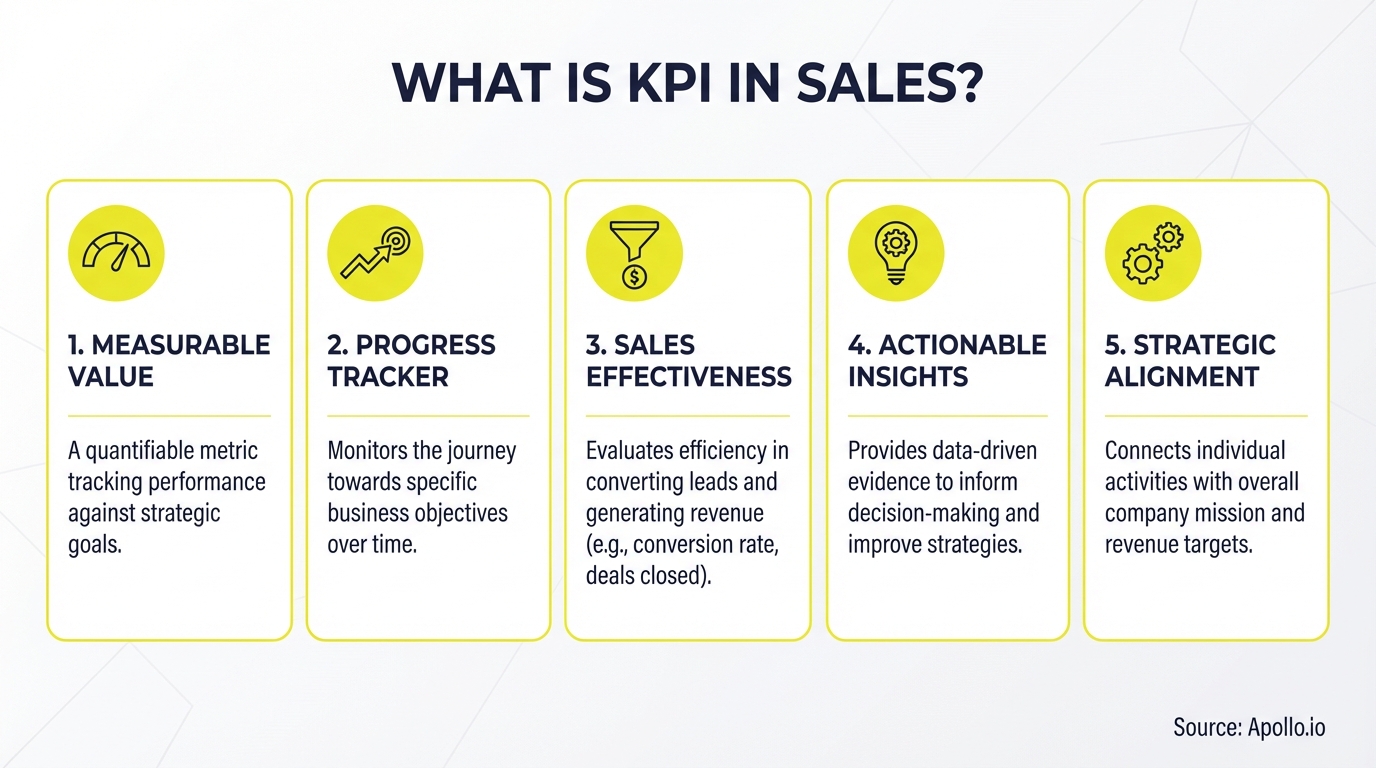
A KPI in sales is a Key Performance Indicator: a measurable value that directly ties your team's activities to revenue outcomes. But in 2026, effective KPIs go beyond tracking activity.
They create an operating system that connects data quality, seller productivity, and buyer behavior into a framework that drives coaching, forecasting, and growth. Sales leaders who master this approach turn metrics into action, while those who don't watch their analytics programs fail despite massive investment in tools.
Understanding what sales KPIs you should track in 2026 starts with recognizing why so many KPI programs underdeliver. According to Martal, only 2-5% of B2B leads typically convert into paying customers, yet many teams still focus solely on lead volume rather than conversion quality. This disconnect between activity and outcome is exactly what modern KPI frameworks must solve.

Scale Your Team Without The Growing Pains
Struggling with inconsistent processes as your team grows? Apollo standardizes playbooks and automates workflows so every rep performs like your best. Built-In boosted win rates 10% with Apollo's guidance.
Start Free with Apollo →Key Takeaways
- KPIs in sales are measurable indicators that connect daily activities to revenue outcomes, not just activity tracking
- 84% of sales leaders report their analytics have less influence than expected due to poor data quality and inability to translate metrics into action
- Modern KPI frameworks require governance, data readiness, and role-specific metrics to avoid seller overwhelm
- Leading indicators tied to buyer behavior outperform lagging metrics for forecasting and coaching
- Effective KPI systems consolidate tech stacks and create single sources of truth for decision-making
What Is a KPI in Sales and Why Do Most Programs Fail?
A KPI (Key Performance Indicator) in sales is a quantifiable metric that measures progress toward specific revenue goals. KPIs differ from general metrics by focusing on outcomes that directly impact business results.
Examples include win rate, average deal size, sales cycle length, and pipeline coverage ratio.
The challenge: 84% of sales leaders say their analytics programs deliver less influence on performance than expected. The root causes include poor data quality (44% cite this as a barrier), regulatory constraints (45%), and limited cross-functional collaboration (44%).
Teams collect hundreds of data points but can't translate them into coaching conversations or strategic decisions.
Another hidden problem is seller overwhelm. Research shows 72% of sellers feel overwhelmed by required skills, and 50% are overwhelmed by technology demands.
Overwhelmed sellers are 45% less likely to hit quota. This means your KPI framework itself can become a productivity drain if it's too complex or disconnected from how reps actually work.
How Do Sales Leaders Choose the Right KPIs?
Choosing KPIs starts with identifying which stage of the revenue cycle needs improvement. Leading indicators (activities that predict future outcomes) include outreach volume, meeting-to-opportunity conversion, and stakeholder engagement breadth.
Lagging indicators (results) include closed-won deals, revenue attainment, and customer lifetime value.
For SDRs and BDRs, focus on activity-to-outcome ratios: emails sent per meeting booked, meetings held per opportunity created, and response rates by channel. According to Abacum, B2B companies typically see lead conversion rates of 1-5%, making it critical to track not just volume but conversion quality at each stage.
For Account Executives, prioritize deal velocity and pipeline health: average sales cycle length (industry benchmark is approximately 69 days per Databox), win rate by deal size, and multi-threading depth (number of stakeholders engaged per opportunity). Research from Gradient Works shows win rates decreased to 17-20% in 2023, making pipeline coverage and stage-to-stage conversion more important than ever.
For RevOps and Sales Leaders, governance KPIs matter: forecast accuracy, CRM data completeness, pipeline coverage ratio (3:1 or higher for healthy pipelines), and team capacity utilization. CSO-led analytics initiatives are 2.3x more likely to achieve higher forecast accuracy than non-CSO-led efforts, emphasizing the importance of executive ownership.
What KPIs Should SDRs and BDRs Track in 2026?
SDRs and BDRs need KPIs that balance activity with efficiency. The shift in 2026 is away from pure activity metrics (calls made, emails sent) toward outcome-focused indicators that respect sellers' limited bandwidth.

Core SDR/BDR KPIs:
- Meeting Conversion Rate: Percentage of outreach sequences that result in booked meetings
- Meeting-to-Opportunity Rate: Percentage of meetings that convert to qualified pipeline
- Response Rate by Channel: Email, phone, and social engagement rates to optimize channel mix
- Time-to-First-Response: Speed of follow-up after inbound lead capture or trigger event
- Account Penetration: Number of contacts engaged per target account (multi-threading at the prospecting stage)
The key insight: reps spend only 28-30% of their time actually selling. SDR managers should track "time returned to selling" as a KPI, measuring how automation and tool consolidation increase productive selling hours. Struggling to track these metrics across multiple tools? Get complete pipeline visibility with Apollo's deal management platform that consolidates prospecting, engagement, and tracking in one workspace.
Turn Forecasting Guesswork Into Revenue Certainty
Forecasting feels like rolling dice because your pipeline data isn't real-time. Apollo delivers live deal visibility and intent signals so you predict revenue with confidence. Built-In boosted win rates 10% with Apollo's guidance.
Start Free with Apollo →How Do Data Quality and Governance Impact KPI Effectiveness?
KPIs are only as reliable as the data behind them. Poor data quality creates "garbage in, garbage out" reporting that erodes trust and leads to bad decisions.
In 2026, data governance is a prerequisite for KPI credibility.
Essential Governance Practices:
- Single Source of Truth: One system of record for customer data (typically CRM) with clear data ownership
- Field Definitions: Standardized definitions for opportunity stages, lead sources, and deal classifications
- Data Quality KPIs: CRM completeness percentage, duplicate record rate, and data freshness metrics
- Privacy and Compliance Controls: GDPR/CCPA-compliant data collection and retention policies
- Cross-Functional Accountability: Clear ownership mapping (who owns each metric, who reviews it, who acts on it)
The impact is measurable: 64% of B2B marketing leaders don't trust their organization's measurement for decision-making. Building trust requires regular data audits, standardized attribution models, and transparent reporting cadences.
Teams that implement CSO-led analytics governance are 2.3x more likely to achieve forecast accuracy and 1.8x more likely to exceed customer acquisition goals.
Tired of dirty data sabotaging your KPIs? Start free with Apollo's 224M+ verified business contacts and 96% email accuracy to build reliable metrics from day one.
What Is the KPI Operating System and How Does It Drive Action?
A KPI Operating System transforms metrics from passive dashboards into active coaching and decision-making tools. It includes five core components: definition, measurement, ownership, triggers, and coaching loops.
| Component | Description | Owner |
|---|---|---|
| Definition | Clear metric calculation and target thresholds | RevOps |
| Measurement | Automated tracking with data quality checks | Sales Ops |
| Ownership | Assigned accountability for each KPI | Sales Leader |
| Triggers | Alerts when KPIs hit thresholds (red/yellow/green) | Manager |
| Coaching Loops | Structured 1:1s using KPI data to drive improvement | Frontline Manager |
This framework addresses the core problem: analytics programs fail not because of insufficient data, but because leaders can't translate metrics into action. The operating system creates a rhythm where KPIs trigger specific coaching conversations, process adjustments, or resource reallocations.
For example, if an AE's average deal size drops 20% quarter-over-quarter (trigger), the manager reviews recent lost deals (measurement), identifies a shift toward smaller accounts (insight), and adjusts territory assignment or discount authority (action). Without this closed-loop system, the metric is just a number on a dashboard.
How Should Sales Teams Implement KPIs Without Creating Seller Overload?
The minimalist approach to KPIs recognizes that more metrics don't equal better performance. In fact, metric overload contributes to the 72% of sellers who feel overwhelmed by job complexity.
Implementation Best Practices:
- Role-Specific KPI Sets: Limit each role to 5-7 core KPIs (SDRs focus on meeting creation, AEs on deal progression, leaders on forecast accuracy)
- Weekly Inspection Cadence: Review leading indicators weekly, lagging indicators monthly or quarterly
- Alerts Over Dashboards: Push notifications when KPIs hit thresholds rather than requiring reps to check dashboards
- Integration with Workflow: Embed KPI tracking into existing tools (CRM, email, calendar) rather than separate reporting systems
- Progressive Rollout: Start with 3 core KPIs, prove value, then expand based on team feedback
The goal is to make KPI tracking invisible to sellers while providing managers with actionable insights. Platforms that consolidate prospecting, engagement, and analytics into one workspace reduce the cognitive load on reps while improving data quality.
As one customer noted, consolidating tools was a game changer for their team's productivity and focus.
Conclusion: Turn Your Sales KPIs Into Revenue Outcomes
A KPI in sales is more than a metric on a dashboard. It's a measurable indicator that connects daily activities to revenue outcomes through a structured operating system of governance, ownership, and action. In 2026, effective sales analytics requires clean data, role-specific metrics, and minimalist frameworks that drive coaching rather than create overwhelm.
The best KPI programs share three characteristics: they prioritize leading indicators tied to buyer behavior, they maintain data quality through governance, and they translate metrics into specific coaching actions. Organizations that implement CSO-led analytics with cross-functional accountability see measurably better forecast accuracy and customer acquisition results.
For teams building or redesigning their KPI frameworks in 2026, start with your biggest pain point. Is it forecast accuracy?
Focus on pipeline coverage and stage conversion rates. Is it seller productivity?
Track time-to-first-response and automation impact. Is it data quality?
Implement CRM completeness and duplicate-rate KPIs first.
Ready to consolidate your sales tech stack and build KPIs on a foundation of verified data? Schedule a Demo to see how Apollo's all-in-one platform helps teams track the metrics that matter while cutting costs and complexity.
Prove ROI In Weeks, Not Quarters
Budget approval stuck on unclear metrics? Apollo delivers measurable pipeline impact from day one—quantifiable time savings and revenue growth your leadership demands. Customer. io achieved 50% YoY growth with Apollo's automation.
Start Free with Apollo →Don't miss these
Sales
Inbound vs Outbound Marketing: Which Strategy Wins?
Sales
What Is a Sales Funnel? The Non-Linear Revenue Framework for 2026
Sales
What Is a Go-to-Market Strategy? The 2026 GTM Playbook
See Apollo in action
We'd love to show how Apollo can help you sell better.
By submitting this form, you will receive information, tips, and promotions from Apollo. To learn more, see our Privacy Statement.
4.7/5 based on 9,690 reviews
