
What Is Cost of Sales? Definition, Calculation, and Impact on Profitability
Cost of sales sits at the heart of every revenue conversation. For Sales Leaders, RevOps teams, and CFOs tracking unit economics in 2026, understanding this metric means the difference between sustainable growth and margin erosion. According to Business Dasher, the average B2B company spends $536 to acquire a customer across all marketing channels, though this number varies dramatically by industry and company size. When you factor in direct selling costs, operational inefficiencies, and tech stack sprawl, the true cost of revenue delivery often surprises leadership teams.

Apollo Finds Your Buyers In Minutes, Not Hours
Tired of slow lead generation killing your pipeline? Apollo delivers qualified prospects with 96% email accuracy while you focus on closing. Join 550K+ companies building predictable revenue.
Start Free with Apollo →Key Takeaways
- Cost of sales includes all direct expenses to generate revenue: sales team salaries, commissions, tools, travel, and customer acquisition costs
- B2B SaaS companies typically target cost of sales at 15-30% of revenue to maintain healthy gross margins
- RevOps teams can reduce cost of sales by consolidating sales tech stacks and automating manual prospecting workflows
- Tracking cost per deal and cost per qualified opportunity reveals hidden inefficiencies in your sales motion
- AI-powered GTM systems help Sales Leaders lower cost of sales while maintaining or improving conversion rates
What Is Cost of Sales?
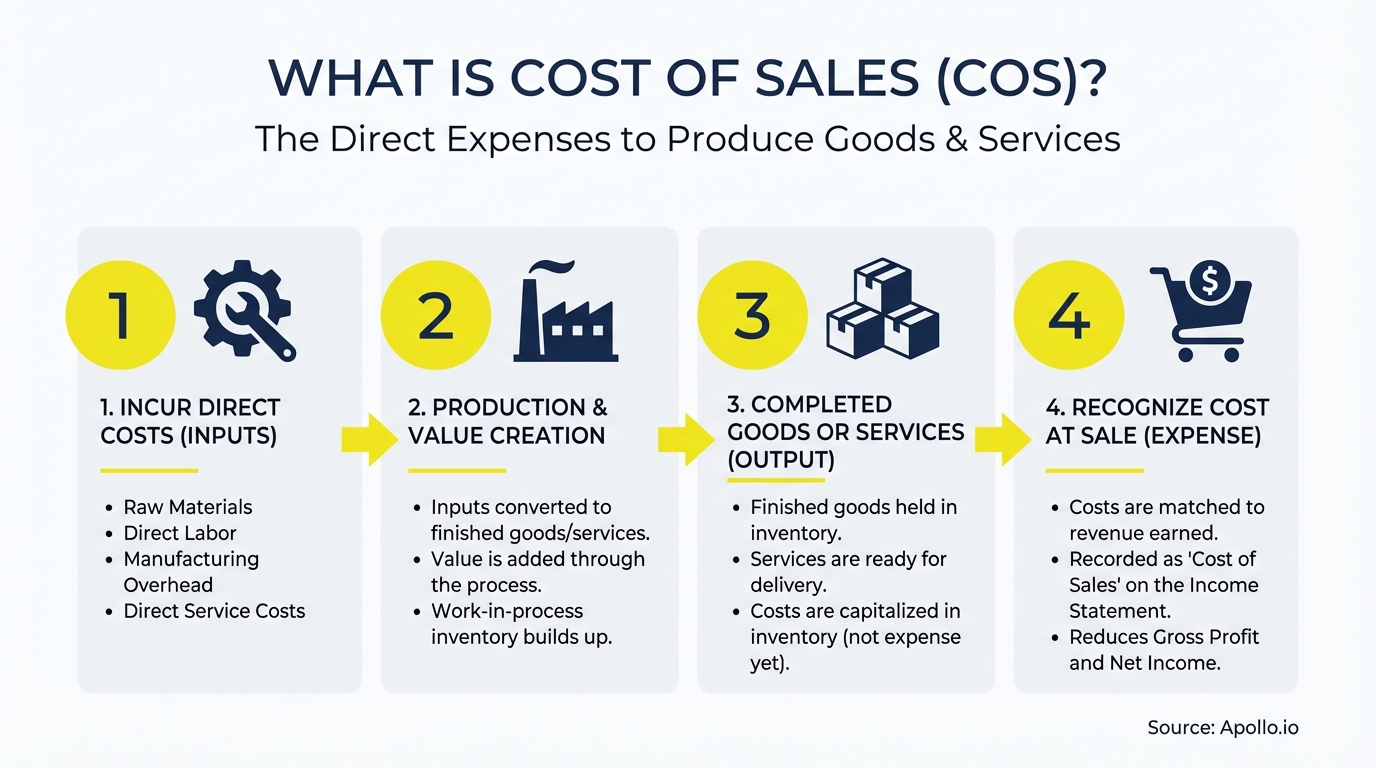
Cost of sales represents all direct expenses your organization incurs to generate revenue. This includes sales team compensation (base salary, commissions, bonuses), sales tools and software subscriptions, travel and entertainment, training, and customer acquisition costs.
It differs from Cost of Goods Sold (COGS), which covers production and delivery expenses. Cost of sales focuses specifically on the selling function.
For B2B sales teams, this metric encompasses everything from your CRM subscription to the SDR who books the first meeting to the AE who closes the deal. RevOps leaders track this number closely because it directly impacts gross margin and profitability. A bloated cost of sales signals inefficiency, while a lean number indicates a well-oiled revenue engine.
Research from Genesys Growth shows CAC has surged dramatically, with a 222% increase over the past eight years and a 60% increase over the last five years. This upward pressure makes cost of sales optimization a strategic priority for 2026.
How Do Sales Leaders Calculate Cost of Sales?
Calculate cost of sales by summing all direct selling expenses over a period, then dividing by revenue generated in that same timeframe. The formula: (Total Sales Expenses ÷ Total Revenue) × 100 = Cost of Sales Percentage.
Here's what to include in total sales expenses:

- Personnel costs: Salaries, commissions, bonuses, payroll taxes, benefits for all quota-carrying reps and sales managers
- Technology stack: CRM, sales engagement platform, data enrichment, conversation intelligence, dialers, email sequencing tools
- Marketing attribution: Portion of marketing spend directly tied to sales-qualified leads (varies by attribution model)
- Travel and entertainment: Client meetings, conferences, team offsites
- Training and enablement: Onboarding programs, ongoing coaching, sales methodology certifications
For AEs managing high-ticket sales, cost of sales often runs higher due to longer deal cycles and custom selling motions. SaaS companies typically target 15-30% cost of sales to maintain healthy unit economics.
What Are Common Cost of Sales Benchmarks by Industry?
Cost of sales benchmarks vary significantly by industry, company stage, and sales motion. B2B SaaS companies with product-led growth motions often achieve 15-20% cost of sales, while enterprise sales models with field reps and custom implementations may run 25-35%.
According to SerpDojo, financial services and Fintech carry some of the highest acquisition costs, estimated at around $1,450 per customer in 2025 data. This translates to elevated cost of sales when factoring in the full selling cycle.
Key benchmark considerations:
- Early-stage startups: 40-60% (building sales team, establishing process)
- Growth-stage SaaS: 25-35% (scaling repeatable motions)
- Mature B2B companies: 15-25% (optimized operations, established brand)
- Transactional sales: 10-20% (shorter cycles, lower touch)
Turn Forecast Guesswork Into Revenue Certainty
Missing quota because your pipeline is full of question marks? Apollo delivers real-time deal visibility and qualified prospects with 96% email accuracy. Built-In increased win rates 10% using Apollo's intelligence.
Start Free with Apollo →Why Does Cost of Sales Matter for Revenue Operations?
Cost of sales directly impacts profitability and determines how much revenue actually flows to the bottom line. RevOps teams use this metric to identify inefficiencies, optimize resource allocation, and forecast realistic growth scenarios. A company generating $10M in revenue with 40% cost of sales has $6M for product development, operations, and profit. Drop that to 25% and you unlock $1.5M in additional margin.
Sales Leaders rely on cost of sales analysis to:

- Justify headcount requests and territory planning decisions
- Evaluate sales tool ROI and eliminate redundant subscriptions
- Set realistic quota and compensation structures
- Identify which segments, products, or channels deliver the best unit economics
- Benchmark performance against competitors and industry standards
Struggling to track deal velocity and resource allocation? Get complete pipeline visibility with Apollo's unified deal management platform.
How Can SDRs and AEs Reduce Cost of Sales?
SDRs and AEs reduce cost of sales by improving efficiency at every stage of the buyer journey. This means more qualified meetings per rep, shorter sales cycles, and higher win rates.
Tactical improvements compound quickly when scaled across the entire sales organization.
For SDRs building pipeline:
- Use data enrichment to prioritize high-fit accounts instead of spray-and-pray outreach
- Automate repetitive tasks (list building, email sequences, follow-ups) to increase daily output
- Leverage conversation intelligence to refine messaging based on what actually books meetings
- Focus on channels with the highest conversion rates for your ICP
For AEs closing deals:
- Shorten discovery by entering conversations with pre-call research and buyer intelligence
- Use sales analytics to identify patterns in won vs. lost deals
- Implement standardized sales methodologies to reduce variability in outcomes
- Consolidate your tech stack to eliminate context-switching and duplicate data entry
Teams at Census and Predictable Revenue report significant cost reductions after consolidating their sales tools. "We reduced the complexity of three tools into one," notes Collin Stewart at Predictable Revenue. "We cut our costs in half," adds the Census team.
What Role Does Sales Technology Play in Cost of Sales?
Sales technology can either bloat or optimize your cost of sales, depending on how you deploy it. The average sales team uses 10+ tools across prospecting, engagement, data enrichment, conversation intelligence, and pipeline management.
Each subscription adds to your cost of sales, and the context-switching tax reduces rep productivity.
Smart RevOps teams are consolidating into all-in-one platforms that combine contact data, engagement workflows, and deal management in a single workspace. This approach reduces licensing costs, eliminates data sync issues, and shortens rep ramp time. According to Flyweel, a healthy benchmark across B2B sectors is an LTV:CAC ratio of 3:1 or higher, meaning a customer should generate at least three times their acquisition cost in value to ensure profitability.
Spending too much on disconnected sales tools? Consolidate your go-to-market tech stack with Apollo's unified platform.
How Do Founders and CFOs Optimize Cost of Sales?
Founders and CFOs optimize cost of sales by treating it as a strategic lever, not just an expense line. This means rigorous analysis of which sales motions, segments, and channels deliver the best unit economics.
The goal: maximize revenue while minimizing the incremental cost to generate each dollar.
Start with these high-impact initiatives:
- Segment analysis: Calculate cost of sales by customer segment, deal size, and acquisition channel to identify your most efficient growth paths
- Capacity modeling: Determine optimal rep-to-manager ratios and quota targets based on realistic productivity benchmarks
- Tool stack audit: Eliminate redundant subscriptions and consolidate onto platforms that integrate across the entire sales workflow
- Comp plan design: Structure variable compensation to reward behaviors that improve efficiency (shorter cycles, higher ASP, better retention)
- Automation investment: Deploy AI-powered tools for research, outreach, and qualification to amplify rep capacity without adding headcount
Many B2B companies discover that optimizing their sales funnel and improving lead quality delivers better ROI than simply adding more reps. Focus on conversion rate improvements before scaling volume.
Start Reducing Your Cost of Sales in 2026
Cost of sales optimization separates efficient revenue engines from bloated operations. Sales Leaders who master this metric unlock sustainable growth, higher profitability, and competitive advantage.
The key lies in continuous measurement, ruthless prioritization of high-ROI activities, and strategic deployment of technology that consolidates rather than complicates your sales motion.
For RevOps teams, Founders, and CFOs building scalable go-to-market strategies in 2026, the path forward is clear: invest in tools and processes that reduce friction, eliminate waste, and amplify rep productivity. Track your cost of sales monthly, benchmark against industry standards, and make data-driven decisions about where to deploy resources.
Ready to lower your cost of sales while improving conversion rates? Start free with Apollo and consolidate your prospecting, engagement, and pipeline management into one unified platform. Join 90K+ companies reducing complexity and costs.
Prove Apollo's Value In Your First Week
Budget approval stuck on unclear metrics? Apollo tracks pipeline impact from day one—meetings booked, deals influenced, revenue attributed. Customer. io achieved 50% YoY growth with measurable automation ROI.
Start Free with Apollo →Don't miss these
Sales
Inbound vs Outbound Marketing: Which Strategy Wins?
Sales
What Is a Sales Funnel? The Non-Linear Revenue Framework for 2026
Sales
What Is a Go-to-Market Strategy? The 2026 GTM Playbook
See Apollo in action
We'd love to show how Apollo can help you sell better.
By submitting this form, you will receive information, tips, and promotions from Apollo. To learn more, see our Privacy Statement.
4.7/5 based on 9,690 reviews
