
What Is an RFP in Sales? Definition and Strategy Guide
An RFP (Request for Proposal) in sales is a formal document buyers use to solicit vendor proposals, but here's what most sales teams miss: by the time you receive an RFP, the buyer has often already decided who will win. Understanding RFPs as late-stage validation tools—not discovery opportunities—changes everything about how you approach B2B sales strategy.

Apollo Eliminates 4+ Hours Of Daily Research
Tired of spending 4+ hours daily hunting for contact info? Apollo delivers verified emails and mobile numbers instantly—no more manual research. Join 550K+ companies closing more deals with less effort.
Start Free with Apollo →Key Takeaways
- RFPs are late-stage validation documents where 95% of winners are already on the buyer's Day-One shortlist
- Modern RFP response requires AI-enabled workflows and content governance to meet compressed 24-day median deadlines
- Sales teams need upstream influence strategies and go/no-go frameworks to avoid wasting resources on unwinnable deals
- Buyers increasingly demand rep-free digital assets and structured, machine-parseable proposal responses
- Content operations and single-source-of-truth systems are now critical for managing high-volume RFP programs
What Is an RFP in Sales?
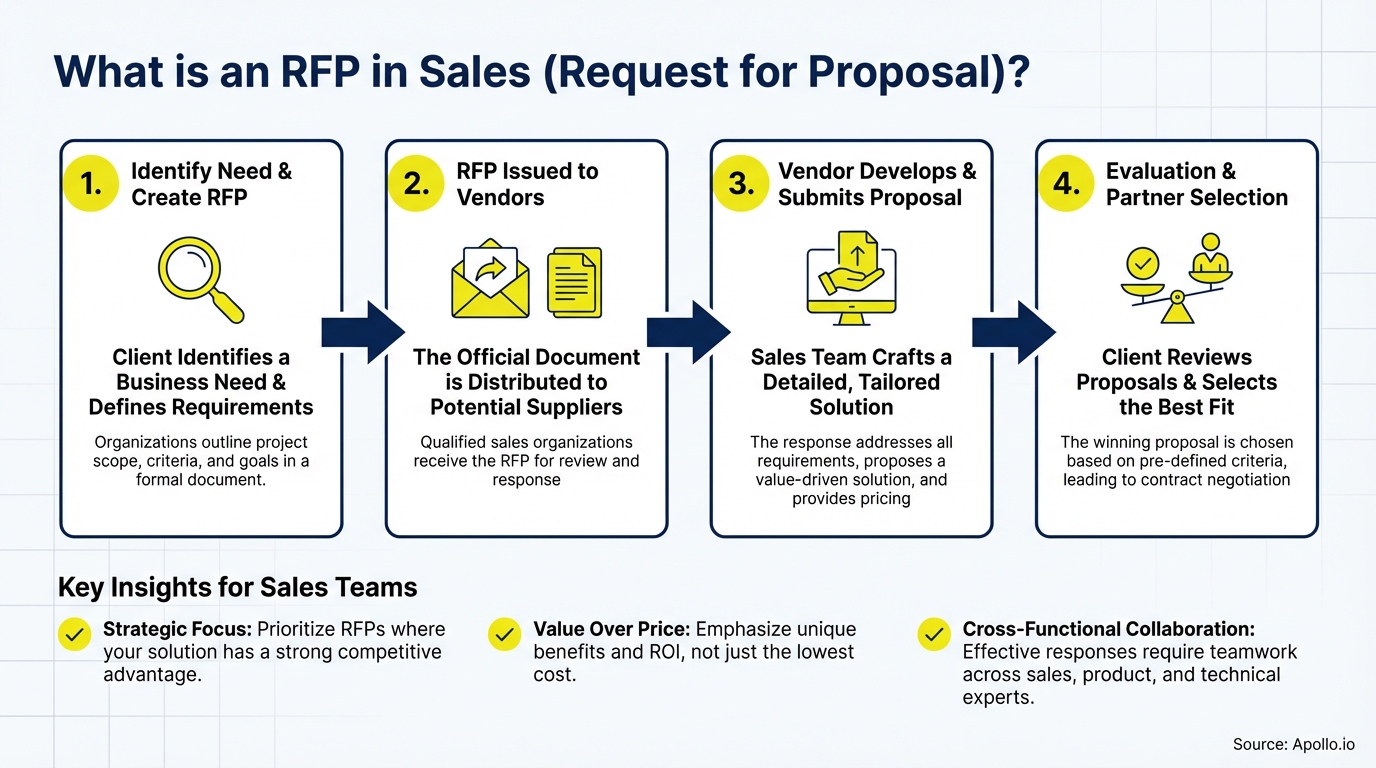
An RFP (Request for Proposal) is a formal document organizations issue when they need to purchase complex products or services. According to Arphie, RFPs commonly include project scope, requirements, evaluation criteria, timelines, and pricing structures, and are prevalent in sectors like IT, software, government, and construction.
But here's the reality most Account Executives miss: RFPs arrive late in the buying journey as validation artifacts, not discovery tools. The buyer has already researched vendors, formed preferences, and built their shortlist.
Your RFP response confirms their decision—it rarely changes it.
For sales teams in 2026, RFPs represent a critical moment where preparation meets opportunity. Research from Salesforce confirms that RFPs commonly include project scope, requirements, evaluation criteria, timelines, and pricing structures—all elements that require cross-functional coordination to address effectively.
Why Do Buyers Already Know Who Will Win Before Issuing RFPs?
6sense's 2025 B2B Buyer Experience Report reveals a stark truth: 95% of the time, the winning vendor is already on the buyer's Day-One shortlist. Even more telling, buyers contact their preferred vendor first and purchase from them in nearly 80% of cases.
This means RFPs function as procurement validation, not vendor discovery. Buyers need formal documentation for internal approval, compliance requirements, or purchasing policies—but their preference is already established through earlier research, peer reviews, and solution evaluation.
For SDRs and Account Executives, this shifts the strategic focus upstream. Getting on that Day-One shortlist requires visibility months before the RFP arrives.
That means content marketing, thought leadership, product-led growth, and relationship building during the buyer's research phase—not just proposal excellence.
How Do Sales Teams Decide Which RFPs to Pursue?
With Loopio reporting that 61% of organizations plan to submit more RFPs in 2025, volume is increasing while resources remain finite. Sales leaders need a rigorous go/no-go framework tied to real benchmarks.
Critical qualification criteria:
- Prior relationship: Were you engaged before the RFP? Early contact wins roughly 80% of deals.
- Win probability: Industry average is 45% (Loopio, 2025). If you're below 40%, reconsider participation.
- Resource availability: Can SMEs respond within the median 24-day deadline without derailing other priorities?
- Strategic value: Does this account align with your revenue operations targets and ideal customer profile?
- Competitive position: Do you know who else is bidding? Are you positioned to win on differentiation?
RevOps leaders should track win rates by RFP source, deal size, and industry vertical. This data-driven approach prevents the common mistake of chasing every opportunity regardless of fit or probability.
How Is AI Transforming RFP Response in 2026?
Loopio reports that 68% of teams now use generative AI in their RFP process, up from 34% the previous year, with 32% using AI daily. But Gartner's July 2025 report notes that GenAI for procurement has entered the "trough of disillusionment"—ROI is uneven due to data quality and integration complexity.
AI works best when applied to structured, repeatable workflows:
| AI Application | Use Case | Governance Required |
|---|---|---|
| Response drafting | Generate initial answers from content library | Human review, fact-checking, brand voice validation |
| Requirements analysis | Parse RFP to extract questions and compliance needs | Manual verification of extracted requirements |
| Content matching | Map RFP questions to existing approved responses | Content approval workflow and version control |
| Compliance checking | Flag missing requirements or incomplete sections | Legal and security team final review |
The key insight: AI accelerates response time but doesn't replace domain expertise, compliance validation, or strategic positioning. Teams seeing measurable results implement AI within a governed content operations framework—not as a standalone solution.
Struggling to track deal progress across multiple proposals? Apollo's deal management platform gives you complete pipeline visibility and automated tracking.

What Content Governance Do High-Performing RFP Teams Use?
With compressed buying cycles (6sense reports average cycle length dropped from 11.3 months in 2024 to 10.1 months in 2025) and tighter deadlines (median 24 days, per Settle's analysis of 7,569 RFPs), manual proposal creation is no longer viable.
Sales Enablement and Marketing teams need single-source-of-truth systems:
Content library requirements:
- Approved product descriptions, feature explanations, and technical specifications
- Security and compliance documentation (SOC2, ISO certifications, GDPR attestations)
- Customer case studies and ROI data with usage rights confirmed
- Integration architecture diagrams and API documentation
- Pricing templates and commercial terms (Legal-approved)
This content must be versioned, searchable, and maintained through a formal review cycle. When Product launches new capabilities or Legal updates terms, those changes propagate to all proposal content immediately—preventing outdated or contradictory responses.
For teams managing multiple simultaneous RFPs, content governance reduces response time and ensures consistency. It also protects against compliance risk when AI-generated content is used, since all source material is pre-approved.
Turn Forecast Guesswork Into Revenue Certainty
Pipeline forecasting a guessing game? Apollo delivers real-time deal visibility and buyer intent signals that make revenue planning predictable. Built-In boosted win rates 10% with Apollo's scoring.
Start Free with Apollo →How Do Buyers Want to Engage with Vendors in 2026?
Gartner's 2025 survey found that 61% of B2B buyers prefer a rep-free buying experience, and 73% actively avoid suppliers who send irrelevant outreach. This fundamentally changes what "RFP in sales" means—it's no longer just about proposal quality but about the digital assets buyers can access independently.
Sales Leaders should prioritize creating self-service resources:
Rep-free assets buyers actually use:
- Interactive product demos and sandbox environments
- ROI calculators with industry-specific benchmarks
- Technical documentation and integration guides
- Security and compliance certifications (downloadable)
- Customer case studies with measurable outcomes
- Transparent pricing (where competitive dynamics allow)
When the RFP arrives, these assets should be referenced and packaged—not created from scratch. Buyers who have already explored your solution through self-service channels are more likely to have you on their Day-One shortlist.
This approach also addresses the integration trend Settle identified: API/integration keywords appeared in 21.4% of RFPs analyzed, making technical implementation reality a key evaluation factor.
Need to build pipeline before the RFP arrives? Search Apollo's 224M+ contacts with 65+ filters to identify decision-makers early.

What Practical Tools Help Teams Win More RFPs?
Beyond AI and content libraries, successful RFP programs require operational infrastructure:
Essential RFP response toolkit:
- Go/no-go scorecard: Standardized evaluation criteria tied to win rate benchmarks
- Response timeline template: Reverse-engineered from submission deadline with SME assignments
- Content contribution workflow: Clear ownership for Product, Legal, Security, and Sales Engineering inputs
- Compliance checklist: Requirements matrix ensuring all mandatory elements are addressed
- Post-submission debrief: Win/loss analysis capturing what worked and what didn't
Teams should also track velocity metrics: time from RFP receipt to internal kickoff, SME response time, and review cycle duration. These operational KPIs reveal bottlenecks and guide process improvement.
For organizations managing high volumes, dashboards showing active RFPs, resource allocation, and win rates by segment become critical management tools. This is where sales KPIs and operational excellence intersect.
Frequently Asked Questions About RFPs in Sales
What Is the Difference Between an RFP, RFI, and RFQ?
An RFI (Request for Information) is used early in the buying process when organizations are exploring solutions and gathering general information. An RFP (Request for Proposal) comes later and asks vendors to propose specific solutions with detailed pricing and implementation plans.
An RFQ (Request for Quote) is the most transactional, requesting pricing for clearly defined products or services.
How Long Should an RFP Response Take?
Settle's 2026 analysis found a median turnaround of 24 days, with 45.7% of RFPs requiring responses in 21 days or less. Teams need pre-built content libraries and defined workflows to meet these compressed timelines without sacrificing quality.
Can You Win an RFP if You Weren't Engaged Before It Arrived?
It's possible but statistically unlikely. 6sense data shows that buyers contact their preferred vendor first and purchase from them in nearly 80% of cases. If you're responding to an RFP cold, your win probability is below 20%—making it a questionable resource investment unless strategic factors justify participation.
How Do Sales Teams Use AI Responsibly in RFP Responses?
Effective AI governance includes human review of all generated content, fact-checking against approved sources, validation of compliance and security claims, and clear disclosure when AI is used for drafting. Teams should never submit AI-generated responses without subject matter expert review and Legal approval.
Winning RFPs Starts Long Before You Receive Them
RFPs in sales are late-stage validation documents, not discovery opportunities. The winning strategy combines upstream influence to get on the Day-One shortlist, rigorous go/no-go qualification to focus resources on winnable deals, and operational excellence through content governance and AI-enabled workflows.
For Account Executives, this means building relationships and establishing credibility months before the RFP arrives. For Sales Leaders, it means implementing the infrastructure—content libraries, response playbooks, and performance metrics—that enables teams to respond quickly and consistently.
And for RevOps, it means tracking the leading indicators that predict RFP success: early engagement, buyer intent signals, and competitive positioning.
The teams winning RFPs in 2026 aren't just better writers—they're better strategists who understand that proposal excellence is the final step in a much longer buyer journey.
Ready to build the pipeline that puts you on buyers' Day-One shortlist? Start your free Apollo trial and access the sales intelligence platform that consolidates prospecting, engagement, and deal management in one workspace.
Prove Apollo's ROI In Your First 30 Days
Budget approval stuck on unclear metrics? Apollo delivers measurable pipeline impact from day one—quantifiable time savings, higher win rates, and faster deal velocity. Built-In increased win rates 10% and ACV 10% with Apollo's signals.
Start Free with Apollo →Don't miss these
Sales
Inbound vs Outbound Marketing: Which Strategy Wins?
Sales
What Is a Sales Funnel? The Non-Linear Revenue Framework for 2026
Sales
What Is a Go-to-Market Strategy? The 2026 GTM Playbook
See Apollo in action
We'd love to show how Apollo can help you sell better.
By submitting this form, you will receive information, tips, and promotions from Apollo. To learn more, see our Privacy Statement.
4.7/5 based on 9,690 reviews
