
What Is a Sales Pipeline? Definition, Stages, and How to Build One
Your sales pipeline determines whether your team hits quota or misses forecast. In 2026, with buying committees averaging 13 stakeholders and 86% of B2B deals stalling mid-process, a well-structured pipeline isn't optional.
It's your revenue engine. This guide shows you how to build a pipeline that prevents stalls, accelerates deals, and scales predictably across your team.

Get Verified Contacts In Seconds With Apollo
Tired of spending 4+ hours daily hunting for contact info? Apollo delivers 224M verified contacts with 96% email accuracy. Join 550K+ companies closing more deals.
Start Free with Apollo →Key Takeaways
- A sales pipeline is a visual system tracking prospects from first contact through closed deals, with defined stages and exit criteria
- Average B2B pipelines convert 15-25% of opportunities into wins, with top performers exceeding 40%
- Pipeline hygiene and clear stage definitions prevent the 86% stall rate plaguing B2B buying in 2026
- Modern pipelines integrate AI signals, multi-stakeholder tracking, and self-serve buyer assets
- RevOps teams use pipeline metrics like velocity, coverage ratio, and conversion rates to forecast accurately
What Is a Sales Pipeline?
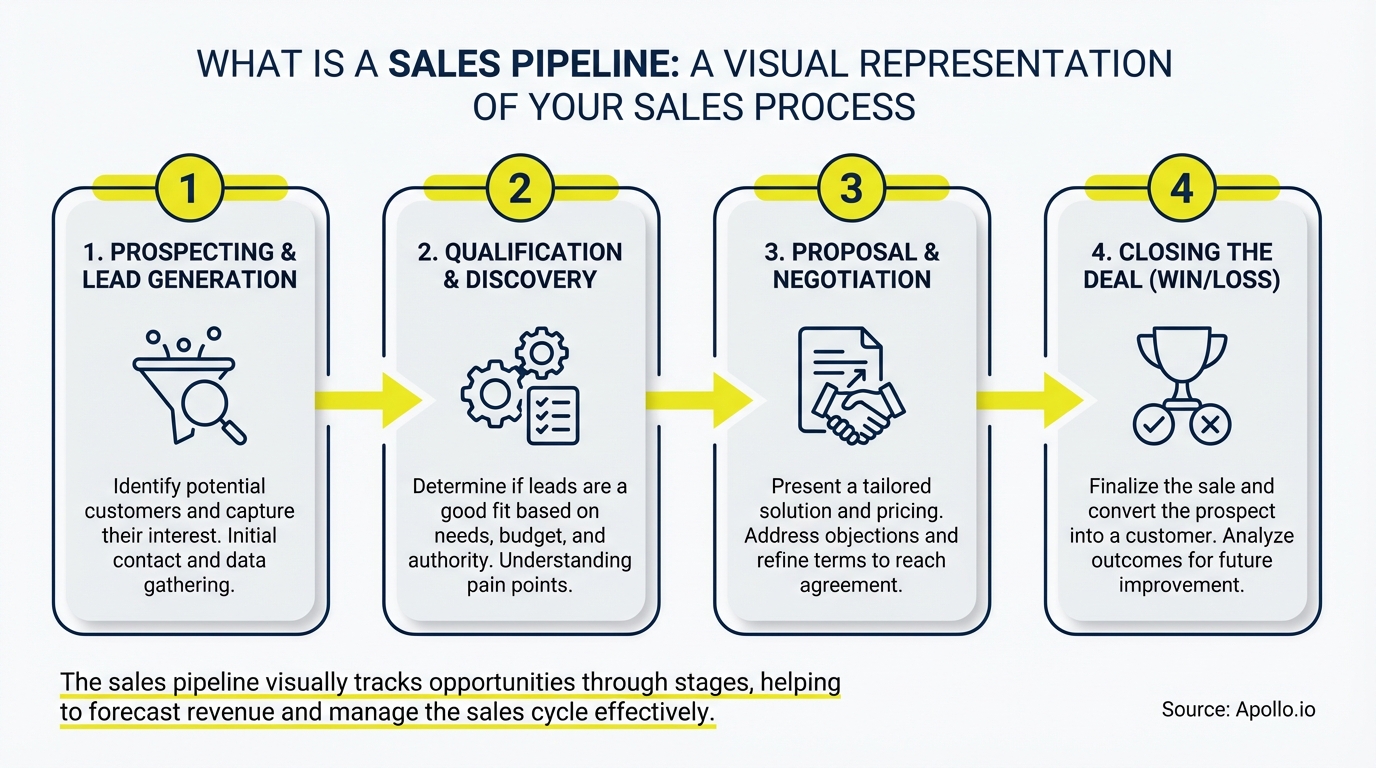
A sales pipeline is a visual representation of your sales process showing where prospects are in their buying journey and what actions move them forward. Each stage represents a milestone in the buyer's progression from awareness to closed deal. Your pipeline structure defines how your team qualifies, nurtures, and converts opportunities into revenue.
The pipeline differs from a sales funnel in a critical way: funnels show aggregate conversion rates across all prospects, while pipelines track individual deals through specific stages. According to Databox, most B2B deals take more than a month to close, with over 30% taking between one and three months. This timeline makes stage-by-stage tracking essential.
Modern pipelines in 2026 function as both a system of record and a system of signals. They aggregate CRM data with conversation intelligence, buyer intent signals, and engagement metrics to provide real-time deal health visibility.
What Are the Standard Sales Pipeline Stages?
Most B2B pipelines include five to seven core stages, though the exact structure varies by sales model and deal complexity. Here's the standard framework Account Executives and SDRs use:
| Stage | Definition | Exit Criteria | Typical Conversion Rate |
|---|---|---|---|
| Prospecting | Identifying potential buyers who match your ICP | Contact information verified, initial outreach sent | 1-2% to MQL |
| Qualification | Confirming fit, budget, authority, need, and timeline | BANT criteria met, discovery call scheduled | 20-25% (Lead to MQL) |
| Needs Analysis | Deep-dive discovery to understand pain points and requirements | Business case documented, stakeholders identified | 10% (MQL to SQL) |
| Proposal | Solution presentation and formal proposal delivery | Proposal reviewed, objections addressed | 22% (Opportunity to close) |
| Negotiation | Contract terms, pricing, and legal review | Mutual agreement on terms, procurement approved | 29% (Qualified opportunity close rate) |
| Closed Won/Lost | Deal finalized or opportunity lost | Contract signed or formal rejection received | N/A |
Research from MarketJoy shows Lead to MQL conversion averages 20-25%, while Growth Today reports B2B SaaS companies typically see 10% MQL to SQL conversion and 22% opportunity-to-close rates. The key is defining clear exit criteria so deals don't stall between stages.
Turn Forecast Guesswork Into Revenue Certainty
Pipeline forecasting a guessing game? Apollo delivers real-time deal intelligence and verified contacts so you can predict revenue with confidence. Built-In increased win rates 10% with Apollo's signals.
Start Free with Apollo →How Do Sales Leaders Track Pipeline Health?
Sales Leaders and RevOps teams monitor pipeline health through five critical metrics. These indicators predict forecast accuracy and reveal where deals stall:

- Pipeline Coverage Ratio: Total pipeline value divided by quota. Most teams target 3-4x coverage to account for win rates and deal slippage.
- Win Rate: Percentage of opportunities that close successfully. According to Remuner, benchmarks are: under 20% (needs improvement), 20-40% (average), over 40% (strong performance).
- Average Deal Size: Mean contract value across closed deals, segmented by product line or customer segment.
- Sales Velocity: How quickly deals move through your pipeline, calculated as (Number of Opportunities × Average Deal Value × Win Rate) ÷ Sales Cycle Length.
- Stage Conversion Rates: Percentage of deals advancing from each stage to the next, revealing bottlenecks.
Pipeline hygiene audits have become a formal RevOps discipline in 2026. Automated data cleansing and duplicate detection ensure your metrics reflect reality, not CRM fiction.
Clean data is the foundation for AI-powered forecasting and agentic workflows that automatically update deal status based on buyer signals.
Struggling to track deals across multiple tools? Manage your entire pipeline in Apollo's unified workspace, eliminating the need for separate CRM, engagement, and data enrichment platforms.
How Do Account Executives Move Deals Through the Pipeline?
Account Executives accelerate pipeline velocity through structured qualification, multi-stakeholder engagement, and proactive deal management. Here's how top AEs operate in each stage:

During Qualification: AEs use frameworks like MEDDIC or BANT to validate fit before investing significant time. They identify the economic buyer, confirm budget availability, and establish a mutual action plan with clear next steps and timelines.
During Discovery: Deep-dive conversations uncover technical requirements, business impact, and decision criteria. AEs map the buying committee (averaging 13 people across 2+ departments) and understand each stakeholder's priorities and concerns.
During Proposal: Presentations connect your solution directly to discovered pain points. AEs provide self-serve assets like ROI calculators, implementation plans, and security documentation that enable buyers to build internal consensus without constant seller involvement.
During Negotiation: Top performers use proven closing techniques to address objections, negotiate terms, and coordinate legal/procurement review. They maintain momentum by setting clear timelines and action items for both parties.
The shift toward rep-free buying means AEs must enable buyers to evaluate, compare, and justify purchases independently. Providing comprehensive documentation and responsive support prevents the stalls that derail 86% of B2B deals.
What Pipeline Metrics Do RevOps Teams Monitor?
RevOps leaders track pipeline metrics that predict revenue outcomes and identify process inefficiencies. These sales KPIs inform strategic decisions and resource allocation:
- Pipeline Generation Rate: New opportunities created per period, segmented by source (inbound, outbound, partner)
- Stage Duration: Time spent in each pipeline stage, with benchmarks for healthy progression
- Conversion Velocity: Speed of stage-to-stage movement, calculated separately for each transition
- Pipeline Hygiene Score: Percentage of opportunities with complete data, recent activity, and realistic close dates
- Forecast Accuracy: Variance between projected and actual closed revenue, tracked by quarter
- Multi-Touch Attribution: Pipeline credit across marketing and sales touchpoints
In 2026, Revenue Operations teams use AI to detect early warning signals: declining engagement, missing stakeholders, stalled activity, or unrealistic close dates. These signals trigger automated interventions like manager coaching prompts or additional resources for the rep.
Need visibility into pipeline performance across your entire team? Apollo's deal management platform provides real-time dashboards, conversion analytics, and AI-powered deal health scoring in one unified system.
How Do You Build a Sales Pipeline That Prevents Stalls?
Anti-stall pipeline design requires clear stage definitions, buyer-enablement assets, and governance rituals. Here's the framework high-performing teams implement:
Define Objective Exit Criteria: Replace subjective stage movement with measurable milestones. For example, moving to Proposal requires documented stakeholder alignment, budget confirmation, and a signed mutual action plan, not just a scheduled demo.
Create Self-Serve Buyer Assets: Build a library of resources buyers need at each stage: pricing guides, security questionnaires, implementation timelines, ROI calculators, and comparison matrices. This reduces back-and-forth and enables buyers to build consensus internally.
Map Stakeholder Paths: Track which buying committee members have engaged, what their concerns are, and who still needs to be involved. Use multi-threaded outreach to build relationships across the organization.
Implement Pipeline Reviews: Weekly deal reviews focus on opportunities at risk of stalling. Managers ask: What changed since last week? What's blocking forward movement? What resources does the rep need?
Automate Pipeline Hygiene: Use AI to flag stale opportunities, duplicate accounts, missing contact information, and unrealistic close dates. Automated alerts prompt reps to update deal status or re-engage buyers.
Teams using Apollo consolidate prospecting, engagement, data enrichment, and pipeline analytics into one workspace. As Predictable Revenue noted: "We reduced the complexity of three tools into one."
What Are Common Sales Pipeline Mistakes?
Even experienced teams make pipeline management errors that inflate forecasts and hide problems. Avoid these pitfalls:
- Stage Inflation: Moving deals forward prematurely to show progress without meeting exit criteria
- Ignoring Stalled Deals: Leaving old opportunities in the pipeline instead of marking them lost or recycling to earlier stages
- Single-Threading: Engaging only one stakeholder when buying committees average 13 decision-makers
- Inconsistent Definitions: Allowing reps to interpret stages differently, making aggregate data meaningless
- Neglecting Pipeline Coverage: Failing to maintain sufficient top-of-funnel activity to hit future quotas
- Manual Data Entry: Relying on reps to update CRM manually, leading to incomplete and outdated records
The solution is process standardization and automation. Define stage criteria in writing, train your team consistently, and use technology to auto-capture activity and update deal status.
Pipeline hygiene is now a forecast-critical discipline, not admin work.
Start Building Your Pipeline Today
Your sales pipeline determines revenue predictability. In 2026, winning teams combine clear stage definitions, buyer-enablement content, multi-stakeholder tracking, and AI-powered deal health monitoring to prevent the stalls that derail most B2B purchases.
The key is treating your pipeline as an anti-stall system: objective exit criteria, self-serve assets for buyers, and automated hygiene checks that surface problems early. When you consolidate your sales tech stack into one platform, you eliminate data silos and give your team a single source of truth.
Ready to transform your pipeline management? Start free with Apollo and access 224M+ verified contacts, AI-powered engagement sequences, and unified deal tracking that consolidates your prospecting, outreach, and pipeline analytics into one workspace.
Prove Apollo's ROI In Your First 30 Days
Budget approval stuck on unclear metrics? Apollo delivers measurable pipeline impact from day one—track time saved, meetings booked, and deals closed. Built-In increased win rates 10% and ACV 10% using Apollo's signals.
Start Free with Apollo →Don't miss these
Sales
Inbound vs Outbound Marketing: Which Strategy Wins?
Sales
What Is a Sales Funnel? The Non-Linear Revenue Framework for 2026
Sales
What Is a Go-to-Market Strategy? The 2026 GTM Playbook
See Apollo in action
We'd love to show how Apollo can help you sell better.
By submitting this form, you will receive information, tips, and promotions from Apollo. To learn more, see our Privacy Statement.
4.7/5 based on 9,690 reviews
