
What Is a Sales Cadence and Why Is It Important in Planning Outreach?
Most outreach fails not because reps lack effort, but because touches land at the wrong time, in the wrong channel, with the wrong message. A well-designed sales cadence solves all three problems simultaneously by turning scattered follow-ups into a coordinated, buyer-first system. In 2026, that distinction separates teams that fill pipeline from teams that fill spam folders.

Research Less, Close More With Apollo
Tired of burning hours verifying contact info instead of selling? Apollo delivers accurate business contacts so your reps spend time closing, not chasing. Join 600K+ companies building pipeline faster.
Start Free with Apollo →Key Takeaways
- A sales cadence is a structured sequence of multi-channel outreach touches designed to engage prospects at the right time with the right message.
- Cadence quality matters more than cadence quantity: buyers actively avoid irrelevant outreach, so relevance and timing drive results, not volume alone.
- Modern B2B buyers use roughly 10 interaction channels, making multi-channel orchestration a requirement, not a differentiator.
- SDRs and BDRs who pair disciplined cadences with strong targeting generate significantly more meetings and conversions than those running ad hoc outreach.
- AI is shifting cadences from fixed schedules to signal-based plays, triggering outreach around funding events, intent spikes, and hiring signals.
What Is a Sales Cadence?
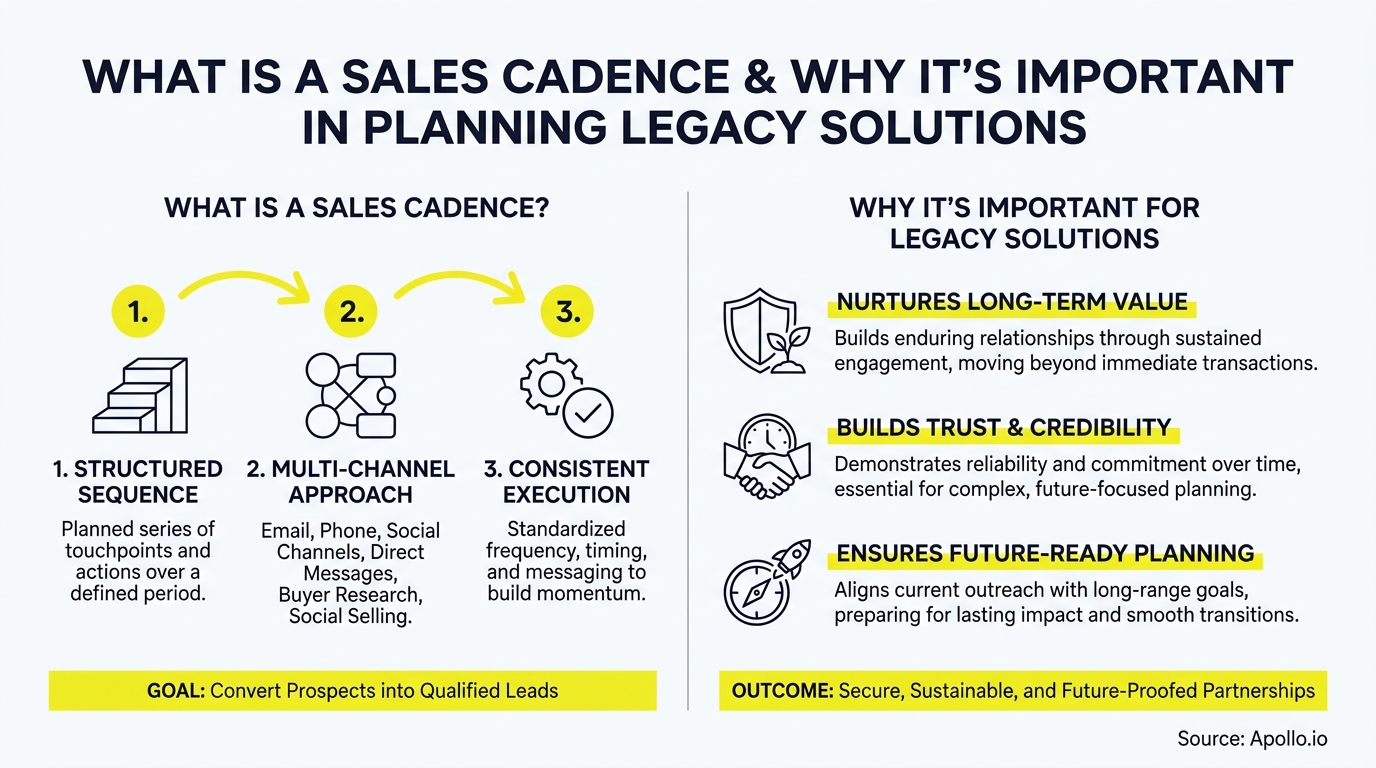
A sales cadence is a structured, repeatable sequence of outreach activities a salesperson uses to engage prospects over a defined period, coordinating timing, channel, and message to guide buyers through the pipeline. According to DealHub, it is "a structured and predefined sequence of outreach activities and touchpoints that a salesperson uses to engage with prospects over a set period, aiming to build relationships and guide them through the sales pipeline."
Cadences are not the same as sequences. A sequence is a single series of automated steps (e.g., three emails over two weeks).
A cadence is the broader operating model that defines rhythm, channel mix, pacing, and decision rules across all sequences for a given segment or persona.
As noted by Tendril, touchpoints in a cadence typically involve multiple channels: email, phone calls, social media interactions, video messages, and even direct mail. Explore sales cadence examples and best practices to see how high-performing teams structure their sequences.
Why Is a Sales Cadence Important in Planning Outreach?
A sales cadence is important because modern B2B buyers actively avoid bad outreach. A 2025 Gartner survey of 632 B2B buyers found that 73% actively avoid suppliers that send irrelevant outreach. Without a cadence, reps default to generic, high-volume messaging that damages the brand relationship before it starts.
The same research found 61% of B2B buyers prefer a rep-free buying experience overall. That means seller-initiated outreach only earns attention when it is timely, relevant, and genuinely useful.
A structured cadence forces that discipline by building in channel logic, spacing rules, and persona-specific value at each touch.
There is also an efficiency case. Salesforce's 2024 State of Sales research found reps spend 70% of their time on non-selling tasks.
A planned cadence automates routine follow-up so SDRs and AEs can focus human effort on the moments that actually require judgment, like discovery calls, objection handling, and champion development.
How Do SDRs and BDRs Build High-Converting Cadences?
SDRs and BDRs build high-converting cadences by treating channel mix, message relevance, and cadence length as separate, testable variables rather than fixed assumptions. Real-world data from practitioners consistently challenges conventional wisdom on all three.
A sales professional wrote on Redditthat running a 21-task sequence over 28 days (7 calls, 7 emails, 7 social touches) resulted in 25 meetings in a single month: 24 from calls, 1 from email, and 0 from social.
The practical takeaway: channel weight should match your specific market and ICP, not a generic template.
On cadence length, a sales professional shared a firsthand perspective that the first three emails in a sequence earned an 8-9% reply rate each, but three additional emails added to hit KPI targets produced 0% replies across more than 1,000 sequences. Longer is not better. Cutting a cadence at the point of diminishing returns preserves sender reputation and focuses effort where it works.
Spending hours on manual follow-up? Automate your multi-channel sequences with Apollo's sales engagement platform and let the system handle spacing and reminders while you focus on responses.

What Does a Multi-Channel Cadence Look Like in Practice?
A multi-channel cadence coordinates email, phone, and social touches into a single, sequenced plan with clear rules for timing and escalation. The goal is to meet buyers where they already are, not to flood every channel simultaneously.
| Day | Channel | Action | Purpose |
|---|---|---|---|
| Day 1 | Personalized intro referencing a specific trigger (funding, hire, content) | Establish relevance immediately | |
| Day 3 | Phone | Brief call referencing email sent | Add human touch, increase awareness |
| Day 5 | Social | Engage with prospect's post or share relevant content | Build familiarity without direct ask |
| Day 8 | Value-add follow-up (case study, relevant insight) | Demonstrate expertise, not just persistence | |
| Day 12 | Phone | Decision call with clear ask | Convert or disqualify |
| Day 18 | Breakup email with low-friction opt-out | Preserve relationship, protect domain reputation |
McKinsey's 2024 B2B Pulse Survey found B2B customers use an average of 10 interaction channels in their buying journey, up from 5 in 2016. That does not mean touching all 10 channels in every cadence. It means your cadence design should reflect how your specific buyers prefer to research and engage, then layer in the channels that match those preferences. For enterprise deals, also review strategies for breaking into enterprise accounts where multi-threading across stakeholders is essential.
Turn Weak Leads Into Pipeline With Apollo
Pipeline forecasting a guessing game because marketing leads never convert? Apollo surfaces in-market buyers the moment they're ready to act. Top sales teams close more — not by working harder, but by targeting smarter.
Schedule a Demo →How Do You Build a Buyer-First Cadence That Avoids Spam?
A buyer-first cadence is built around signals, not schedules. Instead of launching generic Day 1/Day 3/Day 7 sequences, signal-based cadences trigger outreach around events that make the message relevant: a funding round, a new hire, a job change, an intent spike, or a product trial.
The Salesforce 2026 State of Sales report found that 34% of sales teams with AI agents use them specifically for prospecting, and high performers are 1.7x more likely than underperformers to use AI prospecting agents. AI is not replacing the cadence; it is making cadences smarter by surfacing the right moment to reach out.
Key guardrails for a buyer-first cadence:
- Personalize the first line: Reference a real, specific trigger. Generic openers are the fastest route to the delete folder.
- Cap total touches: Practitioner data consistently shows diminishing returns after the first few high-quality touches.
- Include value at every step: Each touch should offer something useful (insight, case study, answer to a likely question), not just a "just checking in" reminder.
- Pause on engagement signals: If a prospect opens three emails but never replies, change the channel or message before continuing.
- Respect opt-outs immediately: Google's sender guidelines require easy unsubscribe options and penalize high spam rates, making clean cadence hygiene a deliverability requirement.
For RevOps leaders building cadence infrastructure, clean CRM data is the prerequisite. Stale or incomplete contact records make even well-designed cadences fire at the wrong person with the wrong context. See how teams use sales automation the right way to keep data and sequences aligned. Also track the right sales KPIs to measure cadence performance systematically.
Need accurate contact data to fuel your cadences? Search Apollo's 230M+ verified contacts with 65+ filters to build targeted prospect lists before your cadence launches.
What Are the Most Common Sales Cadence Mistakes to Avoid?
The most common sales cadence mistakes are prioritizing volume over relevance, ignoring channel fit, and extending sequences past the point of diminishing returns. Each mistake compounds the others.
| Mistake | What to Do Instead |
|---|---|
| Generic, templated first touch | Personalize with a specific signal or trigger relevant to that prospect |
| Email-only sequences | Blend email, phone, and social based on ICP channel preference |
| Cadences over 10-12 touches with no engagement | Cut cadence at diminishing-return point; test shorter sequences first |
| No pause/escalation logic | Build rules: if opened 3x without reply, change channel or message |
| Same cadence for all personas | Segment by role (champion, economic buyer, technical evaluator) and stage |
| Ignoring deliverability | Authenticate domains, monitor spam rates, honor opt-outs immediately |
For teams selling complex deals with multiple stakeholders, the buying-committee dimension is critical. Forrester's 2024 State of Business Buying found an average of 13 people are involved in B2B buying decisions and 89% of purchases involve two or more departments. A single-threaded cadence aimed at one contact cannot navigate that complexity. Build role-based cadences for champions, economic buyers, and technical evaluators separately, then coordinate timing across all three. Explore outbound sequence length secrets for guidance on calibrating touches to deal complexity.

How Does Apollo Help Teams Run Better Sales Cadences?
Apollo consolidates prospecting, sequencing, dialing, and analytics into one platform so GTM teams can build and execute cadences without stitching together multiple tools. "We reduced the complexity of three tools into one," noted Collin Stewart of Predictable Revenue. "Having everything in one system was a game changer," added Cyera.
For SDRs, Apollo surfaces verified business contact data alongside sequence tools in one workspace, eliminating the tab-switching between a data tool, CRM, and engagement platform. For RevOps leaders, a single platform means cleaner attribution, fewer integration points to maintain, and a single source of truth for cadence performance data.
Apollo serves B2B GTM teams from early-stage startups through enterprise, with advanced routing, governance, and admin controls for larger organizations.
Apollo's AI features help teams move from fixed-schedule cadences to signal-based plays, with AI-powered messaging that has driven a 35% increase in bookings for teams using it. Trusted by nearly 100K paying customers including Anthropic, Smartling, and Redis, Apollo brings prospecting and engagement together so your cadence starts with the right contacts and ends with booked meetings.
Ready to put your cadence into action? Start free with Apollo and run your first multi-channel sequence today.
Prove Pipeline ROI From Day One
ROI pressure killing your next budget approval? Apollo delivers measurable pipeline impact fast — with 46% more meetings and 35% more bookings using AI. 600K+ companies justify the spend easily.
Start Free with Apollo →Don't miss these
Sales
Inbound vs Outbound Marketing: Which Strategy Wins?
Sales
What Is a Sales Funnel? The Non-Linear Revenue Framework for 2026
Sales
What Is a Go-to-Market Strategy? The 2026 GTM Playbook
See Apollo in action
We'd love to show how Apollo can help you sell better.
By submitting this form, you will receive information, tips, and promotions from Apollo. To learn more, see our Privacy Statement.
4.7/5 based on 9,690 reviews
