
What Early Wins Should a GTM Engineering Hire Focus On in Their First 90 Days?
A new GTM Engineer hire should focus their first 90 days on four high-leverage wins: unifying the TAM, fixing data and deliverability foundations, building a signal-based scoring model, and shipping governed AI messaging. These aren't glamorous — but they're the difference between a GTM motion that compounds and one that resets every quarter.
Here's the uncomfortable truth most job descriptions miss: the GTME role is too often framed as "stitch together 14 tools and call it a workflow." The best GTM Engineers don't wear that as a badge of honor. They're revenue strategists. Their job is to collapse fragmented execution into one elegant system — then make it run. Learn more about building a winning GTM strategy before mapping your 90-day priorities.

Build Pipeline Faster With Apollo
Tired of hours lost to manual research and bad contact data? Apollo surfaces verified leads instantly so your reps spend time selling, not searching. Join 600K+ companies building predictable pipeline.
Start Free with Apollo →Key Takeaways
- The first 30 days should produce a unified TAM list and a deliverability infrastructure plan — not just stakeholder meetings.
- Fixing targeting and suppression logic early prevents the outreach noise that actively drives buyers away.
- A signal-based scoring model converts scattered data into consistent, defensible account prioritization for the whole team.
- Governed AI content ops dramatically increase messaging throughput without introducing brand or compliance risk.
- Rapid, structured onboarding creates compounding returns: research by DealHub found rapid onboarding of new sales hires can increase sales growth rates by 10% and improve objective achievement by 14%.
What Should a GTM Engineering Hire Accomplish in Days 1–30?
Days 1–30 are for foundation: map the current state, build the TAM, and size the infrastructure. These three outputs give the entire GTM motion a single source of truth it almost certainly doesn't have yet.
According to Mural's 2025 GTM Alignment Gap study, 85% of professionals report misalignment within their GTM teams, often due to misaligned KPIs. A unified TAM list with agreed ICP criteria is the first structural fix for that problem.
| Week | Deliverable | Owner |
|---|---|---|
| 1 | Current-state audit: lists, tools, sequences, data sources | GTME |
| 2 | TAM build with AI qualification and ICP segmentation | GTME + Sales Lead |
| 3 | Deliverability infrastructure plan: domains, mailboxes, send limits, SPF/DKIM/DMARC setup | GTME + RevOps |
| 4 | Suppression logic and routing rules to stop hitting wrong accounts | GTME + RevOps |
Suppression logic deserves special attention. Bad targeting isn't just inefficient — it actively destroys pipeline. A 2024 Gartner survey of 632 B2B buyers found that 73% actively avoid suppliers who send irrelevant outreach. Fixing routing and enrichment in week four is one of the fastest ROI wins available. Pair this work with a solid sender reputation strategy to protect domain health from day one.
Struggling to build a clean TAM from scattered lists? Search Apollo's 230M+ verified contacts with 65+ filters to qualify your entire addressable market in one place.
What Should RevOps and GTM Engineers Build in Days 31–60?
Days 31–60 are for intelligence: a scoring model that encodes actual business priorities, and a data foundation that connects CRM, web, and enrichment signals into one pipeline. This phase transforms raw TAM into a ranked, actionable market.
RevOps leaders find this phase particularly high-value because it replaces gut-feel prioritization with a system anyone on the team can query. The scoring model distributes 100 points across signals — fit, intent, timing, inbound engagement — weighted by what actually predicts wins, not what feels important.
- Define signal dimensions: firmographic fit, buying intent, recent funding, product usage signals, inbound engagement (downloads, webinar attendance, pricing page visits)
- Assign weights: calibrate against a sample of 100–200 accounts; adjust until scores match reality
- Wire data sources: connect 1st-party CRM and web data, 2nd-party enrichment, and 3rd-party intent into a unified processing layer
- Establish lifecycle stage definitions: agree on what "MQL," "SAL," and "SQL" actually mean in your data model
The data foundation work matters more than most teams realize. Research from TryKondo's B2B Sales Report found AI-enhanced teams are 83% more likely to see revenue growth compared to non-AI teams — but AI is only as good as the data infrastructure behind it. Unified identity resolution and clean lifecycle logic are what separate teams that get value from AI from those that don't.
This is also the right moment to evaluate tech stack consolidation. The classic Frankenstack — n8n stitching 14 tools together — creates fragility at every API seam.
Every new integration is a new point of failure. "Having everything in one system was a game changer," noted the team at Cyera. A unified platform eliminates the integration overhead that slows iteration velocity.

What Should GTM Engineers Ship in Days 61–90?
Days 61–90 are for execution: governed AI content operations, human-in-the-loop review workflows, and live performance reporting. This is where strategy becomes system — and the system starts compounding.
How Do SDRs Benefit from the Human-in-the-Loop Workflow?
SDRs benefit most from HITL by shifting from list-building and research to judgment and conversation. The AI surfaces prioritized accounts with research context and draft messaging.
The SDR reviews top-scored accounts, edits where needed, approves the rest, and focuses their actual time on replies and calls.
- AI content ops setup: build a prompt library tied to scoring signals; each prompt pulls from account research, persona guidelines, and inbound activity context
- Governance guardrails: approval workflows, brand voice checks, and audit trails before messages reach prospects
- HITL routing: top-scored accounts route to SDR review; mid-tier accounts enter automated sequences; low-score accounts enter suppression
- Reporting baseline: track reply rates by segment and score tier, meeting conversion by account score, pipeline contribution from prioritized accounts
Spending hours on manual outreach while your scoring model sits idle? Automate your sequences with Apollo's AI-powered sales automation and let the system handle research and drafting while your team handles decisions.
The reporting layer closes the loop. Campaign-level metrics tell you what happened. Signal-level correlation analysis tells you why. Run r-value correlation between individual signals and pipeline outcomes monthly. Signals above 0.7 get more weight; signals below 0.5 get pruned. The system self-optimizes instead of resetting every quarter. For a deeper framework on measurement, see what sales KPIs to track in 2026.
Turn Funnel Guesswork Into Real Pipeline
Tired of watching marketing leads stall before they ever reach your reps? Apollo surfaces in-market buyers the moment they're ready, so your team stops chasing cold contacts and starts closing. Nearly 100K paying customers trust Apollo to build predictable pipeline.
Start Free with Apollo →What Does the Full 30/60/90 Framework Look Like?
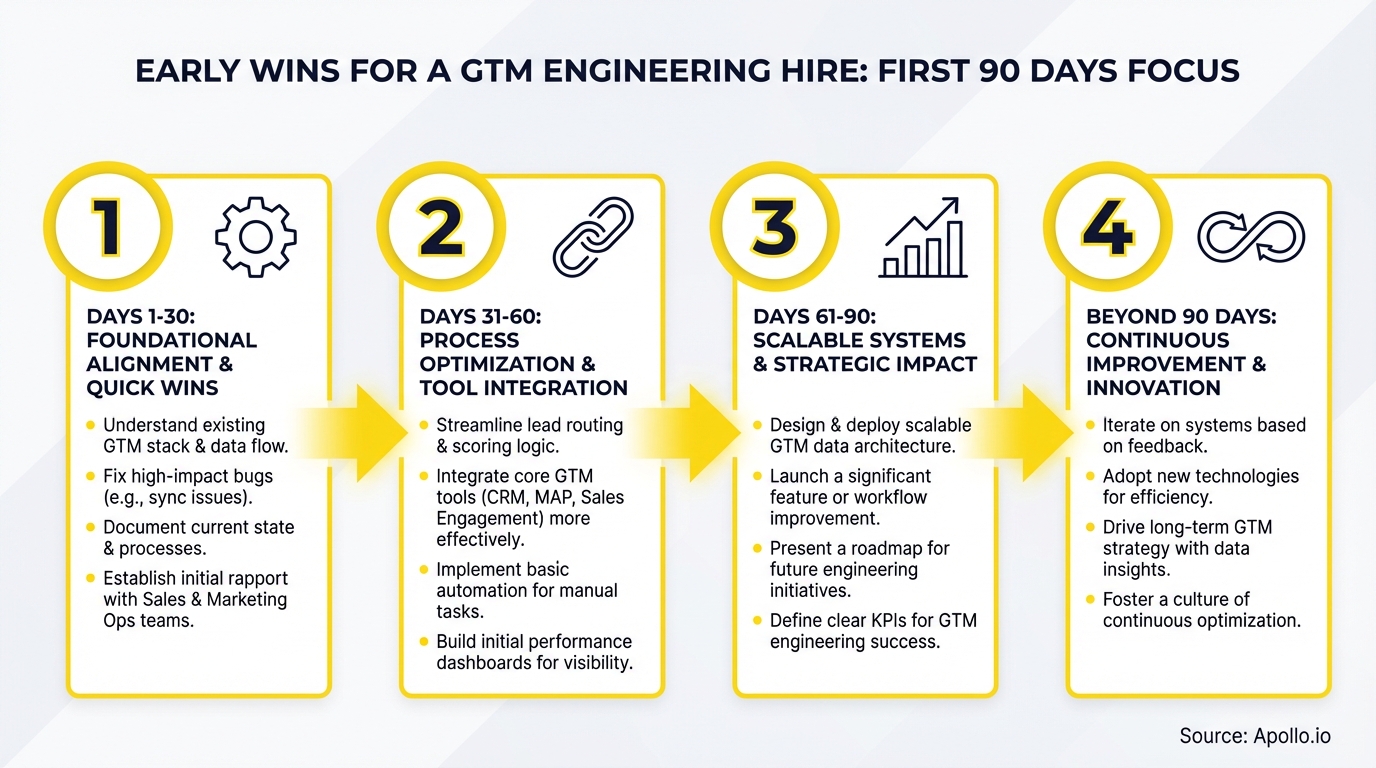
The 90-day GTM engineering plan maps directly to three compounding phases: foundation, intelligence, and execution. Each phase builds on the last.
| Phase | Days | Primary Deliverables | Key KPIs |
|---|---|---|---|
| Foundation | 1–30 | Unified TAM, deliverability infrastructure, suppression logic | TAM size (exact count), bounce rate, domain health score |
| Intelligence | 31–60 | Scoring model, data pipeline, lifecycle definitions | % accounts scored, data completeness rate, lifecycle stage accuracy |
| Execution | 61–90 | AI content ops, HITL workflows, live reporting | Reply rate by score tier, meetings booked, pipeline from prioritized accounts |
The trajectory beyond 90 days points toward agentic GTM: systems that prioritize accounts, draft messages, trigger sequences, and schedule meetings with minimal human intervention. The GTME who wins long-term isn't the one who builds the most elaborate workflow. It's the one who deploys the most elegant strategy at the highest velocity. The GTM Engineering (GTME) Program is built around exactly this progression — from foundation through intelligence to fully autonomous execution. Explore the full GTME methodology for the seven-pillar framework that underpins this approach.
For context on how demand generation connects to this GTM engineering foundation, the underlying principle is the same: systematic targeting and consistent execution compound over time in ways that one-off campaigns never do.

How Do You Measure Success After the First 90 Days?
Success after 90 days is measured by system health, performance, and efficiency metrics — not just pipeline volume. The system should be running, not just built.
- System health: TAM coverage %, deliverability metrics (bounce rate below 2%, spam complaint rate below 0.1%), data refresh completeness
- Performance: reply rate improvement by segment, meeting conversion rate by account score tier, pipeline contribution from top-scored accounts vs. unscored outreach
- Efficiency: team time on data gathering vs. selling, percentage of market contacted, infrastructure utilization vs. plan
The reporting cadence matters as much as the metrics. Monthly tactical reviews tune prompts and adjust signal weights. Quarterly strategic reviews refresh the TAM and prune underperforming signals. This is how the system builds institutional memory instead of resetting. Connect this to a broader customer engagement metrics framework to track the full buyer journey impact.
Start Building Your GTM Engine
The first 90 days of a GTM engineering hire aren't about learning the tools. They're about shipping a system: a unified TAM, a scored and prioritized market, governed AI messaging, and the reporting infrastructure to optimize it all continuously.
The teams that get this right stop rebuilding campaigns every quarter. They pivot in hours, not months.
They answer the questions that actually matter — market coverage, signal correlation, pipeline by score tier — with data instead of guesses.
Apollo is built for exactly this workflow: one platform for prospecting, scoring, sequencing, and reporting. No API babysitting. No Frankenstack. Start Prospecting and build your GTM engine the right way from day one.
Prove Pipeline ROI Without the Guesswork
ROI pressure killing your next tool renewal? Apollo delivers measurable pipeline impact from day one — no lengthy pilots, no vague metrics. Leadium 3x'd annual revenue. See your ROI fast.
Start Free with Apollo →Don't miss these
Sales
Inbound vs Outbound Marketing: Which Strategy Wins?
Sales
What Is a Sales Funnel? The Non-Linear Revenue Framework for 2026
Sales
What Is a Go-to-Market Strategy? The 2026 GTM Playbook
See Apollo in action
We'd love to show how Apollo can help you sell better.
By submitting this form, you will receive information, tips, and promotions from Apollo. To learn more, see our Privacy Statement.
4.7/5 based on 9,690 reviews
