
What Is Sender Reputation and Why Does It Determine Your Email Success?
Sender reputation is no longer just a deliverability metric—it's a compliance requirement and revenue lever. In 2026, Google enforces a hard 0.3% spam complaint threshold, Microsoft requires authentication for bulk senders sending 5,000+ emails daily, and mailbox providers treat engagement patterns as trust signals.
Your sender reputation determines whether your cold email, nurture sequence, or product update lands in the inbox or disappears into spam.
This guide breaks down what sender reputation is, how major providers measure it under current enforcement policies, and how to build and protect it with actionable, cross-functional workflows.

Apollo Finds Verified Contacts In Seconds
Tired of spending 4+ hours daily hunting for contact info? Apollo delivers 224M contacts with 96% email accuracy. Join 550K+ companies closing deals faster.
Start Free with Apollo →Key Takeaways
- Sender reputation is a compliance gate: Google blocks delivery support if spam rate exceeds 0.3%; Microsoft enforces authentication for high-volume senders as of May 2025.
- Authentication is non-negotiable: According to The Digital Bloom, fully authenticated emails can achieve 85-95% inbox placement, while unauthenticated emails typically see 30-50%.
- List quality drives reputation: Invalid and risky addresses make up nearly 20% of typical B2B lists, directly damaging deliverability.
- Engagement matters more than ever: Mailbox providers prioritize user feedback signals—opens, clicks, replies, and complaint rates—over infrastructure alone.
- Cross-functional ownership is required: Reputation management now spans Marketing, IT/SecOps, and RevOps with shared KPIs and incident response protocols.
What Is Sender Reputation?
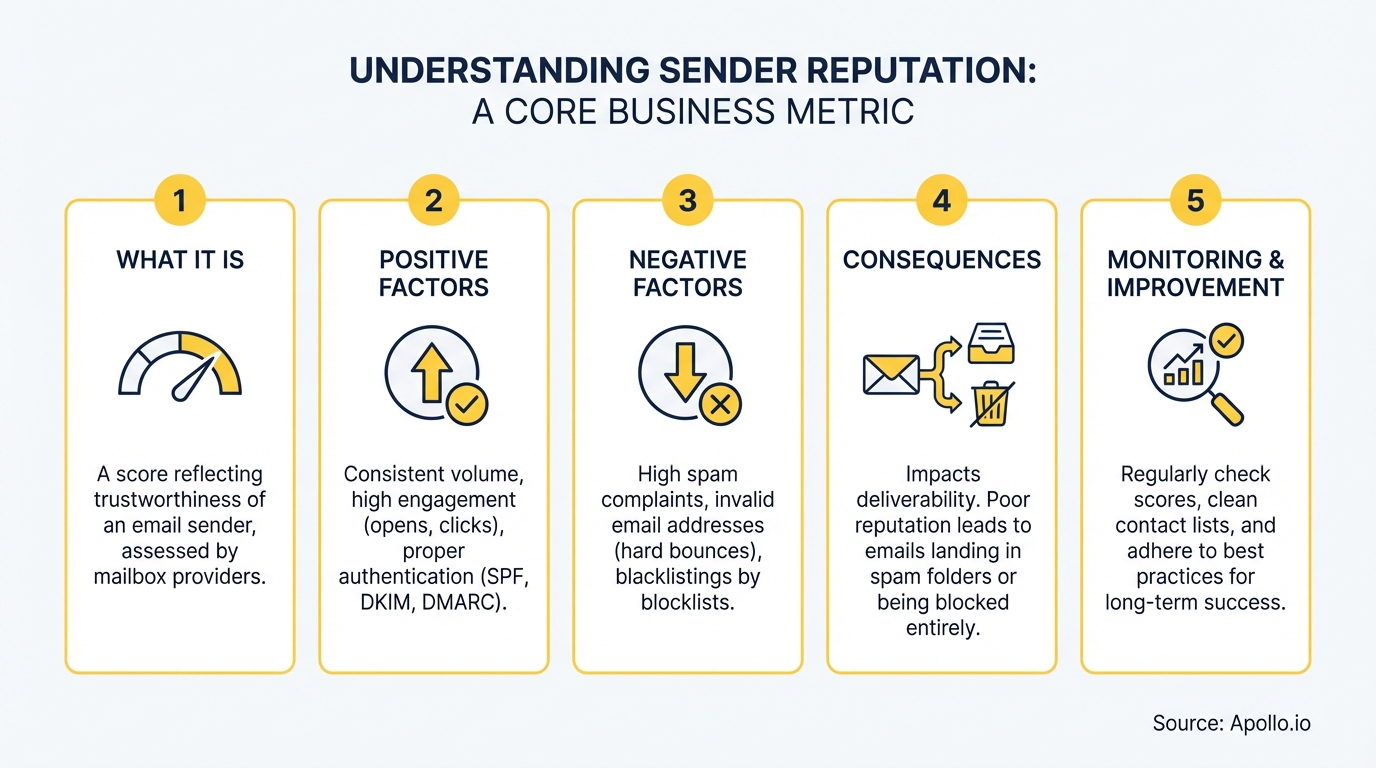
Sender reputation is a trust score assigned to your email sending domain and IP address by mailbox providers (Gmail, Outlook, Yahoo). It functions like a credit score: high reputation = inbox placement; low reputation = spam folder or outright rejection.
Reputation is determined by:
- Bounce rates: Hard bounces (invalid addresses) signal poor list hygiene.
- Spam complaints: User-reported spam directly damages reputation.
- Engagement metrics: Opens, clicks, replies, and time spent reading indicate value.
- Authentication compliance: SPF, DKIM, and DMARC verify your identity and prevent spoofing.
- Send consistency: Sudden volume spikes trigger spam filters.
Domain vs. IP Reputation: Domain reputation (increasingly prioritized by Gmail and Outlook) stays with your sending domain across platforms. IP reputation is tied to the sending server—shared IPs inherit reputation from other senders, while dedicated IPs give you full control but require careful warming.
How Do Mailbox Providers Measure Sender Reputation in 2026?
Major providers have operationalized reputation as an explicit compliance framework with hard thresholds and enforcement mechanisms.
Google's Bulk Sender Requirements
Google's guidelines (enforced since 2024, still current in 2026) set clear thresholds:
- Spam rate must stay below 0.3%: If you exceed this threshold, delivery support and mitigations become unavailable.
- Authentication required: SPF, DKIM, and DMARC (minimum p=none for bulk senders).
- One-click unsubscribe: Required for marketing emails to Gmail users.
Google Postmaster Tools provides domain reputation visibility, spam rate monitoring, and DKIM/DMARC authentication success rates. Senders typically achieve 95%+ authentication success when properly configured.
Microsoft's May 2025 Enforcement
Microsoft now applies bulk-sender authentication requirements for senders at or around 5,000+ emails per day (effective May 5, 2025). Non-compliance risks junking or rejection for Outlook and Hotmail recipients.
Requirements mirror Google's: SPF, DKIM, DMARC, and clear unsubscribe mechanisms.
Yahoo and Other Providers
Yahoo enforces similar authentication and complaint-rate thresholds. Smaller providers increasingly adopt these standards, making authentication and engagement optimization universal requirements for B2B senders.
Why Sender Reputation Matters for B2B Teams
Research from Validity shows that in 2023, the average inbox placement rate was 86%, meaning roughly 1 in 6 legitimate, permission-based marketing emails did not reach the inbox. Poor sender reputation is a primary driver of this gap.
Revenue impact: Low reputation means fewer emails seen, fewer meetings booked, and slower pipeline velocity. High reputation drives consistent inbox placement, higher engagement rates, and faster deal cycles.
"Apollo enriches everything we have: contacts, leads, accounts... And we don't really have to touch it, it just works."
Brand protection: Sender reputation is tied to domain trust and DMARC enforcement, which protects against impersonation and business email compromise (BEC). Organizations reporting direct financial penalties due to phishing increased 144% in 2024, raising the stakes for domain security and reputation management.
The Cross-Functional Sender Reputation Framework
Reputation management is no longer a single-team responsibility. It requires coordination across Marketing, IT/SecOps, and Revenue Operations with shared KPIs and incident response protocols.
| Function | Responsibilities | KPIs |
|---|---|---|
| Marketing | List hygiene, segmentation, content optimization, engagement tracking | Bounce rate <2%, spam rate <0.3%, open rate >20% |
| IT/SecOps | SPF/DKIM/DMARC setup, domain monitoring, BIMI implementation, blocklist monitoring | 95%+ authentication success, zero blocklist hits, DMARC p=reject enforcement |
| RevOps | CRM hygiene, sequence management, send volume pacing, cross-platform alignment | Hard bounce <2%, complaint rate <0.1%, consistent send cadence |
Governance model: Establish a monthly reputation review meeting with Marketing, IT, and RevOps. Use Google Postmaster Tools, blocklist monitors, and engagement dashboards to track compliance. Define incident response protocols for spam rate spikes, blocklist hits, or authentication failures.

How to Build and Protect Your Sender Reputation
1. Authenticate Everything (SPF, DKIM, DMARC, BIMI)
Authentication is the foundation of sender reputation. According to The Digital Bloom, fully authenticated emails can achieve 85-95% inbox placement, while unauthenticated emails typically see 30-50%.
- SPF (Sender Policy Framework): Authorizes which servers can send email on behalf of your domain.
- DKIM (DomainKeys Identified Mail): Adds a cryptographic signature to verify message integrity.
- DMARC (Domain-based Message Authentication, Reporting & Conformance): Tells receivers what to do with unauthenticated emails. Start with p=none for monitoring, then move to p=quarantine or p=reject.
- BIMI (Brand Indicators for Message Identification): Displays your logo in the inbox (requires DMARC p=quarantine or p=reject and a Verified Mark Certificate).
Target 95%+ authentication success rates using Google Postmaster Tools or similar monitoring.
Turn Forecast Guesswork Into Revenue Certainty
Missing quota because your pipeline data is outdated? Apollo delivers real-time deal visibility and verified contacts so you can forecast with confidence. Join 550K+ companies closing predictable revenue.
Start Free with Apollo →2. Maintain List Hygiene with Quantitative Standards
A 2025 email list quality report found that 11.7% of emails are invalid (hard-bounce prone) and 7.9% are risky (including spamtraps and disposable addresses), totaling 19.6% of addresses that can damage sender reputation.
Actionable hygiene cadence:
- Verify new contacts before first send using email verification tools.
- Re-verify lists quarterly to catch decayed addresses.
- Remove hard bounces immediately.
- Suppress unengaged contacts after 6-12 months (no opens or clicks).
- Monitor complaint rates daily and remove complainers instantly.
Need clean, verified contact data? Start with Apollo's 96% email accuracy and real-time enrichment.
3. Segment Based on Engagement
Mailbox providers prioritize user feedback signals. Sending to unengaged contacts accelerates reputation decay.
Segmentation strategy:
- Engaged contacts: Opened or clicked in the last 30 days—send regular campaigns.
- Moderately engaged: Opened or clicked in the last 90 days—reduce frequency.
- Unengaged: No activity in 6+ months—move to re-engagement sequence or suppress.
According to Verified.email, top-quartile programs achieved 50%+ opens and 10%+ CTR through rigorous segmentation, AI-powered personalization, and deliverability optimization.
4. Warm Sending Domains and IPs Gradually
Sudden volume spikes trigger spam filters. Warm new domains and dedicated IPs over 4-6 weeks, starting with small volumes to highly engaged contacts and scaling gradually.
Warming schedule example:
- Week 1: 50-100 emails/day to engaged contacts
- Week 2: 200-500 emails/day
- Week 3: 1,000-2,000 emails/day
- Week 4+: Scale to target volume, monitoring bounce and complaint rates
5. Monitor Key Reputation Metrics Daily
Track these metrics in Google Postmaster Tools, your ESP dashboard, or a unified monitoring stack:
- Spam rate: Must stay below 0.3% (Google's hard threshold)
- Bounce rate: Keep hard bounces under 2%
- Complaint rate: Target <0.1%
- Authentication success: Aim for 95%+ DKIM and DMARC pass rates
- Inbox placement rate: According to UseBouncer, anything above 89% is considered "good," and 95%+ is "excellent," while rates below 80% are poor.
6. Optimize Content for Engagement
Low engagement signals low value to mailbox providers. Optimize subject lines, personalize content, and make CTAs clear and relevant.
Content best practices:
- Avoid spam trigger words ("free," "guaranteed," excessive punctuation)
- Use plain text or lightly formatted HTML (avoid image-heavy emails)
- Personalize beyond first name—reference company, role, or recent activity
- Include a clear, single CTA
- Test subject lines and preview text
7. Separate Traffic Types by Subdomain
Use subdomains to isolate reputation risk across traffic types:
- marketing.yourdomain.com: Newsletters, campaigns
- transactional.yourdomain.com: Receipts, password resets
- outreach.yourdomain.com: Sales sequences, cold outreach
This prevents a cold outreach spam complaint from damaging your transactional email reputation.

8. Implement One-Click Unsubscribe and Honor Opt-Outs Instantly
Google requires one-click unsubscribe for bulk senders. Make it easy and instant. Process unsubscribes within seconds and suppress across all systems to avoid complaint escalation.
9. Monitor Blocklists and Resolve Hits Immediately
Blocklist hits damage reputation and inbox placement. Monitor major blocklists (Spamhaus, Barracuda, SURBL) daily.
If listed, identify the root cause (compromised account, spam trap hit, complaint spike), remediate, and request delisting.
10. Build a Reputation Recovery Plan
If reputation drops (spam rate spike, blocklist hit, authentication failure), pause sending immediately. Diagnose the issue, remediate (clean list, fix authentication, remove bad content), and rewarm gradually with engaged contacts only.
"We benchmarked ZoomInfo versus Apollo, Clearbit, Lusha, and Seamless, and ultimately Apollo won on all fronts, especially in enrichment. Higher quality than ZoomInfo, greater breadth than Clearbit."
How Apollo Helps You Build and Protect Sender Reputation
Apollo provides the data quality, engagement tools, and workflows B2B teams need to maintain high sender reputation:
- 96% email accuracy: Verified contact data reduces hard bounces and protects reputation.
- Real-time enrichment: Keep lists clean with automatic updates and validation.
- Smart sequencing: Send rules, pacing controls, and engagement tracking to optimize delivery.
- Intent and job change alerts: Focus outreach on responsive, high-intent prospects.
- Unified platform: Manage prospecting, engagement, and pipeline in one workspace to maintain consistent send practices.
Struggling with list quality or engagement? See how Apollo's verified data and engagement tools protect your sender reputation.
Sender Reputation in 2026: Compliance, Trust, and Revenue
Sender reputation is no longer a background technical concern. It's a compliance gate enforced by major mailbox providers, a brand protection mechanism against impersonation, and a direct driver of pipeline velocity.
B2B teams that treat reputation as a cross-functional program—with shared KPIs, daily monitoring, and proactive hygiene workflows—consistently hit the inbox, drive higher engagement, and accelerate revenue. Teams that treat it as an afterthought face declining deliverability, rising spam complaints, and lost revenue opportunities.
The choice is clear: build reputation systematically, or watch your emails disappear.
Ready to protect your sender reputation and boost inbox placement? Start Your Free Trial with Apollo's 224M+ verified contacts, smart sequencing, and engagement tracking.
Prove Apollo ROI In Your First 30 Days
Budget approval stuck on unclear metrics? Apollo delivers measurable pipeline impact from day one—quantifiable meetings booked, deals influenced, and time saved. Built-In increased win rates 10% and ACV 10%.
Start Free with Apollo →Don't miss these
Sales
Inbound vs Outbound Marketing: Which Strategy Wins?
Sales
What Is a Sales Funnel? The Non-Linear Revenue Framework for 2026
Sales
What Is a Go-to-Market Strategy? The 2026 GTM Playbook
See Apollo in action
We'd love to show how Apollo can help you sell better.
By submitting this form, you will receive information, tips, and promotions from Apollo. To learn more, see our Privacy Statement.
4.7/5 based on 9,690 reviews
