
What Does Tool Sprawl Look Like for Mid-Market GTM Teams and How Does It Hurt Performance in 2026?
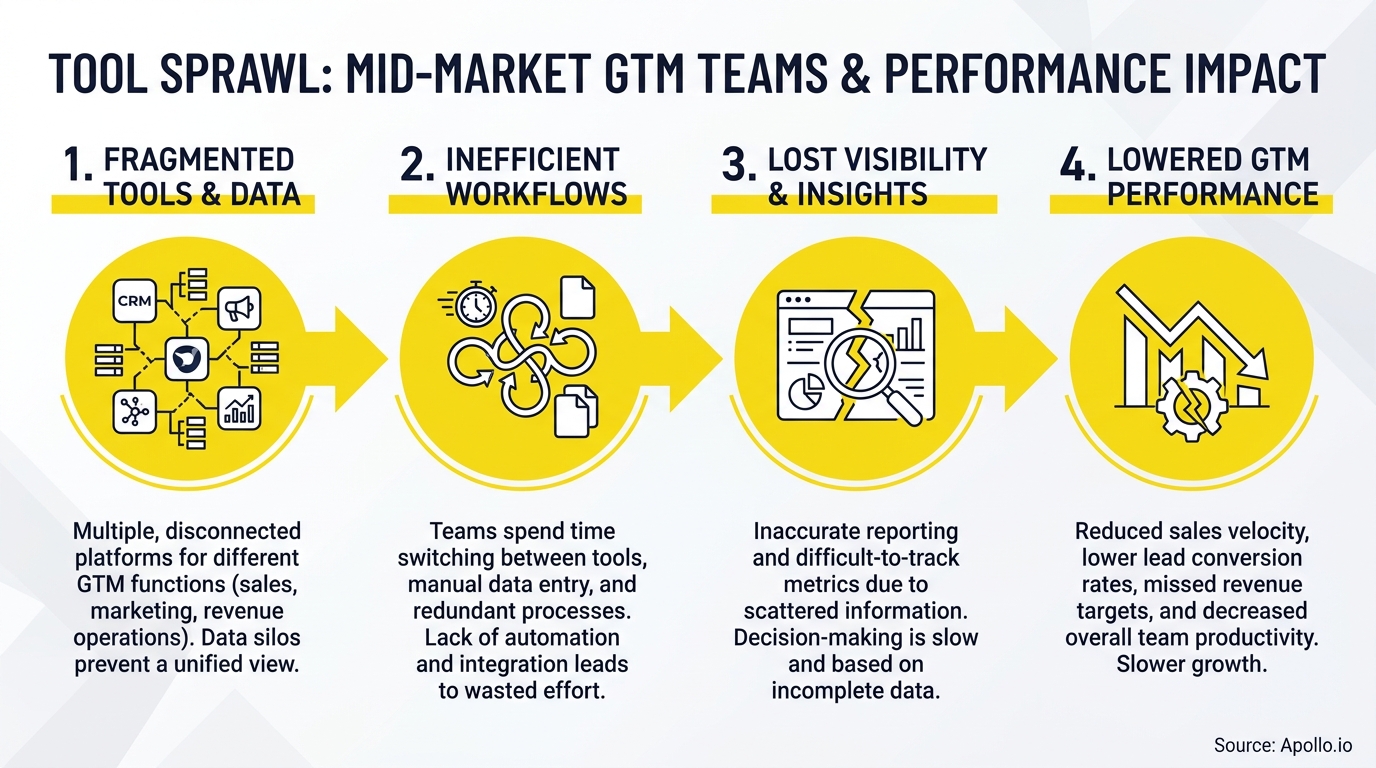
Mid-market GTM teams are drowning in tools. The average sales rep now touches an average of 10 tools to close a single deal, according to JohnnyGrow. Each new tool added to fix a gap creates two new gaps: an integration problem and a training burden. The result is a fragmented stack that slows down every rep, every deal, and every forecast. Understanding how to build a sales tech stack that scales starts with diagnosing what tool sprawl actually costs you.

Research Less, Pipeline More With Apollo
Tired of your reps burning hours verifying emails and hunting down contacts? Apollo delivers 230M+ accurate business contacts instantly, so your team sells instead of searches. Start building real pipeline today.
Start Free with Apollo →Key Takeaways
- Mid-market GTM teams face a measurable "sprawl tax": more tools correlates directly with less selling time and lower quota attainment.
- Tool sprawl is not just a budget problem. It creates data silos, broken handoffs, and context-switching drag that compounds across every rep and every deal.
- SDRs and RevOps leaders feel the pain most acutely: fragmented stacks force manual data entry, reduce outreach consistency, and make attribution nearly impossible.
- The fix is not replacing tools one-for-one. It requires consolidating to a unified GTM platform that covers prospecting, engagement, and pipeline management in one workspace.
- Teams that consolidate report lower costs, faster ramp times, and cleaner data, as reflected in real customer outcomes like "We cut our costs in half" (Census) and "Having everything in one system was a game changer" (Cyera).
What Does Tool Sprawl Actually Look Like for Mid-Market GTM Teams?
Tool sprawl in mid-market GTM means running separate systems for prospecting, sequencing, dialing, enrichment, intent data, meeting scheduling, call recording, CRM, and reporting, with each requiring its own login, data export, and manual sync. According to FullFunnel, mid-market firms frequently grapple with tools that are not fully integrated or adopted, leading to operational bottlenecks that block GTM execution.
The most common mid-market sprawl pattern looks like this:
| GTM Function | Tools Typically Deployed | Sprawl Symptom |
|---|---|---|
| Prospecting | Data provider + enrichment tool | Duplicate contacts, stale data |
| Outreach | Sequencer + dialer | Disconnected activity tracking |
| Pipeline | CRM + deal tracker | Manual updates, forecast errors |
| Meetings | Scheduler + call recorder | No shared context post-call |
| Reporting | BI tool + spreadsheets | Attribution gaps, delayed insights |
The Salesforce State of Sales 2026 report found that 42% of sales reps feel overwhelmed by too many tools, directly linking overload to lower adoption and more time spent on non-selling work.
Turn Funnel Guesswork Into Pipeline Clarity
Tired of watching marketing leads stall before they ever reach your pipeline? Apollo surfaces high-intent prospects and arms your team with the signals to act fast. Top revenue teams use Apollo to forecast with confidence — not hope.
Schedule a Demo →How Does Tool Sprawl Hurt GTM Performance?
Tool sprawl hurts performance by converting selling time into tool-management time. Research from Integrate.io found that nearly two-thirds of data teams (62%) juggle more than 10 tools in their stack, and almost half (49%) describe their stack as fragmented or too complex. That complexity has a direct cost in pipeline.
The performance damage shows up across four dimensions:
- Reduced selling time: Every context switch between tools eats minutes that add up to hours per week per rep.
- Data silos:CX Today reports that disconnected systems make 19% of sales data inaccessible, meaning reps act on incomplete information.
- Broken attribution: When activity data lives in five different systems, RevOps cannot accurately measure what is driving pipeline, making revenue operations decisions based on guesswork.
- Tool underutilization:Corcava found that almost 49-53% of SaaS licenses go unused, meaning teams pay full price for tools that are only partially adopted.
Spending hours logging activity across disconnected systems? Automate your sequences and track every touchpoint with Apollo's multi-channel engagement platform.

How Does Tool Sprawl Specifically Hurt SDRs and RevOps Leaders?
SDRs bear the heaviest operational burden from tool sprawl because their daily workflow spans the most systems. A typical SDR outbound motion requires switching between a data provider, a sequencer, a dialer, a CRM, and a calendar tool before a single prospect ever picks up the phone. The Regie.ai State of Sales Development Report 2025 found that 46% of sales orgs use 4-6 tools in outbound and 21% use 7 or more, with admin burden remaining a persistent drag on quota attainment.
RevOps leaders face a different but equally damaging version of the problem. When data lives across fragmented systems, RevOps cannot maintain a single source of truth. Lifecycle stage definitions drift. UTM governance breaks. Lead routing misfires. A 2024 DATAVERSITY survey cited by Netguru found that 68% of respondents flagged fragmented business data across multiple systems as a top concern, a 7% increase from the year before. For RevOps, sprawl is not just an inconvenience. It is a structural barrier to building predictable sales performance management and accurate forecasting.
What Are the Root Causes of Tool Sprawl in Mid-Market GTM?
Tool sprawl in mid-market GTM is caused by decentralized buying decisions, point-solution thinking, and rapid team growth outpacing stack governance. Mid-market companies scale faster than their ops function can govern, so each new hire or team brings a preferred tool, and no one owns the full stack audit.
Three root causes dominate:
- Point-solution buying: Teams solve immediate pain with the fastest available tool instead of evaluating fit within the existing stack.
- No stack owner: Without a dedicated RevOps function or a clear tool governance policy, redundant subscriptions accumulate unnoticed.
- AI layer expansion: In 2026, AI copilots and agents are being added on top of existing SaaS stacks, initially expanding complexity before teams consolidate around orchestration-capable platforms.
The result is what Martech.org describes as "organizational drag," where marketing and sales ops teams spend more time connecting systems than using them to drive pipeline. This is a direct tax on demand generation efficiency and speed-to-lead.

How Can Mid-Market GTM Teams Fix Tool Sprawl Through Consolidation?
Mid-market GTM teams fix tool sprawl by consolidating to a unified platform that covers the full workflow from prospecting to closed-won, eliminating the integrations and handoffs that create drag. The goal is not fewer tools for its own sake.
It is fewer context switches, cleaner data, and faster rep workflows.
A practical consolidation approach follows three steps:
- Audit and map: List every active tool, its owner, its cost, and its overlap with other systems. Identify where data is being manually re-entered or exported.
- Consolidate around workflow, not category: Instead of replacing tools one-for-one, look for platforms that cover multiple GTM functions natively. Prioritize shared data context over point integrations.
- Govern going forward: Assign a RevOps owner for every new tool request. Require a consolidation check before approving any new SaaS license.
Teams that complete this process report measurable outcomes. Cyera noted that "having everything in one system was a game changer." Predictable Revenue reduced complexity by consolidating three tools into one. Census reported cutting costs in half. These outcomes reflect the compounding value of removing the sprawl tax from your sales transformation roadmap.
Struggling to manage pipeline visibility across disconnected tools? Get complete pipeline visibility with Apollo's unified deal management.
How Does Apollo Help Mid-Market Teams Eliminate Tool Sprawl?
Apollo is a unified GTM platform that consolidates prospecting, sales engagement, AI automation, data enrichment, meeting scheduling, call intelligence, and pipeline management into one workspace. For mid-market teams, this means SDRs, AEs, RevOps, and marketing leaders all work from the same data, in the same system, without exporting or re-syncing across platforms.
Apollo serves nearly 100K paying customers and 2M+ users across 600K+ companies, from startups through enterprise GTM teams. The platform's 230M+ business contacts with 97% email accuracy eliminate the need for a separate data provider. Built-in sales automation replaces standalone sequencers. Native data sync with CRMs removes manual entry. The outcome is a leaner stack with fewer failure points and faster rep ramp times.
Conclusion: The Sprawl Tax Is a Performance Problem, Not Just a Budget Problem
Tool sprawl is not a cost line item to optimize at renewal. It is an active drag on every rep's selling capacity, every RevOps leader's ability to measure pipeline, and every SDR's ability to hit quota.
The mid-market GTM teams winning in 2026 are the ones treating consolidation as a performance initiative, not a cost-cutting exercise.
The path forward is clear: audit your stack, identify where data and workflows break across systems, and consolidate around a platform that covers the full GTM motion natively. Apollo gives mid-market teams one workspace for prospecting, outreach, pipeline, and intelligence, eliminating the hidden sprawl tax at every stage of the funnel.
Ready to cut your tech stack and reclaim selling time? Schedule a Demo with Apollo and see how consolidation drives measurable GTM performance.
Prove Pipeline ROI With Apollo
ROI pressure killing your tool budget? Apollo delivers measurable pipeline impact from day one — so justifying the investment is easy. Leadium 3x'd annual revenue. Your CFO will thank you.
Start Free with Apollo →Don't miss these
Sales
Inbound vs Outbound Marketing: Which Strategy Wins?
Sales
What Is a Sales Funnel? The Non-Linear Revenue Framework for 2026
Sales
What Is a Go-to-Market Strategy? The 2026 GTM Playbook
See Apollo in action
We'd love to show how Apollo can help you sell better.
By submitting this form, you will receive information, tips, and promotions from Apollo. To learn more, see our Privacy Statement.
4.7/5 based on 9,690 reviews
