
What Does Good Sales Sequence Management Look Like in a Modern Engagement Platform?
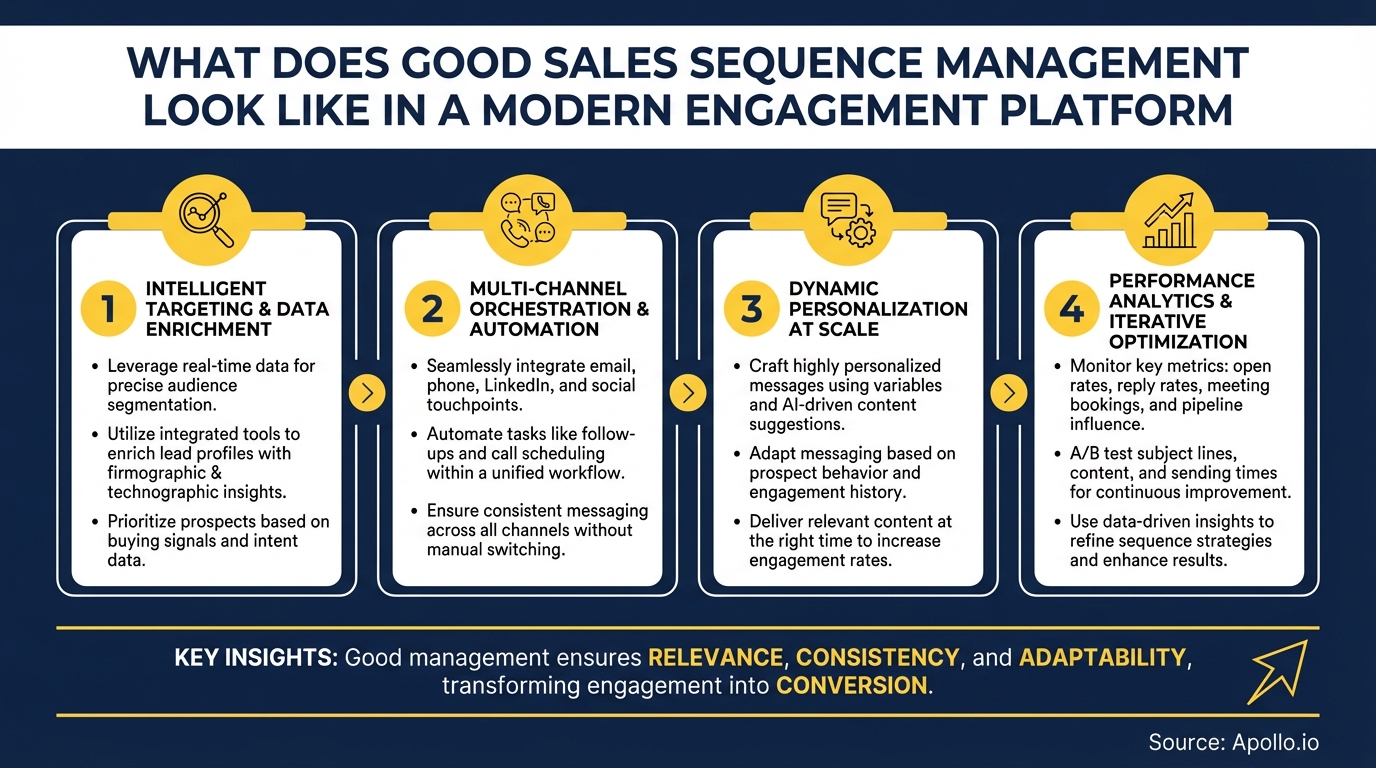
Most sales teams still treat sequence management as a copywriting exercise. In 2026, that mindset is a liability. Modern sales sequence management combines relevance controls, omnichannel orchestration, AI governance, and deliverability operations into one unified discipline. According to Cirrus Insight, the global sales automation market more than doubled from $7.8 billion in 2019 to $16 billion in 2025, reflecting how central engagement platforms have become to revenue operations.
If your sequences are still set-and-forget cadences, you're leaving pipeline on the table and risking your sender reputation. Here's what good actually looks like today, and how to build it inside a winning sequence framework.

Research Less, Pipeline More With Apollo
Tired of burning hours verifying contacts that go nowhere? Apollo delivers 230M+ accurate business contacts so your reps spend time selling, not searching. Start building real pipeline today.
Start Free with Apollo →Key Takeaways
- Good sequence management is governance-first: relevance controls, suppression rules, and deliverability ops are non-negotiable in 2026.
- Omnichannel orchestration across email, phone, and social outreach outperforms single-channel cadences because channel gaps drive buyer churn.
- AI in sequences requires guardrails, not just prompts: brand voice controls, duplicate-enrollment alerts, and auditability matter as much as copy generation.
- SDRs and RevOps teams both benefit from a unified platform that connects prospecting data, sequences, and analytics in one workspace.
- Continuous optimization loops (build, govern, launch, measure, iterate) replace static playbooks as the operating model for modern teams.
Why Does Modern Sequence Management Require a Governance-First Approach?
Modern sequence management requires governance controls because volume-based outreach actively damages pipeline. Buyer behavior has shifted: B2B buyers now expect relevance, not frequency.
Irrelevant outreach triggers avoidance, unsubscribes, and spam complaints that compound into deliverability problems across every future sequence.
A governance-first approach means building these controls before launching any sequence:
- Suppression lists: Exclude active customers, open opportunities, and recent responders automatically.
- Duplicate-enrollment prevention: Alert reps when a contact is already enrolled in another active sequence.
- Intent thresholds: Only enroll contacts who meet a minimum signal score (job title match + company fit + recent trigger).
- Stop rules: Auto-exit contacts on reply, meeting booked, or out-of-office detection.
- Deliverability instrumentation: Surface SPF/DKIM/DMARC status, throttling controls, and sending-schedule governance inside the platform.
Email inbox providers tightened enforcement significantly in late 2025, with Google implementing full rejection of non-compliant bulk traffic. Sequence management that ignores authentication and unsubscribe mechanics is now an operational risk, not just a best practice concern.
What Does Omnichannel Sequence Management Actually Involve?
Omnichannel sequence management means coordinating email, phone, and social outreach steps within a single governed workflow, with unified tracking across every touchpoint. Single-channel cadences create experience gaps that push buyers toward competitors. Data from BookYourData shows that 80% of all B2B sales engagements now occur through digital channels, making cross-channel coordination a baseline requirement.
A well-structured omnichannel sequence follows a clear step logic:
| Step | Channel | Purpose | Governance Control |
|---|---|---|---|
| Day 1 | Persona-specific opener | Spam-rate throttle | |
| Day 3 | Phone | Live touchpoint or voicemail | Call outcome logging |
| Day 5 | Social outreach | Warm signal + content share | Persona filter |
| Day 8 | Value asset or case study | Open/click branching | |
| Day 12 | Phone | Decision-point check-in | Auto-exit on reply |
The critical capability is unified attribution: every channel's activity feeds a single contact record so you know which touchpoints drove replies and meetings. Without this, optimization is guesswork. For a deeper look at proven multi-channel structures, see these top sales sequence examples with real results.
Spending hours building sequences manually across disconnected tools? Automate your omnichannel sequences with Apollo's multi-channel engagement platform.

How Do SDRs and RevOps Teams Benefit from Unified Sequence Management?
SDRs benefit from unified sequence management because it eliminates the tool-switching friction that fragments their workflow and reduces time on actual prospecting. RevOps leaders benefit because a unified platform creates a single source of truth for sequence performance, attribution, and rep adherence.
For SDRs and BDRs:
- One workspace connects contact data, sequence enrollment, call tasks, and reply tracking.
- AI-assisted step drafts reduce time spent on personalization without sacrificing relevance.
- Next-best-action prompts surface which contacts to prioritize each day based on engagement signals.
For RevOps:
- Sequence analytics reveal which cadences convert and which drain sender reputation.
- Governance dashboards show enrollment overlap, opt-out rates, and deliverability health across all active sequences.
- A unified platform removes the integration complexity of maintaining separate prospecting, sequencing, and analytics tools.
As Collin Stewart at Predictable Revenue put it: "We reduced the complexity of three tools into one." That consolidation directly reduces RevOps overhead and gives SDRs faster access to the data they need. Explore how sales performance management frameworks connect sequence execution to revenue outcomes.
Turn Weak Leads Into Real Pipeline
Tired of marketing leads that never become real opportunities? Apollo surfaces high-intent prospects so your team works buyers who are ready to convert. Join 600K+ companies building predictable pipeline.
Start Free with Apollo →What Role Does AI Play in Modern Sequence Management?
AI in modern sequence management handles copy generation, step prioritization, and send-time optimization, but its value depends entirely on the governance layer surrounding it. Without controls, AI accelerates the wrong behaviors: over-enrollment, generic messaging at scale, and deliverability damage.
Research from Sopro found that 54% of sales teams report increased efficiency from AI tools through smarter lead scoring, automated tasks, and faster content creation. But efficiency gains require guardrails to prevent those tools from creating compliance or reputation risk.
AI governance requirements for sequences in 2026:
- Brand voice controls: AI-generated steps must pass a tone and messaging review before activation.
- Personalization thresholds: Define which message fields get AI-generated content vs. human-written copy.
- Experiment frameworks: A/B test AI-generated vs. rep-written steps with statistical significance gates before rollout.
- Auditability: Every AI-generated step should be logged with the input context and the rep who approved it.
- Hallucination controls: Restrict AI from generating company-specific claims it cannot verify from the contact record.
Apollo's platform has seen 500% YoY AI platform growth, with teams using AI-powered messaging reporting a 35% increase in bookings. The key is pairing AI generation with the governance controls above. See the full breakdown of how Apollo compares to other engagement platforms on AI and sequencing capabilities.
How Should Teams Measure Sequence Performance?
Sequence performance measurement should track a layered set of metrics: deliverability health at the top, engagement quality in the middle, and pipeline contribution at the bottom. Most teams only measure opens and replies, which misses the signals that predict future deliverability collapse or pipeline conversion.
| Metric Layer | Key Metrics | Target Signal |
|---|---|---|
| Deliverability | Spam rate, bounce rate, unsubscribe rate | Spam rate below 0.1% |
| Engagement | Open rate, reply rate, click rate by step | Reply rate by persona segment |
| Conversion | Meetings booked, opportunities created | Sequence-to-opportunity rate |
| Pipeline | Revenue influenced, deal velocity | Sequence attribution to closed-won |
For AEs managing deals downstream, connecting sequence-sourced opportunities to deal velocity gives RevOps the attribution data needed to justify sequence investment and optimize ICP targeting. Learn how sales analytics drives revenue growth when connected to sequence data.
Not seeing the pipeline results your sequences should be generating? Build and track your pipeline inside Apollo's unified GTM platform.
What Does the Modern Sequence Lifecycle Look Like?
The modern sequence lifecycle replaces set-and-forget cadences with a continuous optimization loop: build, govern, launch, monitor, and iterate on a weekly cadence. Static playbooks decay quickly because buyer signals, deliverability conditions, and competitive messaging all shift faster than quarterly reviews can catch.
The five-stage lifecycle:
- Build: Define ICP segment, channel mix, step count, and personalization fields. Align with your ICP framework before writing a single word.
- Govern: Apply suppression lists, enrollment rules, deliverability checks, and AI content review.
- Launch: Activate with a controlled rollout (start with a smaller send volume, monitor spam metrics for 48 hours).
- Monitor: Track deliverability, reply rates, and meeting conversion weekly. Flag underperforming steps immediately.
- Iterate: Swap underperforming steps, test new subject lines, and adjust send timing based on engagement data.
This lifecycle maps directly to what building winning sequences in Apollo looks like in practice, where analytics and optimization tools sit inside the same workspace as enrollment and execution.

How Do You Get Started with Better Sequence Management in 2026?
Good sales sequence management in 2026 starts with one decision: stop treating sequences as isolated campaigns and start treating them as governed, measurable revenue assets. The platform you use must support governance controls, omnichannel execution, AI guardrails, and unified attribution in one workspace, not across five disconnected tools.
Teams that consolidate see the compounding benefit immediately. As the team at Cyera noted: "Having everything in one system was a game changer." And Census reported: "We cut our costs in half." Both outcomes trace back to the same root cause: unified data plus governed execution reduces waste at every stage of the sequence lifecycle.
Apollo gives B2B GTM teams, from SDRs to enterprise RevOps leaders, the sequencing, data, AI, and analytics tools to run this entire operating model in one place. Trusted by nearly 100,000 paying customers including Anthropic, Smartling, and DocuSign, Apollo is the all-in-one platform built for how modern sequences actually work.
Start Free with Apollo and run your first governed, omnichannel sequence today.
Prove Pipeline ROI With Apollo
ROI pressure killing your tool budget? Apollo delivers measurable pipeline impact your leadership can see — fast. Teams like Leadium 3x'd annual revenue after switching.
Start Free with Apollo →Don't miss these
Sales
Inbound vs Outbound Marketing: Which Strategy Wins?
Sales
What Is a Sales Funnel? The Non-Linear Revenue Framework for 2026
Sales
What Is a Go-to-Market Strategy? The 2026 GTM Playbook
See Apollo in action
We'd love to show how Apollo can help you sell better.
By submitting this form, you will receive information, tips, and promotions from Apollo. To learn more, see our Privacy Statement.
4.7/5 based on 9,690 reviews
