
What Good Outbound Pipeline Attribution Looks Like for Mid-Market Sales
Most mid-market sales orgs track activity. Few track attribution. The gap between those two things is where pipeline credibility collapses, budgets get cut, and SDR programs lose their seat at the revenue table. According to Digital Applied, multi-touch attribution adoption reached 47% in 2026, up from 31% in 2023, yet a February 2026 MarTech report found 75% of marketers still say their measurement systems are falling short. The gap is governance, not technology.
Good outbound pipeline attribution connects SDR touches, calls, and meetings to opportunities, pipeline stages, and closed revenue, in a way your CFO can audit and your CRO can act on. This guide gives RevOps leaders and sales managers the framework to build it. For broader context on how revenue operations drives pipeline growth, start there first.

Research Smarter, Not Harder With Apollo
Tired of burning hours on manual lead research while your pipeline stalls? Apollo surfaces verified contacts and scales your outreach instantly. Join 600K+ companies building predictable pipeline.
Start Free with Apollo →Key Takeaways
- Good outbound attribution requires shared definitions across sales and marketing, not just a reporting model.
- Buying-group reality means contact-level tracking is insufficient. Account-level attribution is the standard for mid-market.
- Single-touch models are unreliable for B2B sales cycles. Multi-touch and multi-model approaches are now the baseline.
- Teams with complete sales and marketing alignment significantly outperform those without it on pipeline goal attainment.
- RevOps owns the attribution data model. Without CRM hygiene and governance, the numbers will always be disputed.
What Is Outbound Pipeline Attribution for Mid-Market Sales Orgs?
Outbound pipeline attribution is the process of crediting specific sales activities (calls, emails, sequences, meetings) to pipeline creation and progression within your CRM, at the account and opportunity level. For mid-market teams, this means mapping SDR and BDR touches to sourced opportunities and tracking which activities influenced deal velocity through each stage.
This is distinct from marketing attribution, which focuses on campaign-to-lead linkage. Outbound attribution focuses on rep activity to opportunity creation, and it must survive scrutiny from finance. As sales analytics frameworks show, the difference between tracking and attribution is whether the data can answer "why did this deal enter pipeline?" not just "what happened before it did."
Why Do Most Mid-Market Attribution Models Break Down?
Most attribution models break down because they use contact-level tracking in a buying-group world. B2B deals involve multiple stakeholders, and if your CRM only logs the lead who responded to the first email, you are missing the full picture of what created the opportunity.
Three structural failure points are common:
- Single-touch models: As noted by Hyphadev, single-touch models can be misleading for sales cycles longer than 60 days, which describes nearly every mid-market deal.
- Missing call attribution: Phone conversations that led to meetings often go unlogged. Attribution models that ignore calls will misallocate budget away from what is actually working.
- No shared definitions: When sales defines "sourced" differently than marketing, every pipeline review becomes a turf war rather than a planning session.
For B2B sales organizations operating with 50 to 500 employees, this misalignment is especially damaging because there is no margin to waste pipeline credibility.
What Does a Governance-First Attribution Framework Look Like?
A governance-first attribution framework starts with shared definitions agreed upon by sales, marketing, and RevOps before any tooling is configured. Without this, attribution data will always be disputed at the leadership level.
The core governance layer includes five components:
- Sourced vs. influenced definitions: Document exactly what qualifies an opportunity as "SDR-sourced" (e.g., outbound sequence initiated contact before any inbound signal) versus "influenced" (e.g., SDR touched an account already in-market).
- Lifecycle stage ownership: Each CRM stage must have a defined owner, entry criteria, and SLA. RevOps sets the rules; sales and marketing sign off.
- Opportunity-contact association hygiene: Every contact who participated in the buying process must be associated to the opportunity record, not just the primary contact.
- Activity logging standards: Calls, emails, and meetings must be logged against account and opportunity records, not just contact records. This is what enables account-level attribution.
- Attribution model selection: Choose 2-3 models to run in parallel (e.g., first-touch, multi-touch linear, and pipeline influence) rather than forcing a single truth that no one trusts.
Struggling to track which pipeline activities are actually moving deals forward? Apollo's deal management gives RevOps complete pipeline visibility across every stage.

How Do SDRs and RevOps Teams Measure Outbound Contribution?
SDRs measure outbound contribution through activity-to-opportunity conversion metrics, while RevOps measures it through pipeline coverage, stage progression, and sourced revenue. Both views must connect inside a single CRM data model.
The metrics that matter at each level:
| Metric | Owner | What It Measures |
|---|---|---|
| Meetings booked per rep per month | SDR Manager | Top-of-funnel activity output |
| SQL acceptance rate | RevOps / AE | Quality of SDR-sourced opportunities |
| Sourced pipeline by rep/segment | RevOps | Attribution of pipeline creation |
| Pipeline influenced (multi-touch) | RevOps / Marketing | Outbound contribution to non-sourced deals |
| Outbound pipeline as % of total | CRO / VP Sales | SDR program ROI at the org level |
Benchmark context: according to Rachel Krug, outbound SDRs typically book 5 to 25 meetings per month, with high-performing teams reaching 15 or more while maintaining strict qualification. And data from SalesS0 shows top teams achieve a 59% SQL acceptance rate for outbound leads entering the active pipeline. If your numbers fall well below these ranges, the problem is usually data quality or qualification criteria, not rep effort.
For SDR managers building their performance tracking systems, the sales performance management framework provides the measurement architecture that connects rep activity to revenue outcomes.
Turn Funnel Guesswork Into Closed Deals
Pipeline forecasting a guessing game because quality leads never materialize into opportunities? Apollo surfaces verified, in-market buyers so your pipeline reflects reality. Join 600K+ companies forecasting with confidence.
Start Free with Apollo →How Does Account-Level Attribution Work for Buying Groups?
Account-level attribution credits outbound touches at the account and opportunity level rather than the individual contact level, reflecting how B2B buying actually happens across multiple stakeholders. This requires a specific CRM data model to execute correctly.
The practical steps for mid-market RevOps teams:
- Tag every stakeholder: Associate all contacts involved in a deal to the opportunity record. Include role tags (champion, economic buyer, blocker, influencer).
- Log activity against the account: Calls and emails should sync to both the contact and the parent account so account-level engagement is visible.
- Map SDR touches to opportunity creation date: Use CRM timestamps to establish which outbound activities preceded opportunity creation within a defined attribution window.
- Define attribution windows by segment: As noted by Improvado, B2B sales cycles spanning 3 to 18 months mean attribution windows must span quarters or years, not days.
Spending hours trying to enrich and verify the contact data behind your buying groups? Apollo's data enrichment keeps your CRM records accurate across 230M+ verified contacts, so your attribution data stays clean at the source.
How Do You Make Outbound Attribution CFO-Ready?
CFO-ready attribution links outbound activities to closed revenue using a reconciliation method that finance can verify against CRM records and bookings data. This means your attribution report must match your revenue report.
Three rules for audit-ready attribution:
- Tie attribution to opportunity records, not activities: Finance cares about pipeline created and pipeline closed. Every sourced opportunity must trace back to a logged activity with a timestamp, a rep, and a CRM record.
- Report sourced pipeline separately from influenced pipeline: Combining these creates confusion. Sourced means outbound created the opportunity. Influenced means outbound touched an opportunity that originated elsewhere.
- Reconcile quarterly: Run a pipeline reconciliation at quarter-end that compares outbound-sourced pipeline to closed revenue from that cohort. This creates the ROI narrative that justifies SDR headcount in budget reviews.
Understanding the broader drivers behind your numbers is equally important. The factors that affect sales performance often explain attribution anomalies that the data alone cannot.
What Should Mid-Market Sales Orgs Build First?
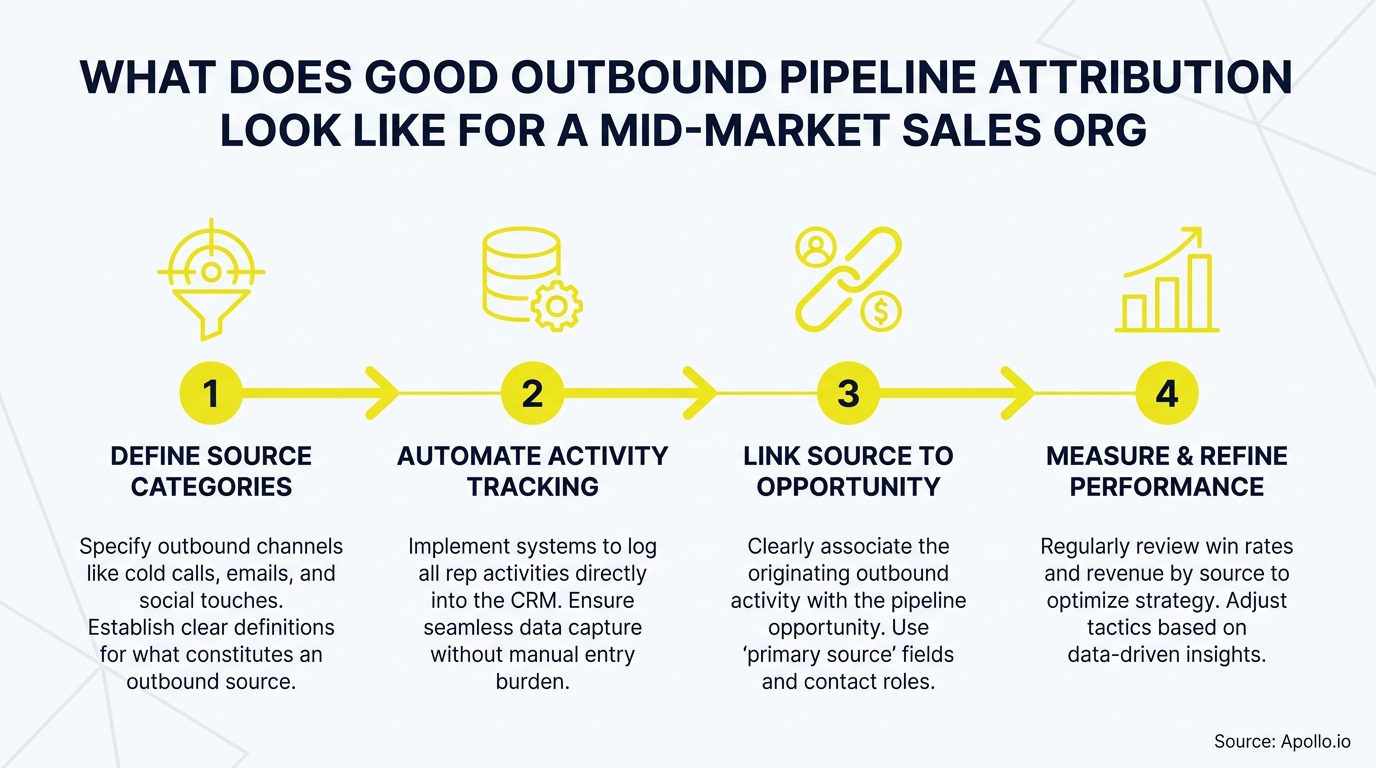
Start with governance, not tooling. Before configuring dashboards or attribution software, align your sales and marketing leadership on sourced versus influenced definitions, lifecycle stage ownership, and SLAs for opportunity creation.
This agreement is the foundation everything else runs on.
A practical 30-60 day build sequence:
- Days 1-15: Define sourced vs. influenced with sales, marketing, and RevOps. Document in a shared wiki or CRM field dictionary.
- Days 16-30: Audit CRM opportunity-contact associations and activity logging. Fix gaps before building reports.
- Days 31-45: Configure 2-3 attribution models in your CRM or BI tool. Run them in parallel. Do not pick one winner yet.
- Days 46-60: Present sourced pipeline report to CRO and CFO. Establish a monthly review cadence.
Teams that invest in building this foundation see measurable improvements in pipeline predictability and leadership trust in the numbers. For teams still building out their operational foundation, the RevOps-led sales transformation playbook covers the org design decisions that make attribution governance sustainable.

Conclusion: Attribution Is a Revenue Strategy, Not a Reporting Task
Good outbound pipeline attribution for a mid-market sales org is not a dashboard. It is a governance system, a shared data model, and a quarterly reconciliation process that connects SDR activity to closed revenue in a way leadership can trust and finance can verify.
The teams that get this right share three things: cross-functional definitions everyone signed off on, CRM hygiene that makes account-level attribution possible, and the discipline to run multiple attribution models rather than arguing about one. Build the governance first.
The reporting follows naturally.
Apollo gives mid-market GTM teams the unified platform to run outbound, track engagement, enrich contact data, and connect activity to pipeline, without stitching together five separate tools. As Cyera put it, "Having everything in one system was a game changer." Get Leads Now and start building attribution-ready pipeline from day one.
Prove Pipeline ROI Before Next QBR
ROI pressure killing your tool budget before renewal? Apollo delivers measurable pipeline impact your CFO can actually see. Leadium 3x'd annual revenue — start your free trial and show results fast.
Start Free with Apollo →Don't miss these
Data
How to Structure a Marketing Team That Actually Drives Revenue in 2026
Data
Solving Data Synchronization Headaches Across Multiple Business Systems
Data
What Marketing Metrics Should B2B Teams Track in 2026?
See Apollo in action
We'd love to show how Apollo can help you sell better.
By submitting this form, you will receive information, tips, and promotions from Apollo. To learn more, see our Privacy Statement.
4.7/5 based on 9,690 reviews
