
How a 10-Person Revenue Team Builds a Winning B2B Prospecting Workflow
A 10-person revenue team cannot afford a prospecting workflow built for a 50-person org. Every manual step, every disconnected tool, every uncoordinated outreach eats into the roughly 30% of time reps actually spend selling. The winning workflow for a small team is research-led, automation-assisted, and committee-aware from the first touch. If you're building or rebuilding your B2B prospecting process, this playbook covers exactly how to structure it.

Let Apollo Find Your Next Buyer
Tired of burning hours verifying contact info that goes nowhere? Apollo surfaces accurate, ready-to-engage prospects so your team sells instead of searches. Over 600K companies have already made the switch.
Start Free with Apollo →Key Takeaways
- Small teams win with research-led, automation-heavy workflows, not volume-led cold blasting.
- B2B buying decisions now involve multiple stakeholders, so multi-threading is a requirement, not a nice-to-have.
- Sequences must include self-serve assets to meet buyers who prefer to research before engaging sales.
- RevOps-defined SLAs and routing rules prevent pipeline leakage on small teams where every lead counts.
- Tool consolidation is a force multiplier: fewer platforms mean less context switching and more selling time.
What Does a Winning B2B Prospecting Workflow Look Like for a 10-Person Revenue Team?
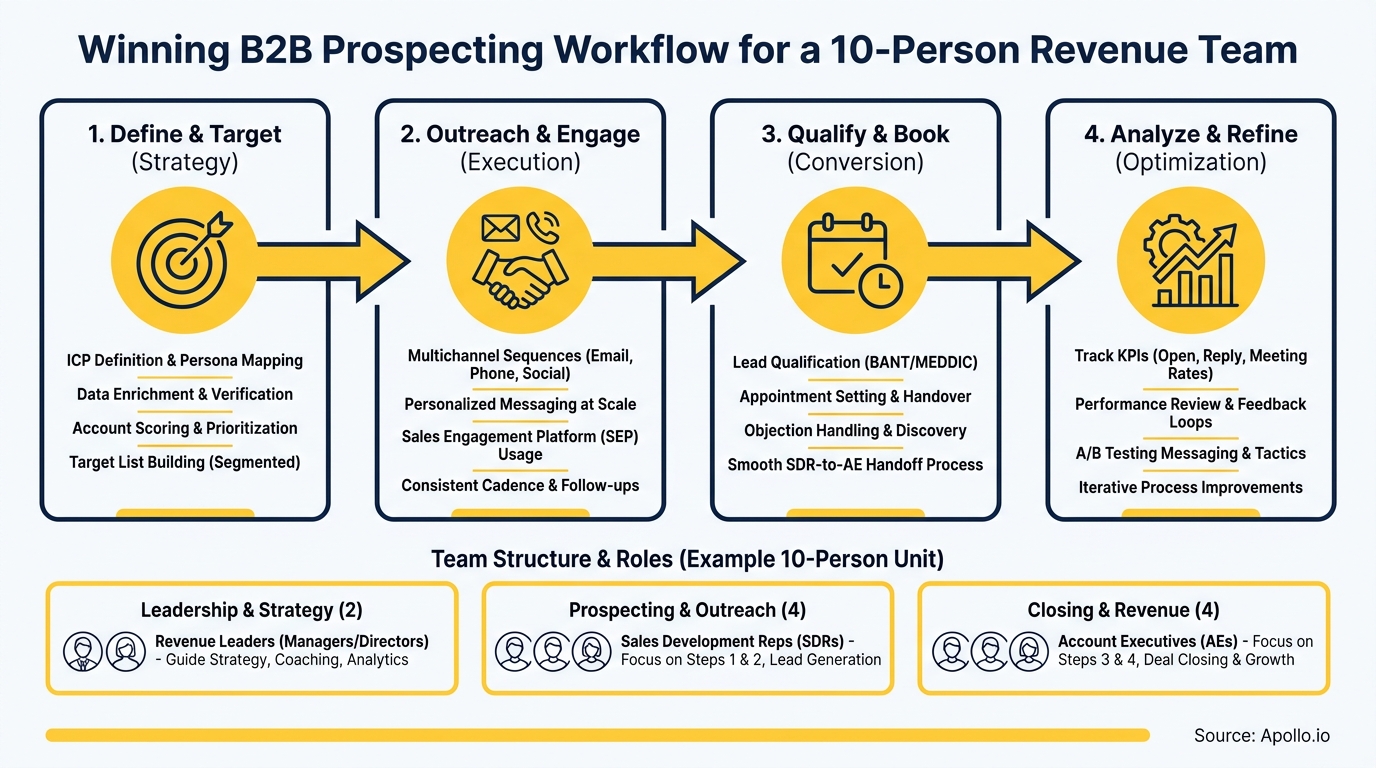
A winning B2B prospecting workflow for a 10-person revenue team combines ICP-first targeting, automated multi-channel sequences, committee-aware messaging, and RevOps-defined handoffs, all running inside a unified platform to eliminate tool sprawl. The goal is maximum output per rep-hour, not maximum volume. According to Kondo's B2B Sales Report, the average B2B sales cycle lengthened to 6.5 months in 2023, up from 4.9 months in 2019, which means every workflow decision compounds over time. Getting it right from the start matters.
The five core components of this workflow are: ICP and signal-based targeting, verified contact data, multi-threaded sequences with self-serve assets, RevOps-owned routing and SLAs, and AI-assisted personalization at scale. Each feeds the next.
How Should SDRs Structure Their Prospecting Time Each Week?
SDRs on a 10-person team should allocate their prospecting time across four distinct activities: ICP research, list building, sequence enrollment, and follow-up on replies. Time spent on manual list building directly reduces time available for live conversations, so automation must handle as much of the former as possible.
| Activity | Recommended Weekly Allocation | Automate or Human? |
|---|---|---|
| ICP targeting and signal review | ~2 hours | Human (judgment-required) |
| Contact list building and enrichment | ~1 hour | Automate |
| Sequence enrollment and messaging review | ~2 hours | Hybrid (AI draft, human review) |
| Reply handling and meeting booking | ~3 hours | Human |
| CRM logging and pipeline updates | ~1 hour | Automate |
Struggling to find qualified leads without burning hours on research? Search Apollo's 230M+ contacts with 65+ filters and build targeted lists in minutes, not hours.
Turn Funnel Guesswork Into Real Pipeline
Tired of watching marketing leads stall before they ever reach your pipeline? Apollo surfaces in-market buyers with precision targeting so your team acts on real signals, not hope. Over 600K companies stopped guessing and started closing.
Start Free with Apollo →How Does Committee-First Prospecting Work for Small Teams?
Committee-first prospecting means mapping all relevant stakeholders in a target account before sending a single message, then running parallel sequences tailored to each role. According to SalesHive, modern B2B buyers are approximately 70% through their journey and often involve 8 to 13 stakeholders before engaging with sales. Reaching only one contact per account is a structural weakness, not a volume problem.
For a 10-person team, the practical committee map looks like this:
- Economic buyer: Receives ROI-focused, business-outcome messaging.
- Technical evaluator: Receives integration, security, and capability-focused content.
- End user / champion: Receives workflow-benefit and peer-proof messaging.
- Procurement / legal: Receives contract and compliance-oriented assets when deal advances.
Each thread runs independently but is tracked centrally. Collision-avoidance rules (no two reps contacting the same stakeholder within 72 hours) prevent confusion and maintain a coherent account experience. This approach is core to effective B2B sales techniques for growing teams.
Why Do Sequences Need Self-Serve Buyer Enablement Assets?
Sequences need self-serve assets because a meaningful share of B2B buyers prefer to research and validate vendors before engaging with a rep. Rather than fighting this preference, winning teams embed resources directly into outreach, case studies, ROI calculators, short demo videos, and comparison pages, so prospects can advance their own evaluation on their timeline.
Each outbound touch should include at least one asset that enables independent research. This is especially important for email and social touchpoints where a live conversation is unlikely on the first contact. Data from Atlassian shows that emails with personalized subject lines are 26% more likely to be opened, which means your asset-led message at least gets seen when personalization is applied. Pair personalized subject lines with a relevant asset link, and the sequence earns its next step. For a deeper look at how email fits the broader buyer journey, see what has changed in the B2B buyer journey in 2026.

What RevOps Rules Keep a 10-Person Team's Pipeline Clean?
RevOps rules that prevent pipeline leakage on a small team include a documented ICP definition, lead routing logic, stage-entry criteria, and response SLAs. Without these, reps waste time on off-ICP accounts, leads stall between handoffs, and pipeline reporting becomes unreliable. These definitions belong in a revenue operations framework that the whole team operates from.
- ICP signal triggers: Define which firmographic and behavioral signals qualify an account for active prospecting (e.g., headcount growth, funding event, job posting patterns).
- Routing rules: Assign accounts by territory, segment, or rep capacity automatically, not manually.
- SLA for inbound leads: Set a maximum response time and enforce it with automated alerts.
- Stage-exit criteria: Define what must happen before a prospect moves from prospecting to active opportunity, preventing premature pipeline inflation.
Research from The Insight Collective found that 95% of surveyed individuals agree that demand generation is significantly improved with a data-driven strategy. RevOps-defined workflows are how that data-driven approach gets operationalized at the team level.
How Does Tool Consolidation Multiply Prospecting Output for Small Teams?
Tool consolidation multiplies output by eliminating context switching, reducing data silos, and keeping every rep working from a single source of truth. A 10-person team running separate tools for data, engagement, dialing, and pipeline management loses time to manual syncing, duplicate records, and missed handoff signals.
Consolidating into one unified platform removes that overhead entirely.
Teams that have made this shift report measurable gains. As Cyera put it: "Having everything in one system was a game changer." Predictable Revenue noted: "We reduced the complexity of three tools into one." For AEs managing active deals while SDRs are still prospecting, a unified workspace means account context is always current without anyone having to manually update three different systems. Spending too much time on manual outreach instead of conversations? Automate your multi-channel sequences with Apollo and keep your team focused on replies and booked meetings.
Apollo brings prospecting, enrichment, sequencing, dialing, and pipeline management into one platform, replacing the stack of point solutions that small teams cannot afford to manage. Trusted by nearly 100K paying customers including Anthropic, Smartling, and Redis, it is purpose-built for the productivity math a 10-person team faces. For a broader look at how AI and automation tools support B2B prospecting, the full breakdown is worth reviewing alongside this workflow.

Start Running This Workflow Today
A winning B2B prospecting workflow for a 10-person revenue team is built on four non-negotiables: verified ICP-matched contacts, committee-aware sequences with self-serve assets, RevOps-defined routing and SLAs, and a consolidated tech stack that keeps every rep in one workspace. Each element reduces wasted motion and concentrates effort where it converts.
The teams that win in 2026 are not the ones sending the most emails. They are the ones with the tightest workflow and the clearest buyer intelligence.
Ready to build a prospecting workflow your whole team can actually execute? Get Leads Now and see how Apollo consolidates your entire GTM stack into one platform.
Prove Pipeline ROI With Apollo
ROI pressure killing your tool budget? Apollo delivers measurable pipeline impact your leadership can see — fast. Leadium 3x'd annual revenue. Get results you can actually bring to your next budget review.
Start Free with Apollo →Don't miss these
Sales
Inbound vs Outbound Marketing: Which Strategy Wins?
Sales
What Is a Sales Funnel? The Non-Linear Revenue Framework for 2026
Sales
What Is a Go-to-Market Strategy? The 2026 GTM Playbook
See Apollo in action
We'd love to show how Apollo can help you sell better.
By submitting this form, you will receive information, tips, and promotions from Apollo. To learn more, see our Privacy Statement.
4.7/5 based on 9,690 reviews
