
What Does a Sales Development Representative Do in 2026?
A Sales Development Representative (SDR) is a specialized sales role focused on generating and qualifying pipeline — not closing deals. SDRs sit at the top of the sales funnel, converting cold prospects into warm, sales-ready opportunities that Account Executives can close. In 2026, the role has evolved significantly: SDRs are no longer just meeting-setters. They are operators of AI-assisted prospecting systems, buying-group navigators, and buyer enablement specialists.

Research Less, Pipeline More With Apollo
Tired of your reps burning hours on manual lead research instead of closing deals? Apollo surfaces verified contacts instantly so your team spends time selling, not searching. Join 550K+ companies building pipeline on autopilot.
Start Free with Apollo →Key Takeaways
- SDRs focus on prospecting, qualifying, and handing off pipeline — not closing deals.
- The average SDR spends only about two hours per day on actual selling activities; the rest is consumed by admin, research, and tool-switching.
- Multi-channel outreach (email + phone + voicemail) measurably outperforms single-channel approaches.
- Modern SDRs must engage entire buying groups, not just a single decision-maker.
- AI tools are now core to SDR workflows, automating enrichment, sequencing, and message drafting so reps can focus on judgment and qualification.
What Are the Core Responsibilities of an SDR?
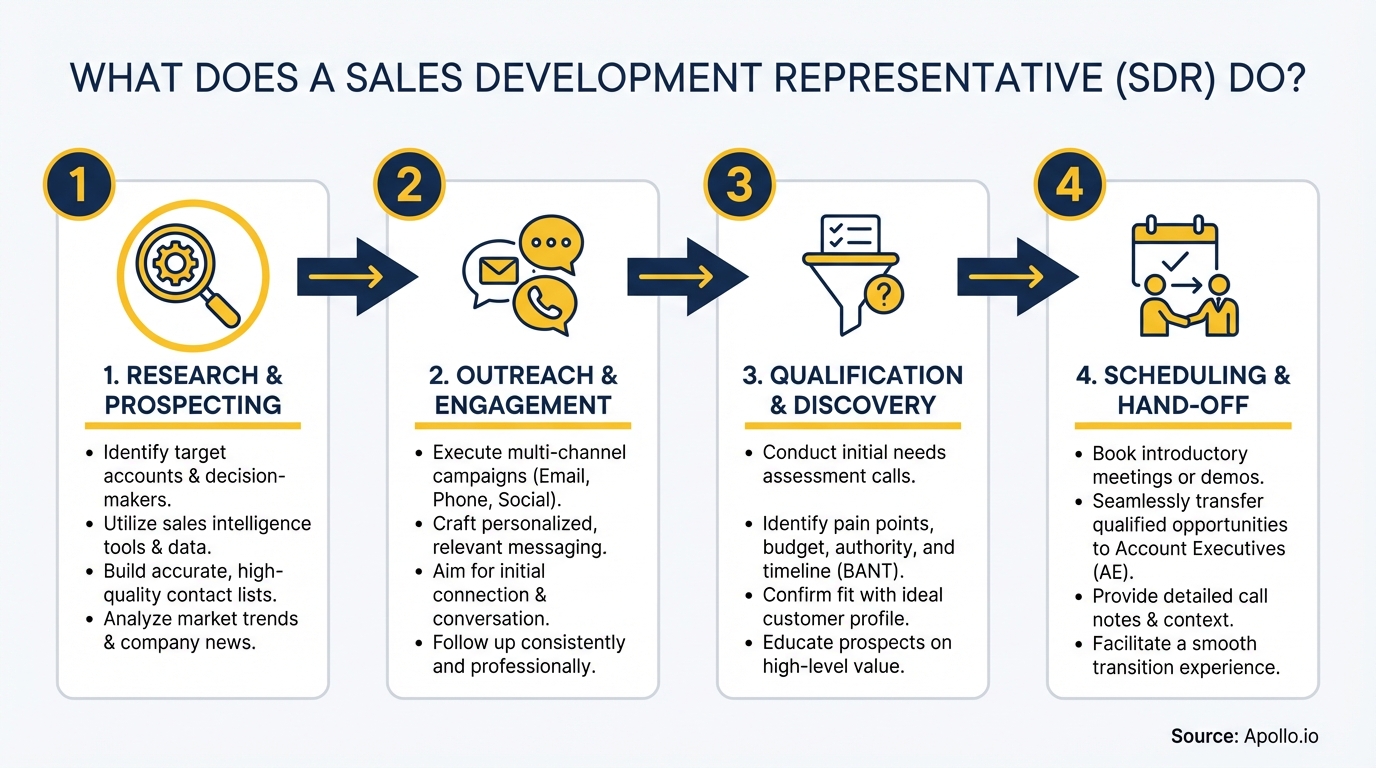
SDRs handle the top-of-funnel work that feeds the entire revenue engine. According to Salesforce, SDRs spend significant time identifying potential customers who align with their company's ideal customer profile (ICP). Their core responsibilities break down into five areas:
- Prospect Research: Identifying target accounts and contacts that match the ICP using firmographic, technographic, and intent data.
- Outbound Outreach: Engaging prospects via email, phone, and social channels. As noted by Activated Scale, SDRs use multiple channels simultaneously to reach decision-makers.
- Lead Qualification: Running discovery conversations to assess fit, budget, timeline, and authority before passing to an AE.
- CRM Management: Logging every touchpoint accurately. Per Superhuman Prospecting, SDRs are responsible for diligent data management, KPI tracking, and reporting to sales leadership.
- AE and Marketing Collaboration: Aligning on messaging, targeting, and handoff criteria to ensure qualified meetings convert to pipeline.
How Do SDRs Actually Spend Their Time?
Time allocation is one of the biggest SDR challenges in 2026. Research from MarketBetter reports that the average SDR sells for roughly two hours a day, with the rest consumed by CRM entry, lead research, tool switching, and internal meetings. That means most of an SDR's day is overhead — not revenue-generating activity.
The breakdown of a typical SDR workday looks like this:
| Activity | Time Allocation |
|---|---|
| Active prospecting and outreach | ~2 hours |
| CRM data entry and admin | ~2 hours |
| Lead research and list building | ~2 hours |
| Internal meetings and training | ~2 hours |
Struggling to find qualified leads fast enough? Search Apollo's 224M+ verified contacts with 65+ filters to cut research time and get into outreach faster.
What Does an Effective SDR Multi-Channel Playbook Look Like?
Single-channel outreach is no longer competitive. The data clearly supports a blended approach across email, phone, and voicemail. SDRs in B2B sales who layer channels see measurably higher response rates than those relying on email alone.
A proven 10-day SDR sequence structure:
- Day 1: Personalized intro email referencing a specific trigger (job change, funding, news).
- Day 2: Cold call + voicemail if no answer.
- Day 4: Follow-up email with a relevant case study or insight.
- Day 6: Second call attempt + social engagement (comment on a post, share relevant content).
- Day 8: Value-add email (ROI calculator, benchmark report, relevant resource).
- Day 10: Breakup email with a soft CTA.
Channel diversification is also becoming a deliverability requirement. Teams that rely solely on high-volume email sequences risk inbox placement issues.
Modern SDR excellence includes list hygiene, segmentation, and testing — not just volume.
Turn Funnel Guesswork Into Pipeline Wins
Tired of watching quality leads stall before they ever reach your pipeline? Apollo surfaces in-market buyers at the right moment, so your team acts on real signals — not gut feelings. 550K+ companies trust Apollo to build pipeline that actually converts.
Start Free with Apollo →How Do SDRs Navigate Buying Groups Instead of Single Decision-Makers?
One of the biggest shifts in the modern SDR role is the move from single-contact outreach to buying-group mapping. A Forrester Buyers' Journey Survey found that 73% of B2B purchases involve 3 or more departments, with an average of 13 internal people involved in a purchasing decision. Targeting one "decision-maker" is no longer sufficient.
Effective SDR buying-group strategy:
- Map the org chart: Identify the economic buyer, technical evaluator, champion, and end users at each target account.
- Multi-thread outreach: Send tailored messages to each persona with relevant pain points, not the same template to everyone.
- Track group engagement: Use intent signals and engagement data to gauge account-level interest before escalating to an AE.
- Structured handoff: Pass the AE a contact map, not just a single lead — including who else is involved and what each stakeholder cares about.
For inside sales reps and SDRs moving upmarket, multi-threading buying groups is the difference between a meeting that stalls and a deal that advances.

How Can SDRs Use AI to Maximize Selling Time?
AI is now a core part of how SDRs operate — not a nice-to-have. The shift is from writing every email manually to designing and managing a prospecting system.
SDRs who adopt AI workflows spend less time on admin and more time on the conversations that actually move pipeline.
Key AI-enabled SDR workflows in 2026:
- Automated enrichment: Pull verified contact data (email, phone, title, company details) without manual research.
- Intent signal monitoring: Get alerts when target accounts show buying signals (job postings, tech installs, web visits).
- AI message drafting: Generate personalized first drafts tailored to prospect role, company, and trigger — then refine with human judgment.
- Sequence automation: Run multi-step, multi-channel sequences without manually scheduling each touchpoint.
- Call summaries: Auto-generate notes and next steps after every discovery call.
Spending hours on manual outreach and admin? Automate your multi-channel sequences with Apollo and let AI handle enrichment, drafting, and scheduling so you can focus on qualified conversations.
Apollo brings together prospecting, sequencing, AI automation, and CRM sync in one platform. As Predictable Revenue put it: "We reduced the complexity of three tools into one." That consolidation directly translates to more selling time for SDRs.

What Key Performance Indicators (KPIs) Do SDRs Track?
SDR performance is measured across activity, efficiency, and pipeline contribution. The right KPI stack reflects the full scope of the role, from outreach volume to qualified pipeline created. Sales analytics tools make it possible to track these in real time.
| KPI | What It Measures |
|---|---|
| Outreach activities per day | Call + email + social touchpoints |
| Connect rate | % of calls that reach a live prospect |
| Reply rate | % of emails that generate a response |
| Meetings booked | Total qualified meetings set for AEs |
| Meeting show rate | % of booked meetings that actually occur |
| SQL conversion rate | % of meetings that become Sales Qualified Leads |
| Pipeline sourced | Dollar value of opportunities created by SDR activity |
Sales leaders and RevOps teams use these metrics to coach SDRs, identify sequence performance issues, and allocate resources to the highest-converting segments. Understanding sales productivity at the rep level is essential for scaling a team predictably.
How Do SDRs Differ From Account Executives and BDRs?
These three roles are often confused. The distinction matters for team structure and career planning:
| Role | Primary Focus | Owns |
|---|---|---|
| SDR | Outbound prospecting and qualification | Pipeline creation |
| BDR | Strategic partnerships and inbound qualification (varies by org) | New market entry |
| AE (Account Executive) | Running demos, negotiations, and closing | Revenue and closed-won |
In most B2B organizations, SDRs pass qualified opportunities to AEs after confirming fit and interest. The SDR-to-AE handoff is a critical moment: a weak handoff wastes both parties' time; a strong one includes full context on the buying group, the prospect's pain points, and the agreed next step. Learn more about modern sales development models and AI strategy for structuring these workflows effectively.
How Does Apollo Help SDRs Perform at Their Best?
Apollo is the all-in-one GTM platform built for SDRs, BDRs, and the revenue teams that support them. Instead of juggling separate tools for data, sequencing, calling, and CRM sync, SDRs get everything in one workspace. As Cyera's team noted: "Having everything in one system was a game changer."
Apollo gives SDRs:
- Access to 224M verified business contacts with 65+ search filters to build precise ICP lists
- Multi-channel sequence automation across email, phone, and social
- AI-assisted message drafting tailored to prospect context and role
- Real-time intent signals to prioritize outreach by buying readiness
- Built-in CRM sync to eliminate manual data entry
- Call recording and AI call summaries to speed up rep coaching
SDRs using Apollo report spending more time in qualified conversations and less time switching between tools. For Sales Leaders and RevOps teams, the unified platform means cleaner data, better attribution, and a single source of truth for revenue operations.
Ready to build more pipeline with less overhead? Try Apollo free and see how SDRs at 90,000+ companies are booking more meetings with one unified platform.
Prove Pipeline ROI From Day One
Budget approval stuck on unclear metrics? Apollo delivers measurable pipeline impact fast — so you walk into every renewal conversation with proof. Leadium 3x'd their revenue. Your results start free.
Start Free with Apollo →Don't miss these
Sales
Inbound vs Outbound Marketing: Which Strategy Wins?
Sales
What Is a Sales Funnel? The Non-Linear Revenue Framework for 2026
Sales
What Is a Go-to-Market Strategy? The 2026 GTM Playbook
See Apollo in action
We'd love to show how Apollo can help you sell better.
By submitting this form, you will receive information, tips, and promotions from Apollo. To learn more, see our Privacy Statement.
4.7/5 based on 9,690 reviews
